

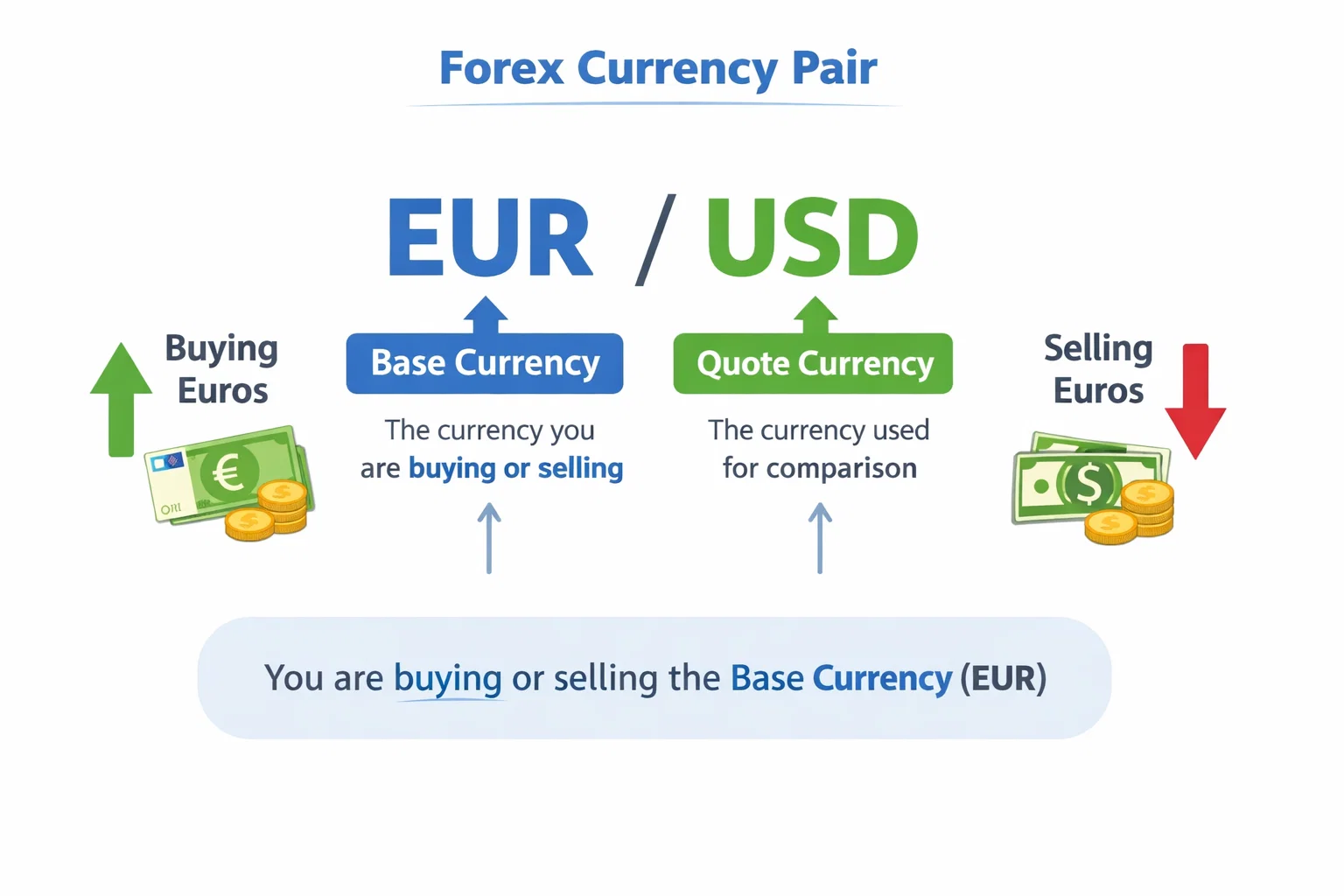
The base currency is the first currency listed in a forex currency pair and represents the currency being bought or sold. In a pair like EUR/USD, the euro (EUR) is the base currency, and the exchange rate shows how much of the quote currency is needed to buy one unit of the base currency.
Key Takeaways: Base Currency
- The base currency is the first currency in a forex pair.
- It shows the currency you are buying or selling in a trade.
- Exchange rates are always quoted relative to the base currency.
- Understanding the base currency helps traders read prices correctly.
- It is essential for calculating profit, loss, and trade direction.
What Is Base Currency in Forex Trading?
In forex trading, the base currency is the first currency in a currency pair and acts as the reference point for the trade. When traders buy or sell a pair, they are effectively buying or selling the base currency while simultaneously selling or buying the quote currency. This structure helps traders clearly understand trade direction and value.
How Base Currency Works in a Currency Pair
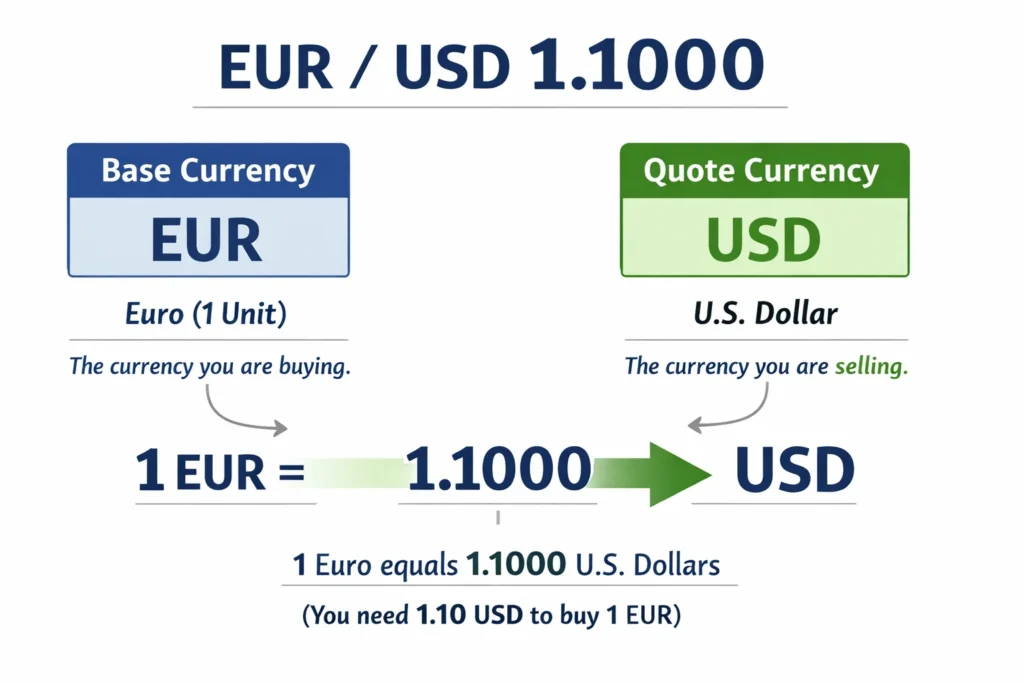
In every forex currency pair, the base currency appears first and determines how the exchange rate is interpreted. The price of the pair shows how much of the quote currency is required to buy one unit of the base currency. If the exchange rate rises, the base currency is strengthening; if it falls, the base currency is weakening against the quote currency.
Base Currency Example (With Table)
To understand base currency clearly, let’s look at how it works in real forex currency pairs. The base currency is always the first currency listed, and the exchange rate tells you how much of the second currency is needed to buy one unit of the base currency.
Example Table: Base Currency in Common Forex Pairs
| Currency Pair | Base Currency | Quote Currency | What the Price Means |
| EUR/USD | EUR | USD | 1 EUR = X USD |
| GBP/USD | GBP | USD | 1 GBP = X USD |
| USD/JPY | USD | JPY | 1 USD = X JPY |
| AUD/USD | AUD | USD | 1 AUD = X USD |
Example Explanation: If EUR/USD is trading at 1.1000, it means 1 euro (base currency) equals 1.10 US dollars (quote currency). When you buy EUR/USD, you are buying euros and selling US dollars.
Why Base Currency Is Important for Forex Traders
Understanding the base currency helps traders correctly interpret exchange rates and trade direction. Since all profits and losses are calculated based on the base currency, misreading it can lead to incorrect position sizing and risk exposure. A clear grasp of the base currency is essential for managing leverage, setting stop-loss levels, and making informed trading decisions.
Advantages and Disadvantages of Understanding Base Currency
| Advantages | Disadvantages |
| Helps you know which currency you are buying or selling | Can be confusing for new traders at the beginning |
| Makes it easier to read and understand forex prices | Mixing up base and quote currency can lead to mistakes |
| Helps calculate profit, loss, and trade size correctly | Requires basic practice with currency pairs |
4 Common Mistakes Traders Make With Base Currency
- Confusing base currency with quote currency: Many beginners forget that the base currency is always the first currency in the pair, which leads to misunderstanding trade direction.
- Misinterpreting buy and sell orders: Buying a pair means buying the base currency, not the quote currency, this mistake often causes incorrect trades.
- Ignoring base currency when calculating risk: Some traders focus only on price movement and forget how the base currency affects position size and profit or loss.
- Assuming USD is always the base currency: While USD is common, it is not always the base currency (for example, EUR/USD).
Base Currency vs Quote Currency
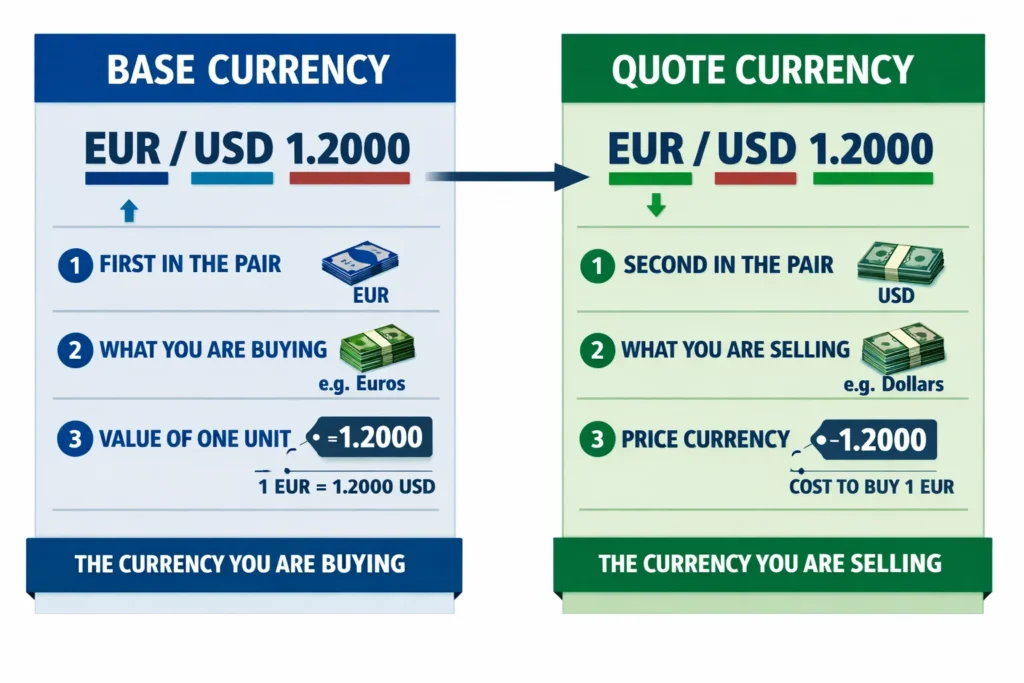
In forex trading, every currency pair consists of two currencies: the base currency and the quote currency. The base currency is the first currency in the pair, while the quote currency is the second. The exchange rate shows how much of the quote currency is needed to buy one unit of the base currency.
Comparison Table
| Aspect | Base Currency | Quote Currency |
| Position in pair | First | Second |
| Role | Currency being bought or sold | Currency used for pricing |
| Example in EUR/USD | EUR | USD |
| Exchange rate meaning | 1 EUR equals X USD | X USD equals 1 EUR |
Is Base Currency Easy for Beginners to Understand?
Yes, base currency is generally easy for beginners to understand once they grasp how currency pairs are structured. Since the base currency is always listed first, traders only need to remember that buying a pair means buying the base currency. With a few real trade examples, this concept becomes clear quickly.
Trading Currency Pairs on Defcofx
Understanding the base currency becomes much easier when you apply it to real market conditions. On Defcofx, traders can practice trading major and minor currency pairs while clearly identifying the base currency in each trade. This helps improve decision-making, risk control, and trade execution in live market environments.
Why Traders Choose Defcofx
- High leverage up to 1:2000, giving flexibility when trading base currencies in different market conditions.
- 40% welcome bonus on first deposits from $1,000, available to all clients.
- No commissions or swap fees, with low spreads starting from 0.3 pips.
- Global access, welcoming traders from all countries with multi-language support.
- Fast withdrawals, processed within 4 business hours, including weekends.
These features allow traders to focus on understanding core forex concepts like base currency, without worrying about hidden costs or slow transactions.
Open a Live Trading AccountFAQs About Base Currency
The base currency is the first currency listed in a forex pair and represents the currency being bought or sold. The exchange rate shows how much of the quote currency is needed to buy one unit of the base currency.
Yes, in forex trading the base currency is always the first currency in a currency pair. This standard structure helps traders easily understand pricing and trade direction.
The base currency does not change within a specific currency pair, but it can differ between pairs. For example, EUR is the base currency in EUR/USD, while USD is the base currency in USD/JPY.
Base currency is important because it determines trade direction, profit and loss calculations, and position sizing. Misunderstanding it can lead to incorrect trades and risk exposure.
When USD is the base currency, such as in USD/JPY, the exchange rate shows how much of the quote currency is needed to buy one US dollar.