

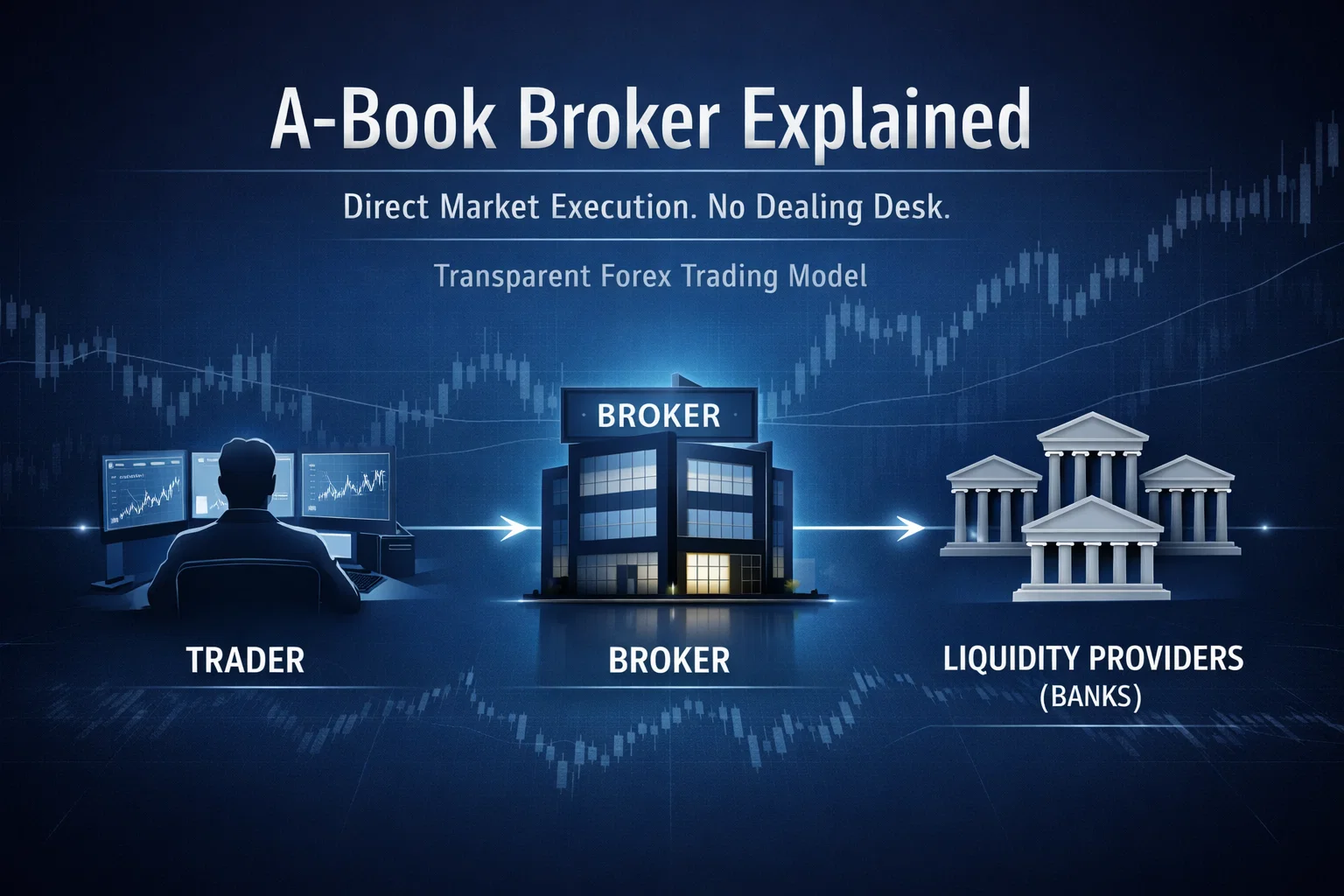
An A-Book broker is a forex broker that sends client trades directly to liquidity providers instead of taking the opposite side of the trade. This model reduces conflict of interest because the broker earns from spreads rather than client losses.
Key Takeaways
- An A-Book broker routes trades to external liquidity providers.
- The broker does not trade against clients.
- Revenue comes mainly from spreads, not losses.
- Often associated with STP or ECN execution.
- Considered more transparent than pure market maker models.
What Is an A-Book Broker?
An A-Book broker operates using a straight-through processing (STP) or ECN-style execution model. Instead of acting as the counterparty to a trader’s position, the broker forwards the order to banks or liquidity providers.
This means if a trader buys EUR/USD, the broker passes that order into the broader market.
The broker earns through:
- Spread markups
- Volume-based compensation
- Transparent pricing structures
Because of this structure, the broker does not benefit directly from a trader’s loss.
How A-Book Execution Works
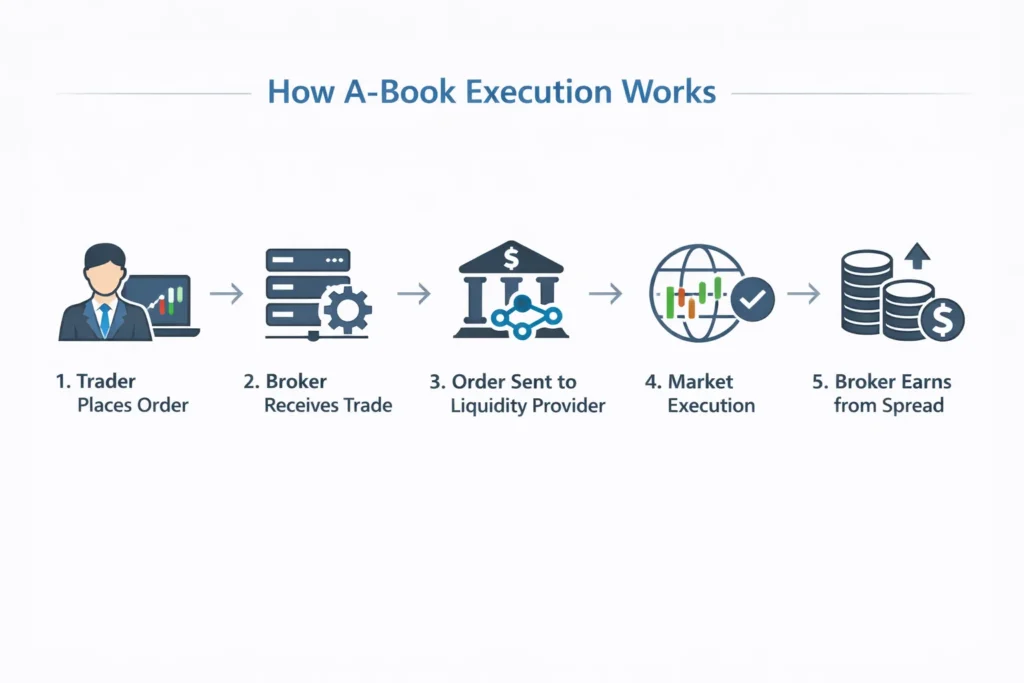
Here is a simplified process:
- The trader places a trade.
- The broker receives the order.
- The order is routed to a liquidity provider.
- Trade is executed at market price.
- The broker earns from the spread or agreed markup.
This system is designed to align broker revenue with trading activity, not with client losses.
A-Book vs B-Book Broker
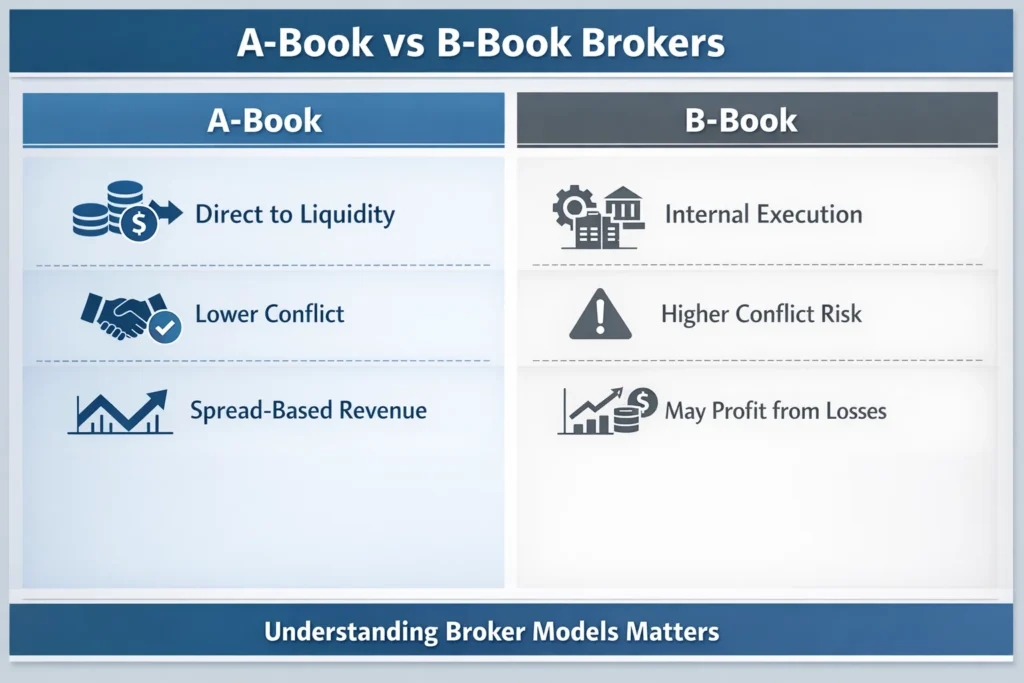
| Feature | A-Book Broker | B-Book Broker |
| Order Routing | Trades are sent directly to external liquidity providers such as banks or financial institutions, allowing access to the broader market. | Trades are kept inside the broker’s system, where the broker becomes the counterparty to the trade. |
| Conflict of Interest | Lower conflict of interest because the broker does not benefit from client losses. | Higher potential conflict of interest, as the broker may profit when clients lose trades. |
| Revenue Model | Earnings mainly come from spreads or small markups, focusing on trading volume rather than losses. | Revenue can come from spreads and, in some cases, from client losses on in-house trades. |
| Transparency | Generally more transparent since pricing and execution are linked to real market liquidity. | Transparency varies depending on the broker’s internal policies and execution practices. |
Some brokers operate a hybrid model, combining both A-Book and B-Book systems. This usually depends on factors such as account type, trade size, or trading behavior.
5 Advantages of A-Book Brokers
A-Book brokers offer several benefits that many traders find appealing, especially those who value transparency and fair execution.
- Reduced Conflict of Interest: Since trades are sent directly to liquidity providers, the broker does not profit from client losses. This lowers the risk of price manipulation or unfair trade handling.
- Market-Based Pricing: Prices are based on real market supply and demand. This means traders receive rates that reflect actual market conditions rather than internally adjusted quotes.
- Access to Real Liquidity: Orders are connected to banks or external liquidity providers, allowing trades to be executed in the broader financial market.
- More Transparent Execution: Because trades are routed externally, pricing and order flow are generally clearer compared to brokers that keep trades in-house.
- Often Preferred by Experienced Traders: Many advanced traders prefer A-Book models because they value direct market access and reduced dealing-desk involvement.
However, it is important to remember that execution speed, slippage, and liquidity quality still depend on the broker’s technology, infrastructure, and partnerships.
Are A-Book Brokers Safer?
An A-Book execution model can improve transparency, but it does not automatically make a broker safe. Overall safety depends on several important factors:
- Regulation: A regulated broker follows rules set by financial authorities, which helps protect traders from unfair practices and misuse of funds.
- Fund Security: This refers to how client money is stored and protected. Reputable brokers keep client funds separate from company funds to reduce risk.
- Withdrawal Reliability: A safe broker processes withdrawals smoothly and on time. Consistent and fast withdrawals are a strong sign of operational trustworthiness.
- Customer Support: Reliable customer support ensures traders can get help quickly when facing technical issues, account problems, or urgent questions.
- Trading Conditions: Fair spreads, clear pricing, and transparent policies indicate a broker that operates with honesty and professionalism.
While the A-Book model reduces conflict of interest, the execution model alone does not guarantee trust. Traders should always evaluate the broker’s overall structure, policies, and reliability before trading.
Transparent Trading with Defcofx
At Defcofx, trading conditions are designed for clarity and fairness:
- High leverage up to 1:2000 for flexible trading
- 40% welcome bonus on first deposits from $1000
- No commissions or swap fees
- Spreads starting from 0.3 pips
- Withdrawals processed within 4 business hours, including weekends
- Available globally with multilingual support
By focusing on transparent pricing and no hidden costs, traders can operate with greater confidence.
Open a Live Trading AccountFAQs
A-Book refers to a broker model where client trades are sent directly to liquidity providers instead of being handled internally.
It depends on the trader’s needs. A-Book brokers generally offer more transparency, but execution quality and regulation are equally important.
Some do, especially ECN brokers. Others operate only through spreads.
Yes. Many brokers use a hybrid model depending on account type or trade volume.