

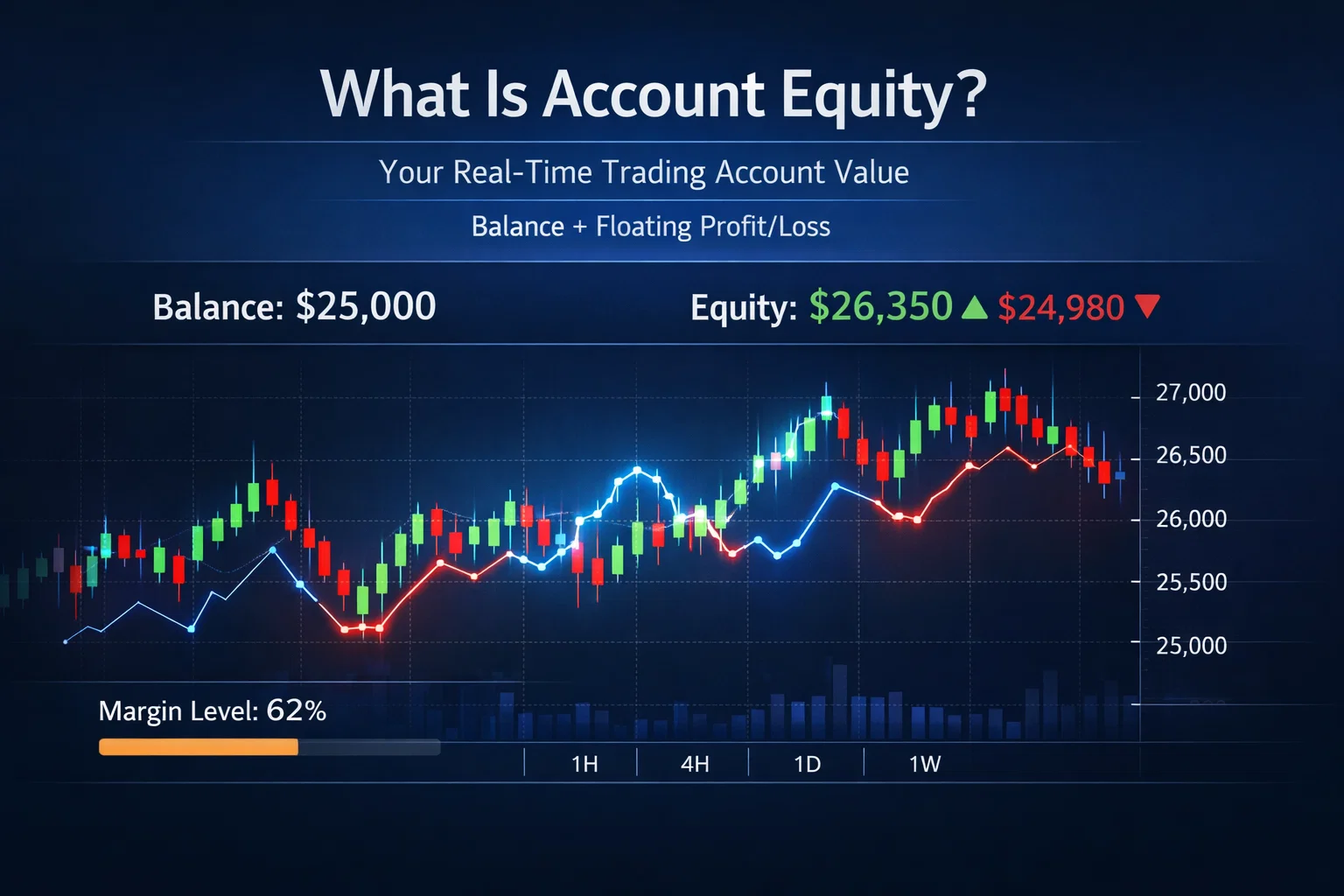
Account equity is the real-time total value of your trading account, calculated by adding or subtracting the floating profit or loss from your account balance. It changes continuously as market prices move.
Key Takeaways
- Equity shows your true account value at any moment.
- It includes floating (unrealized) profit or loss.
- Equity constantly changes with market movements.
- It determines your margin level and trading capacity.
- Low equity can trigger margin calls or stop-outs.
What Is Account Equity?
Account equity represents the actual current value of your trading account, including open trades.
It is calculated using this formula:
Equity = Account Balance ± Floating Profit/Loss
This means:
- If your open trades are in profit, equity increases.
- If your open trades are at a loss, equity decreases.
- If you have no open trades, equity equals balance.
Unlike balance, equity reflects real-time market exposure.
Practical Example of Account Equity
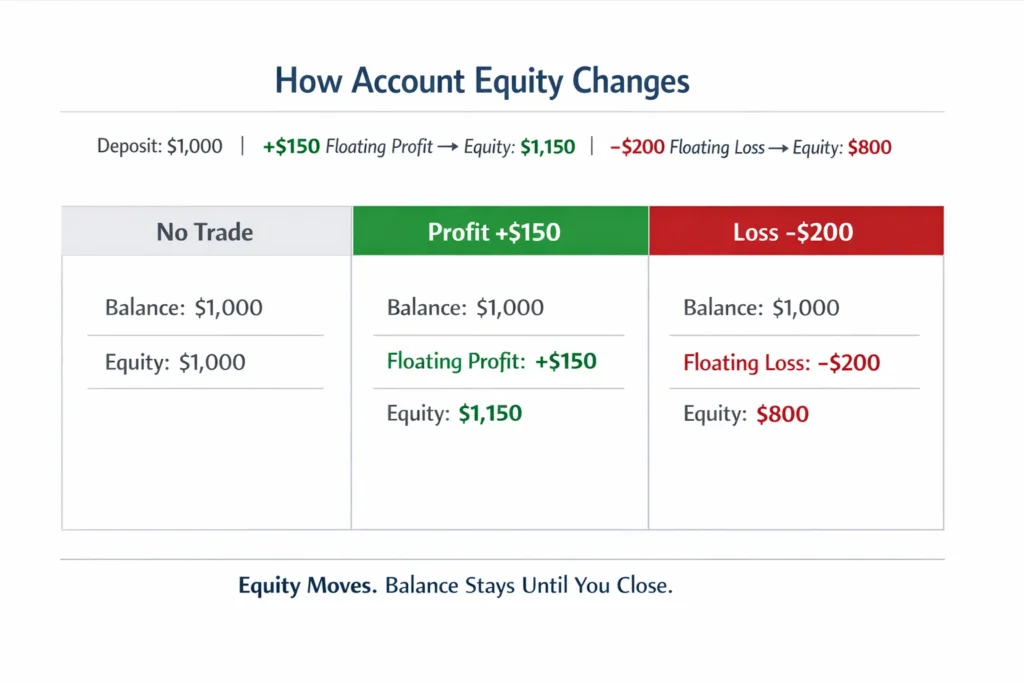
Let’s simplify it with a realistic scenario.
You deposit $1,000.
You open a trade.
| Scenario | Account Balance | Floating P/L | Account Equity |
| Trade not opened | $1,000 | $0 | $1,000 |
| Trade in profit | $1,000 | +$150 | $1,150 |
| Trade-in loss | $1,000 | -$200 | $800 |
Notice something important:
Your balance stays at $1,000 until you close the trade.
Your equity keeps moving based on market price changes.
This is why traders must monitor equity carefully, especially when using leverage.
Account Equity vs Account Balance
Many beginners confuse these two terms. Here is the difference explained clearly:
| Feature | Account Balance | Account Equity |
| Includes Open Trades? | No | Yes |
| Changes in Real Time? | No | Yes |
| Reflects Floating Profit/Loss? | No | Yes |
| Used to Calculate Margin? | No | Yes |
| Determines Risk Level? | No | Yes |
In simple words:
- Balance = What you have after closing trades
- Equity = What your account is worth right now
Why Account Equity Is Extremely Important
Equity directly affects your ability to trade.
1. Margin Calculation
When you open a leveraged trade, a portion of your equity is locked as used margin.
Brokers calculate your available (free) margin based on equity, not balance.
If equity drops because of floating losses:
- Your free margin decreases.
- Your ability to open new trades becomes limited.
- Your account becomes more vulnerable to margin calls.
This is why traders must monitor equity during volatile markets.
2. Margin Call Risk
A margin call happens when your equity falls close to your used margin level.
This is a warning sign that your account is under pressure.
At this stage, you usually have two options:
- Deposit additional funds to increase equity.
- Close some positions to reduce exposure.
If you ignore a margin call and the market continues against you, the broker may automatically close trades.
3. Stop-Out Protection
If equity continues to decline beyond the broker’s stop-out level, positions are automatically closed.
This happens to:
- Prevent negative balance situations.
- Protect both trader and broker from extreme losses.
For example, if your broker has a 20% stop-out level and your margin level drops below that threshold, trades may start closing automatically, starting with the largest losing position.
This is why understanding equity is critical for survival in leveraged trading.
Verified Industry Insight
Regulatory disclosures required by financial authorities such as the FCA (UK) and ESMA (Europe) consistently show that a large majority of retail CFD and forex traders lose money.
- Excessive leverage usage
- Poor risk management
- Lack of stop-loss discipline
- Failure to monitor equity and margin levels
How Leverage Affects Equity
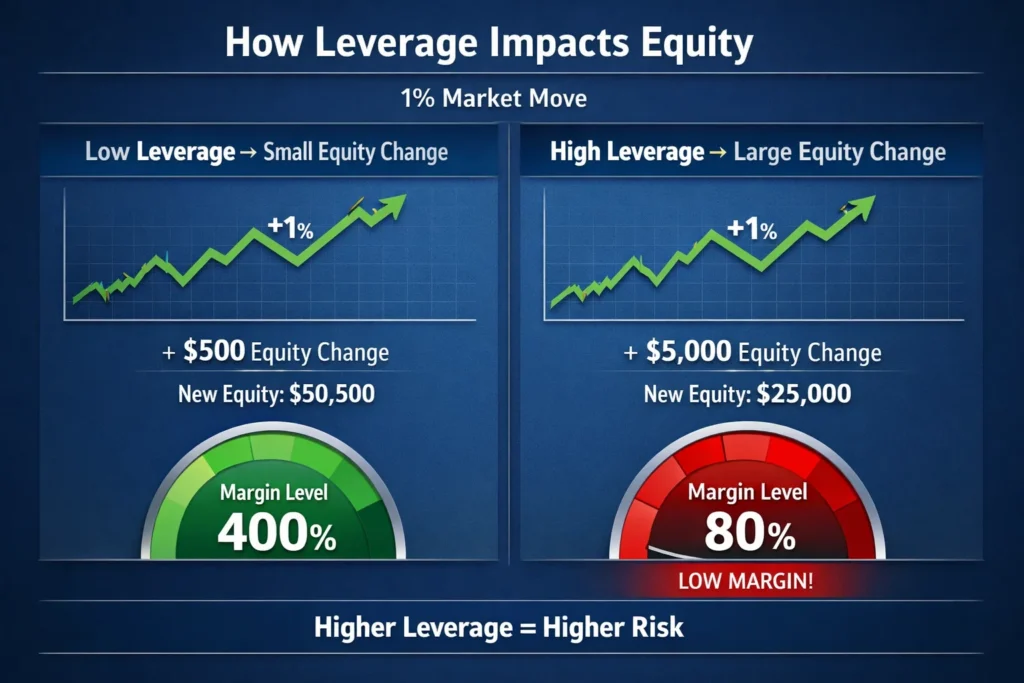
Leverage allows traders to control larger positions with smaller capital. However, this magnifies both gains and losses.
For example: If you use 1:200 leverage, a 1% market movement equals a 200% effect on your position size relative to your margin.
This means:
- A small favorable move → equity increases quickly.
- A small unfavorable move → equity decreases quickly.
- High leverage → faster equity fluctuation.
- Faster fluctuation → higher margin call risk.
This is why professional traders always calculate risk before entering a leveraged trade.
Leverage is powerful, but without equity management, it becomes dangerous.
Managing Equity with Defcofx
At Defcofx, traders benefit from
- Leverage options up to 1:2000 for flexible strategy use
- No commissions or swap fees
- Spreads starting from 0.3 pips
- Fast withdrawals within 4 business hours
- Global access with multilingual support
Because equity is central to leveraged trading, transparent trading conditions and fast fund access help traders manage risk more efficiently.
Open a Live Trading Account4 Common Mistakes Traders Make About Equity
Many beginner traders misunderstand how equity works. These mistakes often lead to avoidable account losses.
1. Thinking Equity and Balance Are the Same
Some traders only look at their balance and assume their account is stable.
However:
- Balance shows closed results.
- Equity shows real exposure.
Ignoring equity means ignoring real-time risk.
2. Ignoring Floating Losses
Traders sometimes hold losing trades, hoping the market will reverse.
But floating losses directly reduce equity.
If the loss grows too large:
- Free margin disappears.
- Margin level drops.
- Positions may be forced closed.
Monitoring floating P/L protects your account.
3. Using High Leverage Without Understanding Margin
High leverage increases position size, but it also increases how quickly equity changes.
Without calculating risk per trade, traders may:
- Overexpose their account
- Lose equity too quickly
- Trigger margin calls unexpectedly
Leverage must always match account size and risk tolerance.
4. Not Monitoring Margin Level Percentage
Many trading platforms show a margin level percentage, calculated as:
Margin Level = (Equity / Used Margin) × 100
If this percentage drops too low:
- You receive margin warnings.
- Automatic stop-outs may occur.
Monitoring this number helps traders act before forced closures happen.
FAQs
Equity is the total real-time value of your trading account, including floating profit or loss.
Free margin is the portion of equity that is not being used as margin for open trades. It represents how much capital you have available to open new positions.
Equity changes because it includes floating (unrealized) profit or loss.
As market prices move, the value of your open positions changes, which directly affects your equity, even if you haven’t closed the trade yet.
Yes. If your open trades are currently in profit, your equity will be higher than your balance. The difference reflects unrealized gains that would become balanced only after closing the trade.
If equity drops too close to your used margin, you may receive a margin call warning. If it continues falling and reaches the broker’s stop-out level, some or all open positions may automatically close to prevent further losses.
Yes. When you close a trade, the floating profit or loss becomes realized and is added to or subtracted from your account balance. After closing, equity and balance become equal again (if no other trades are open).
You can protect your equity by:
1. Using appropriate position sizes
2. Setting stop-loss orders
3. Avoiding excessive leverage
4. Monitoring margin level regularly
Risk management helps prevent sudden equity drops.
For active traders, yes.
Balance shows historical results, but equity shows real-time exposure. Since margin, stop-outs, and trading capacity depend on equity, it is the most important number during open trades.
Yes, if open trades generate large losses and margin protection triggers.
However, many brokers use automatic stop-out systems and negative balance protection to prevent equity from going below zero.