

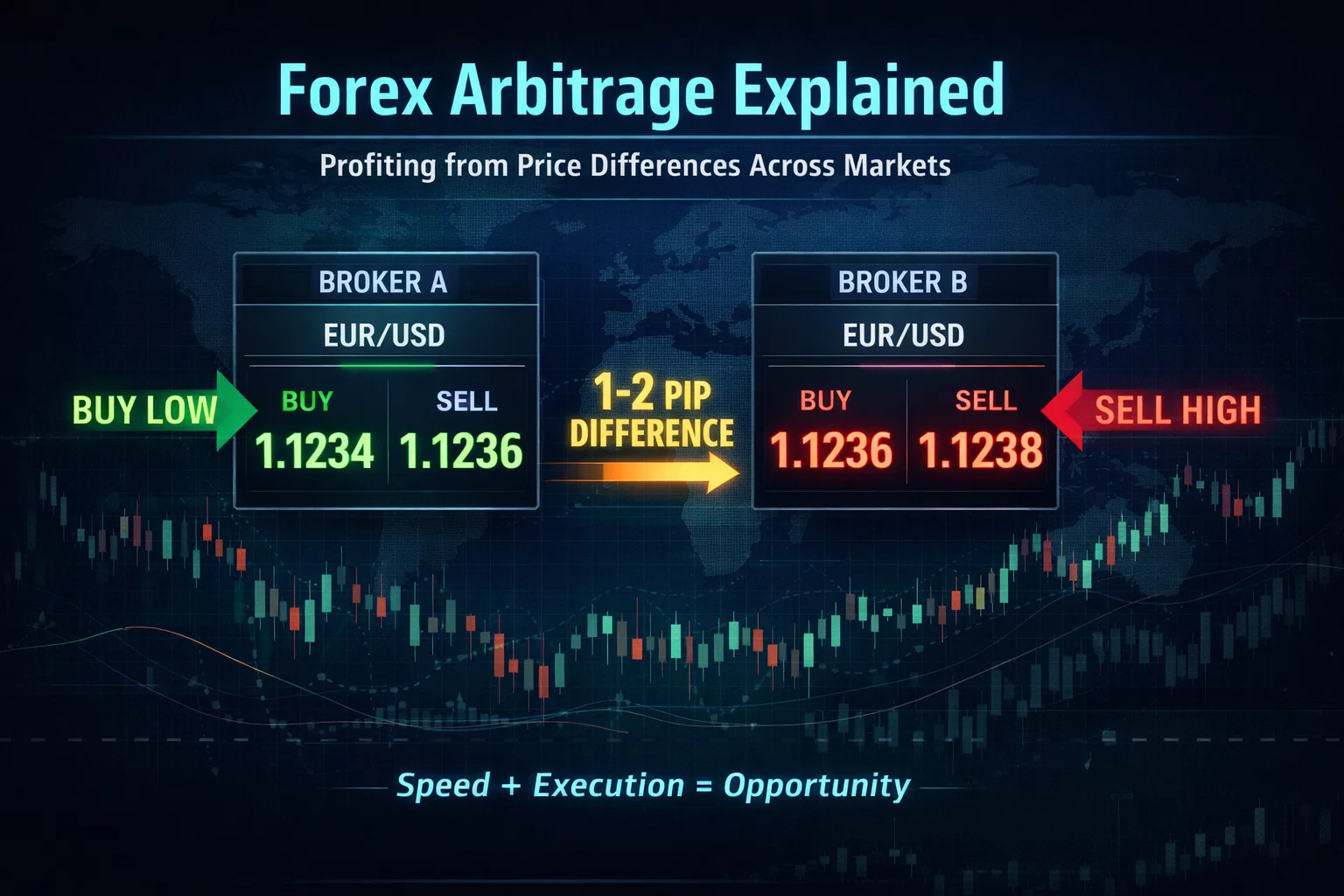
Arbitrage in forex is a trading strategy where a trader attempts to profit from price differences of the same currency pair across different markets or brokers. It involves buying at a lower price in one place and selling at a higher price in another.
Key Takeaways
- Arbitrage takes advantage of price differences between markets.
- It usually involves very small price gaps.
- Speed and execution quality are critical.
- It is considered a low-risk strategy in theory.
- Technology plays a major role in modern arbitrage trading.
What Is Arbitrage in Forex?
Arbitrage in forex is based on the principle that the same currency pair should trade at the same price everywhere. However, because forex prices come from different liquidity providers and trading platforms, small temporary price differences may appear.
These price differences can happen due to:
- Slight delays in price updates between brokers
- Different liquidity sources
- Market volatility during news events
- Technology speed differences
When a trader identifies this price difference, they attempt to:
- Buy at the lower price.
- Sell at the higher price.
- Lock in the difference as profit.
However, these opportunities are usually extremely small, often just 1–2 pips, and disappear in milliseconds.
This is why arbitrage today is primarily done using automated trading systems, not manual execution.
Simple Example of Forex Arbitrage
Let’s make it more realistic.
Suppose:
| Broker | EUR/USD Bid | EUR/USD Ask |
| Broker A | 1.1000 | 1.1002 |
| Broker B | 1.1003 | 1.1005 |
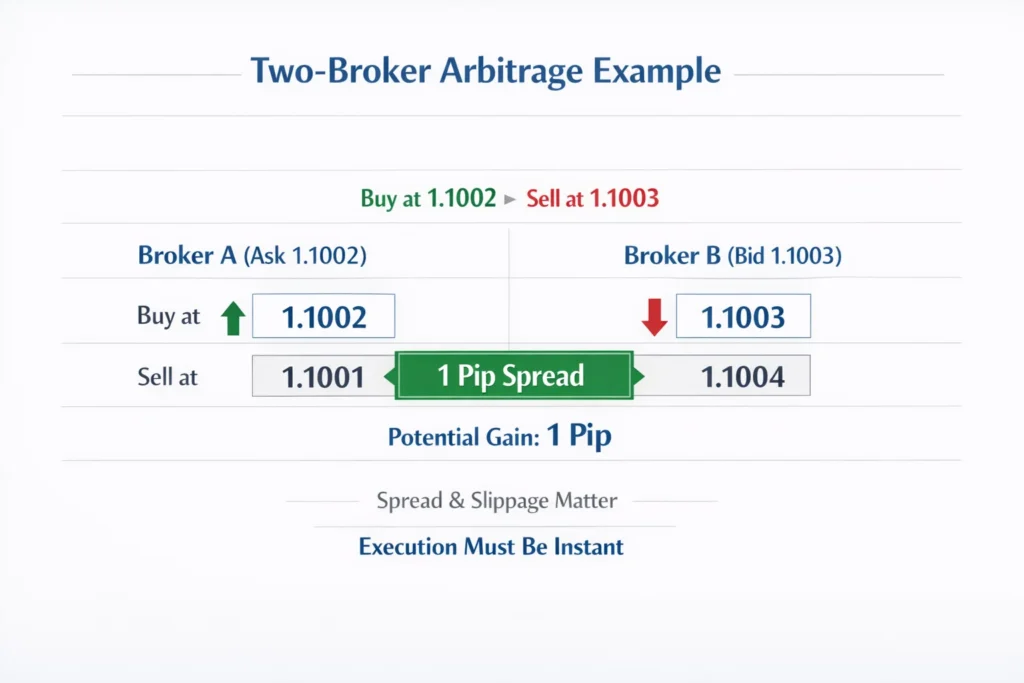
Here, Broker B’s bid (1.1003) is higher than Broker A’s ask (1.1002).
A trader could:
- Buy from Broker A at 1.1002
- Sell to Broker B at 1.1003
This creates a 1-pip difference.
But here’s the important part beginners often miss:
- Spreads must be considered.
- Execution must be instant.
- Both trades must be filled successfully.
- Slippage can remove the profit.
If execution is delayed even slightly, the opportunity disappears.
3 Types of Arbitrage in Forex
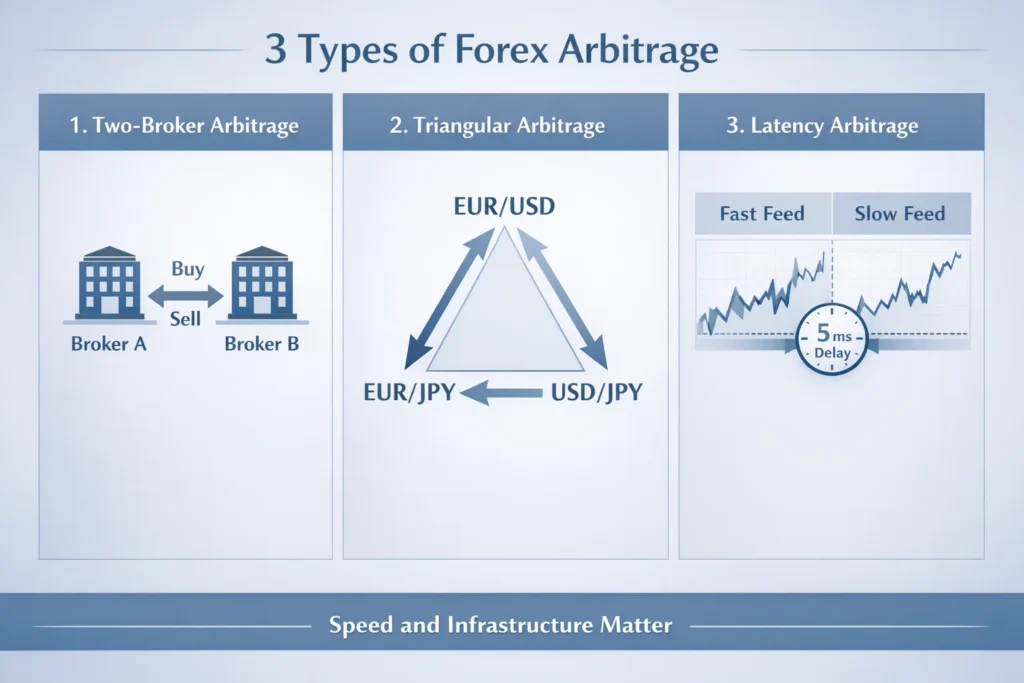
1. Two-Broker Arbitrage
This involves opening accounts with two brokers and monitoring price differences between them.
Requirements:
- Two trading accounts
- High-speed internet connection
- Low execution delay
- Very tight spreads
Risk: If one broker fills your trade and the other rejects or delays execution, you may be exposed to market risk instead of locking in profit.
2. Triangular Arbitrage
Triangular arbitrage uses three related currency pairs to exploit pricing imbalance.
Example:
If:
- EUR/USD = 1.1000
- USD/JPY = 150.00
The implied EUR/JPY rate should be
1.1000 × 150.00 = 165.00
If EUR/JPY is temporarily trading at 165.20, a pricing imbalance exists.
A trader could rotate through:
EUR → USD → JPY → EUR
to capture the difference.
However, this requires:
- Instant execution
- Accurate rate calculations
- Institutional-level speed
Most triangular arbitrage is performed by banks and hedge funds.
3. Latency Arbitrage
Latency arbitrage takes advantage of price update delays between different data feeds.
Example:
- A fast data feed updates immediately after news.
- A slower broker feed updates milliseconds later.
Traders using ultra-fast systems execute trades before the slower feed adjusts.
Because this can exploit technical delay rather than market inefficiency, many brokers:
- Monitor for this behavior.
- May restrict or cancel such trades.
- Include clauses against latency abuse.
This makes it controversial and often restricted.
Why Arbitrage Opportunities Are Rare
According to the Bank for International Settlements (BIS), global forex trading volume exceeds $7 trillion per day, making it the most liquid financial market in the world.
Because of this massive liquidity:
- Prices are constantly monitored by banks.
- Algorithmic systems detect inefficiencies instantly.
- Large institutions compete aggressively.
- Market pricing adjusts in milliseconds.
In today’s electronic markets, most arbitrage gaps last less than a second.
Retail traders without advanced infrastructure usually cannot compete with institutional systems.
Advantages and Challenges of Arbitrage
| Aspect | Detailed Explanation |
| Low Theoretical Risk | If both trades execute perfectly at the same time, price difference can create near risk-free profit. |
| Small Profit Margins | Arbitrage gains are usually tiny (1–2 pips), requiring large volume to be meaningful. |
| Execution Dependency | Delays, slippage, or rejected orders can turn a “risk-free” trade into a losing one. |
| Technology Requirement | High-speed systems and automation are usually necessary. |
| Broker Policy Risk | Some brokers restrict certain arbitrage methods under their terms of service. |
This shows that while arbitrage sounds simple in theory, it is complex in practice.
Is Arbitrage Risk-Free?
Arbitrage is often described as “risk-free,” but this assumes:
- Both trades execute simultaneously.
- No slippage occurs.
- No rejection happens.
- No spread widening occurs.
In real trading environments:
- Prices can change during execution.
- One leg of the trade may fill, the other may not.
- Network delays can create exposure.
- Broker systems may cancel trades.
Because of these real-world risks, arbitrage is not truly risk-free for retail traders.
Execution Quality and Trading Conditions
Successful arbitrage depends heavily on:
- Tight spreads
- Fast execution
- Stable trading infrastructure
- Reliable order processing
At Defcofx, traders benefit from
- Spreads starting from 0.3 pips
- No commissions or swap fees
- Leverage up to 1:2000
- Fast withdrawals within 4 business hours
- Global access with multilingual support
Strong infrastructure and transparent pricing are important for any strategy that depends on precision and speed.
Open a Live Trading Account3 Common Misconceptions About Arbitrage
“Arbitrage guarantees profit.”
No strategy guarantees profit. Arbitrage relies on perfect execution. If execution fails or spreads widen, losses can occur.
“Manual traders can easily do arbitrage.”
Modern forex markets move too fast for manual execution. Arbitrage today is primarily algorithm-driven.
“All brokers allow arbitrage.”
Broker policies differ. Some allow standard arbitrage strategies, while others restrict latency-based or exploitative methods.
Traders should always review broker terms and trading policies.
FAQs
Yes, arbitrage is legal in most jurisdictions. However, broker terms and conditions may limit certain practices.
Arbitrage usually requires advanced tools and fast systems, making it difficult for beginners.
Because price differences are small, significant capital or high trade volume is often required.
Large institutions and automated trading systems detect and correct price inefficiencies within milliseconds.
Triangular arbitrage avoids using multiple brokers but requires precise rate calculations and fast execution.
Some do, some restrict it. Traders should always review broker terms before using such strategies.