


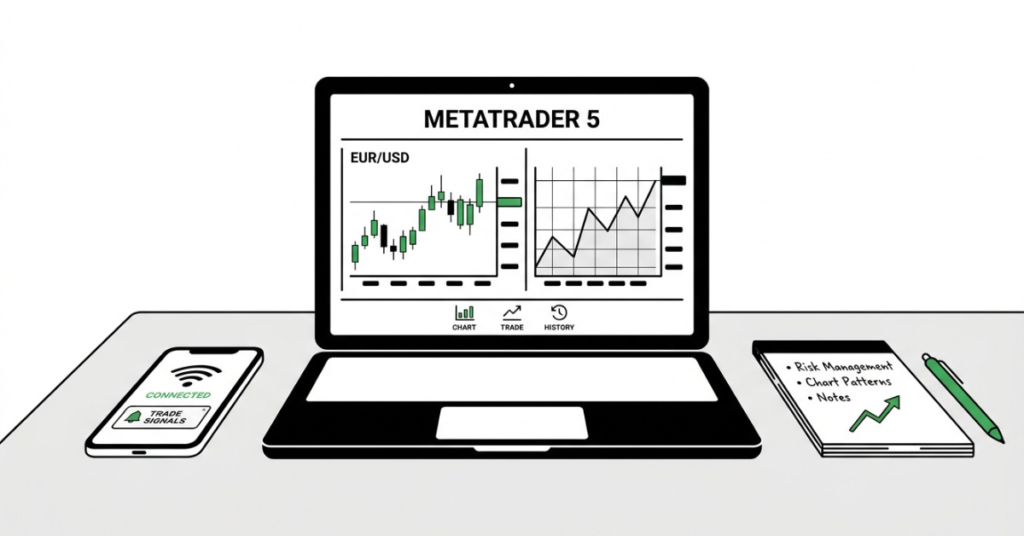
The minimum requirements to start forex trading include meeting local eligibility rules, opening a suitable broker account, completing required verification, and using a supported platform with reliable internet. For live trading, you also need sufficient funds for the broker’s deposit and margin requirements, plus a plan to manage losses.
Key takeaways
- There is no global minimum deposit. Each broker and account sets its own funding and trading-size requirements.
- Regulated brokers generally apply identity checks under local AML rules; accepted documents and the timing of checks vary.
- Use reliable internet and a device that meets the current requirements of your broker’s supported platform, such as MT5.
- A demo account lets you practise with virtual funds. Its execution and trading experience can differ from a live account.
- You must meet the legal age and eligibility requirements in your jurisdiction and the broker’s account terms.
- A formal trading qualification is generally unnecessary, but local eligibility rules and broker knowledge or appropriateness checks can apply.
Minimum requirements checklist
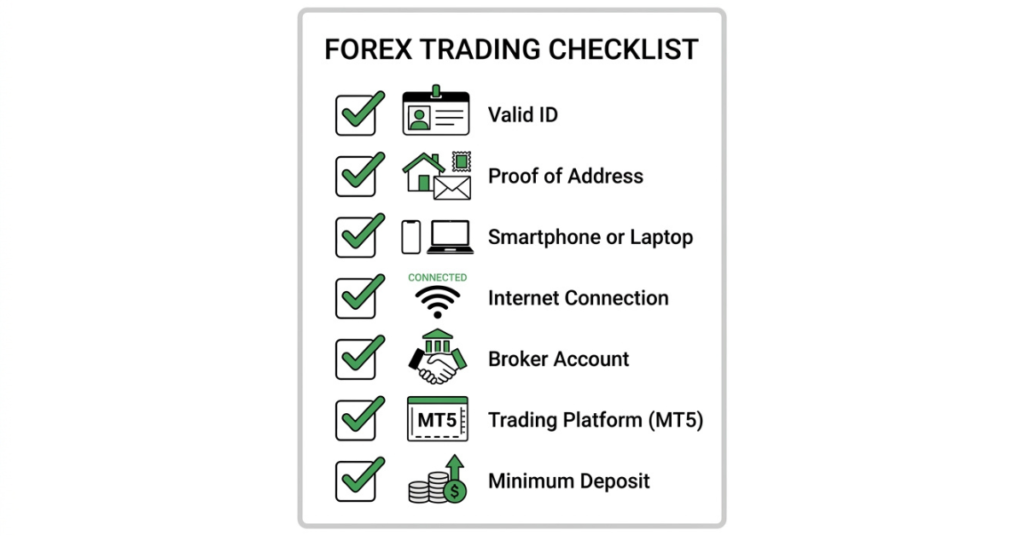
Here is everything you need in one place, with no extras added.
| Requirement | What You Need | Notes |
| Legal age | Legal age under local law and broker terms | Often 18 or older; verify local requirements |
| Valid ID | Passport, national ID, or driving licence | For KYC/AML verification by your broker |
| Proof of address | Recent utility bill or bank statement, if requested | Accepted documents and maximum age depend on broker policy |
| Device | PC, Mac, Android, or iOS phone/tablet | Check current operating-system requirements |
| Internet connection | Stable broadband or mobile data | Poor connectivity can delay order submission; slippage also occurs in fast markets |
| Broker account | Live account with required checks, or a demo account | Demo registration and live verification requirements can differ |
| Minimum deposit | Set by the broker and account type | Virtual demo funds are not withdrawable money |
| Trading platform | MetaTrader 5, MetaTrader 4, or broker app | Choose a platform supported by your broker |
How much capital do you need?
There is a wide gap between the bare minimum you can deposit and the amount that gives you room to trade properly. Here is how to think about it:
The broker’s minimum deposit
The advertised minimum deposit is an account funding condition. It does not guarantee enough free margin to open a position or enough capital to follow your risk limit. Check minimum lot size, contract size, margin, spreads and other costs before funding.
Capital for your trading plan
A $100–$500 balance is an illustrative starting range, not a safe or recommended minimum for everyone. Adequacy depends on minimum trade size, stop distance, trading costs and your risk limit. Even a micro-lot can expose a small account to substantial losses.
Position size and percentage risk
There is no universal professional account size or balance that makes trading a reliable income source. Size positions from the amount you are prepared to risk and the distance to your stop, rather than targeting a standard lot. For example, on EUR/USD assuming a standard contract of 100,000 euros, a 0.01-lot position is approximately $0.10 per pip in a USD account: a 50-pip loss is about $5 before costs, or 5% of a $100 account.
For a detailed breakdown of account sizing, read our article on best lot size for a $1,000 account, which explains how lot size and stop distance affect the amount at risk.
Open a Live AccountHow account verification works (KYC)
KYC stands for Know Your Customer. Regulated brokers generally verify customers under applicable anti-money-laundering rules. Requirements and when checks occur differ by jurisdiction and account type. These checks help address fraud and money-laundering risks; they do not establish the safety of a broker or investment.
Verification time depends on the broker, document quality and any additional review. Check the provider’s current instructions. Common requests include:
- An accepted government-issued photo ID, such as a passport or national identity card
- Proof of residential address, if required, with a document type and issue date accepted by the broker
- In some cases, a selfie holding your ID for enhanced verification
Choose a compatible device and platform
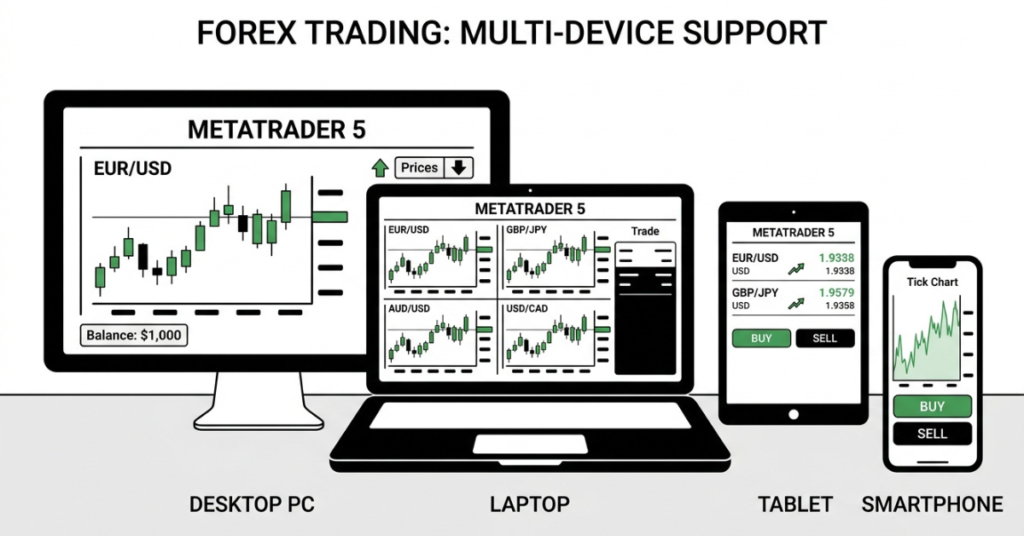
MetaTrader 5 (MT5) is a widely used trading platform. It is free to download and runs on Windows, macOS, Android, and iOS. Use official MetaQuotes downloads or links on your broker’s verified website, and check current device compatibility.
| Device Type | MT5 Support | Best For |
| Windows PC / Laptop | Full desktop client | Multiple charts and supported desktop tools |
| Mac | Official macOS installer using Wine, or supported WebTrader | Check current macOS and broker compatibility |
| Android smartphone / tablet | MT5 mobile app (Google Play) | Monitoring trades, quick entries on the go |
| iPhone / iPad | MT5 mobile app (App Store) | Monitoring trades, mobile management |
| Supported web browser | MT5 WebTrader, if offered by your broker | Quick access without downloading software |
Check legal eligibility before trading
Access to retail forex and CFDs depends on your country, the product and the broker’s authorization. Check the relevant regulator before opening or funding a live account. Key points include:
- Meet the legal age and other account eligibility requirements under local law and the broker’s terms.
- Retail forex rules differ by country and product. In the United States, check the dealer’s eligibility and registration through the CFTC and NFA before opening an account. Sanctions and broker eligibility restrictions may also apply.
- Do not assume an offshore broker is lawful to use wherever its website is accessible. For example, the State Bank of Pakistan’s advisory prohibits residents from buying the specified offshore forex, margin-trading and CFD services and remitting funds to them. Check your local regulator’s current rules before trading or funding an account.
- Tax treatment and reporting obligations depend on your country and trading circumstances. Income tax or capital-gains rules may apply; consult a qualified local tax adviser.
Looking for a beginner-friendly broker? Our guide on best forex broker for beginners covers what to look for in a platform when you are just starting out.
Starting forex trading with Defcofx
Defcofx is built for traders at every level. The account overview lists a $50 starting deposit for Silver and $1,000 for Gold. Verify the current onboarding requirements, residency eligibility and legal entity before depositing; a broker’s acceptance of an application does not establish that its services are authorized in your country.
The website currently advertises the following account features. Confirm terms and instrument specifications before trading:
| Feature | Defcofx Offer |
| Spreads | From 0.5 pips |
| Leverage | Up to 1:2000 on Silver and 1:500 on Gold; instrument limits apply |
| Commissions | Zero |
| Swap Fees | Zero |
| Welcome Bonus | 40% trading credit for eligible new clients’ first deposit of at least USD 1,000 or EUR 1,000; request and receive it before trading. Verification, country exclusions and full terms apply. The bonus itself is not withdrawable. |
| Withdrawals | Typically around 3 hours; withdrawal eligibility and processing conditions apply |
| Platform | MetaTrader 5 (MT5) |
| Account Types | Silver and Gold live accounts; demo accounts available |
Not ready to deposit yet? Open a free demo account and practise with virtual funds in a simulated trading environment. No deposit required.
When you are ready to go live, open a live trading account on Defcofx and review the complete welcome bonus conditions. Do not place trades or pending orders before requesting and receiving the bonus. Withdrawals and internal transfers cancel bonus credit, and residency exclusions apply.
Prepare before funding a forex account
Starting forex trading does not require an expensive setup or professional qualification. You mainly need a verified broker account, suitable capital, a reliable device and internet connection, and access to a trading platform such as MetaTrader 5. The more important part is understanding how to manage risk before putting real money into the market.
If you are completely new, a demo account gives you a practical way to learn the platform, practise position sizing, and experience market movements without risking your own funds. Once you understand the basics and have a clear trading plan, you can decide if live trading fits your goals and financial situation.
Forex account requirements FAQ
A formal trading qualification is generally unnecessary. You still need to meet local eligibility rules, complete required broker checks and understand leverage, costs and potential losses. Some providers assess your knowledge or the product’s appropriateness.
There is no universal verification deadline. Timing depends on the provider, document quality and any manual review or additional checks. Follow the broker’s current instructions and ask support for an estimate if your application remains pending.
Yes. MT5 has Android and iOS apps for placing and managing trades. Features differ from the desktop platform, particularly automated trading tools. Check device compatibility and your broker’s platform support; web access depends on its offering.
Yes. Meeting the deposit minimum does not ensure adequate margin or position sizing. The smallest available trade may risk too much of a small balance. Calculate potential losses from lot size, stop distance and costs before trading.
Tax treatment depends on your country, product and circumstances. Profits may attract income tax or capital-gains tax, and reporting duties can apply even to occasional trades. Ask a qualified local tax adviser about records and applicable rules.
Basic trading does not always require expensive hardware. Check current MT5 system requirements and allow for your chart or automated-tool workload. Reliable internet helps reduce connection delays, but it cannot prevent slippage caused by volatility or limited liquidity.
Demo accounts generally use virtual funds without a live deposit; access and expiry terms vary. Live accounts require actual funding and expose you to losses. Demo execution can differ from live trading, and virtual profits cannot be withdrawn.