

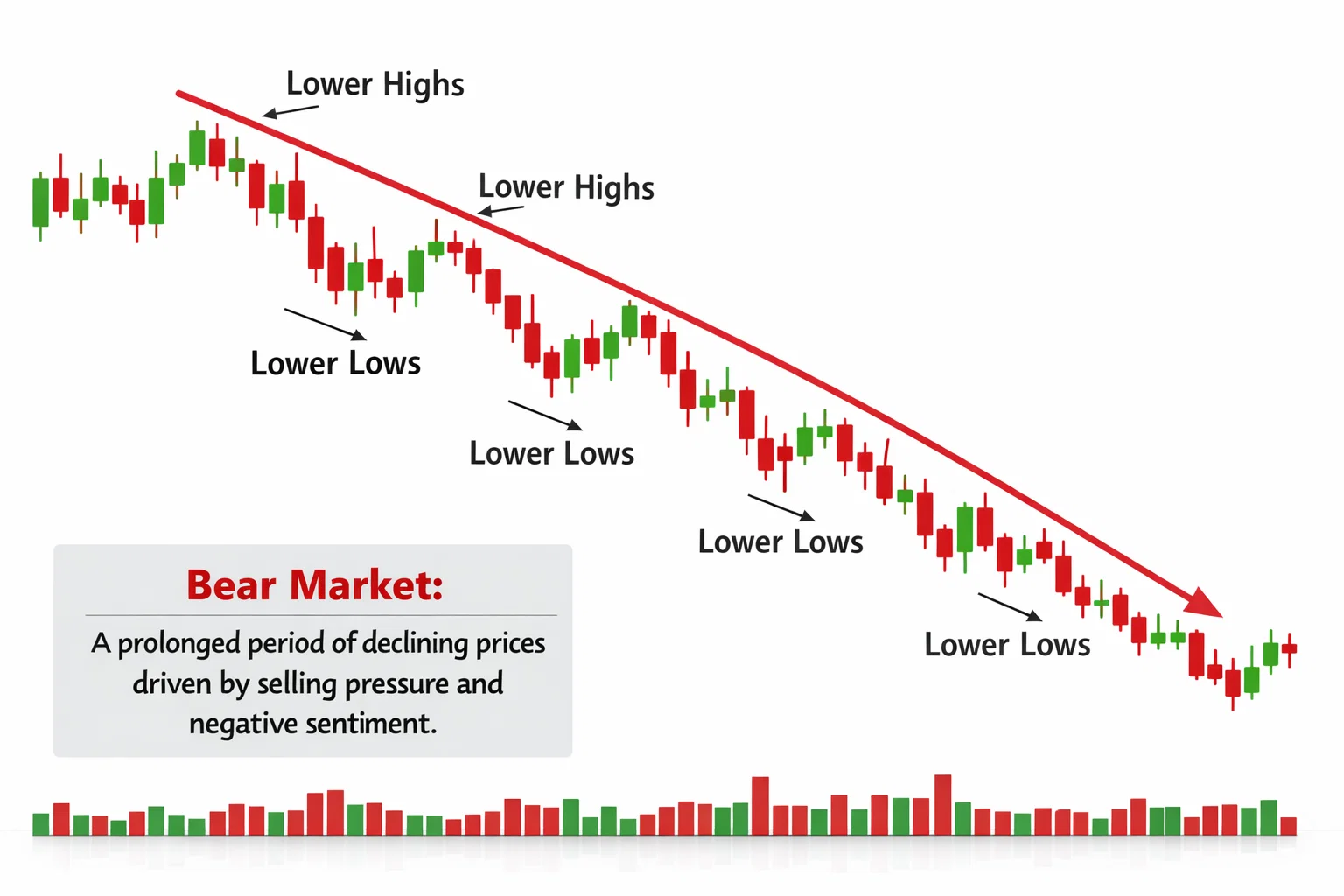
A bear market is a period in which prices in a financial market fall consistently, usually by 20% or more from recent highs, driven by negative investor sentiment and strong selling pressure. In forex and other markets, a bear market reflects prolonged downward trends and increased caution among traders.
Key Takeaways: Bear Market
- A bear market refers to a prolonged period of declining prices, typically a drop of 20% or more.
- It is driven by negative market sentiment and strong selling pressure.
- Bear markets can occur in forex, stocks, crypto, and commodities.
- Prices usually form lower highs and lower lows during a bear market.
- Traders can still find opportunities, but risk management becomes critical.
What Is a Bear Market in Forex & Financial Markets?
In financial markets, a bear market describes a long-lasting period of falling prices caused by pessimism, weak economic conditions, or reduced investor confidence. In forex trading, a bear market usually means one currency is consistently weakening against another, leading to a sustained downward trend in a currency pair rather than a single short-term price drop.
How Bear Markets Develop
Bear markets usually develop gradually as negative factors begin to outweigh positive market sentiment. They are not caused by a single price drop but by sustained selling pressure over time.
Here’s how a bear market typically forms:
- Economic or financial concerns appear. This may include slowing economic growth, high inflation, rising interest rates, or geopolitical uncertainty.
- Investor and trader sentiment turns negative. Confidence weakens, leading more market participants to sell rather than buy.
- Prices begin forming lower highs and lower lows. This confirms a bearish trend instead of a short-term correction.
- Selling pressure increases. As prices fall further, fear grows and more traders exit positions, reinforcing the downtrend.
- A bear market becomes established. Once prices decline by around 20% or more from recent highs, the market is commonly considered to be in a bear phase.
In forex, this process often shows up as one currency consistently losing value against stronger currencies over an extended period.
Bear Market Example (With Table)
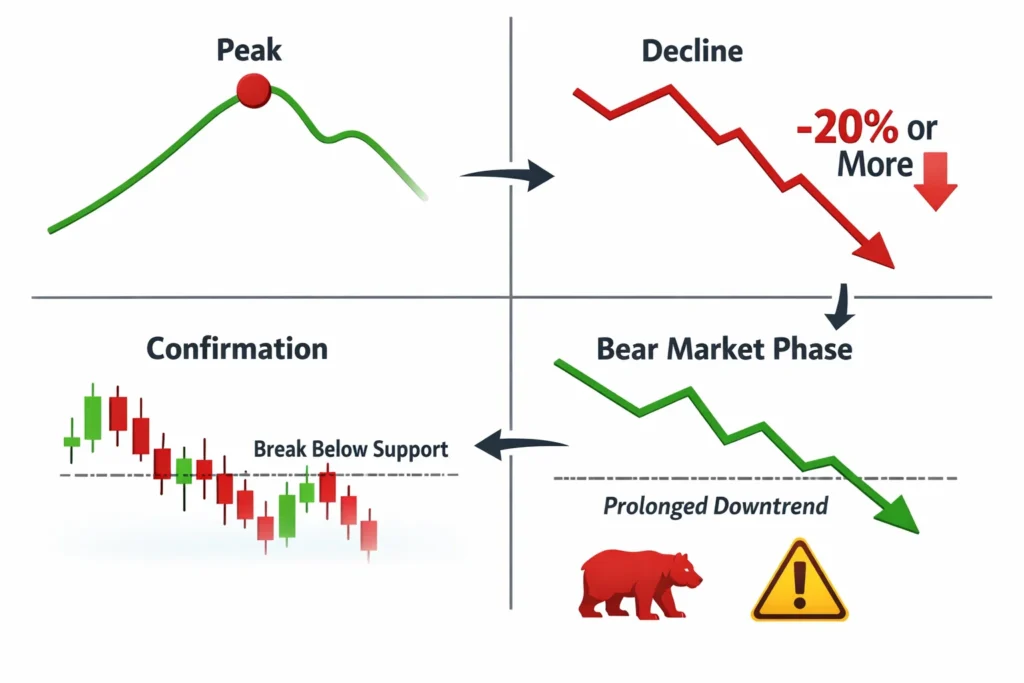
A bear market is identified by sustained price declines, not short-term pullbacks. Below is a simplified example to show how a bear market looks in practice.
Example Table: Bear Market Price Decline
| Stage | Price Level | Change | Market Behavior |
| Market Peak | 1.2000 | — | Strong buying, optimism |
| Early Decline | 1.1400 | −5% | Selling pressure begins |
| Trend Confirmation | 1.0500 | −12.5% | Lower highs & lower lows |
| Bear Market Phase | 0.9600 | −20% | Bear market confirmed |
| Extended Decline | 0.9000 | −25% | Strong bearish sentiment |
Example Explanation: If a currency pair falls 20% or more from its recent high and continues forming lower highs and lower lows, it is commonly considered to be in a bear market. This definition is widely used across financial markets and referenced by major financial sources such as Investopedia.
Why Bear Markets Matter to Traders
Bear markets matter because they change how traders manage risk, choose strategies, and time their trades. During a bear market, prices trend downward for extended periods, which increases volatility and emotional pressure. Traders must adapt by focusing more on risk management, trade timing, and market confirmation rather than expecting quick recoveries.
In forex trading, bear markets can also create opportunities, such as trading stronger currencies against weaker ones or using short-selling strategies—but only with disciplined risk control.
Advantages and Disadvantages of Bear Markets
| Advantages | Why This Is an Advantage |
| Clear market direction (downtrend) | In a bear market, prices generally move lower over time. This makes trends easier to identify compared to choppy or sideways markets. |
| Opportunities to profit from falling prices | Traders can use strategies like short-selling or selling weaker currencies against stronger ones in forex. |
| Improves trader discipline | Bear markets force traders to focus on risk management, stop-losses, and confirmation instead of emotional buying. |
| Better long-term entry prices | For longer-term traders and investors, bear markets can offer opportunities to enter at lower prices once conditions stabilize. |
| Disadvantages | Why This Is a Disadvantage |
| Higher risk and volatility | Prices can move sharply and unpredictably, increasing the chance of losses if risk is not controlled. |
| False reversals are common | Temporary price bounces can look like recoveries but often fail, trapping inexperienced traders. |
| Negative market sentiment | Fear and pessimism dominate, which can lead traders to panic-sell or exit too early. |
| Bear markets can last longer than expected | Many traders underestimate how long a downtrend can continue, leading to poor timing and losses. |
5 Common Mistakes Traders Make in Bear Markets
1. Trying to buy too early (catching the bottom). Many traders assume prices cannot fall further and start buying too soon. In bear markets, prices often continue declining longer than expected.
2. Ignoring the overall trend. Trading against a strong bearish trend without confirmation usually leads to repeated losses.
3. Overtrading due to fear or impatience. Increased volatility can push traders to enter too many trades, increasing risk instead of controlling it.
4. Using high leverage without risk control. While leverage can increase gains, it also magnifies losses in fast-moving bearish conditions.
5. Confusing short-term pullbacks with reversals. Temporary price bounces are common in bear markets and are often mistaken for the start of a bull market.
Bear Market vs Bull Market
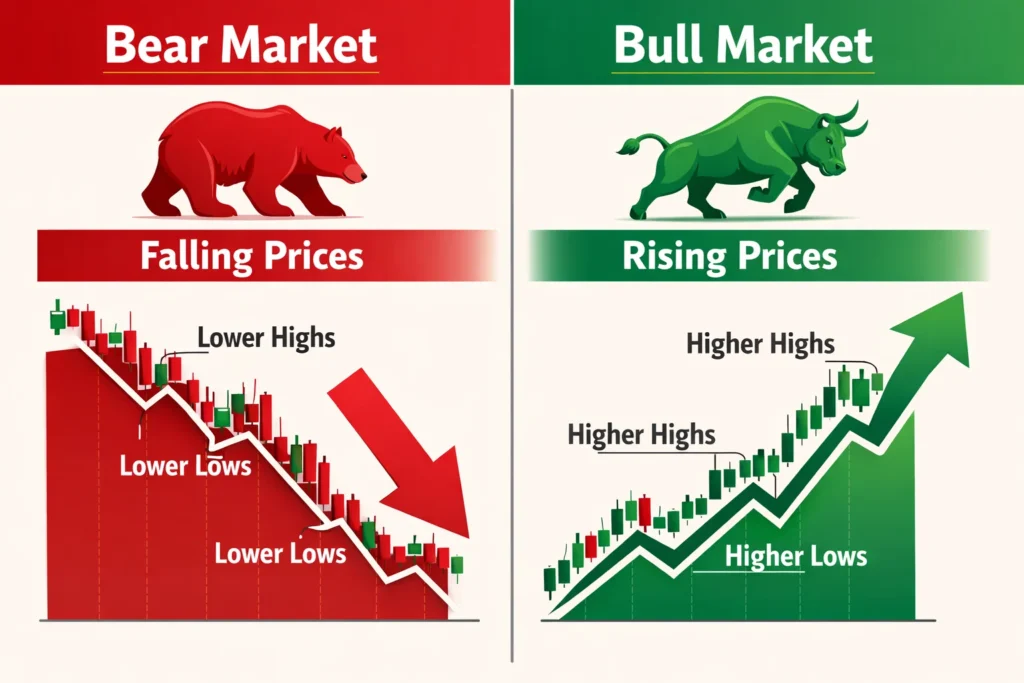
Bear markets and bull markets describe two opposite market conditions. Understanding the difference helps traders adjust their strategies and expectations correctly.
Comparison Table: Bear Market vs Bull Market
| Aspect | Bear Market | Bull Market |
| Price direction | Falling prices over time | Rising prices over time |
| Typical price move | Decline of 20% or more | Increase of 20% or more |
| Market sentiment | Pessimistic and cautious | Optimistic and confident |
| Price structure | Lower highs and lower lows | Higher highs and higher lows |
| Common trader behavior | Selling, shorting, risk control | Buying, holding, trend-following |
| Risk level | Higher due to volatility | Lower during stable growth |
Simple Explanation: In a bear market, traders expect prices to continue falling, while in a bull market, traders expect prices to keep rising. Recognizing which market you are in helps you choose the right trading approach.
Is a Bear Market Easy for Beginners to Understand?
Yes, the concept of a bear market is easy for beginners to understand because it simply means prices are falling over a longer period. However, trading during a bear market can be challenging. Beginners should focus on learning trend identification, risk management, and avoiding emotional decisions before actively trading bearish conditions.
Trading During Bear Markets with Defcofx
Bear markets require strong risk control and flexible trading conditions. Defcofx allows traders to adapt to bearish environments by offering tools and features designed for both rising and falling markets.
Why Defcofx Fits Bear Market Trading
- Leverage up to 1:2000, offering flexibility in bearish strategies.
- 40% welcome bonus on first deposits of $1,000 or more.
- No commissions or swap fees, with low spreads starting from 0.3 pips.
- Global access, welcoming traders from all countries with multi-language support.
- Fast withdrawals, processed within 4 business hours, even on weekends.
These conditions help traders stay agile and focused, even during extended market downturns.
Open a Live Trading AccountFAQs About Bear Market
A bear market is a period when prices in a financial market fall by around 20% or more from recent highs and continue declining due to negative sentiment and strong selling pressure.
A bear market can last anywhere from a few weeks to several years. Its duration depends on economic conditions, market sentiment, and recovery strength.
Yes, traders can make money in a bear market by trading downward trends, short-selling, or selling weaker currencies against stronger ones, while managing risk carefully.
No. A bear market refers to falling market prices, while a recession is an economic slowdown. They often occur together, but one does not always cause the other.
A bear market is commonly confirmed when prices fall 20% or more from recent highs and continue forming lower highs and lower lows over time.