



Momentum stock trading means buying stocks that are already moving strongly upward and selling them when the momentum slows down. Traders use price trends, volume, and stock momentum indicators to find strong moves and ride them for short-term profits while managing risk carefully.
Key Takeaways
- Momentum stock trading focuses on stocks already moving strongly in one direction.
- A solid momentum trading strategy uses trend, volume, and breakout signals.
- Learning how to find momentum stocks is key to success.
- Stock momentum indicators help confirm strong price movement.
- Risk management is critical because momentum can reverse quickly.
What Is Momentum Stock Trading?
Momentum stock trading is based on one simple idea: strong stocks tend to keep moving in the same direction for a period of time. If a stock is rising quickly with high volume, momentum traders look to buy it. If it is falling sharply, some traders may short it.
This strategy does not focus on company fundamentals like earnings reports or balance sheets. Instead, it focuses on price action. The goal is to capture part of a fast move and exit before the trend slows down.
Momentum stocks for beginners can be exciting because price moves are clear and strong. However, they can also be risky if you enter too late.
Why Momentum Works in the Market
Markets are driven by psychology. When investors see a stock rising quickly, more buyers jump in. This creates a cycle of increasing demand. As demand increases, price rises even more.
Institutional traders, hedge funds, and algorithms often amplify these moves. When volume increases along with price, it signals strong interest.
Momentum trading strategy works best in markets where:
- There is strong news or earnings surprise
- Volume is higher than average
- The overall market is trending
However, momentum does not last forever. Eventually, buyers slow down, and price may reverse sharply.
How to Find Momentum Stocks
Understanding how to find momentum stocks is the foundation of success. You can’t trade momentum without first identifying strong movers.
Start by looking for:
- Stocks making new 52-week highs
- Stocks with high relative strength
- Unusual volume spikes
- Breakouts above resistance levels
- Strong gap-ups at market open
Stock screeners are very useful for this process. You can filter by:
- Percentage price change
- Volume increase
- Moving average crossover
- Relative strength index (RSI)
Momentum breakout stocks often appear after a consolidation period. The price moves sideways, builds pressure, and then breaks out strongly with volume.
Ready to practice identifying momentum setups? Start tracking live market movers and build your momentum strategy step by step.
Open Account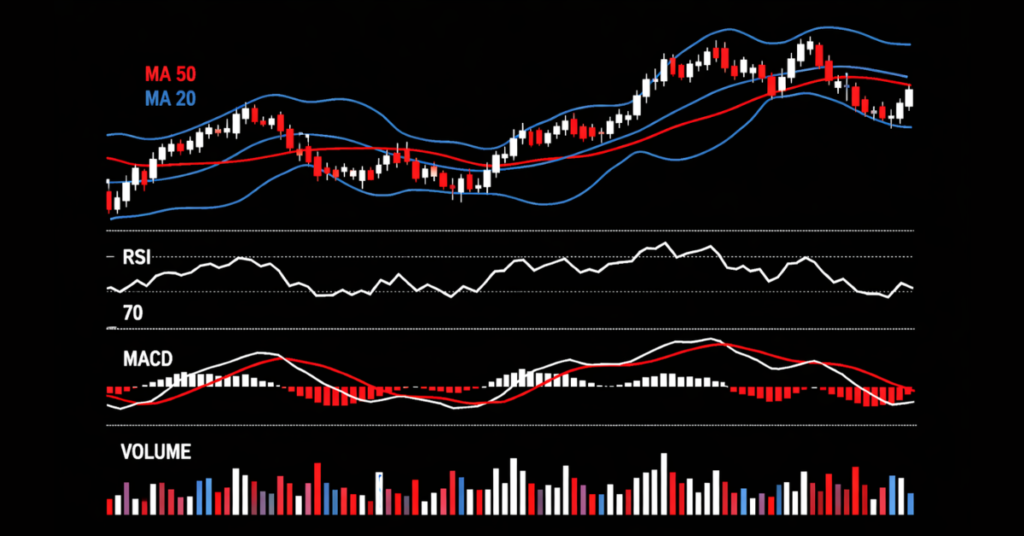
Stock Momentum Indicators Explained
Stock momentum indicators help confirm that a price move has strength behind it. They reduce the chances of entering too early or too late.
Here are the most popular stock momentum indicators:
| Indicator | What It Measures | Best Used For |
| RSI (Relative Strength Index) | Overbought or oversold conditions | Identifying strong trends or reversals |
| MACD | Trend strength and momentum shifts | Confirming breakouts |
| Moving Averages | Trend direction | Identifying trend continuation |
| Volume | Buying or selling pressure | Confirming breakout strength |
| Stochastic Oscillator | Momentum speed | Timing entries |
RSI above 70 may indicate strong buying momentum. MACD crossing above its signal line can confirm upward momentum. Volume spikes validate breakout strength.
Building a Momentum Trading Strategy
A solid momentum trading strategy follows a clear process.
First, identify a strong stock using screeners. Second, confirm the trend with moving averages. Third, wait for a pullback or breakout entry. Fourth, set stop-loss and take-profit levels.
Entry timing is important. Many traders enter:
- On breakout above resistance
- After a small pullback in an uptrend
- On high-volume gap-up
An exit strategy is equally important. You can exit when:
- The momentum indicator turns downward
- Volume drops significantly
- Price breaks below support
Momentum stocks for beginners should be traded with small position sizes until experience grows.
Trading Momentum Breakout Stocks
Momentum breakout stocks are some of the most powerful setups. These occur when the price breaks above a resistance level with strong volume.
A typical pattern looks like this:
- Stock consolidates in a tight range
- Volume decreases during consolidation
- Price breaks above resistance
- Volume spikes significantly
The breakout signals new buyers entering the market.
The key is to enter quickly but not chase too far above the breakout level. If price moves too far too fast, risk increases.
Risk Management in Momentum Stock Trading
Momentum trading can produce fast gains. It can also cause fast losses. Risk management protects your capital.
Always use:
- Stop-loss orders
- Position sizing rules
- Maximum daily loss limits
Never risk more than a small percentage of your account on one trade. Many experienced traders risk 1–2% per trade.
Momentum moves can reverse suddenly due to profit-taking or news events. Without risk control, one bad trade can erase multiple wins.
4 Common Beginner Mistakes in Momentum Stocks
Trading momentum stocks can be profitable, but many beginners make avoidable errors that increase their risk.
- One of the most common mistakes is chasing a stock after it has already made a large move. Entering too late, especially after an extended breakout—often means buying near short-term exhaustion, which can lead to sharp pullbacks.
- Another critical mistake is ignoring volume confirmation. Strong momentum breakouts are typically supported by above-average trading volume. When price rises without volume support, the move may lack conviction and fail quickly.
- Many new traders also fail to set stop-loss orders. Momentum stocks can reverse rapidly, and without proper risk management, small losses can turn into significant ones.
- Overtrading is another frequent issue. Just because a stock is moving quickly does not mean every price swing presents a high-probability opportunity. Not every breakout is tradable, and patience is essential.
Successful momentum trading requires discipline, proper timing, and strict risk management.
Psychology Behind Momentum Trading
Momentum trading requires emotional control. Fear and greed are strong during fast moves.
When a stock rises quickly, greed pushes traders to enter late. When the price dips slightly, fear causes panic selling.
Successful momentum traders follow rules, not emotions. They plan entry, stop-loss, and exit before entering the trade.
Consistency matters more than one big win.
Practical Example of a Momentum Setup
Imagine a stock trading between $50 and $55 for three weeks. Volume slowly decreases. Suddenly, strong earnings news is released. The stock breaks above $55 with double its average volume.
RSI moves above 65. MACD crosses upward. This is a classic momentum breakout stock.
A trader may enter at $56, set a stop-loss at $53, and target $65 if momentum continues.
This structured approach defines a strong momentum trading strategy.
Start practicing your momentum trading strategy today by tracking live breakouts and testing your rules consistently. Discipline builds profits over time.
Open AccountFinal Thoughts on How to Trade Momentum Stocks
Momentum stock trading is about identifying strong price movement, confirming it with volume and stock momentum indicators, and managing risk carefully. Whether you are learning how to find momentum stocks or refining your momentum trading strategy, discipline is essential.
Traders who also explore fast-moving markets often look for platforms that offer tight spreads, flexible leverage, and quick withdrawals to react efficiently. Many choose brokers like Defcofx, known for competitive trading conditions, high leverage options, and fast withdrawal processing, which can help traders act quickly when momentum opportunities appear.
Open a Live Trading AccountFrequently Asked Questions
What is momentum stock trading in simple terms?
Momentum stock trading means buying stocks that are already moving strongly upward and selling them before the momentum slows. Traders focus on price trends and volume instead of company fundamentals. The goal is to ride strong short-term trends using stock momentum indicators for confirmation.
How do beginners start trading momentum stocks?
Momentum stocks for beginners require starting small. First, learn how to find momentum stocks using screeners. Then practice using indicators like RSI and volume. Always use stop-loss orders and avoid chasing price. Begin with small position sizes until you gain experience.
What are the best stock momentum indicators?
The most common stock momentum indicators include RSI, MACD, moving averages, and volume analysis. RSI measures overbought conditions. MACD confirms trend shifts. Volume validates breakout strength. Combining multiple indicators increases reliability in a momentum trading strategy.
How do I identify momentum breakout stocks?
Momentum breakout stocks usually break above resistance levels with high volume. Look for stocks that consolidate in tight ranges and then surge with strong buying pressure. Volume spikes are key confirmation signals when identifying breakout opportunities.
Is momentum trading risky?
Yes, momentum trading can be risky because trends can reverse quickly. Without proper risk management, losses can occur fast. Always use stop-loss orders, manage position sizes carefully, and avoid emotional decisions. A disciplined approach reduces risk significantly.