


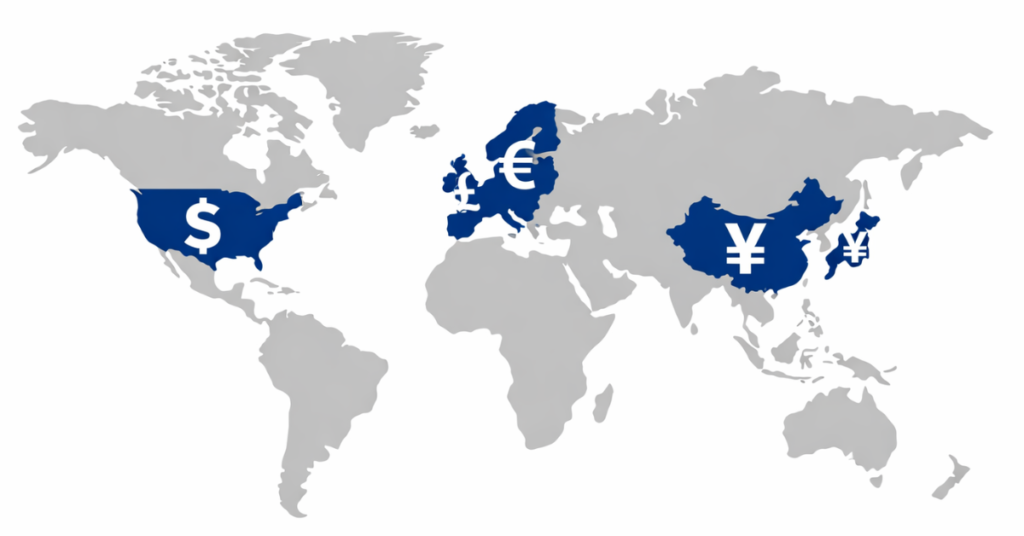
The most widely accepted currencies around the world are the US Dollar (USD), Euro (EUR), British Pound (GBP), Japanese Yen (JPY), and Chinese Yuan (CNY). These currencies dominate global trade, international payments, and foreign exchange markets due to their stability, liquidity, and strong backing economies.
Key Takeaways
- The US Dollar (USD) is the most globally accepted currency, used in trade, reserves, and even informal economies worldwide
- The Euro (EUR) is the second most widely used currency, especially across Europe and international transactions
- Currencies like GBP, JPY, and CNY play major roles in global finance and regional trade
- Widely accepted currencies are not always the strongest but are the most usable globally
- These currencies dominate both international trade and forex trading markets, making them highly liquid and accessible
What Does “Widely Accepted Currency” Actually Mean?
A widely accepted currency refers to money that is commonly used beyond its home country for international trade, travel, and financial transactions. It doesn’t just mean legal usage, it reflects how easily a currency can be exchanged, trusted, and used globally.
In practical terms, a currency becomes globally accepted when businesses, governments, and financial institutions are willing to hold, trade, and transact in it without hesitation. This is why some currencies are used internationally even in countries where they are not official legal tender.
Legal tender → officially used within a country
Globally accepted → widely used across borders for trade, reserves, or payments
For example, the US Dollar is often accepted in international transactions even in countries where it is not the official currency.
Why Global Acceptance Matters
Global acceptance isn’t random it is driven by several key factors:
- Economic strength of the issuing country
- Stability and trust in the currency
- Use in international trade (especially commodities like oil and gold)
- High liquidity in global financial markets
Currencies that meet these criteria become the backbone of cross-border payments and global commerce.
Understanding this distinction is important before exploring which currencies dominate the world and why they hold such a powerful position in both everyday transactions and the forex market.
The Most Widely Accepted Currencies in the World
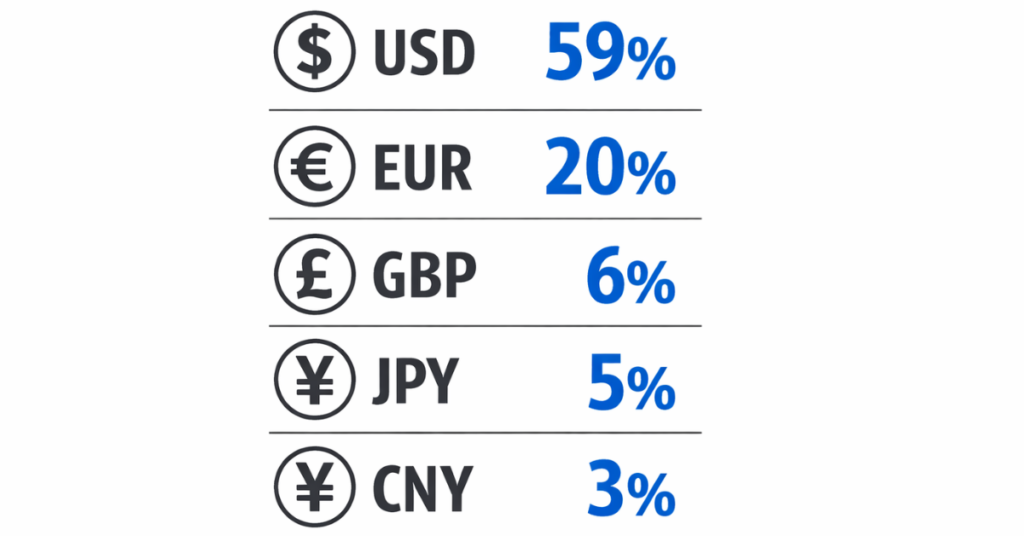
When people ask what currencies are most widely accepted around the world, they’re usually referring to currencies that dominate global trade, international payments, and financial markets. These currencies are trusted, highly liquid, and easily exchanged almost anywhere.
US Dollar (USD): The Global Standard
The US Dollar (USD) is by far the most widely accepted currency in the world. It serves as the primary global reserve currency and is used in the majority of international transactions.
- Widely used in global trade, especially commodities like oil and gold
- Held by central banks worldwide as a reserve asset
- Commonly accepted even in countries where it is not official currency
This dominance is driven by the economic strength and global influence of the United States, making USD the backbone of international finance.
Euro (EUR): The International Trade Giant
The Euro (EUR) is the second most widely used currency globally and is the official currency of many European nations.
- Heavily used in cross-border payments
- Strong presence in global banking systems
- Preferred for trade within and beyond Europe
Its stability and large economic backing make it a key player in international transactions.
British Pound (GBP): Stability & Financial Influence
The British Pound (GBP) remains one of the most respected currencies in global finance.
- Widely used in international banking
- Strong historical reputation in global markets
- Maintains importance in forex trading
Despite being less dominant than USD and EUR, it continues to play a significant role in global currency systems.
Japanese Yen (JPY): Safe-Haven Currency
The Japanese Yen (JPY) is widely used in global finance, especially in Asia.
- Considered a safe-haven currency during economic uncertainty
- Highly traded in forex markets
- Strong role in international investment flows
Its stability makes it attractive during times of global market volatility.
Chinese Yuan (CNY): Rising Global Power
The Chinese Yuan (CNY) is gaining global importance as China expands its role in international trade.
- Increasing use in cross-border trade agreements
- Supported by China’s growing economic influence
- Gradually being adopted in global payment systems
While not as dominant as USD yet, its global usage is steadily increasing.
Why These Currencies Are Accepted Worldwide
The reason certain currencies are widely accepted across the globe isn’t accidental; it’s the result of economic power, global trust, and financial system integration. These currencies have earned their position through consistent use in trade, reserves, and international finance.
Economic Strength and Global Influence
Currencies issued by economically powerful countries naturally gain global acceptance. Nations with strong GDP, stable governments, and global trade influence create currencies that others trust.
For example, the dominance of the US economy has made the US Dollar the default choice for international transactions, while the Euro benefits from the combined strength of multiple European economies.
Stability and Trust
A currency must be stable over time to gain worldwide acceptance. Businesses and governments prefer currencies that:
- Maintain value over long periods
- Are backed by reliable financial systems
- Experience lower inflation and volatility
This stability builds confidence, making these currencies widely usable across borders.
Role in Global Trade
Many of the world’s most important commodities such as oil, gold, and natural resources are priced in major currencies. This creates constant demand for them in international markets.
As a result:
- Countries need these currencies to trade
- Businesses use them for cross-border deals
- Financial institutions rely on them for settlements
High Liquidity in Financial Markets
Widely accepted currencies are also the most traded in the forex market, meaning they can be bought or sold quickly without affecting their price significantly.
High liquidity ensures:
- Faster transactions
- Lower trading costs
- Better price stability
This is why traders often prefer major currencies because they offer smoother and more predictable market conditions.
Integration into Global Financial Systems
These currencies are deeply embedded in:
- Central bank reserves
- International banking systems
- Payment networks (like SWIFT)
This makes them the default choice for cross-border payments and global finance operations.
Most Traded Currencies in Forex (Trading Perspective)
The most widely accepted currencies are also the most traded in the forex market, making them highly attractive for both beginners and experienced traders. Major pairs like EUR/USD, GBP/USD, USD/JPY, and USD/CNY dominate global trading due to high liquidity, stability, and broad international acceptance.
Why Traders Focus on These Currencies
- Liquidity: These currencies can be bought and sold quickly without affecting market prices significantly
- Global relevance: Their acceptance worldwide ensures constant demand in financial markets
- Predictable movements: High adoption and stable economies make trading more manageable
Trading Advantage
Traders can leverage Defcofx to take advantage of these globally accepted currencies in a way that maximizes flexibility and efficiency:
- High Leverage Options: Offers up to 1:2000 leverage, giving traders more flexibility to trade major currencies with smaller capital
- No Commissions or Swap Fees: Trade major pairs like USD/EUR with low spreads starting from 0.3 pips, ensuring cost-effective transactions
- Global Reach: Defcofx welcomes clients from all countries, making major currencies accessible regardless of location
- Fast Support and Withdrawals: Withdrawal process completed within 4 business hours, even during weekends, ensuring liquidity for traders
These features allow traders to capitalize on the liquidity and stability of major currencies while keeping costs low and execution fast.
Best Currencies for Travel and International Transactions

When traveling or making cross-border payments, using widely accepted currencies ensures convenience, safety, and cost efficiency. These currencies are recognized globally, can be exchanged easily, and are often preferred for larger transactions or international trade.
Practical Use for Travelers
Travelers benefit greatly from carrying major globally accepted currencies rather than relying solely on local money. Key points include:
- US Dollar (USD): Accepted almost everywhere worldwide, including countries where it is not an official currency. Often used for hotels, international airports, and tourist services.
- Euro (EUR): Widely used throughout Europe and in some non-Eurozone countries as a reliable alternative for payments and conversions.
- British Pound (GBP) & Japanese Yen (JPY): Commonly exchanged in major cities, especially in financial hubs or airports where travelers need cash quickly.
- Chinese Yuan (CNY): Increasingly accepted across Asia, especially in trade-focused regions or border cities.
Using these currencies reduces the need for repeated conversions, minimizes fees, and provides a level of reliability in unfamiliar countries.
Practical Use for Businesses and International Payments
For businesses, widely accepted currencies simplify cross-border transactions and reduce financial risk:
- Import/export settlements: Companies can invoice and pay in currencies that are trusted worldwide, reducing exposure to exchange rate fluctuations.
- International payroll and supplier payments: Businesses can use major currencies to pay staff or suppliers abroad without facing currency conversion barriers.
- Digital and online transactions: Widely accepted currencies integrate seamlessly with international banking systems and payment platforms.
This widespread usability makes these currencies a practical choice for both individuals and organizations conducting international transactions regularly.
Why Global Acceptance Matters in Practice
- Reduces transaction delays and ensures smooth payments
- Minimizes conversion costs and fees when moving money between countries
- Provides a stable reference point compared to local currencies, which may fluctuate heavily or be less trusted in international trade
By prioritizing globally recognized currencies, travelers and businesses can operate efficiently, avoid unnecessary risks, and ensure predictable financial transactions abroad.
Widely Accepted vs Strongest Currencies (Clarification Section)
It’s important to understand that a currency being widely accepted does not necessarily mean it is the strongest in value. Global acceptance is about usability and trust, while strength refers to the currency’s exchange rate relative to others.
Understanding the Difference
- Widely Accepted Currencies: These are used frequently for international trade, travel, and foreign reserves. Their dominance is driven by global trust, liquidity, and integration into international finance systems. Examples include USD, EUR, and JPY.
- Strongest Currencies: Strength is measured by high exchange value relative to other currencies. For instance, the Kuwaiti Dinar (KWD) or Bahraini Dinar (BHD) may be strong in terms of value but are rarely used internationally.
Examples
| Currency | Acceptance | Strength (Exchange Rate) |
| US Dollar (USD) | Extremely high – global trade & reserves | Moderate |
| Euro (EUR) | High – Europe + global usage | Moderate |
| Kuwaiti Dinar (KWD) | Low – limited international usage | Very High |
| Japanese Yen (JPY) | High – Asia + forex markets | Moderate |
| Bahraini Dinar (BHD) | Low – limited global usage | Very High |
This shows that global usability and strength don’t always align. A widely accepted currency like the USD may not be the strongest in exchange value, but its accessibility and reliability make it dominant.
Why This Matters
- For travelers and businesses, usability is more important than strength. Using widely accepted currencies ensures smooth transactions.
- For traders, strong currencies may offer potential gains in exchange rates, but widely accepted currencies provide stability, liquidity, and lower risk in trading.
- Understanding this distinction helps individuals and businesses make informed decisions when choosing which currencies to hold or trade.
How Global Currency Acceptance Impacts You (Practical Insight)
Understanding which currencies are widely accepted worldwide isn’t just academic, it has real-world implications for travelers, businesses, and traders. Knowing the global usability of certain currencies helps in making smarter financial decisions, reducing risk, and improving efficiency in international transactions.
Impact on Travelers
Travelers who carry widely accepted currencies like USD, EUR, GBP, or JPY enjoy several advantages:
- Easier transactions: Hotels, restaurants, and tourist services often accept these currencies directly.
- Lower conversion fees: Fewer exchanges mean less loss from conversion rates or hidden fees.
- Reliability: Using widely accepted currencies reduces the risk of dealing with unstable or lesser-known local currencies.
For example, a tourist visiting multiple countries in Europe may find the Euro accepted almost everywhere, simplifying travel without constantly needing local currency.
Impact on Businesses
For international businesses, using widely accepted currencies offers practical benefits:
- Smoother cross-border payments: Payments to suppliers or clients are processed faster when using globally recognized currencies.
- Reduced currency risk: Popular currencies tend to be more stable, minimizing the impact of exchange rate fluctuations.
- Integration with financial systems: Major currencies are easily compatible with banking and digital payment networks, ensuring efficient international operations.
Impact on Forex Traders
Forex traders rely heavily on widely accepted currencies due to their high liquidity and stability:
- Major currency pairs like EUR/USD, USD/JPY, and GBP/USD are heavily traded, ensuring better spreads and faster execution.
- These currencies offer predictable trading patterns, making them ideal for strategies like day trading or scalping.
- Widespread usage globally ensures that liquidity is available at all times, reducing the risk of slippage.
Risks & Limitations of Globally Accepted Currencies
While widely accepted currencies provide convenience, stability, and usability, they are not without risks. Understanding these limitations is essential for travelers, businesses, and traders to make informed financial decisions.
Exchange Rate Volatility
Even globally accepted currencies fluctuate in value due to:
- Changes in interest rates
- Economic performance of the issuing country
- Global events such as geopolitical tensions or trade wars
For example, the USD can strengthen or weaken against the Euro depending on market conditions, which may impact international payments or travel costs.
Over-Reliance on a Single Currency
Relying heavily on one dominant currency like the USD can create risks:
- Exposure to policy changes in the issuing country
- Vulnerability to inflation or unexpected devaluation
- Reduced flexibility in regions where other currencies are preferred
Diversifying the use of multiple widely accepted currencies can mitigate these risks.
Limitations for Travelers and Businesses
- Some countries may restrict foreign currency usage for cash transactions
- Smaller or less popular currencies may still be required for local payments
- Exchange services may charge higher fees for converting non-local currencies
Forex Trading Risks
Even for traders, widely accepted currencies carry challenges:
- Leverage risks: Using high leverage can amplify gains but also losses
- Market volatility: Major currencies can still experience sharp movements during economic announcements
- Liquidity differences: While major currencies are liquid, some exotic pairs involving widely accepted currencies may have lower liquidity
FAQs
The US Dollar (USD) is the most widely accepted currency worldwide. It is used for trade, reserves, travel, and even in countries where it is not the official currency.
Globally, the US Dollar (USD) leads in usage, followed by the Euro (EUR), British Pound (GBP), Japanese Yen (JPY), and Chinese Yuan (CNY). These currencies dominate international payments and foreign exchange markets.
The USD’s dominance is due to the economic strength of the United States, global trust, high liquidity, and its role in pricing major commodities like oil and gold. It also serves as the primary reserve currency for central banks.
Currencies like USD, EUR, GBP, JPY, and CNY are ideal for international trade. They are widely recognized, easily exchangeable, and supported by global financial networks, ensuring smooth transactions across borders.
Yes. Widely accepted currencies provide high liquidity, lower spreads, and predictable market behavior, making them preferable for forex trading. Traders can enter and exit positions more easily compared to less-used or exotic currencies.
Final Thoughts on What Currencies are most Widely Accepted around the World?
Globally accepted currencies like the US Dollar (USD), Euro (EUR), British Pound (GBP), Japanese Yen (JPY), and Chinese Yuan (CNY) play a crucial role in international trade, travel, and financial markets. Their widespread usability, stability, and liquidity make them the preferred choice for individuals, businesses, and traders alike.
It’s important to remember that acceptance does not always equal strength. While some currencies may be extremely strong in value, they might not be widely used internationally. For practical purposes whether for travel, cross-border payments, or forex trading usability and acceptance are often more important than nominal strength.
By understanding which currencies are globally accepted and why, you can make informed decisions about which currencies to hold, use, or trade, optimizing convenience and reducing risk in any international financial activity.