


The term ‘40 wise currencies’ is not an official financial classification. It is often used informally to describe the strongest or most valuable currencies in the world based on exchange rates, economic stability, and global demand. However, currency strength is more complex than simple rankings.
Want to trade global currencies based on real market strength? Explore how Defcofx provides access to major forex markets with flexible trading conditions.
Open a Live Trading AccountKey Takeaways
- The term “40 wise currencies” is not an official financial classification but commonly refers to the top 40 strongest currencies globally based on value and stability.
- Currency strength is typically measured by exchange rates, economic performance, and global demand.
- The strongest currencies often come from economically stable and resource-rich countries.
- These currencies play a major role in global trade, investments, and forex markets.
- Understanding currency rankings helps traders and investors make more informed financial decisions.
What Does “40 Wise Currencies” Actually Mean?
The phrase “40 wise currencies” isn’t an official term used in economics or by financial institutions. Instead, it is an informal way people refer to the top 40 strongest or most valuable currencies in the world based on their exchange rate and economic strength.
In most cases, users searching this term are actually looking for:
- A currency ranking list
- The strongest currencies compared to the US Dollar
- Or the most valuable global currencies
So, “wise” here is generally interpreted as “strong,” “valuable,” or “powerful” in the global financial system.
What makes this important is that currency strength is not random. It reflects a country’s:
- Economic stability
- Inflation control
- Interest rates
- Global trade influence
This means the currencies included in such a list are typically from financially stable and economically advanced or resource-rich nations.
Understanding this concept helps users move beyond just a keyword and actually grasp how global currencies are ranked and why certain currencies consistently outperform others.
How Currency Strength Is Measured
Currency strength is determined by a combination of economic and market-driven factors, not just its price compared to another currency. While many people focus only on exchange rates, the real picture is broader and more analytical.
At its core, a strong currency reflects confidence in a country’s economy. One of the primary indicators is its exchange rate against the US Dollar, which is widely used as a global benchmark. However, this alone is not enough to determine true strength.
Several key factors influence how strong a currency becomes:
- A country with low inflation typically has a stronger currency because its purchasing power remains stable over time. In contrast, high inflation weakens a currency as it reduces its value.
- Interest rates also play a major role. Higher interest rates tend to attract foreign investors looking for better returns, increasing demand for that currency and strengthening it.
- Another critical factor is economic stability and growth. Countries with strong GDP, stable governments, and consistent economic policies tend to maintain stronger currencies because they inspire investor confidence.
- Global demand also matters. If a country exports valuable resources such as oil, gas, or rare commodities its currency often becomes stronger due to increased international demand.
- Finally, trade balance plays a part. Countries that export more than they import usually see stronger currencies because more foreign buyers need their currency to purchase goods.
Complete List of the Top 40 Strongest Currencies in the World
| Rank | Currency Name | Code | Country / Region | Approx. Value vs USD |
|---|---|---|---|---|
| 1 | Kuwaiti Dinar | KWD | Kuwait | 1 KWD ≈ 3.25 USD |
| 2 | Bahraini Dinar | BHD | Bahrain | 1 BHD ≈ 2.65 USD |
| 3 | Omani Rial | OMR | Oman | 1 OMR ≈ 2.60 USD |
| 4 | Jordanian Dinar | JOD | Jordan | 1 JOD ≈ 1.41 USD |
| 5 | British Pound Sterling | GBP | United Kingdom | 1 GBP ≈ 1.25 USD |
| 6 | Cayman Islands Dollar | KYD | Cayman Islands | 1 KYD ≈ 1.20 USD |
| 7 | Euro | EUR | Eurozone | 1 EUR ≈ 1.08 USD |
| 8 | Swiss Franc | CHF | Switzerland | 1 CHF ≈ 1.10 USD |
| 9 | US Dollar | USD | United States | 1 USD ≈ 1.00 USD |
| 10 | Canadian Dollar | CAD | Canada | 1 CAD ≈ 0.74 USD |
| 11 | Singapore Dollar | SGD | Singapore | 1 SGD ≈ 0.74 USD |
| 12 | Brunei Dollar | BND | Brunei | 1 BND ≈ 0.74 USD |
| 13 | Australian Dollar | AUD | Australia | 1 AUD ≈ 0.66 USD |
| 14 | New Zealand Dollar | NZD | New Zealand | 1 NZD ≈ 0.61 USD |
| 15 | Libyan Dinar | LYD | Libya | 1 LYD ≈ 0.20–0.22 USD* |
| 16 | Fijian Dollar | FJD | Fiji | 1 FJD ≈ 0.45 USD |
| 17 | Saudi Riyal | SAR | Saudi Arabia | 1 SAR ≈ 0.27 USD |
| 18 | UAE Dirham | AED | UAE | 1 AED ≈ 0.27 USD |
| 19 | Qatari Riyal | QAR | Qatar | 1 QAR ≈ 0.27 USD |
| 20 | Israeli New Shekel | ILS | Israel | 1 ILS ≈ 0.27 USD |
| 21 | Polish Zloty | PLN | Poland | 1 PLN ≈ 0.25 USD |
| 22 | Danish Krone | DKK | Denmark | 1 DKK ≈ 0.15 USD |
| 23 | Norwegian Krone | NOK | Norway | 1 NOK ≈ 0.094 USD |
| 24 | Swedish Krona | SEK | Sweden | 1 SEK ≈ 0.094 USD |
| 25 | Chinese Yuan | CNY | China | 1 CNY ≈ 0.14 USD |
| 26 | Hong Kong Dollar | HKD | Hong Kong | 1 HKD ≈ 0.128 USD |
| 27 | Japanese Yen | JPY | Japan | 1 JPY ≈ 0.0066 USD |
| 28 | South Korean Won | KRW | South Korea | 1 KRW ≈ 0.00075 USD |
| 29 | Indian Rupee | INR | India | 1 INR ≈ 0.012 USD |
| 30 | Turkish Lira | TRY | Turkey | 1 TRY ≈ 0.031 USD |
| 31 | Russian Ruble | RUB | Russia | 1 RUB ≈ 0.010–0.011 USD |
| 32 | Brazilian Real | BRL | Brazil | 1 BRL ≈ 0.20 USD |
| 33 | South African Rand | ZAR | South Africa | 1 ZAR ≈ 0.053 USD |
| 34 | Thai Baht | THB | Thailand | 1 THB ≈ 0.028 USD |
| 35 | Malaysian Ringgit | MYR | Malaysia | 1 MYR ≈ 0.21 USD |
| 36 | Indonesian Rupiah | IDR | Indonesia | 1 IDR ≈ 0.000065 USD |
| 37 | Philippine Peso | PHP | Philippines | 1 PHP ≈ 0.018 USD |
| 38 | Egyptian Pound | EGP | Egypt | 1 EGP ≈ 0.020–0.021 USD |
| 39 | Pakistani Rupee | PKR | Pakistan | 1 PKR ≈ 0.0035–0.0036 USD |
| 40 | Mexican Peso | MXN | Mexico | 1 MXN ≈ 0.055 USD |
Top 10 Strongest Currencies Explained
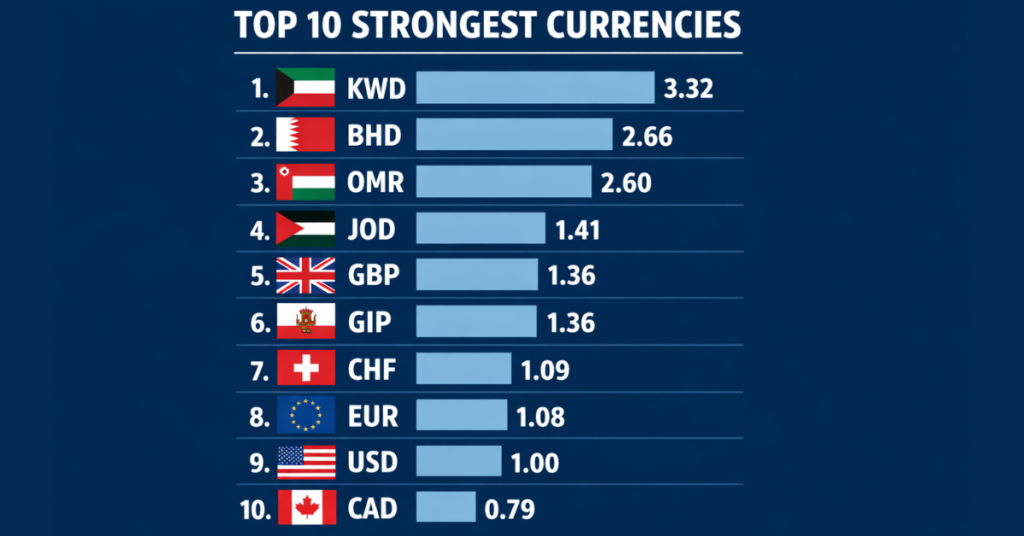
Here’s a deeper look at the top 10 currencies, explaining why they are considered strong and how their economic factors contribute to global influence:
1. Kuwaiti Dinar (KWD)
- Highest-valued currency globally due to oil-rich economy and strong fiscal reserves.
- Stable government policies and low inflation help maintain its high exchange rate.
2. Bahraini Dinar (BHD)
- Strength comes from Bahrain’s diverse financial sector and oil exports.
- Pegged to the US Dollar, which ensures stability in international trade.
3. Omani Rial (OMR)
- Strong because of Oman’s oil revenue and conservative monetary policy.
- Limited supply of OMR in circulation increases demand.
4. Jordanian Dinar (JOD)
- Pegged to the US Dollar, providing stability in the Middle East.
- Low inflation and careful economic management strengthen the currency.
5. British Pound Sterling (GBP)
- One of the oldest currencies, backed by a large, diversified economy.
- Strong global demand due to London’s role as a financial hub.
6. Cayman Islands Dollar (KYD)
- Limited circulation and Cayman Islands’ status as an offshore financial center support its high value.
- Pegged to USD, which keeps it stable.
7. Euro (EUR)
- Official currency of the Eurozone, used by 19 countries.
- Strength comes from the combined economic output and stability of multiple member states.
8. Swiss Franc (CHF)
- Known as a safe-haven currency due to Switzerland’s stable banking system and political neutrality.
- Low inflation and strong exports maintain its global trust.
9. US Dollar (USD)
- The world’s primary reserve currency, widely used in global trade.
- Backed by a large, diverse economy and stable political system.
10. Canadian Dollar (CAD)
- Strength comes from Canada’s natural resources, strong economy, and stable banking system.
- Frequently traded against USD as a major forex pair.
CCurrency Value vs Currency Strength
Many traders and investors confuse currency value with currency strength, but they are fundamentally different. Understanding this distinction is essential for making informed decisions in global markets.
Comparison Table
| Aspect | Currency Value | Currency Strength |
|---|---|---|
| Definition | Numerical exchange rate compared to another currency | Overall stability, reliability, and demand in global markets |
| Focus | Price of currency in relation to another | Economic strength, trust, and global usage |
| Example | 1 Kuwaiti Dinar ≈ 3.26 USD | US Dollar widely used globally despite lower numeric value |
| Indicates Power? | Not necessarily | Yes, reflects real global influence |
| Use in Trading | Limited insight alone | Crucial for long-term trading decisions |
| Key Factors | Exchange rate only | Inflation, demand, liquidity, global adoption |
Explanation
Currency Value: Refers to the numerical exchange rate of one currency against another.
Example: 1 Kuwaiti Dinar ≈ 3.26 USD. While this indicates a high value, it does not necessarily mean the currency dominates global trade.
Currency Strength: Represents a currency’s stability, purchasing power, and trust in global markets.
Example: The US Dollar, despite a lower numeric value, remains one of the strongest currencies due to its global reserve status and widespread use
Key Considerations for Traders
- Do not judge a currency solely by its numeric value
- Focus on stability, demand, and global usability
- Strong currencies tend to offer lower risk and better consistency
Trading Advantage with the Right Platform
With platforms like Defcofx, traders can maximize opportunities when trading strong currencies:
- Fast support and withdrawals for better fund management
- High leverage up to 1:2000 for increased market exposure
- Low spreads from 0.3 pips with no commissions or swap fees
Which Currencies Are Stronger Than the US Dollar
Several currencies are considered stronger than the US Dollar when measured by exchange rate or purchasing power. While the USD is the world’s most widely used reserve currency, some nations issue currencies with higher numeric value or more restricted supply, giving them a stronger rate against the dollar.
Examples of Currencies Stronger Than USD
- Kuwaiti Dinar (KWD): Highest-valued currency globally, supported by Kuwait’s oil wealth and low inflation.
- Bahraini Dinar (BHD): Maintains high value due to stable economy and pegged rate to USD.
- Omani Rial (OMR): Strong thanks to conservative monetary policies and limited supply.
- Jordanian Dinar (JOD): Pegged to USD, ensuring stability while maintaining a higher exchange rate.
- British Pound Sterling (GBP): High global demand and economic diversification make it stronger numerically than USD.
Key Takeaways for Traders
- Numeric value alone doesn’t always indicate usability; global demand and stability are crucial.
- Trading these strong currencies can be advantageous, especially with brokers that provide high leverage, low spreads, and fast withdrawals.
- Platforms like Defcofx allow traders to take positions on these currencies with up to 1:2000 leverage and spreads starting from 0.3 pips, helping maximize potential returns while keeping costs minimal.
Why Some Currencies Are More Valuable Than Others
The value of a currency is not determined randomly; it reflects the economic health, stability, and global demand of the country that issues it. Understanding why certain currencies consistently hold strong value is essential for traders, investors, and anyone interested in global finance.
Economic Stability
A country with a strong, well-managed economy usually issues a stronger currency. This includes factors like:
- Steady GDP growth: Countries with consistent economic expansion tend to have higher currency demand.
- Low national debt: Governments with manageable debt levels inspire investor confidence.
- Transparent financial policies: Clear monetary policies reduce uncertainty and support currency strength.
Stable economies like Switzerland, Germany, and the United States are examples where strong economic fundamentals contribute directly to the strength of their currencies.
Inflation Rates
Inflation affects a currency’s purchasing power.
- Low and controlled inflation preserves the value of money over time.
- High inflation reduces value, as goods and services become more expensive in local currency terms.
For example, countries like Switzerland and Kuwait maintain low inflation rates, which is one reason their currencies remain highly valued globally.
Interest Rates
Central banks influence currency strength through interest rates:
- Higher interest rates attract foreign investors seeking better returns on investments denominated in that currency.
- This increased demand pushes up the currency’s value relative to others.
Countries with strong currencies, like the US and Canada, often see significant capital inflows when interest rates are favorable.
Global Trade and Resources
A country’s trade performance and access to valuable resources also strengthen its currency:
- Nations that export high-demand commodities (oil, metals, technology) see increased foreign currency inflows.
- Countries like Kuwait, Oman, and Norway benefit from oil exports, which support the high value of their currencies.
Currencies from export-oriented economies are not only strong numerically but also widely used in international trade, giving them global relevance.
Political Stability
Political stability is a critical factor in maintaining a currency’s value.
- Stable governments reduce economic uncertainty, encouraging both domestic and foreign investment.
- Conversely, countries with political turmoil or frequent policy changes often see weaker currencies due to reduced investor confidence.
Key Takeaways for Traders
- Currency strength is multi-dimensional, influenced by economics, trade, inflation, interest rates, and politics.
- Strong currencies offer more predictable trading opportunities, lower volatility, and better long-term stability.
- Understanding these factors allows traders to choose reliable currencies for investments or forex trading, reducing risk and improving decision-making.
Best Currencies for Forex Trading
Not all strong currencies are equally suited for trading. Traders must consider liquidity, volatility, and global demand when selecting currencies to trade. The best currencies balance stability with enough movement to allow profitable trades.
Major Currencies for Trading
- US Dollar (USD): The most traded currency globally, highly liquid, and a standard for forex pairs.
- Euro (EUR): Widely used in Europe; paired frequently with USD, GBP, and JPY.
- British Pound Sterling (GBP): Strong, stable, and highly traded, with significant volatility for profit opportunities.
- Japanese Yen (JPY): Often used as a safe-haven currency; trades well in both calm and volatile markets.
- Swiss Franc (CHF): Known for stability; popular for hedging during uncertain market conditions.
Exotic and Commodity-Linked Currencies
- Kuwaiti Dinar (KWD), Omani Rial (OMR), Bahraini Dinar (BHD): Strong currencies but less liquid; suited for traders with experience or long-term positions.
- Canadian Dollar (CAD) and Australian Dollar (AUD): Commodity-linked currencies influenced by oil and metal exports, offering moderate volatility.
Practical Tips for Traders
- Focus on liquid currency pairs for faster execution and tighter spreads.
- Pay attention to economic announcements, interest rate changes, and geopolitical events, which can significantly affect currency strength.
- Choose a reliable broker like Defcofx that allows flexible trading conditions, such as adjustable leverage and low trading costs, to maximize opportunities while managing risk.
How to Trade Strong Currencies (Beginner-Friendly Guide)
Trading strong currencies requires understanding both the market fundamentals and practical execution strategies. Even experienced traders need a structured approach to manage risk and maximize potential returns.
Step 1: Choose the Right Currency Pairs
- Focus on major pairs like EUR/USD, GBP/USD, USD/JPY for high liquidity and tighter spreads.
- Consider cross-currency pairs if looking for diversification, but be aware of slightly higher volatility.
Step 2: Analyze the Market
- Fundamental analysis: Track economic indicators, interest rates, inflation, and political stability.
- Technical analysis: Use charts, trend lines, and indicators to identify potential entry and exit points.
Step 3: Manage Risk Effectively
- Always set stop-loss and take-profit levels to protect investments.
- Avoid overexposure to a single currency; diversify positions when possible.
- Adjust position size according to market volatility.
Step 4: Use a Reliable Trading Platform
- Choose brokers offering low spreads, fast execution, and secure withdrawals.
- For example, Defcofx allows traders to access strong currencies efficiently, with fast support and flexible trading conditions, making it easier to manage trades even in volatile markets.
Step 5: Monitor and Adapt
- Keep an eye on economic news, central bank announcements, and geopolitical events, as these can quickly affect currency strength.
- Adjust strategies based on market conditions to optimize outcomes.
FAQs
The Kuwaiti Dinar (KWD) is currently the strongest by exchange rate, supported by Kuwait’s stable economy and oil wealth.
There are around 180 recognized currencies used in different countries, though only a fraction are widely traded in forex markets.
While not the highest in numeric value, the US Dollar (USD) is the most powerful globally due to its status as the primary reserve currency and widespread use in international trade.
A currency’s value depends on economic stability, low inflation, high demand, interest rates, and political reliability. Strong currencies often come from resource-rich or economically advanced nations.
Major and stable currencies like USD, EUR, GBP, JPY, and CHF are preferred for trading due to high liquidity, predictable behavior, and tighter spreads. Commodity-linked currencies like CAD or AUD can also offer profitable opportunities.
Not necessarily. The most traded currencies are those with high liquidity, such as USD, EUR, and JPY, rather than those with the highest exchange value.
Final Thoughts on What are the 40 wise currencies?
The concept of the “40 wise currencies” highlights the strongest and most valuable currencies in the world, ranked by stability, purchasing power, and global demand. While some currencies like the Kuwaiti Dinar or Bahraini Dinar may have high numeric values, others, such as the US Dollar or Euro, maintain global dominance due to liquidity, widespread use, and economic trust.
Understanding currency strength goes beyond exchange rates. It involves economic stability, inflation, interest rates, trade performance, and political factors. Traders who grasp these elements can make informed decisions, identify profitable opportunities, and reduce risk in forex or investment activities.
Strong currencies are also a reliable foundation for trading, especially when using brokers that offer flexible trading conditions, low costs, and fast withdrawals, ensuring efficient management of capital in dynamic markets.
Start trading the world’s most active currencies, create your Defcofx account and access global forex markets with flexible trading conditions.
Open a Live Trading Account