


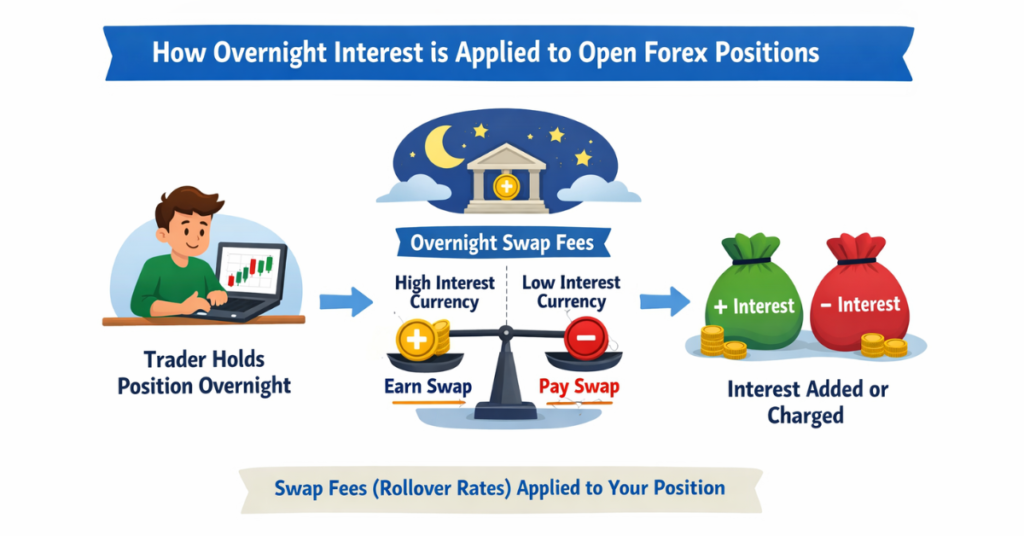
A swap in forex is the overnight interest charged or credited when a trade remains open past the daily market close. It is based on the interest rate difference between the two currencies in a pair and applies to both buy and sell positions.
Key Takeaways
- A forex swap is an overnight interest charged or credited when a trade stays open after the daily rollover time.
- Swap fees are based on the interest rate difference between the two currencies in a forex pair.
- Buy and sell positions have different swap rates, which can be either positive or negative.
- Swap charges mainly affect overnight and long-term trades, while intraday trades are usually unaffected.
What Is a Swap in Forex Trading?
In forex trading, a swap refers to the overnight interest adjustment applied to positions that remain open after the daily market closes. Because forex trades involve exchanging one currency for another, each position is linked to two different interest rates. The swap reflects the interest rate differential between those currencies.
If the currency you buy has a higher interest rate than the one you sell, you may receive a positive swap. If the opposite is true, a negative swap is charged. This mechanism exists because brokers roll positions forward to the next trading day, a process known as rollover.
Swap in forex trading is not a broker-made fee; it originates from interbank lending rates and liquidity providers. However, the exact swap rate can vary between brokers due to execution models and internal pricing policies.
How Forex Swap Works
Forex swaps are calculated and applied daily at the market rollover time, typically at 5:00 PM New York time. When a trade remains open past this time, the broker either credits or debits your account based on the interest rate difference between the two currencies in the pair.
The process works as follows:
- Determine Interest Rate Differential: The difference between the base currency and the quote currency’s interest rates is the main factor.
- Position Direction Matters:
- Buy (Long) Position: You earn or pay swap depending on the base currency’s interest relative to the quote currency.
- Sell (Short) Position: Swap is calculated inversely.
- Broker Adjustments: Brokers may slightly modify swap rates for their business model or currency liquidity.
At Defcofx, traders can take advantage of no swap fees on eligible accounts, helping manage overnight costs efficiently.
Buy Swap vs Sell Swap Explained
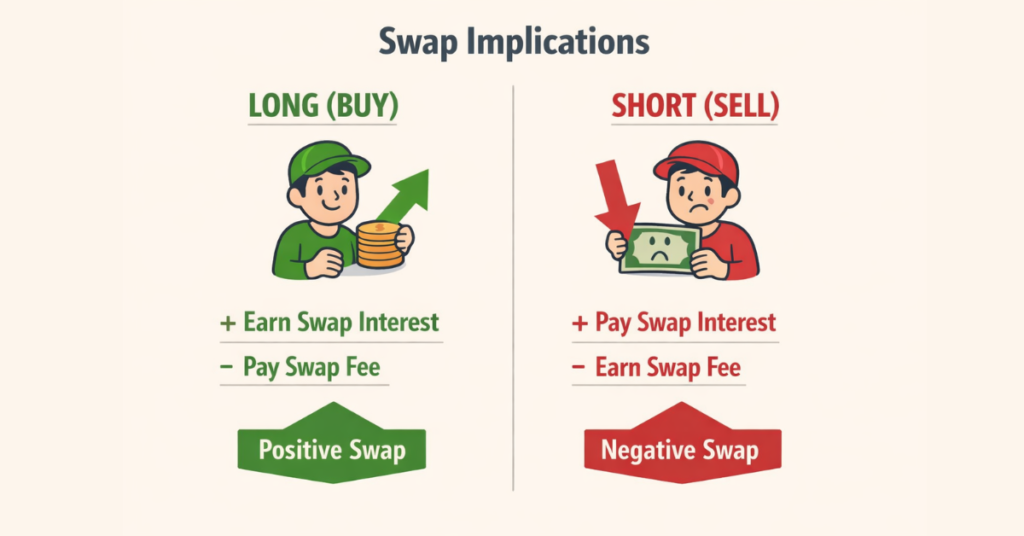
In forex trading, buy (long) and sell (short) positions have different swap implications because they involve opposite currency directions.
- Buy (Long) Swap: When you buy a currency pair, you are borrowing the quote currency to purchase the base currency. If the base currency’s interest rate is higher than the quote currency, you may receive a positive swap. If lower, you pay a negative swap.
- Sell (Short) Swap: When selling a currency pair, you borrow the base currency to sell it and hold the quote currency. Here, the swap calculation is reversed: you may either pay or earn depending on the interest rate differential.
Why Forex Brokers Charge Swap Fees
Forex brokers charge swap fees because every open position represents a loan of one currency to buy another, and this loan carries an interest cost. These fees are directly linked to the interest rate differential between the two currencies in the traded pair. Essentially, brokers act as intermediaries, borrowing and lending currencies in the interbank market to maintain open positions for traders overnight.
Here’s a detailed breakdown:
- Interest Rate Differences:
Each currency has an associated interest rate set by its central bank. When you buy a currency with a higher interest rate than the one you sell, you may earn a positive swap. Conversely, if the base currency’s rate is lower, you will pay a negative swap. - Liquidity Provider Costs:
Brokers do not set these fees arbitrarily. They work with liquidity providers who supply the necessary capital to fund overnight positions. The costs imposed by these providers are reflected in swap fees. - Broker Adjustments and Operational Costs:
Some brokers slightly adjust swap rates to cover operational expenses, maintain low spreads, or balance risk exposure. This adjustment can vary by currency pair and market volatility. - Market Conditions:
Swap rates can fluctuate daily due to changing interest rates, economic news, or central bank decisions. Traders need to monitor these changes to manage long-term or overnight trades effectively.
Forex Swap Rates Explained
Forex swap rates determine the amount of interest credited or debited when holding a position overnight. These rates are influenced by several factors, including the interest rate differential, the broker’s pricing policies, and market conditions. Understanding swap rates is essential for traders who hold positions for multiple days or engage in carry trades.
Key points about swap rates:
- Daily Variation: Swap rates are updated daily, reflecting changes in interest rates and market liquidity.
- Positive vs Negative Swap: If the base currency’s interest rate is higher than the quote currency, a trader may receive a positive swap; if lower, a negative swap applies.
- Broker Differences: Each broker may calculate swap slightly differently, depending on spreads, rollover time, and risk management strategies.
- Currency Pair Dependence: Major pairs often have lower swaps, while exotic pairs may have higher swap rates due to liquidity differences.
8. Triple Swap (Wednesday Swap) Explained
In forex trading, the triple swap occurs on Wednesdays to account for the weekend rollover. Normally, swaps are applied once per day at the market rollover time (usually 5:00 PM New York time). However, because the forex market is closed over the weekend, brokers apply three days’ worth of swaps on Wednesday to cover Friday, Saturday, and Sunday.
Key points about triple swaps:
- Purpose: Ensures traders pay or receive the correct interest for holding positions over the weekend.
- Timing: Applied on Wednesday’s rollover; the exact day may vary depending on the broker.
- Impact on Trades: Long-term positions or carry trades experience a higher swap cost or credit on this day.
- Calculation: Triple swap is simply the regular swap multiplied by three for the specific currency pair and position type.
Swap Fee Example in Forex Trading
To understand how swap fees work, consider this practical example:
Scenario:
- Currency Pair: EUR/USD
- Position: 1 standard lot (100,000 units) long
- Swap Rate: +0.5 points per day
Calculation:
- A positive swap of 0.5 points is applied per day the position is held overnight.
- If the position is held for 3 nights, the total swap credit is 1.5 points.
- For a negative swap (e.g., selling USD/JPY with a -0.3 points rate), the account would be debited 0.3 points per night.
Is Swap in Forex Good or Bad for Traders?
Forex swaps can be both advantageous and costly, depending on your trading strategy and the currencies involved.
- Positive Swaps: Traders can earn interest when holding currencies with higher interest rates than the ones they sold. This is commonly used in carry trades, where the goal is to profit from the interest differential.
- Negative Swaps: Traders pay interest when the currency they buy has a lower interest rate than the one sold. Long-term or overnight trades without planning can accumulate significant costs.
Tip for Traders: Some brokers, like those offering swap-free or low-fee accounts, allow you to avoid negative swap charges, while still benefiting from features such as:
- High Leverage Options: Up to 1:2000, providing more flexibility for trading strategies.
- No Commissions or Swap Fees: Low spreads starting from 0.3 pips, reducing hidden trading costs.
- Fast Support and Withdrawals: Withdrawal processing within 4 business hours, including weekends.
By managing swaps carefully and choosing accounts with favorable conditions, traders can maximize profits and minimize overnight costs effectively.
How to Avoid Swap Charges in Forex
Traders can take several approaches to reduce or completely avoid swap charges, ensuring that overnight costs do not eat into profits. One of the most straightforward methods is using swap-free accounts, which are offered by certain brokers to comply with specific client requirements, such as Islamic trading accounts. These accounts allow positions to remain open overnight without incurring interest fees, making them ideal for traders who hold long-term trades or prefer to avoid daily rollover costs.
Another effective strategy is intraday trading, where positions are opened and closed within the same trading day, before the daily rollover time typically 5:00 PM New York time. By doing so, traders completely bypass the swap calculation, avoiding both positive and negative overnight interest. This method is particularly useful for scalpers or short-term traders who aim to capitalize on intraday market movements.
Traders can also select currency pairs strategically. Swap rates vary significantly depending on the interest rate differential between the currencies in a pair. By focusing on pairs with lower or positive swaps, traders can either minimize costs or earn interest from holding positions overnight.
Leverage management is another consideration. Since swaps are calculated based on trade volume, adjusting position sizes can help control overnight charges. However, traders should balance leverage carefully, as excessive leverage increases both potential profits and risks.
Swap-Free (No Swap) Forex Accounts Explained
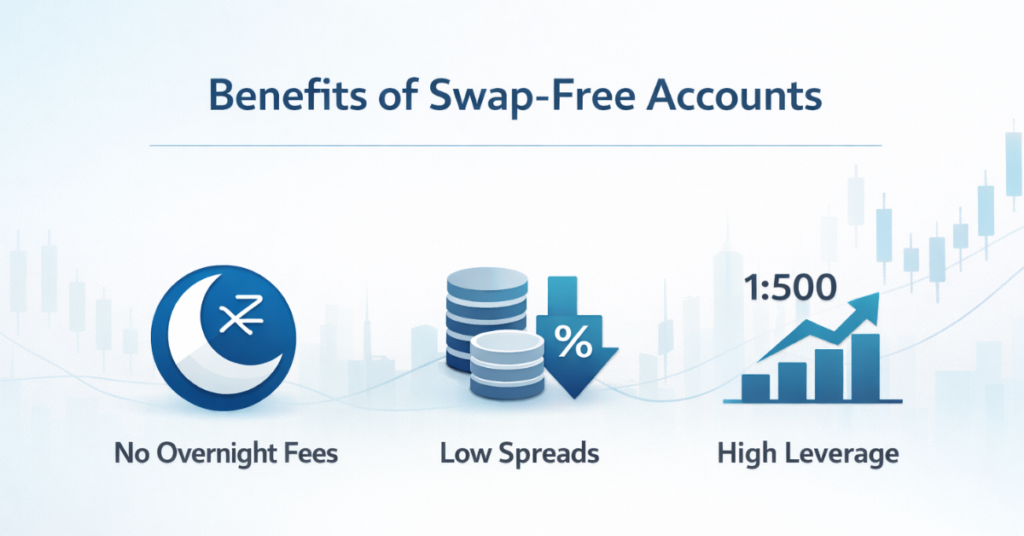
A swap-free forex account allows traders to hold positions overnight without incurring any swap charges. These accounts are particularly popular among traders who follow specific religious guidelines or those who prefer cost-effective long-term trading without worrying about daily rollover fees.
Swap-free accounts function by adjusting the standard swap calculation. Instead of crediting or debiting interest, brokers either eliminate the fee entirely or replace it with a small administrative charge. This ensures that traders can maintain their positions for extended periods while avoiding negative impacts on profitability.
Additionally, traders benefit from fast support and withdrawals, often processed within 4 business hours including weekends, and the ability to access the platform globally with multiple language options. Swap-free accounts combined with these features provide a trader-friendly environment for both beginners and experienced market participants.
Trading Forex Without Swap Fees at Defcofx
For traders who want to avoid overnight interest charges, swap-free accounts are a convenient solution. These accounts allow positions to remain open without incurring daily swap fees, making them ideal for long-term or carry trades.
At Defcofx, swap-free accounts are designed to provide transparent and predictable trading costs. Traders can benefit from low spreads starting from 0.3 pips, no commissions, and no swap fees, which helps in planning trades without worrying about hidden overnight costs.
Other advantages include:
- High Leverage Options: Up to 1:2000, giving traders flexibility to execute diverse strategies.
- Global Reach: Accounts are accessible to clients worldwide, with multiple language options for support.
- Fast Support and Withdrawals: Withdrawal requests are processed within 4 business hours, including weekends.
Final Thoughts on what is the swap in forex
A forex swap is a fundamental aspect of trading that reflects the interest rate differential between two currencies in a pair. Understanding how swaps work, including positive and negative charges, triple swaps, and their impact on long-term trades, is essential for effective risk management and strategy planning.
Traders can minimize or avoid swap costs by using swap-free accounts, practicing intraday trading, and carefully selecting currency pairs. When combined with brokers offering high leverage up to 1:2000, low spreads from 0.3 pips, no commissions, global reach, and fast withdrawals, trading becomes more predictable, flexible, and cost-efficient.
FAQs
A forex swap is the overnight interest charged or credited when a trade remains open past the daily market rollover. It depends on the interest rate difference between the two currencies in a pair.
Swap is based on the interest rate differential between the base and quoted currency, the trade size, and whether the position is long (buy) or short (sell). Brokers may slightly adjust rates.
Yes. If the base currency’s interest rate is higher than the quote currency, the swap may be positive. If lower, it is negative.
A triple swap occurs midweek (usually Wednesday) to account for the weekend rollover, applying three days’ worth of swap in a single adjustment.
Traders can avoid swaps by using swap-free accounts, closing positions before rollover, or trading currency pairs with minimal or positive swaps.
Most brokers charge swaps based on overnight positions. Some brokers, including those offering swap-free accounts, allow traders to hold positions without overnight fees while still benefiting from features like high leverage and low spreads.