


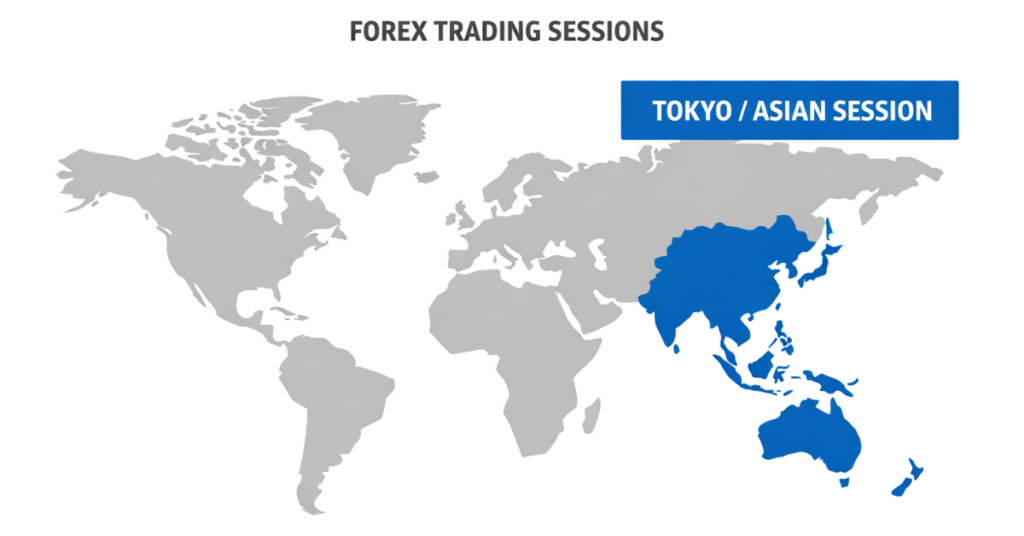
The Tokyo session can be a good time to trade, especially for beginners and traders who prefer stable, low-volatility conditions. It is best suited for range trading and currency pairs like JPY, AUD, and NZD, but may not be ideal for traders seeking fast price movements or breakout opportunities.
Key Takeaways
- The Tokyo session is good for traders who prefer stable, predictable market conditions rather than high volatility.
- It is most suitable for range trading strategies and slower-paced trading styles.
- JPY, AUD, and NZD pairs tend to be most active during this session due to regional market participation.
- Volatility is generally lower compared to the London and New York sessions, which reduces risk but also limits short-term profit potential.
- It is a solid starting environment for beginners, as price movements are slower and easier to analyze.
- Breakout and news-driven traders may find limited opportunities during Tokyo hours.
What Is the Tokyo Session in Forex?
The Tokyo session is one of the four major trading sessions in the global forex market. It represents the period when financial institutions across Asia, led primarily by Tokyo, are actively trading currencies. It is also widely referred to as the Asian session, as it overlaps with other regional financial centers including Sydney, Hong Kong, and Singapore.
During this time, trading activity is driven primarily by Asian economies, which directly influences how certain currency pairs behave in terms of movement, liquidity, and predictability.
Why the Tokyo Session Matters
Understanding this session matters because it sets the initial tone for the global trading day, often establishing the range that later sessions break from. It highlights activity in Asian-linked pairs and offers a different trading environment, one that rewards structure and patience rather than speed.
Tokyo Session Trading Hours
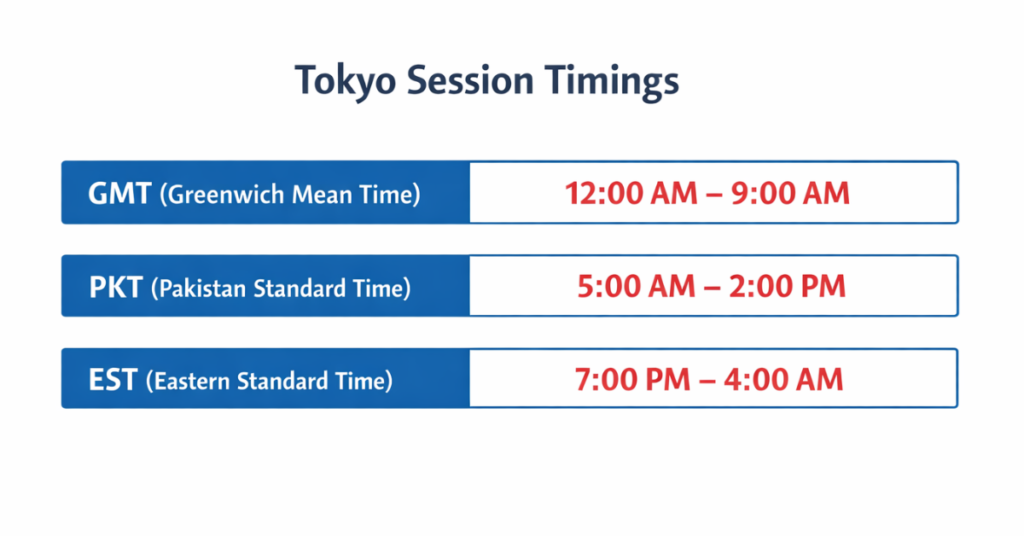
The Tokyo session follows a consistent schedule that traders can plan around. Below are the standard hours in UTC (GMT), which remain stable outside of daylight saving adjustments in certain regions.
Tokyo Session Timing by Time Zone
| Time Zone | Opening Time | Closing Time |
| GMT / UTC | 12:00 AM (Midnight) | 9:00 AM |
| PKT (Pakistan) | 5:00 AM | 2:00 PM |
| EST (New York) | 7:00 PM (Previous Day) | 4:00 AM |
| IST (India) | 5:30 AM | 2:30 PM |
| GST (UAE / Dubai) | 4:00 AM | 1:00 PM |
Session Overlaps to Know
Two overlap windows occur around the Tokyo session, and both are worth understanding for trading purposes:
- Tokyo + Sydney Overlap (approximately 12:00 AM to 7:00 AM UTC): Heightened activity in AUD, NZD, and JPY pairs. This is the first liquidity injection of the trading day.
- Tokyo + London Overlap (approximately 8:00 AM to 9:00 AM UTC): A brief but important window where volatility begins increasing as European traders enter. Price often breaks out of the Tokyo range during this period.
The middle portion of the Tokyo session, roughly 2:00 AM to 6:00 AM UTC, is typically the most stable and range-bound period of the day, which is where most Tokyo session strategies are best applied.
Is the Tokyo Session a Good Time to Trade?
The Tokyo session can be a good time to trade, but only if it matches your trading style. It is characterized by lower volatility, steadier price action, and reduced global trading volume compared to London and New York. That does not make it a poor session. It makes it a different kind of market.
When the Tokyo Session Works Well
The Tokyo session is a good fit if you prefer:
- Range trading strategies where price moves between defined support and resistance zones
- A low-risk environment with fewer sudden price spikes or emotional market moves
- Beginner-friendly conditions where market behavior is easier to follow and analyze
- Trading JPY, AUD, and NZD pairs, which carry stronger regional liquidity during Asian hours
When the Tokyo Session May Not Suit You
It may not be the right session if you rely on:
- Breakout strategies that depend on strong price momentum
- High-volatility setups, which are far more common during London and New York hours
- News-driven trading, since most high-impact economic releases (US NFP, CPI, ECB decisions) fall outside this window
Tokyo Session Volatility: What to Expect
The Tokyo session consistently records lower average volatility than the London and New York sessions. Price movements tend to be more gradual, with fewer sharp reversals or aggressive momentum runs. This is a structural feature of the session, not a flaw.
Why Volatility Is Lower
- Lower global trading volume: Most major European and US institutional traders are inactive, significantly reducing overall market participation.
- Regional focus: Activity is primarily driven by Asian central banks, exporters, and regional institutions rather than global hedge funds or high-frequency traders.
- Fewer high-impact news releases: Most market-moving economic data (US CPI, NFP, ECB rate decisions, Fed statements) falls outside Tokyo hours. Japanese economic data does release during this session but typically produces more contained reactions than major Western releases.
Typical Price Behavior
During the Tokyo session, traders typically observe sideways or range-bound movement on most major pairs, slow and gradual trend development on JPY crosses, strong respect for support and resistance levels, and fewer breakouts compared to the London or New York sessions.
Best Currency Pairs to Trade During the Tokyo Session
Not all pairs are equally active during Tokyo hours. Because regional Asian market participation drives this session, pairs involving JPY, AUD, and NZD consistently show better movement, tighter spreads, and more predictable behavior than EUR or GBP pairs during this window.
Most Active Currency Pairs
| Currency Pair | Why It Moves | Typical Behavior |
| USD/JPY | Strong influence from Japanese financial institutions and BOJ policy | Stable trends, clean technical levels |
| EUR/JPY | Cross-currency flows from both Asian and early European positioning | Moderate movement, suits range trading |
| AUD/JPY | Driven by Asia-Pacific economic activity and commodity flows | Smooth trends, frequent range swings |
| NZD/JPY | Linked to regional commodity demand and RBNZ sentiment | Gradual moves, predictable ranges |
| AUD/USD | Active due to Australian market overlap with Tokyo | Moderate volatility, steady price action |
Why JPY Pairs Dominate
The Japanese Yen is the most traded currency during this session for clear structural reasons. Tokyo is one of the three largest global financial centers alongside London and New York. Japanese banks, exporters, and the Bank of Japan (BOJ) are all active participants. Regional trade settlement flows heavily involve JPY, creating natural and consistent liquidity in JPY crosses throughout the session.
For a focused breakdown of which pairs perform best during Asian hours, see our guide on best currency pairs for the Tokyo session.
Tokyo Session vs London and New York Sessions
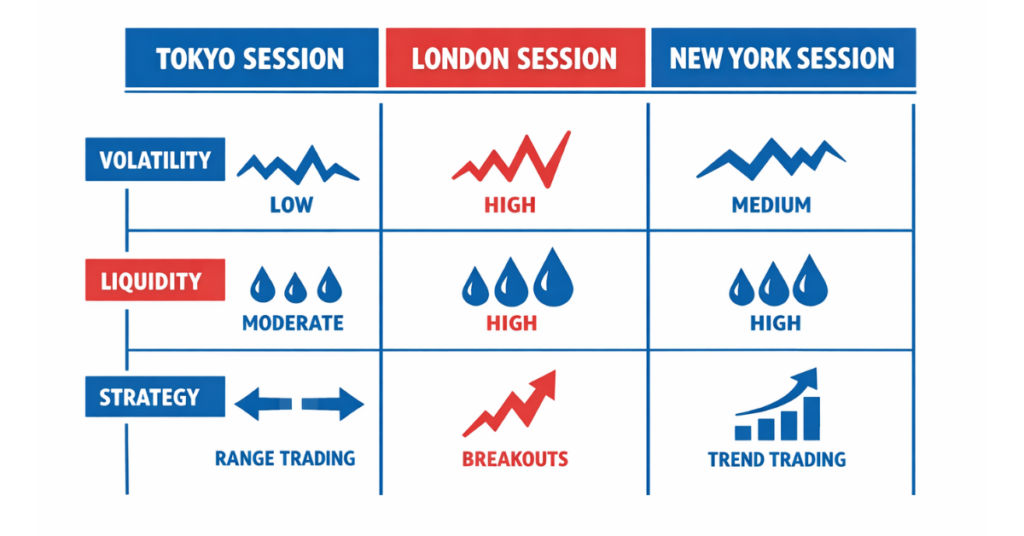
Each major session has a distinct trading character. Comparing them directly helps traders understand which environment suits their strategy and schedule.
| Feature | Tokyo Session | London Session | New York Session |
| Session Hours (UTC) | 12:00 AM – 9:00 AM | 8:00 AM – 5:00 PM | 1:00 PM – 10:00 PM |
| Volatility | Low | High | High |
| Liquidity | Moderate | Very High | Very High |
| Market Behavior | Range-bound | Trends and breakouts | News-driven volatility |
| Best Strategy | Range trading, scalping | Breakout, trend following | Momentum, news trading |
| Risk Level | Lower | Higher | Higher |
| Best Pairs | JPY, AUD, NZD crosses | EUR, GBP pairs | USD pairs, commodities |
Unlike London or New York, the Tokyo session is driven mainly by regional participation. Fewer global institutions are active, price movements are more technical than reaction-based, and the market responds slower to global macro headlines. This is why the Tokyo session feels calmer, and why strategies that rely on clean price structure tend to work better here than strategies that depend on momentum or volume surges.
Best Trading Strategies for the Tokyo Session
The Tokyo session rewards structure and precision. Because price tends to move within defined ranges rather than making sustained directional runs, the most effective trading strategies here are ones that work with that behavior rather than against it.
1. Range Trading (Most Effective in Tokyo)
Range trading is the most consistently applicable strategy during this session. The approach involves identifying a clear support level and a clear resistance level, then buying near support and selling near resistance, repeating until a genuine breakout occurs.
This works well because price repeatedly bounces between the same zones during Tokyo hours, especially on USD/JPY and AUD/JPY. The key is patience, not forcing trades between levels and waiting for price to actually reach the zones you have identified.
2. Scalping (Within Defined Zones)
Scalping can be effective during Tokyo hours but requires tight discipline. The focus is on small, repeatable pip gains within the range rather than holding for large moves. Best applied on USD/JPY due to its clean technical behavior. Requires a broker with low spreads and fast execution, since profit targets are small and costs eat into margins quickly.
3. London Breakout Preparation
One of the most practical uses of the Tokyo session is to mark the high and low of the range it builds. Many traders then use those levels as breakout triggers when London opens. When price breaks above the Tokyo high or below the Tokyo low at the London open, it often signals a strong directional move for the day. This strategy requires no live trading during Tokyo hours, just range identification and preparation for the London session entry.
Is the Tokyo Session Good for Beginners?
The Tokyo session is widely regarded as one of the most suitable starting environments for new forex traders. Slower price action, cleaner market structure, and fewer sudden spikes give beginners more time to analyze, decide, and react without the pressure of fast-moving conditions.
Being beginner-friendly does not mean it guarantees profits. It means the market is less aggressive, which reduces the chance of emotional mistakes that come from trying to keep up with fast markets before you are ready.
Why the Tokyo Session Helps Beginners
- Slower price movements reduce panic-driven decision making
- Market structure is cleaner and easier to read on charts
- Fewer sudden spikes help avoid reactive emotional trades
- More time to practice entry and exit timing at each level
- Ideal environment for learning support and resistance trading basics
What Beginners Should Focus On
- Observing how price behaves in range-bound conditions before placing trades
- Practicing small, well-defined setups rather than chasing any price movement
- Learning how JPY pairs react during Asian market hours
- Building process consistency rather than focusing on short-term profit
If you are new to trading and want to explore Tokyo session conditions with zero financial risk, a free demo account is the right first step. Defcofx offers a demo account on MetaTrader 5 with live market data so you can practice during actual Tokyo session hours before committing real capital.
Open a Free Demo AccountHow to Trade the Tokyo Session Effectively
Trading the Tokyo session requires a different mindset than trading London or New York. Since price moves more slowly and stays more contained, success depends on precision, patience, and choosing the right setups rather than reacting to momentum.
Practical Steps
- Focus on JPY, AUD, and NZD pairs where regional liquidity is most consistent
- Identify clear support and resistance levels on the H1 or H4 chart before the session opens
- Trade primarily during the middle of the session, roughly 2:00 AM to 6:00 AM UTC, when price is most stable
- Use smaller position sizes to match the lower average pip range of this session
- Wait for clear confirmation before entering, especially at range boundaries
- Mark the Tokyo session high and low for use as potential London breakout levels
Risk Management for Tokyo Session Traders
- Always use a stop-loss on every trade, even in slow markets, as slow reversals within ranges can still hit unprotected positions
- Avoid overtrading during low-volume periods, particularly in the first hour after the Tokyo open when liquidity is still building
- Keep profit targets realistic for the session. Smaller moves are normal, and forcing large targets into range-bound conditions leads to frustration and poor exits
- Apply consistent risk management rules on every trade regardless of how “calm” the market appears
Trade the Tokyo Session with Defcofx
Defcofx is a global forex and CFD broker registered in Saint Lucia, offering access to all major currency pairs including JPY, AUD, and NZD crosses through the MetaTrader 5 (MT5) platform. For Tokyo session traders, where profit targets are smaller and trading costs matter more, the conditions at Defcofx are built to support cost-efficient, precise execution.
- Spreads from 0.3 pips with no commissions or swap fees, keeping costs low for scalpers and range traders targeting smaller pip moves
- Leverage up to 1:2000, giving traders full flexibility in position sizing to match Tokyo session conditions
- 40% welcome bonus on first deposits of $1,000 or more, available to all clients globally
- Withdrawals processed within 4 business hours, including weekends, so your funds remain accessible
- MT5 platform with advanced charting tools and fast execution for precise range entries and exits
- Multilingual support and global access, welcoming traders from all countries
In the Tokyo session, where every pip of spread matters and execution precision determines outcome, low-cost trading conditions make a meaningful difference over time. Start on a demo to practice Tokyo session strategies with live market data, then transition to a live account when ready.
Open a Live Trading AccountFinal Thoughts: Is the Tokyo Session a Good Time to Trade?
The Tokyo session is a good time to trade if your strategy and mindset match what it offers. It is not the most volatile session, and it is not designed for traders chasing fast momentum or large single-trade returns. What it does offer is structure, predictability, and a calmer market environment that consistently rewards patience, range-based thinking, and disciplined execution.
For beginners, it provides a learning-friendly environment to practice chart reading, support and resistance trading, and risk management without the pressure of aggressive market conditions. For experienced traders, it offers consistent range setups and valuable preparation for the London breakout that follows.
The Tokyo session is not about being the best session. It is about being the right session for the right trader. If you are ready to explore it, Defcofx gives you access to all major JPY, AUD, and NZD pairs with competitive spreads and full MT5 functionality across all major trading sessions.
Open a Live Trading AccountFAQ
The Tokyo session can be profitable, but it depends on your strategy. Since it has lower volatility and smaller average pip ranges, traders typically focus on range trading and scalping for consistent smaller gains rather than chasing large breakout moves.
The Tokyo session is slower because global trading volume is lower during Asian hours. Most major European and US institutional traders are inactive, reducing overall liquidity. Activity is primarily driven by Japanese, Australian, and New Zealand market participants, which creates more contained and predictable price movements.
Yes. The Tokyo session is one of the most beginner-friendly environments in forex because price moves more slowly, market structure is cleaner, and there are fewer sudden spikes. This gives new traders more time to analyze setups and practice disciplined execution. Defcofx offers a free demo account on MT5 to practice during live Tokyo session hours.
The most active pairs during the Tokyo session are JPY crosses including USD/JPY, EUR/JPY, AUD/JPY, and NZD/JPY. AUD/USD is also active due to the overlap with the Sydney session. These pairs carry stronger liquidity and more predictable movement during Asian trading hours.
Neither is universally better. The Tokyo session is better for structured, low-volatility trading with a focus on range setups. The London session is better for breakout trading and high-momentum strategies. The right choice depends on your strategy, schedule, and risk tolerance.
The Tokyo session opens at 12:00 AM UTC (midnight) and closes at 9:00 AM UTC. This translates to 5:00 AM to 2:00 PM in Pakistan (PKT), 7:00 PM to 4:00 AM in New York (EST, previous day), and 5:30 AM to 2:30 PM in India (IST).