


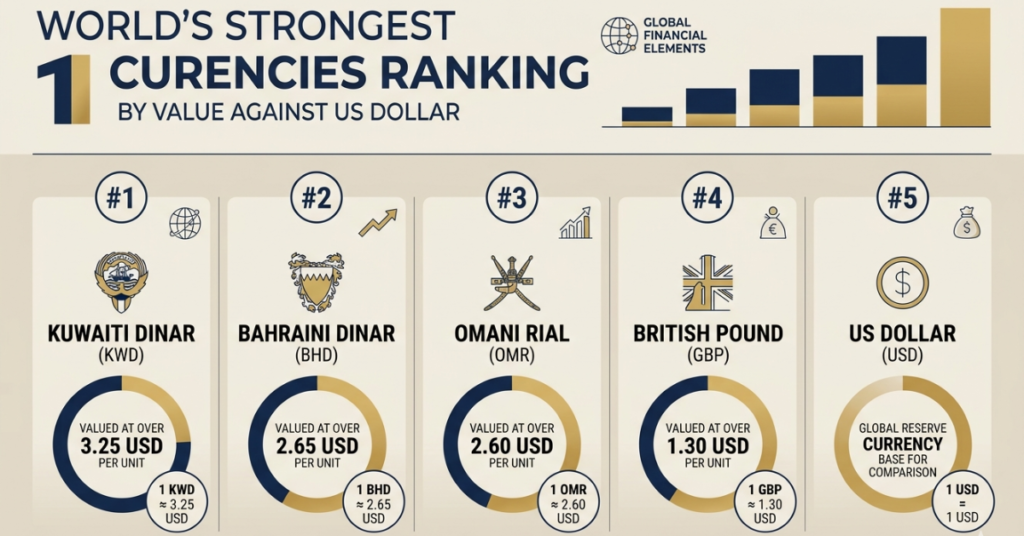
The Kuwaiti Dinar (KWD) is the strongest currency in the world by exchange rate value in 2026, with 1 KWD equal to approximately 3.26 USD. It is followed by the Bahraini Dinar and Omani Rial. However, strength by exchange rate is different from global influence, where the US Dollar remains the most powerful currency.
Key Takeaways
- The Kuwaiti Dinar is the highest-value currency by exchange rate in 2026
- High exchange value does not equal economic strength or global influence
- The USD, EUR, and GBP dominate global trade and forex volume
- Currency strength comes from oil exports, monetary policy, trade surpluses, and reserve status
- Traders focus on currencies with high liquidity, not just high face value
Top 10 Strongest Currencies in the World (2026 Ranking)
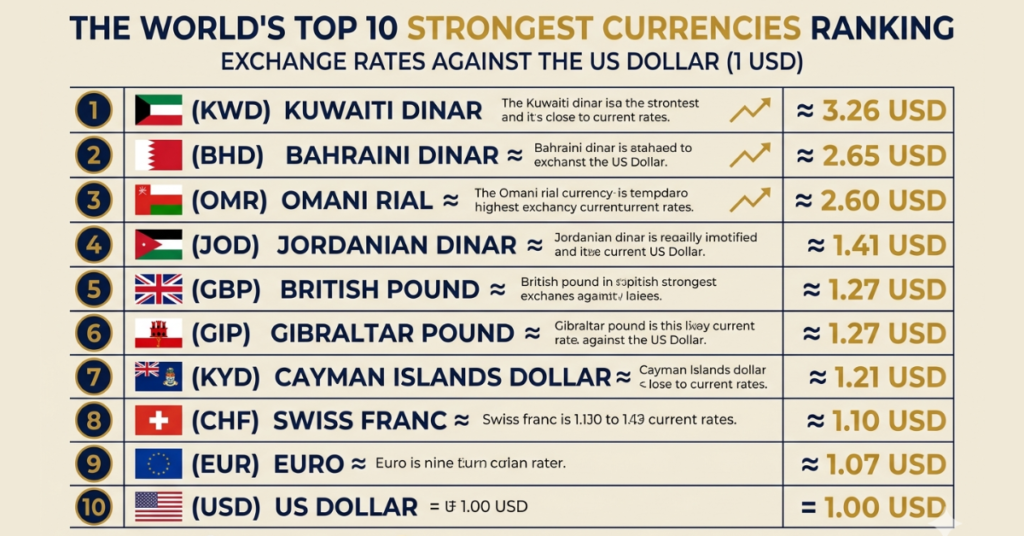
| Currency | Value vs USD (Approx.) |
| Kuwaiti Dinar (KWD) | ~3.26 USD per 1 KWD |
| Bahraini Dinar (BHD) | ~2.65 USD per 1 BHD |
| Omani Rial (OMR) | ~2.60 USD per 1 OMR |
| Jordanian Dinar (JOD) | ~1.41 USD per 1 JOD |
| British Pound (GBP) | ~1.27 USD per 1 GBP |
| Gibraltar Pound (GIP) | ~1.27 USD per 1 GIP |
| Swiss Franc (CHF) | ~1.12 USD per 1 CHF |
| Euro (EUR) | ~1.08 USD per 1 EUR |
| US Dollar (USD) | 1.00 (baseline) |
| Canadian Dollar (CAD) | ~0.74 USD per 1 CAD |
What Makes a Currency Strong?
A currency’s value is not random. Several factors push a currency higher or lower against others.
1. Oil Wealth and Exports
The top three currencies by value, KWD, BHD, and OMR, are all from oil-rich Gulf states. These nations run consistent trade surpluses and peg their currencies to the USD, creating artificial stability at high values. Kuwait’s Dinar is the clearest example. With one of the highest oil revenues per capita in the world, Kuwait can maintain its dinar at a high, fixed rate.
2. Reserve Currency Status
The USD is not the most valuable by exchange rate, but it is the most powerful currency in the world. Roughly 58% of global foreign exchange reserves are held in US dollars. Oil, gold, and most commodities are priced in USD. Central banks globally hold USD as their primary reserve asset.
The EUR holds second place in reserve currency status, with the GBP and JPY also held in significant volumes. This demand for major currencies in global trade gives them consistent underlying strength. You can explore how the US dollar impacts forex markets on the Defcofx blog.
3. Low Inflation and Monetary Discipline
Countries with low, stable inflation tend to have stronger currencies. Inflation erodes purchasing power. When a central bank keeps inflation in check, the currency retains value. Switzerland is a prime example. The Swiss National Bank has a long history of price stability, and the CHF is seen as a safe haven during global uncertainty.
4. Trade Surplus
Countries that export more than they import generate consistent demand for their currency. Foreign buyers must convert their money into the exporting country’s currency to pay for goods. Japan, Germany, and China have historically run large trade surpluses, supporting demand for JPY, EUR, and CNY.
5. Interest Rates and Carry Trades
Higher interest rates attract foreign capital seeking better returns. When a central bank raises rates, investors buy that currency to invest in its bonds or savings instruments. The opposite is the carry trade, where traders borrow in low-interest currencies and invest in high-interest ones. Learn more about how Fed rate decisions impact forex.
Open a Live Trading AccountMost Traded Currencies vs Most Valuable
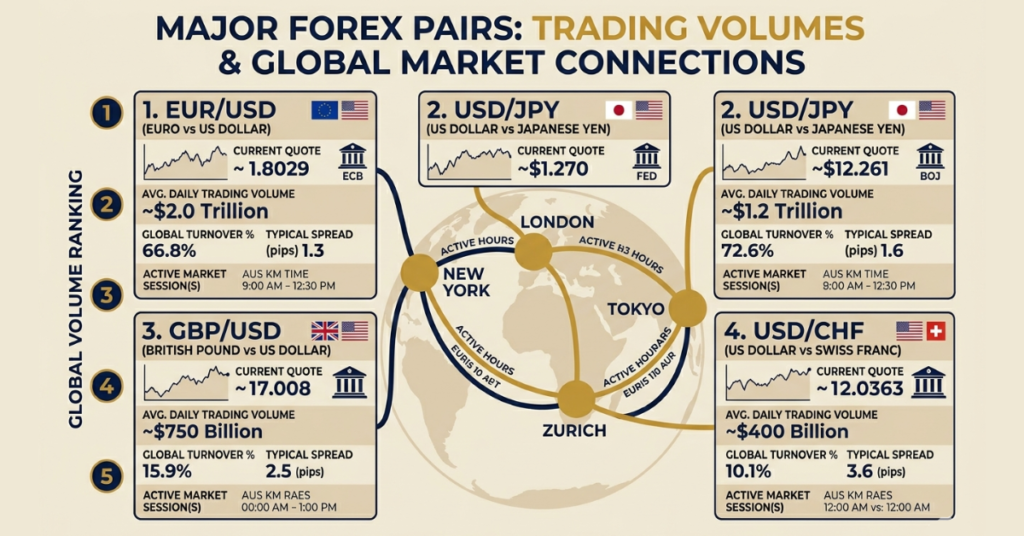
There is an important distinction between a currency’s exchange rate value and its role in global trade. The Kuwaiti Dinar may have the highest value per unit, but it is barely traded in the global forex market. The most actively traded currencies are different:
| Currency | Share of Daily Forex Volume (Approx.) |
| US Dollar (USD) | ~88% |
| Euro (EUR) | ~31% |
| Japanese Yen (JPY) | ~17% |
| British Pound (GBP) | ~13% |
| Australian Dollar (AUD) | ~7% |
| Canadian Dollar (CAD) | ~6% |
| Swiss Franc (CHF) | ~5% |
| Chinese Yuan (CNH/CNY) | ~7% |
Note: percentages exceed 100% because every forex transaction involves two currencies. Data from Bank for International Settlements Triennial Survey (most recent available).
Regional Breakdown of Strong Currencies
Middle East
Kuwait, Bahrain, and Oman top the list by exchange rate value. All three peg to the USD and benefit from oil export revenues. Their currencies are not freely floated, which prevents the kind of depreciation seen in commodity-driven economies without such reserves.
Europe
The British Pound and Swiss Franc are the strongest freely traded European currencies. The GBP benefits from London’s status as a global financial hub. The CHF is driven by Switzerland’s political neutrality, strong banking sector, and SNB’s disciplined monetary policy. The Euro, despite representing the world’s second-largest reserve currency block, trades below the GBP but above the USD in raw value.
Asia-Pacific
The Australian Dollar and New Zealand Dollar sit in the 0.60-0.65 USD range in 2026. The JPY has historically been weak in nominal terms, though it is a major safe-haven currency. The Chinese Yuan trades around 0.14 USD per CNY but carries growing geopolitical influence in trade settlement and emerging market reserves.
Can Currency Strength Change?
Yes, significantly. Currency strength is not fixed. Historical examples show how quickly rankings can shift:
- British Pound: Post-Brexit uncertainty caused major GBP volatility between 2016 and 2020.
- Turkish Lira: Once a mid-range currency, it has lost over 90% of its value against the USD in the last decade due to high inflation and unconventional monetary policy.
- Japanese Yen: Decades of ultra-low rates kept the JPY depressed. Any shift in BOJ policy creates major market moves.
- Euro: The Eurozone debt crisis of 2011-2012 severely tested the EUR. Structural issues in weaker member states still influence EUR/USD from time to time.
How to Trade Strong Currency Pairs
Traders do not simply buy the strongest currency and wait. They trade currency pairs, speculating on the relative strength of one currency versus another.
Major Pairs
EUR/USD, GBP/USD, USD/JPY, and USD/CHF are the most liquid pairs featuring the strongest and most influential currencies. These offer the tightest spreads, deepest liquidity, and the most analytical coverage. Learn how to read currency exchange charts to get started.
Commodity Currency Pairs
AUD/USD, NZD/USD, and USD/CAD are commodity currencies. Their moves reflect not just economic data but also shifts in oil, iron ore, and agricultural prices.
Cross Pairs
Pairs like EUR/GBP or GBP/JPY allow traders to take a view on relative currency strength without USD exposure. They tend to be more volatile and require careful spread management. Review the full list of forex currency pairs available on Defcofx.
Defcofx: Trade the World’s Top Currencies
Defcofx provides access to a full range of major, minor, and exotic currency pairs on MetaTrader 5. Whether you want to trade the USD’s reserve strength or the EUR’s economic data, the platform is built for both beginners and experienced traders.
| Feature | Defcofx Offering |
| Platform | MetaTrader 5 (MT5) |
| Spreads | From 0.3 pips |
| Leverage | Up to 1:2000 |
| Commission | Zero |
| Swap Fees | Zero |
| Welcome Bonus | 40% on first deposits of $1,000+ |
| Withdrawal Speed | Within 4 business hours including weekends |
| Instruments | Forex, Indices, Commodities, Crypto, Stocks |
Risk Management When Trading Currency Pairs
Trading strong currencies does not eliminate risk. Even the safest pairs can gap on unexpected news. A solid risk management framework is non-negotiable.
- Set a fixed percentage risk per trade, typically 1-2% of account balance
- Use stop-loss orders at logical levels, not arbitrary pip distances
- Review forex risk management principles before scaling up position sizes
- Monitor central bank calendars and GDP releases for the currencies you trade
- Avoid over-leveraging on news events even if you have a high-leverage account
Final Thoughts on Strongest Currencies in the World: 2026 Ranking
The “strongest currency” depends on how you define strength. If you are measuring by exchange rate value alone, the Kuwaiti Dinar remains the strongest currency in the world in 2026, followed by the Bahraini Dinar and Omani Rial. However, exchange rate value tells only part of the story. Global influence, liquidity, reserve status, and economic importance often matter far more than the face value of a currency.
This is why the US Dollar continues to dominate international trade, foreign exchange reserves, and global financial markets despite not being the highest-valued currency per unit. Similarly, currencies like the Euro, British Pound, Swiss Franc, and Japanese Yen remain among the most important currencies for investors and traders because of their liquidity, stability, and role in the global economy.
FAQ
The Kuwaiti Dinar (KWD) holds the highest exchange rate value in 2026, with approximately 3.26 USD per KWD. However, the US Dollar remains the most globally influential currency by reserve holdings and trade volume.
Kuwait pegs its dinar to a basket of currencies and benefits from vast oil export revenues with a small population. This creates a high-income-per-capita economy that can sustain a high-value, stable currency without the inflation pressures other countries face.
Not necessarily. A very strong currency makes exports more expensive for foreign buyers, which can hurt export-dependent industries. It can also attract hot money flows that create instability. The best economic outcomes often come from a stable, predictable currency rather than the highest-value one.
The USD’s power comes from its reserve currency status, not its face value per unit. It is used in roughly 88% of all forex transactions, and most global commodities and debt are priced in dollars. That systemic demand is what gives the dollar its real-world power.
Most retail traders access major currency pairs through a forex broker like Defcofx. You trade pairs like EUR/USD or GBP/USD through an MT5 platform. Start with a demo account to practice without risking capital.
Currency strength shifts constantly based on central bank policy, economic data, and geopolitical events. As of mid-2026, the USD has faced some volatility amid Fed policy uncertainty, while currencies in economies with rising interest rates have gained relative ground. Always verify with current market data.