


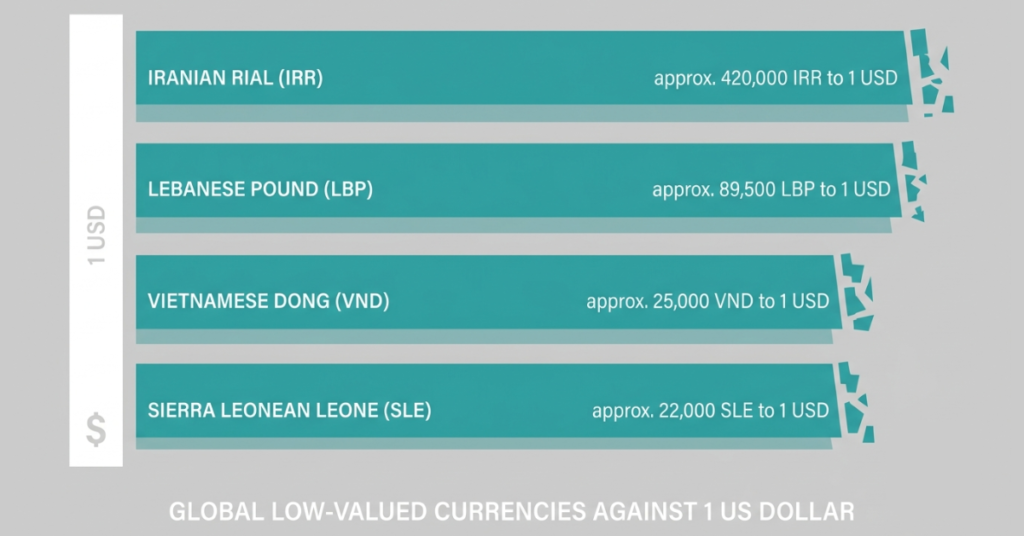
The Iranian rial is the world’s weakest currency by open market exchange rate, trading at well over one million rials per US dollar. By official exchange rate, the Lebanese pound ranks weakest, having lost more than 98% of its value since its currency peg collapsed in 2019. Both reflect long-running sanctions, inflation, and economic instability.
Key Takeaways
- The Iranian rial is the weakest currency by open market rate, trading beyond one million rials per US dollar.
- The Lebanese pound is the weakest currency by official exchange rate, down more than 98% from its old fixed peg.
- “Weakest” and “lowest value” are not identical measures. A currency can trade at a low nominal rate without being in economic crisis.
- The Vietnamese dong, Laotian kip, and Indonesian rupiah also rank among the world’s lowest-valued currencies, though for different reasons than Iran or Lebanon.
- The Kuwaiti dinar is generally considered the world’s strongest currency by nominal exchange rate.
- Currency weakness is driven by inflation, sanctions, political instability, and trade imbalances, not by the size of an economy. See how currency value is determined.
What Does “Weakest Currency” Actually Mean?
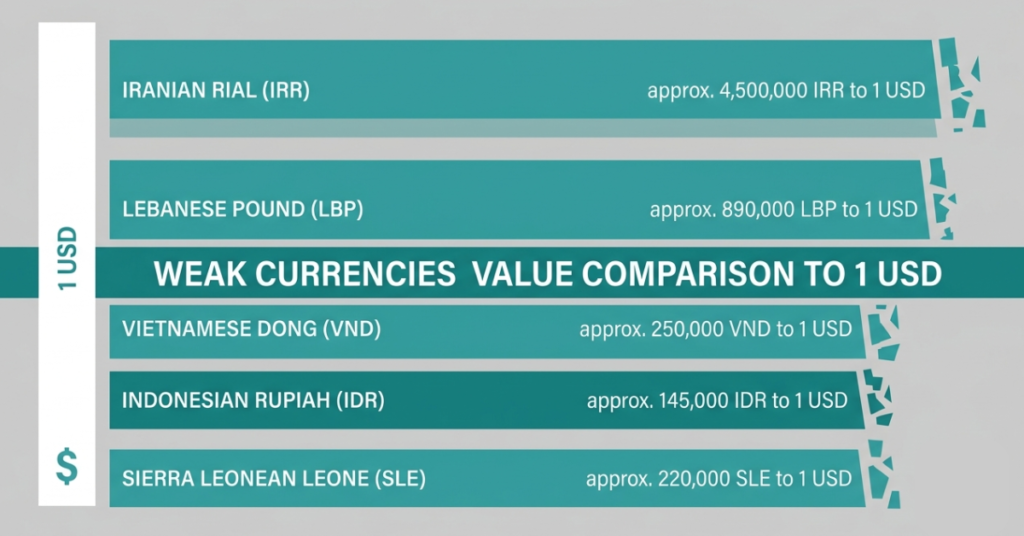
The word weakest gets used loosely, and it can mean two different things. The lowest currency simply refers to the one that requires the most units to equal one US dollar, a purely nominal measure that says nothing about a country’s underlying economy. The weakest currency, in a stricter sense, refers to the one that has lost the most value or stability recently, through inflation, crisis, or policy failure. The two rankings usually point to the same currencies, but not always for the same reasons.
The Iranian Rial: The World’s Lowest-Value Currency
By open market rate, the Iranian rial is the least valuable currency in the world, with one US dollar buying well over one million rials through most of 2026, and parallel market quotes running even higher at times. Iran’s official central bank rate sits considerably lower than the open market rate, creating a persistent gap that reflects limited access to foreign currency. Decades of international sanctions, restricted oil exports, and inflation that has stayed above 55% have driven the rial’s long decline. Iran’s parliament approved a plan to redenominate the currency by removing zeros, but it has not been implemented, so the rial remains in daily use at its current scale.
The Lebanese Pound: Officially the Weakest by Exchange Rate
The Lebanese pound was pegged at roughly 1,507.5 to the US dollar for more than two decades, until the peg broke in late 2019 amid a banking sector collapse and strict capital controls. By 2026 the pound trades at roughly 89,500 per US dollar, a decline of more than 98% from its old fixed rate. Because this is measured against an official benchmark rather than a floating market rate, the Lebanese pound is often cited as the weakest currency in the world by exchange rate, even though the Iranian rial trades at a lower nominal value.
Other Currencies Among the World’s Weakest
Beyond Iran and Lebanon, several other currencies consistently rank near the bottom of global exchange rate tables, each for a different underlying reason:
| Currency | Approx. Rate per USD (2026) | Primary Driver |
| Vietnamese dong (VND) | ~26,200 – 26,400 | Managed devaluation to support exports |
| Laotian kip (LAK) | ~22,200 – 22,600 | Rising external debt burden |
| Indonesian rupiah (IDR) | ~17,900 – 18,100 | Legacy of the 1997–98 Asian financial crisis |
| Sierra Leonean leone (SLL) | ~23,000 – 24,100 | Import dependence and inflation |
| Uzbekistani som (UZS) | ~12,000 – 12,100 | Post-Soviet transition to a market economy |
What Causes a Currency to Become Weak?
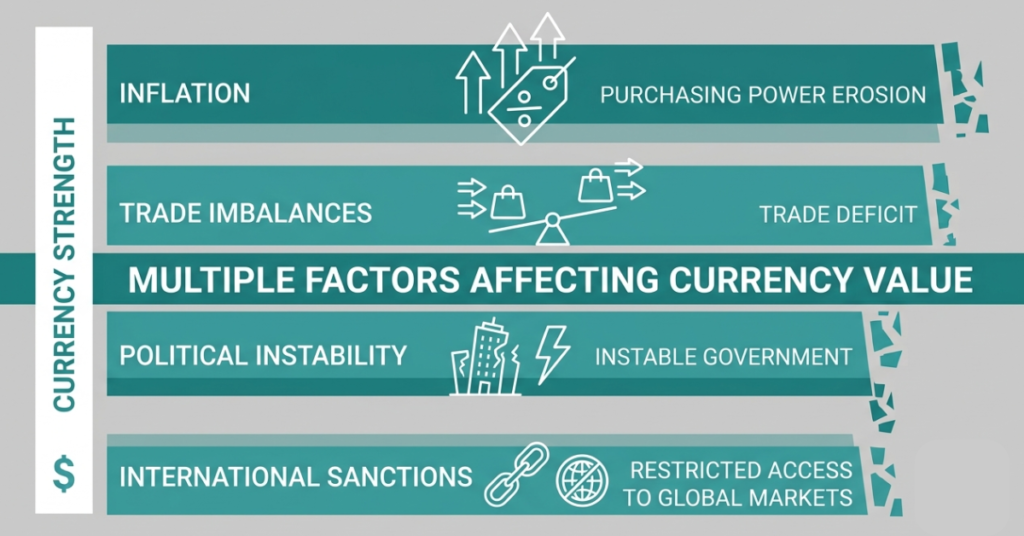
Currency weakness rarely comes from a single cause. It usually builds from a combination of the following pressures, playing out over years rather than weeks.
Inflation
When prices rise faster than incomes, a currency’s purchasing power erodes both at home and against other currencies. Iran’s inflation running above 55% is a direct driver of the rial’s continued slide.
Sanctions and Trade Restrictions
Sanctions cut off access to foreign currency and international trade, reducing dollar inflows a country needs to support its own currency. This has been the central pressure on the Iranian rial for years.
Political Instability
Political uncertainty discourages foreign investment and can trigger capital flight, both of which weaken a currency’s exchange rate over time.
Central Bank and Trade Policy
Some currencies are deliberately kept low. Vietnam’s central bank has allowed the dong to depreciate gradually to keep exports competitive, which is a policy choice rather than a crisis.
Strongest vs Weakest Currencies: Quick Comparison
| Category | Currency | Approx. Rate to USD |
| Strongest | Kuwaiti dinar (KWD) | ~0.31 per USD |
| Strongest | Bahraini dinar (BHD) | ~0.376 per USD |
| Weakest (official) | Lebanese pound (LBP) | ~89,500 per USD |
| Weakest (open market) | Iranian rial (IRR) | 1,000,000+ per USD |
Can You Trade Weak Currencies as a Forex Trader?
Most of the currencies on this list, including the Iranian rial and Lebanese pound, are not available on standard forex platforms because of capital controls, thin liquidity, or sanctions. Retail traders typically get exposure to currency strength and weakness through major and minor pairs instead, watching how currencies like the US dollar, euro, or yen move relative to each other rather than trying to trade a collapsing currency directly. Understanding why a currency is weak still matters for reading broader market sentiment, even on pairs you can actually trade.
Trading Currency Pairs With Defcofx
Defcofx gives traders access to a wide range of major, minor, and exotic forex pairs on MetaTrader 5, with spreads from 0.5 pips and no commission charged on trades. Leverage up to 1:2000 is available for traders who want more flexibility with margin, and qualifying first-time deposits can unlock a 40% welcome bonus. Funds move quickly too, with withdrawals processed within 3 hours, including weekends, so traders are not stuck waiting to access their own capital.
Final Thoughts on What Is the Weakest Currency
The world’s weakest currencies are not simply those with the largest numbers against the U.S. dollar. True currency weakness reflects deeper economic challenges such as persistent inflation, political instability, sanctions, banking crises, or long-term trade imbalances. While the Iranian rial and Lebanese pound currently rank among the weakest currencies, each reached that position for different economic and political reasons.
For forex traders, these currencies are more useful as examples of how macroeconomic forces shape exchange rates than as tradable instruments. Most retail brokers do not offer them because of sanctions, capital controls, or extremely low liquidity. Instead, traders can apply the same economic principles to liquid major and minor currency pairs where execution is reliable and pricing is transparent.
FAQ
By open market exchange rate, the Iranian rial is the weakest. By official exchange rate, the Lebanese pound holds that position.
Decades of international sanctions, restricted oil exports, and inflation above 55% have steadily eroded the rial’s value.
No. The peg that held at roughly 1,507.5 LBP per dollar broke in late 2019 after a banking sector collapse.
The lowest currency is simply the one with the highest number of units per US dollar. The weakest currency refers to one that has lost significant value or stability, which is not always the same currency.
The Kuwaiti dinar is generally considered the world’s strongest currency by nominal exchange rate.
No. These currencies are not available on standard retail forex platforms due to sanctions, capital controls, or limited liquidity.
Not always. Some currencies, like the Vietnamese dong, are kept deliberately low as a trade policy rather than as a sign of crisis.