


It is almost always better to get pesos in Mexico rather than the US. Exchange rates in Mexico, especially at local banks, ATMs, and currency exchange offices (casas de cambio), are significantly more favorable than what US banks, airports, or currency exchange kiosks offer. The only exception is if you can find a zero-fee ATM or bank with a competitive rate before you travel.
Key Takeaways
- Mexican ATMs generally give better rates than US banks or airport kiosks.
- Casas de cambio (currency exchange offices) in Mexico offer competitive rates, often better than hotel desks or tourist area changers.
- US airport exchange booths typically offer the worst rates of all options.
- US bank branches rarely stock pesos and usually charge high fees for ordering them.
- If you do an exchange in the US, credit unions or large banks like Chase or Bank of America give better rates than airport booths.
- Always decline dynamic currency conversion (DCC) when using your card in Mexico.
Why Exchange Rates Differ by Location
Every currency exchange involves a spread, meaning the difference between the rate the exchanger buys at and the rate they sell to you at. That spread is how they make money. The wider the spread, the worse the deal for you.
Locations with high tourist traffic and captive customers (like airports) charge the widest spreads because they know you have limited alternatives and urgency. Local banks and ATMs in Mexico compete more on rate because they serve everyday customers, not just tourists.
Getting Pesos in the US: Your Options
If you want pesos before you travel, here are the main options available in the US and how they compare.
| Option | Typical Rate vs. Live Rate | Fees | Recommendation |
| US Airport Exchange (Travelex etc.) | 10-15% worse | Low to none, but rate spread is the cost | Avoid if possible |
| US Bank Branch (Chase, BofA) | 5-8% worse | Possible order fee | Use only if needed in advance |
| Credit Union | 3-5% worse | Lower fees than major banks | Better option if exchanging in US |
| AAA (for members) | 2-4% worse | Free or low fee for members | Decent option for US exchange |
| Online Exchange (pre-order) | Variable | Varies by service | Compare before using |
The general rule: the more convenient the US option, the worse the rate. Airport booths win on convenience but lose badly on rate. A credit union is slower but cheaper.
Getting Pesos in Mexico: Your Options
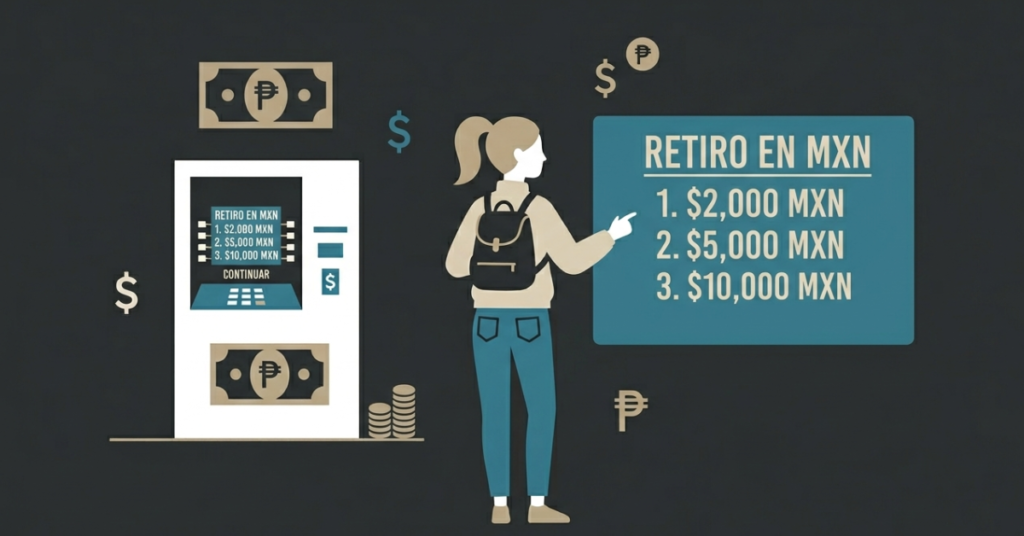
Most people who travel regularly to Mexico agree: get your pesos in Mexico. Here’s how the options there compare.
ATM Withdrawals in Mexico (Best Option for Most Travelers)
Using an ATM in Mexico that’s linked to a Visa/Mastercard network generally gives you the interbank exchange rate minus a small currency conversion fee from your home bank. This is often the best rate available.
Tips for using ATMs in Mexico:
- Use ATMs attached to major Mexican banks like Banamex, BBVA, Banorte, or Santander
- Always choose to be charged in pesos (MXN), not US dollars, when prompted. Choosing USD activates DCC, which uses a terrible conversion rate
- Check your US bank’s international ATM fee before traveling. Some accounts, like Charles Schwab’s High Yield Investor Checking, reimburse ATM fees globally
- Withdraw larger amounts less frequently to minimize per-transaction fees
- Avoid ATMs in tourist areas, bus stations, or airports in Mexico if possible, they often have lower withdrawal limits and add their own fees
Casas de Cambio (Currency Exchange Offices)
Casas de cambio are licensed currency exchange businesses found throughout Mexico, from border towns to city centers. The best ones offer rates close to the interbank rate with transparent spreads.
Where to find good casas de cambio:
- City center branches in major cities like Mexico City, Guadalajara, or Monterrey
- Border crossing towns like Tijuana and Juarez, which have high competition and often good rates
- Avoid casas de cambio in tourist zones like hotel lobbies, resort areas, or popular markets, they charge premium spreads
Mexican Banks
Walking into a local branch of BBVA, Banamex, or Banorte and exchanging cash is reliable and usually offers a fair rate. The downside is that queues can be long and you may need to show identification. The rate won’t be as good as a well-located casa de cambio, but it’s dependable.
Hotel Desks and Resort Exchanges
Avoid these. Hotel exchange desks exist as a convenience service, not a competitive financial product. Their rates are typically 8-15% worse than local market rates. Use them only in an emergency.
Open a Live Trading AccountUS vs. Mexico Exchange: A Direct Comparison
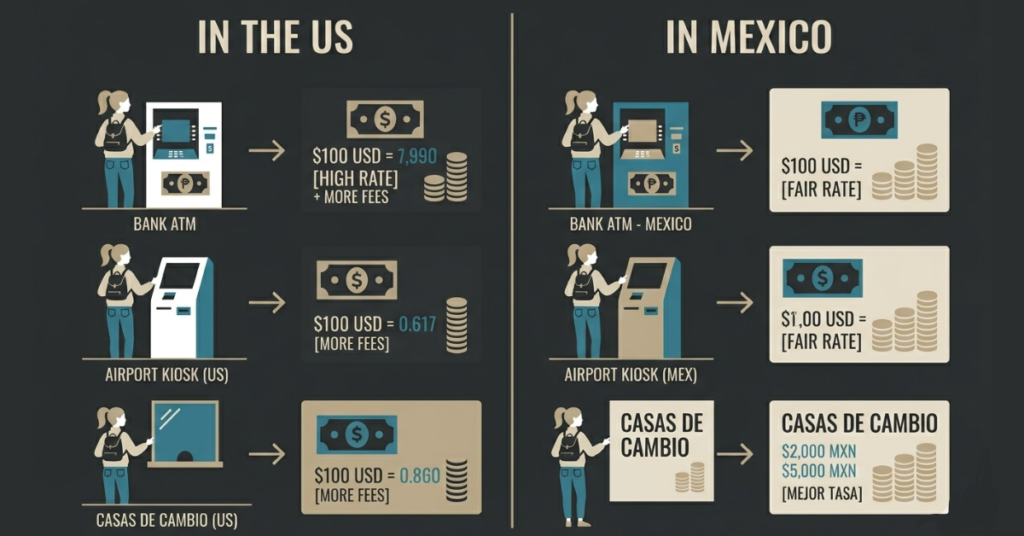
| Factor | Exchange in US | Exchange in Mexico |
| Rate Quality | Generally poor to fair | Good to excellent (ATMs, casas de cambio) |
| Convenience | High (before travel) | Easy once in country |
| Fees | Higher fees or worse rates built in | Lower with ATM or reputable casa |
| Availability | Limited (must order ahead) | Widely available |
| Best Scenario | If no ATM access in Mexico | Most travel situations |
How Much Pesos to Get Before You Go
You don’t need much. A small amount of pesos for immediate needs on arrival is enough, mainly for transportation from the airport, small tips, or a coffee if your first ATM doesn’t work.
In most Mexican cities and tourist destinations, you’ll find ATMs within minutes of arriving. Major international airports in Mexico City (AICM), Cancun, Guadalajara, and other hubs have ATMs in the arrivals area. Have $20-50 worth of pesos at most before you travel, and get the rest in Mexico.
Understanding USD/MXN as a Forex Pair
For those interested in the currency market rather than just travel, USD/MXN is an actively traded exotic pair in forex markets. The Mexican peso is one of the most traded emerging market currencies globally, and USD/MXN reflects the economic relationship between the world’s largest economy and Mexico’s export-driven economy.
What Moves USD/MXN?
- US Federal Reserve interest rate decisions have a major impact: higher US rates tend to strengthen USD against MXN
- Bank of Mexico (Banxico) policy: Banxico often mirrors Fed moves but can diverge, affecting the pair
- Oil prices: Mexico is an oil exporter, so crude oil price increases tend to support the peso
- US-Mexico trade relations: Trade agreements and tariff disputes directly affect the pair
- Global risk sentiment: The peso is considered a risk-sensitive currency. During global market stress, USD/MXN tends to rise (peso weakens)
- Mexican economic data: GDP, inflation, employment figures all move the pair
USD/MXN Characteristics as a Trading Pair
| Characteristic | Detail |
| Classification | Exotic pair (USD + emerging market currency) |
| Average daily range | Can be 0.5% to 2%+ on active days |
| Most active session | New York session, with activity also during Mexico City business hours |
| Key drivers | Fed policy, Banxico decisions, oil prices, trade news |
| Volatility | Higher than major pairs, lower than some other exotic pairs |
To understand more about exotic pairs in the broader forex context, check out forex currency pairs overview and what is forex trading and how does it work.
Defcofx and USD/MXN Trading
Defcofx offers access to USD/MXN and a range of exotic currency pairs through MetaTrader 5. If you’re interested in going beyond travel money exchange and trading the USD/MXN pair as a financial instrument, here’s what Defcofx provides:
- Leverage up to 1:2000 – Manage your exposure to USD/MXN with flexible position sizing.
- Competitive spreads from 0.3 pips across instruments, no commissions, no swap fees on standard accounts.
- 40% Welcome Bonus on first deposits of $1,000 or more, available to all clients globally.
- MT5 platform with full charting, indicators, and automated trading capabilities for USD/MXN analysis.
- Fast withdrawals processed within 4 business hours, including weekends.
- Clients from all countries are welcome, with multi-language support.
Statistics: USD/MXN and Currency Exchange Facts
- The Mexican peso is the 15th most traded currency in the world according to BIS data, making USD/MXN a liquid exotic pair with active markets.
- Mexico is the US’s largest trading partner, with over $800 billion in bilateral trade annually, underpinning consistent demand for USD/MXN exchange in both retail and institutional markets.
- Tourism is a major driver of currency exchange demand: Mexico consistently ranks as one of the top 10 most visited countries in the world, with US tourists making up the single largest group by nationality.
- Airport currency exchange operators typically apply a 10-15% margin above the mid-market rate, according to multiple consumer financial studies, making them among the most expensive exchange options available.
- In 2022, Mexico received approximately $58.5 billion in remittances, the majority from the US, making it one of the top remittance-receiving countries globally and driving consistent USD to MXN conversion demand.
Final Thoughts on Is It Better to Get Pesos in the US or Mexico?
Getting pesos in Mexico gives you a meaningfully better exchange rate than most options available in the US. ATMs at major Mexican banks and well-located casas de cambio in city centers are your best choices. Airport booths on either side of the border, hotel exchange desks, and tourist area changers are consistently the worst options.
The practical takeaway: take a small amount of pesos with you for the first hour or two, then use a Mexican ATM for everything else. Decline dynamic currency conversion every time. Check your bank’s international fee structure before you go, and consider an account designed for travel if you visit Mexico regularly.
For those interested in the financial side of USD/MXN, the pair offers active, tradeable price action driven by real economic forces on both sides of the border.
FAQ
In almost all cases, it is better to exchange in Mexico. ATMs connected to major Mexican banks and reputable casas de cambio offer significantly better rates than US airport booths, US bank branches, or hotel exchange desks.
Using a debit card at a Mexican bank ATM (BBVA, Banamex, Banorte, Santander) gives most travelers the best exchange rate. Always decline the option to pay in USD when prompted, and use an account that keeps international fees low.
You only need a small amount before traveling, around $20-50 worth of pesos for immediate arrival needs. Get the rest from ATMs or casas de cambio once you’re in Mexico where rates are better.
You only need a small amount before traveling, around $20-50 worth of pesos for immediate arrival needs. Get the rest from ATMs or casas de cambio once you’re in Mexico where rates are better.
ATMs belonging to major Mexican banks (BBVA, Banamex, Banorte, Santander) are more reliable and often have better limits than independent ATMs. Avoid ATMs in isolated tourist spots, bus terminals, or small convenience stores.
Dynamic currency conversion (DCC) is when an ATM or card terminal offers to charge you in your home currency (USD) instead of the local currency (MXN). Always choose to be charged in MXN. DCC uses an unfavorable conversion rate chosen by the merchant.
Yes, USD/MXN is a tradeable exotic currency pair available on most forex brokers including Defcofx. It offers higher volatility than major pairs and is influenced by Fed policy, Banxico decisions, oil prices, and US-Mexico trade relations.