


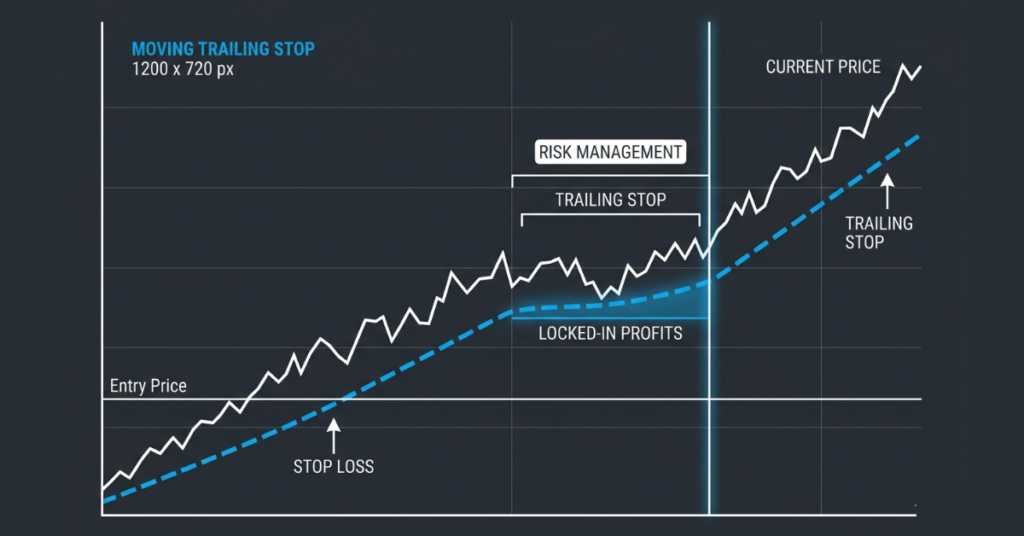
A good trailing stop loss percentage for most forex traders falls between 1% and 3% of the trade value or account balance. For volatile pairs, 3% to 5% can be more practical. The right number depends on your trading style, the currency pair, and the timeframe you are trading on.
Key Takeaways
- Trailing stop loss percentages typically range from 1% to 5% depending on volatility.
- Scalpers and day traders usually set tighter stops (0.5% to 1.5%).
- Swing and position traders benefit from wider stops (2% to 5%).
- The ATR (Average True Range) indicator helps set smarter, market-based trailing stops.
- No single percentage works for every trade. Context always matters.
What Is a Trailing Stop Loss?
A trailing stop loss automatically moves with the price as your trade goes in profit. Unlike a fixed stop loss, it locks in gains by adjusting upward (for buy trades) or downward (for sell trades) as the market moves in your favor.
For example, if you buy EUR/USD at 1.1000 and set a 50-pip trailing stop, the stop begins at 1.0950. If the price rises to 1.1050, the stop automatically moves to 1.1000. If it rises further to 1.1100, the stop moves to 1.1050. You lock in profit without manually adjusting anything.
You can learn more about how this tool works in detail on the Defcofx guide:
Full explainer: What Is a Trailing Stop and How Does It Work
Why the Right Percentage Matters
Set your trailing stop too tight and normal price fluctuations will knock you out of winning trades before they reach their potential. Set it too wide and you give back too much profit before the stop triggers.
This is one of the most common mistakes beginner traders make. They either fear losing gains and set stops too close, or they ignore volatility and set stops so wide that they have no protective function at all.
Good Trailing Stop Loss Percentages by Trading Style
Scalpers (Very Short-Term Trades)
Scalpers typically hold positions for seconds to minutes. They use very tight stops to protect small, frequent gains.
- Recommended range: 0.3% to 1%
- Works best with: EUR/USD, USD/JPY, GBP/USD on 1-minute to 5-minute charts
- Risk: Even 0.5% can be hit by normal spread movement on low-liquidity periods
Day Traders (Intraday Positions)
Day traders open and close positions within the same trading session. They need enough room to avoid being stopped out by intraday noise while still protecting profit.
- Recommended range: 1% to 2%
- Works best with: Major currency pairs during active London and New York sessions
- Pair this with ATR to adjust for the actual daily range of the pair
Swing Traders (Multi-Day Holds)
Swing traders hold positions for days or even weeks. Wider trailing stops are necessary because larger price swings are expected.
- Recommended range: 2% to 4%
- Works best with: EUR/USD, AUD/USD, and commodity-linked pairs
- Use weekly ATR to calibrate the trailing distance
Position Traders (Long-Term Holds)
Position traders hold for weeks to months and care more about macro trends. They accept larger drawdowns in exchange for big moves.
- Recommended range: 3% to 6%
- Works best with: USD/JPY, USD/CHF, major indices
- Trailing stop should be based on weekly or monthly support levels, not just percentage
Using ATR to Set a Smarter Trailing Stop
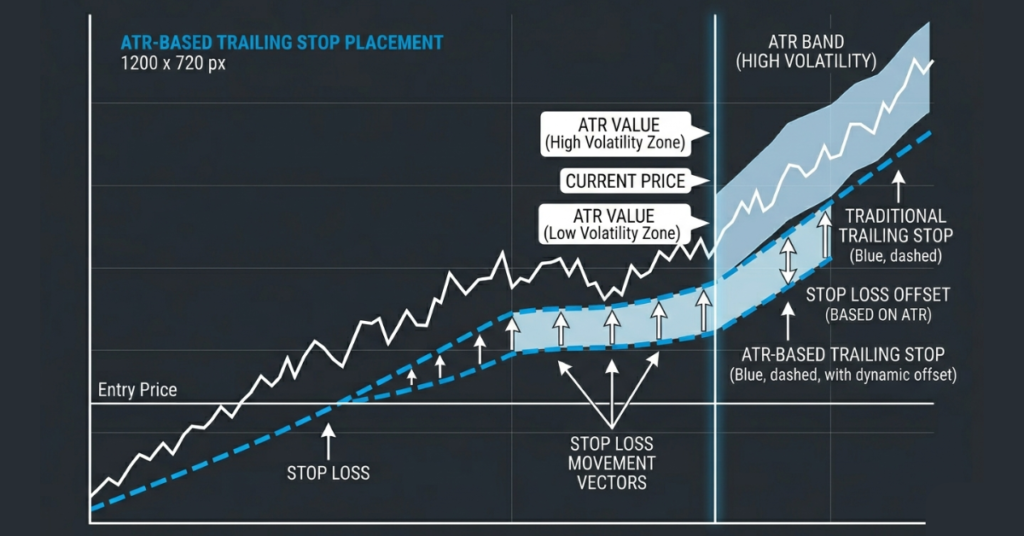
Percentage-based stops are useful, but using the Average True Range (ATR) gives you a more accurate picture of real market volatility. ATR measures how much a pair typically moves over a given period.
A common method is to set your trailing stop at 1.5x to 2x the current ATR value. If EUR/USD has a daily ATR of 80 pips and you are using a 1.5x multiplier, your trailing stop would be set 120 pips behind the price.
This approach adjusts your stop to actual market conditions rather than applying a fixed number to every trade, regardless of how volatile the market is at the time.
Related reading: What Is a Pip in ATR
Trailing Stop vs Trailing Stop Limit: Know the Difference
A trailing stop triggers a market order when the price hits the stop level. A trailing stop limit triggers a limit order instead. The limit version offers more price control but carries the risk of not being filled at all if the market gaps past your limit price.
For forex traders, a standard trailing stop is usually preferable because forex markets can move quickly and you want guaranteed exit, even if the fill is slightly off your target.
Read more: Trailing Stop Loss vs Trailing Stop Limit
Open a Demo Trading AccountCommon Mistakes With Trailing Stops in Forex
1. Setting a Fixed Percentage Without Checking Volatility
A 1% stop on EUR/USD during a low-volatility session is very different from a 1% stop during a major news release. Always check current market conditions before placing your stop.
2. Moving the Trailing Stop Manually
Some traders manually tighten their trailing stop as the trade moves in their favor, which defeats the purpose. Let the trailing stop do its job automatically.
3. Not Accounting for Spread
On pairs with wider spreads (like exotic pairs), a 1% trailing stop may be consumed partly by the spread itself. Always factor in the cost of the spread when setting stops on less liquid pairs.
4. Using the Same Stop for Different Pairs
A 1% trailing stop on GBP/JPY (a highly volatile pair) will behave very differently than on EUR/USD. Each pair has its own personality. Match your stop to the specific pair you are trading.
For more on risk management in forex, see: Forex Risk Management
How Trailing Stops Work on MT5 at Defcofx
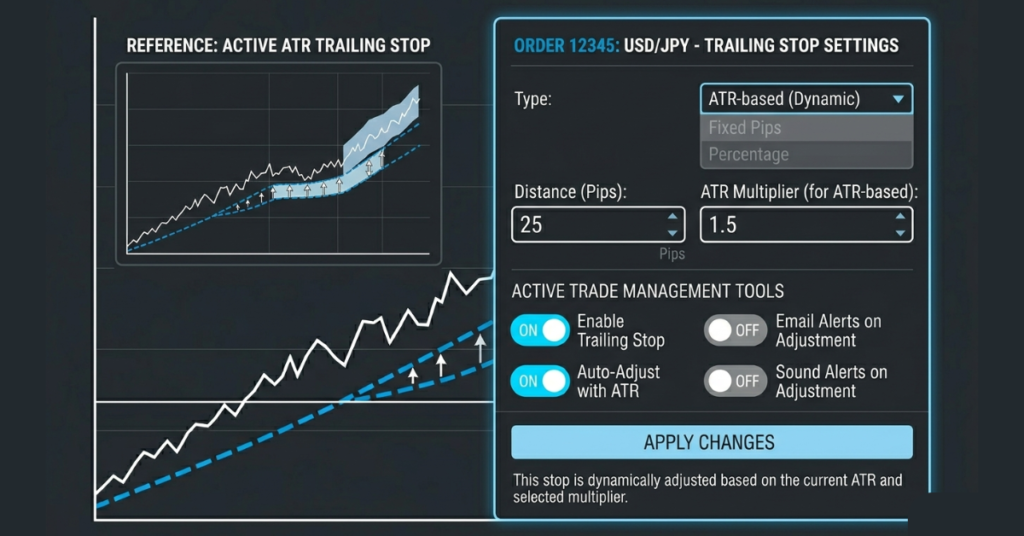
Defcofx runs on MetaTrader 5, which has built-in trailing stop functionality. You can set a trailing stop in pips directly from the terminal window on any open trade.
Steps to set a trailing stop on MT5:
- Open the Terminal window (Ctrl+T)
- Right-click on the open trade
- Select Trailing Stop from the menu
- Choose a pip distance or enter a custom value
MT5 will then automatically move the stop as the trade gains. You can also use Expert Advisors (EAs) to implement more complex trailing stop strategies based on ATR or other indicators.
Learn about MT5 trailing drawdown settings: MT5 Trailing Max Drawdown
Why Trade With Defcofx?
- Defcofx is a MetaTrader 5 broker registered in Saint Lucia that gives traders access to forex, commodities, indices, stocks, and crypto, all from a single platform.
- Here is why traders choose Defcofx for implementing trailing stop strategies:
- Fast execution: Orders are filled quickly, which matters when trailing stops are active on volatile pairs.
- Leverage up to 1:2000: More flexibility in position sizing when using tight stops.
- Spreads from 0.3 pips: Tight spreads mean your trailing stop has room to breathe without being eaten by spread costs.
- No swap or commission fees: Keep more of what your trailing stop preserves.
- 40% Welcome Bonus: On first deposits of $1,000 or more, for added margin cushion.
- Withdrawal within 4 business hours: Including weekends, so your locked-in profits reach you fast.
Final Thoughts on What Is a Good Trailing Stop Loss Percentage?
A good trailing stop loss percentage is not about finding one perfect number. It is about matching your stop to the market conditions, the currency pair, and your trading style. Tight trailing stops may work well for scalpers in calm market conditions, while swing and position traders usually need wider stops to stay in profitable trends without getting shaken out by normal volatility.
The most effective traders do not rely on fixed percentages alone. They combine trailing stops with tools like ATR, support and resistance levels, and overall market structure to create smarter exits. A trailing stop should protect profits while still giving the trade enough room to develop naturally.
On MetaTrader 5 with Defcofx, trailing stops can be managed directly through the platform, making it easier to automate risk management and lock in gains as the market moves in your favor. With spreads from 0.3 pips, leverage up to 1:2000, and no swap or commission fees, traders have the flexibility to test and refine trailing stop strategies across different forex pairs and market conditions.
FAQ
Beginners should start with a 2% trailing stop on major pairs while learning. It gives enough room to avoid being stopped out by noise while still protecting profits. Practice first on a demo account.
On major pairs like EUR/USD during active sessions, 1% can work for day trading. During news events or on volatile pairs like GBP/JPY, 1% is generally too tight and will likely trigger prematurely.
Not necessarily. Trailing stops are most useful when you want to let a winning trade run without watching it constantly. For trades with a fixed profit target, a standard take profit order may be more efficient.
A pip-based trailing stop moves by a fixed number of pips regardless of account size or price. A percentage-based trailing stop is calculated relative to the current trade value or account balance. Percentage stops scale better across different trade sizes.
No. If the market gaps past your trailing stop level (for example, during a major news event), your order may be filled at a worse price. Trailing stops reduce risk but do not eliminate it entirely.
Yes. Defcofx uses MetaTrader 5, which has native trailing stop functionality. You can set stops in pips from the terminal window on any open position.