


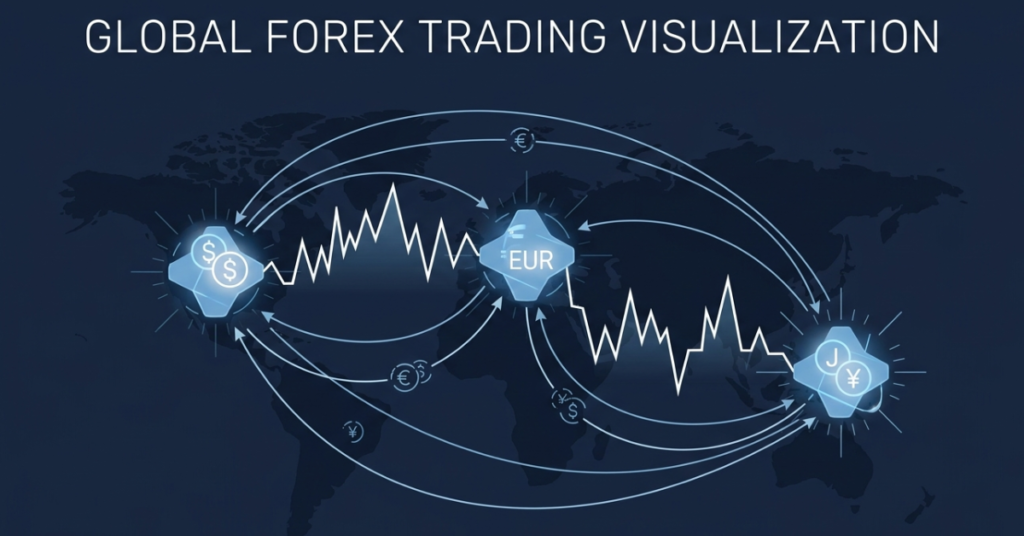
Exchange rates are important because they determine the value of one currency relative to another, which directly affects the cost of imports and exports, the purchasing power of individuals, the profitability of businesses, and the decisions of governments and central banks. For forex traders, exchange rates are the product they trade. For everyone else, exchange rates influence everything from fuel prices to overseas salaries.
Key Takeaways
- Exchange rates affect trade, travel, investments, and everyday prices.
- A stronger currency makes imports cheaper and exports more expensive.
- A weaker currency boosts exports but raises import costs and inflation.
- Central banks monitor exchange rates closely because they reflect economic health.
- Forex traders profit from exchange rate fluctuations between currency pairs.
- Exchange rate movements are driven by interest rates, inflation, trade balances, and political stability.
What Is an Exchange Rate?
An exchange rate is the price of one currency in terms of another. When you see EUR/USD = 1.1050, it means 1 Euro buys 1.1050 US Dollars. If that rate moves to 1.1200, the Euro has strengthened relative to the Dollar.
Exchange rates change constantly because currencies are traded 24 hours a day in the global forex market, which processes over $7.5 trillion in daily volume, making it the largest financial market in the world.
Learn the basics: What Is Forex Trading and How Does It Work
Why Exchange Rates Matter in International Trade
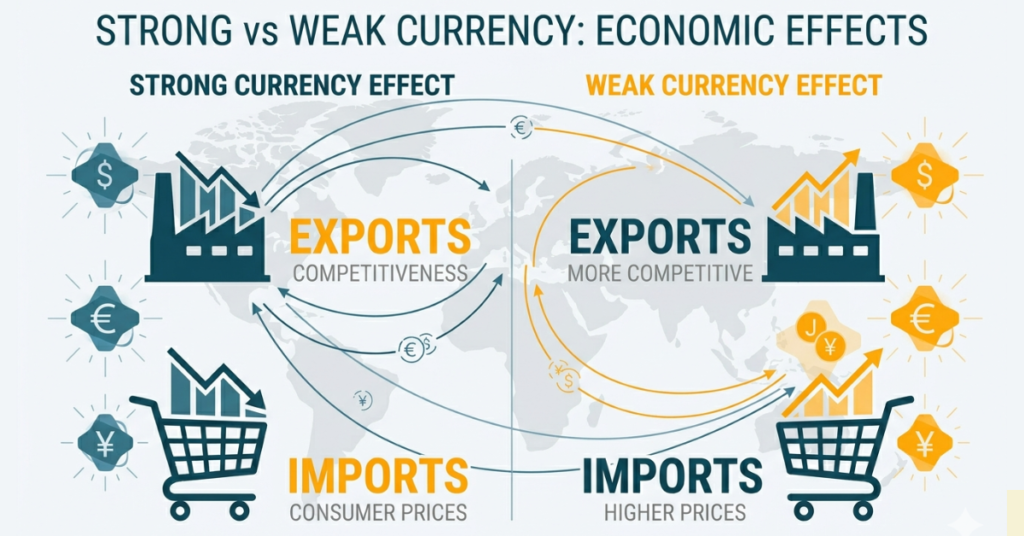
Exchange rates are the backbone of global commerce. Every time a country imports or exports goods, the price of that transaction is affected by the current exchange rate.
When a Currency Strengthens
A strong currency means the country can buy more foreign goods for the same amount of money. Imports become cheaper, which is good for consumers. But exports become more expensive for foreign buyers, which can hurt domestic exporters.
Example: If the US dollar strengthens against the Euro, American exporters selling goods in Europe earn fewer dollars for the same Euro-priced goods. Their profit margins shrink.
When a Currency Weakens
A weak currency makes exports cheaper for foreign buyers, boosting demand for domestic goods. But it raises the cost of imports, which can fuel inflation. This is why countries sometimes deliberately weaken their currency to boost exports, a practice known as currency devaluation.
Exchange Rates and Inflation
Exchange rates and inflation are closely linked. When a country’s currency falls in value, imported goods cost more in local currency. If a large portion of consumer goods are imported, this drives up the general price level, causing inflation.
Central banks like the US Federal Reserve and the European Central Bank watch exchange rates as part of their inflation monitoring. A significant currency depreciation can force a central bank to raise interest rates to cool inflation, even if the domestic economy does not otherwise call for it.
Why Exchange Rates Are Critical for Forex Traders
For forex traders, exchange rates are not background information. They are the product. Every trade is a bet on whether one currency will gain or lose value relative to another.
When you buy EUR/USD, you are buying Euros and selling Dollars. If the Euro strengthens (the exchange rate rises), your trade profits. If it weakens, you lose.
Understanding what drives exchange rate movements gives traders an edge:
- Interest rate decisions: Higher rates attract foreign capital, strengthening the currency.
- Inflation data: Higher inflation erodes purchasing power and typically weakens the currency.
- Trade balance reports: A trade surplus supports currency strength; a deficit weakens it.
- Political stability: Political risk reduces investor confidence and weakens currencies.
- Central bank interventions: Direct buying or selling of currencies to influence rates.
See also: Forex Currency Pairs
And: Best Technical Indicators for Forex
Open a Live Trading AccountExchange Rates and Investment Decisions
Investors who hold assets in foreign countries are directly affected by exchange rates. If you invest in a European stock that rises 10% but the Euro falls 8% against your home currency, your actual return is only about 2%.
This exchange rate risk (also called currency risk) is one reason why large institutional investors use forex hedging strategies to protect the value of international investments.
Learn about forex hedging: Forex Hedging Strategy
Exchange Rates and Everyday Life
Exchange rates are not just for traders and economists. They affect ordinary people in several practical ways:
Travel and Tourism
When you travel abroad, the exchange rate determines how much local currency your money buys. A strong home currency means more spending power overseas. A weak home currency makes foreign travel more expensive.
Remittances
Millions of workers send money home to families in other countries. The exchange rate determines exactly how much their family receives. A 5% shift in the exchange rate can significantly reduce or increase the real value of money sent.
Online Shopping
When you buy from international websites, prices are often listed in a foreign currency. The exchange rate at checkout determines your final cost. This is why prices for imported goods can fluctuate even when the listed price does not change.
Salaries and Contracts
People working for international companies or on cross-border contracts are paid in one currency but may live in another. Exchange rate fluctuations can change the real value of their income without any change in their nominal salary.
Key Statistics on Exchange Rates and Global Trade
| Fact | Data |
| Daily global forex market volume | Over $7.5 trillion (BIS Triennial Survey) |
| Most traded currency pair | EUR/USD (accounts for roughly 23% of daily volume) |
| Countries using a fixed exchange rate regime | Approximately 65 to 70 countries |
| Share of global trade invoiced in USD | Estimated 40% to 50% |
| Largest forex trading centers | London, New York, Singapore, Tokyo, Hong Kong |
Fixed vs Floating Exchange Rates
Not all currencies move freely. There are two main exchange rate systems:
Floating Exchange Rate
The currency’s value is determined by supply and demand in the open market. Most major currencies like USD, EUR, GBP, and JPY operate under a floating system. The rate changes constantly based on economic data, investor sentiment, and capital flows.
Fixed Exchange Rate (Pegged)
The government or central bank sets the currency at a fixed rate against another currency or a basket of currencies. The UAE dirham is pegged to the US dollar, for example. Fixed rates provide stability but require large foreign reserves to maintain.
Understand currency controls: What Are Currency Controls
What Causes Exchange Rates to Change?
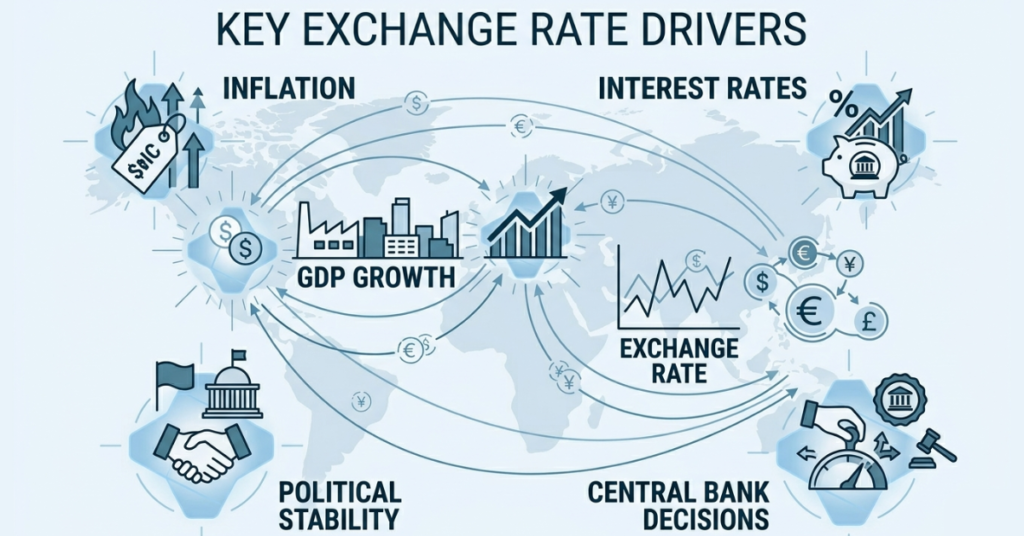
Exchange rates move constantly because the factors that influence them are always in flux:
- Interest rates: Central bank rate hikes attract foreign investment, increasing demand for the currency.
- Inflation rate: Lower inflation relative to trading partners tends to strengthen a currency over time.
- GDP growth: Strong economic growth attracts foreign capital and supports currency value.
- Political events: Elections, policy changes, and geopolitical tension create uncertainty and volatility.
- Speculation: Large institutional traders betting on future movements can move rates in the short term.
- Trade flows: Countries exporting more than they import tend to see stronger currencies over time.
To understand how to read charts that show these movements: How to Read Currency Exchange Charts
Open a Demo Trading AccountFinal Thoughts on Why Exchange Rates Are Important
Exchange rates influence far more than just forex trading. They shape global trade, impact inflation, affect travel costs, determine investment returns, and even influence the price of everyday goods. Whether you are a trader, business owner, traveler, investor, or someone sending money internationally, exchange rates directly affect your financial decisions and purchasing power.
For countries, exchange rates act as a reflection of economic strength, investor confidence, and monetary policy. A currency that moves too sharply in either direction can create economic challenges, which is why central banks closely monitor and sometimes intervene in currency markets.
FAQ
Exchange rates affect the cost of imports and exports, inflation levels, foreign investment flows, and the real value of debt denominated in foreign currencies. A country with a very weak currency may struggle to import essential goods, while one with an overvalued currency may lose export competitiveness.
A weaker currency makes imported goods more expensive in domestic terms. If a country imports a significant share of consumer goods, energy, or raw materials, currency depreciation feeds directly into higher consumer prices, contributing to inflation.
The EUR/USD exchange rate is generally considered the most important because it represents the two largest economies in the world and accounts for the highest daily trading volume in the forex market.
Not directly, but rapid and sustained currency depreciation can signal economic stress. Investors and analysts watch exchange rate trends alongside interest rate movements and trade balance data as leading indicators of economic health.
Forex traders buy a currency pair when they expect the base currency to strengthen and sell when they expect it to weaken. The difference between the entry and exit price, measured in pips, determines the profit or loss.