


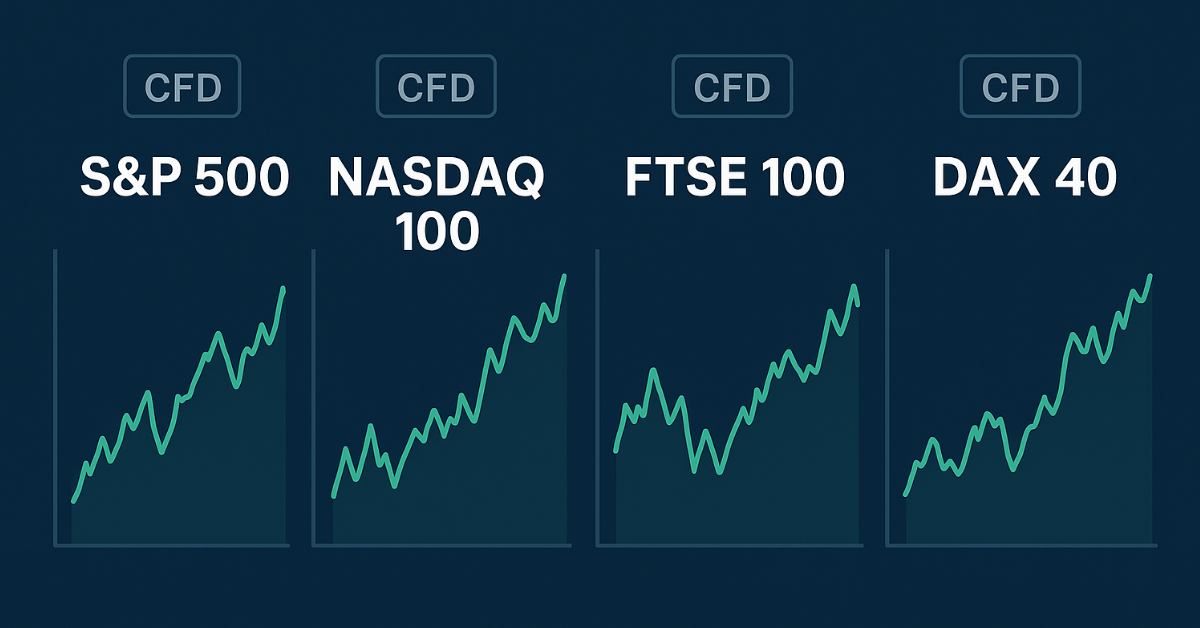
Stock indices are among the most traded financial markets, as they enable traders to monitor the performance of multiple companies using a single instrument. For those new to trading or looking to diversify their portfolio, understanding the world’s top indices can aid in recognizing market trends and making more informed trading decisions.
Key Takeaways
- Stock indices measure the performance of groups of publicly traded companies.
- The US30, S&P 500, NASDAQ-100, FTSE 100, and DAX 40 are some of the most widely followed indices globally.
- Indices reflect different sectors, economies and levels of volatility.
- Economic data, interest rates and corporate earnings are key factors that affect index prices.
- Indices can be traded via CFDs without having to own the underlying stocks.
What is a stock index?
A stock index is a benchmark that measures the performance of a basket of selected publicly listed companies. Traders don’t have to follow a dozen or more stocks (or even hundreds), they can follow one index to get an idea of how a particular market or economy is doing .
If most companies in an index gain in value , the index goes up. If most lose value, the index goes down, this makes stock indices good indicators of general market sentiment and economic strength.
While investors can not buy an index itself, they can trade products that follow the index price movements. One of the most common methods is through Contracts for Difference (CFDs), which allow traders to speculate on rising and falling markets without owning the underlying shares.
Why are stock indices important?
Stock indices are crucial in financial markets for giving a glimpse of an economy or industry. They are used by investors to gauge how the market is performing and by traders to discover opportunities based on trends, volatility and economic news.
There are many companies in each index . Trading an index might provide more market exposure than trading a single stock . This also means that if one firm performs poorly, it may have less of an effect on the total index, depending on its weighting.
Indices are also used by many professional traders as a measure of investor confidence. When indexes rise, it can mean that people feel good about the economy and think it will grow. When they fall, it might mean that people are worried or that the economy is growing more slowly.
The top 5 stock indices
While hundreds of stock indices exist worldwide, five consistently stand out because of their market influence, liquidity, and popularity among traders.
| Rank | Index | Country | Companies | Best Known For |
| 1 | US30 (Dow Jones) | United States | 30 | Blue-chip companies |
| 2 | S&P 500 | United States | 500 | Overall U.S. market |
| 3 | NASDAQ-100 | United States | 100 | Technology companies |
| 4 | FTSE 100 | United Kingdom | 100 | Largest UK businesses |
| 5 | DAX 40 | Germany | 40 | Germany’s leading companies |
#1. US30 (Dow Jones Industrial Average)
The US30, better known as the Dow Jones Industrial Average (DJIA), is one of the world’s oldest and most famous stock indices. It was formed in 1896 and it tracks 30 large U.S. corporations that have shown long-term financial health and stability.
Unlike other broader indices, the US30 is not a multitude of companies but rather a concentrate on strong, established enterprises. It includes household names such as Apple, Microsoft, Visa, Goldman Sachs, Coca-Cola and McDonald’s.
The US30 is also considered as a measure of the general health of large US companies, as it includes mature companies from a number of sectors. It has modest volatility on average which makes it popular among newbies and expert traders alike.
#2. S&P 500 Index
The S&P 500 tracks around 500 of the largest publicly traded corporations in the U.S. The index is seen by many in the financial world as the greatest depiction of the U.S. stock market since it includes companies from many different categories, including technology, healthcare, banking, energy, consumer products, and industrial companies.
Its biggest assets include Apple, Microsoft, NVIDIA, Amazon, Meta, Alphabet and Berkshire Hathaway. This diversification means that the S&P 500 tends to have smoother price swings than more concentrated indices.
For long term investors , the S&P 500 offers a benchmark to compare your investment performance to . For active traders , the S&P 500 provides constant liquidity and regular trading opportunities .
Success Tip : If you are new to index trading, many experienced traders recommend starting with the S&P 500 as it provides broad exposure to the U.S. economy rather than being disproportionately weighted toward one sector.
#3. NASDAQ-100 Index 4.
The NASDAQ-100 consists of 100 of the largest non-financial companies listed on the NASDAQ Stock Exchange. It is significantly weighted toward tech businesses and is one of the fastest-moving stock indexes in the world.
The big firms are Apple, Microsoft, Amazon, Tesla, Meta, Alphabet, and Broadcom, and NVIDIA.
Tech companies can expand fast, but they are also sensitive to fluctuations in interest rates, earnings reports and investor sentiment. Consequently, the NASDAQ-100 is generally more volatile on a daily basis than the S&P 500 or US30.
This increased volatility draws day traders and swing traders searching for greater price swings and more trading possibilities.
#4. FTSE 100
The FTSE 100 is the index of the top 100 firms listed on the London Stock Exchange. It is one of Europe’s most significant stock indices and mirrors the performance of a lot of global firms that are based in the United Kingdom.
The index has firms such as Shell, HSBC, BP, AstraZeneca and Unilever. The FTSE 100 is more diversified than the NASDAQ-100 including companies from sectors like banking, energy, pharmaceuticals and mining.
Many of its companies earn revenues overseas, therefore the FTSE 100 is affected by global economic circumstances, commodity prices and currency fluctuations rather than just by the UK economy.
#5. DAX 40
The DAX 40 (formerly DAX 30) is an index of 40 of the top publicly traded firms in Germany and one of Europe’s key market benchmarks.
The index include companies such as Siemens, SAP, BMW, Mercedes-Benz Group, Deutsche Telekom, Bayer and Allianz.
The DAX often mirrors worldwide industrial activity as Germany is known for its manufacturing, engineering, and exports. The index is most active during European hours and can react swiftly to European Central Bank pronouncements and German economic data.
Comparing the world’s top indices
Each index offers different advantages depending on your trading objectives.
| Index | Volatility | Main Sectors | Best For |
| US30 | Medium | Mixed industries | Beginners |
| S&P 500 | Medium | Broad market | Long-term investing |
| NASDAQ-100 | High | Technology | Active traders |
| FTSE 100 | Medium | Banking, Energy | European exposure |
| DAX 40 | Medium-High | Manufacturing | Day trading |
No single index is “better” than another. Instead, the right choice depends on your trading style, risk tolerance, and preferred market sessions.
What moves stock indices?
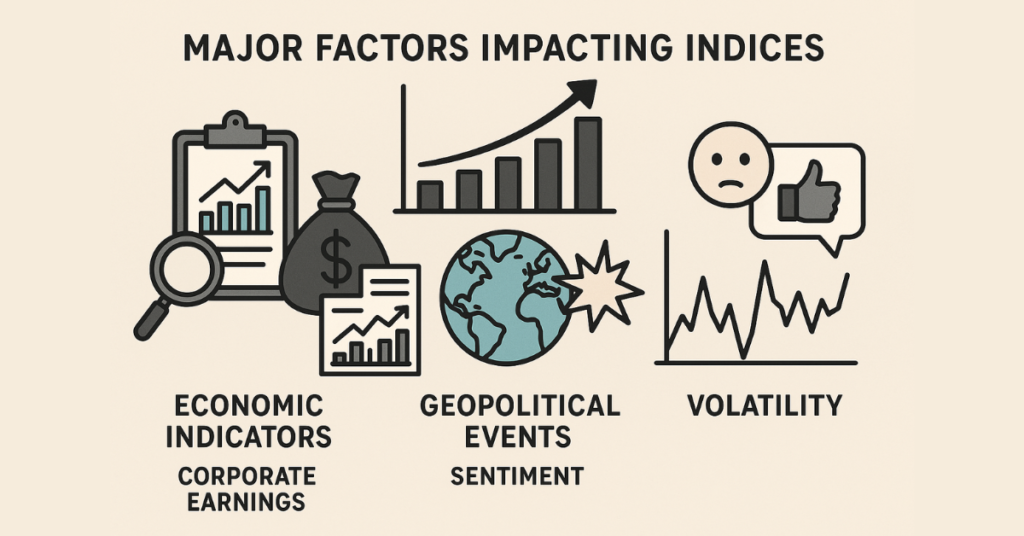
Many things influence index prices on any given day.
Economic data such as inflation, unemployment, GDP growth and retail sales often cause instant market reactions. Interest rate decisions of central banks such as the Federal Reserve, Bank of England and European Central Bank can also have a big impact on stock markets.
Corporate earnings are a big motivator as well. Most indexes are dominated by major companies, so good or bad performance can shift the entire market up or down.
Finally, geopolitical events like elections, trade deals, international conflicts, and shifts in government policy can result in higher market volatility as investors revise their outlooks.
How to trade stock indices
But many traders prefer stock indexes using CFDs, this is because you may trade on a market rise and fall without really holding the shares.
CFDs also offer flexibility through leverage, which permits traders to take greater positions with less capital. But that leverage increases your potential gains and your possible losses . So you need to manage your risk properly .
With a broker like Defcofx, traders may trade key global indices using MetaTrader 5 with spreads from 0.3 pips, no commission, leverage up to 1:2000 and withdrawals in four business hours. Qualifying deposits also get a 40% welcome bonus for eligible clients.
Open a Live Defcofx Trading AccountTypical blunders while trading indexes
One of the biggest mistakes beginners do is to trade without understanding what moves the market. If traders ignore economic news or company earnings, they can be caught off guard by unanticipated volatility.
Over-leveraging is another error. Leverage can improve returns, but it can also raise losses if the market goes against your position.
Many traders also don’t respect the need of risk management. Long-term success is built on the bedrock of stop-loss orders, position size limits, and realistic expectations.
Frequently Asked Questions
What is the most traded stock index?
The S&P 500 and NASDAQ-100 are among the most actively traded stock indices in the world. Their high liquidity, significant market influence, and extensive involvement by institutional and retail traders alike make them such.
What is the greatest stock index for beginners?
A lot of newcomers like to start with the US30 or S&P 500 as they usually have a more balanced movement than tech-heavy indices but still offer great liquidity.
Can you trade on stock indices without owning shares?
Yes. CFDs allow traders to bet on the price of stock indexes without needing to buy the underlying firms. This means that traders might possibly earn in rising and falling markets.
How volatile is the NASDAQ-100?
The NASDAQ-100 has a heavy weighting toward technology and growth companies, which are more susceptible to bigger price movements on earnings reports, innovation and changing expectations for interest rates.
What Index is Best for Day Trading?
Day traders usually prefer the NASDAQ-100 or DAX 40 since they typically experience greater intraday volatility and increased trading opportunities during active market sessions.
What influences stock indices the most?
The most significant elements affecting stock index prices are interest rates, inflation data, employment reports, company earnings, geopolitical events, and market mood.
Summary
The US30, S&P 500, NASDAQ-100, FTSE 100 and DAX 40 are still the most followed stock indices in the world since they include major economies and some of the biggest companies on earth. Each has its own prospects according to your trading style, desired market hours and your risk tolerance. Understanding how these indexes work and the factors influencing their pricing can help traders make more educated judgments and traverse global financial markets more effectively.