


Forex news can change currency prices by shifting expectations about interest rates, growth and risk. It can also widen spreads, increase slippage and disrupt technical setups. Traders may reduce exposure, avoid releases or apply tested event rules, while recognising that price direction and execution remain uncertain.
Key takeaways
- Price responds to surprises relative to expectations, but revisions, report details, positioning and policy guidance also matter.
- High-impact news can cause sharp moves, reversals and gaps. The size of a move varies; no fixed pip range is reliable.
- Scalpers are sensitive to wider spreads and slippage. Swing trades can face policy shifts, gaps and changes in trend.
- Smaller position size can keep planned price risk within a budget when a strategy calls for a wider stop; actual losses can exceed it.
- An economic calendar helps identify scheduled events, but unexpected headlines can arrive without warning.
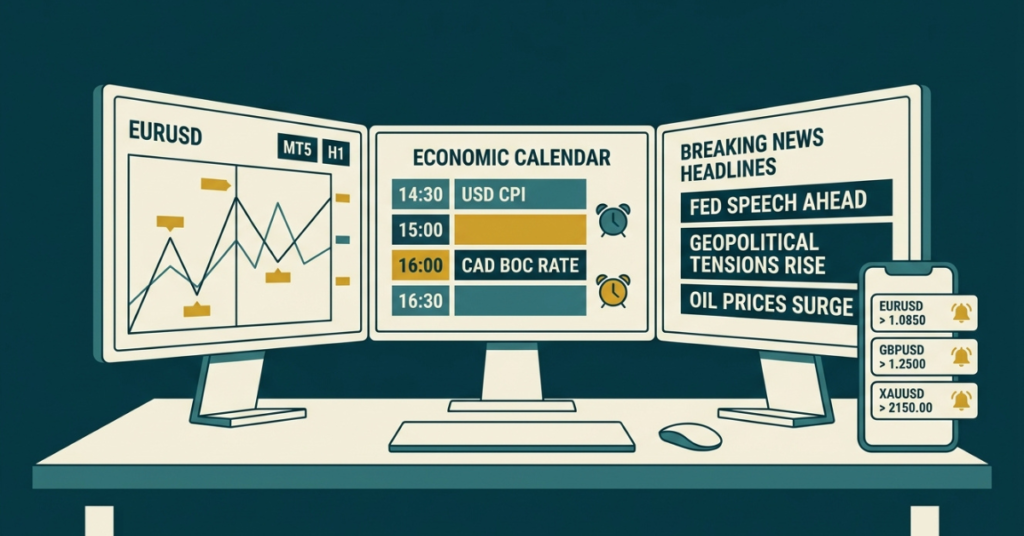
Understand how news can move currencies
Exchange rates reflect relative interest-rate expectations, growth, inflation, capital flows and risk sentiment. The following hypothetical sequence shows one possible response to news. It is not a prediction or a trading rule:
- Data is released. For example, US inflation comes in higher than forecast.
- Rate expectations change. Traders think the Federal Reserve may keep rates higher for longer.
- Money moves. Higher expected returns may attract demand for US dollars, but growth concerns or risk sentiment can outweigh that effect.
- Price reacts. USD pairs move, often within seconds. EUR/USD may fall and USD/JPY may rise, although other factors can override the initial response.
- The market digests. Over the next hours, traders decide if the move was justified, and price either continues or pulls back.
US releases are relevant to many currency pairs. The BIS April 2025 Triennial Survey commentary reports that the dollar was on one side of 89.2% of OTC foreign-exchange turnover. This covers multiple instruments, not just retail spot trading. Currency shares sum to 200% because each transaction has two currencies. The figure measures participation, not the share of trades driven by US news.
Plan for three phases of news
Scheduled releases can be considered in three phases. These timings are illustrative, not guaranteed windows; volatility and spread widening can persist longer.
| Phase | What the market does | What it means for your strategy |
| Before (30 to 60 minutes) | Activity may slow as traders wait; conditions vary | A quiet range does not guarantee a reliable breakout or low event risk. |
| During (first 1 to 5 minutes) | Possible spikes, reversals, wider spreads and slippage | Stops can fill worse than set. Entries are hard to control. |
| After (15 minutes to several hours) | Price may continue, reverse or remain unsettled | Reassess spreads, liquidity and the setup; waiting does not guarantee a clear trend or safer entry. |
One possible approach is to avoid the initial release and reassess later. Check actual spreads and market conditions rather than assuming they have normalised after a fixed number of minutes.
Assess news risk for each strategy
News does not hit every strategy the same way. Here is how the main styles are affected and the usual adjustment:
| Strategy | Main news risk | Possible adjustment to test |
| Scalping | Spread widening and slippage wipe out small targets | Stop trading a few minutes before and after high-impact data |
| Day trading | Stop losses hit by the first spike | Close or reduce positions before data, re-enter after the first move settles |
| Breakout trading | False breakouts can occur both before and after news | Wait for a candle close beyond the level after the release |
| Range trading | News can break an established range | Avoid range setups on high-impact days |
| Swing trading | A trend can reverse on a surprise central bank shift | Check the week’s calendar, reduce size into big decisions |
| Automated / EA trading | Rules built for normal conditions misfire | Add a news filter or pause the EA around key releases |
If you scalp, our article on scalp trading vs swing trading explains why short-term styles are so sensitive to costs. For a wider set of approaches, see the 15 best forex trading strategies.
Calculate position size before a release
Let’s walk through a simple example with round numbers. The figures are for illustration only.
You have a $5,000 account and risk 1% per trade, which is $50. On a normal day, you trade EUR/USD with a 15-pip stop. For a USD account trading EUR/USD with a 100,000-EUR standard lot, one pip (0.0001) is worth $10. Other pairs, contract sizes and account currencies require different calculations.
| Normal day | Hypothetical wider-stop setup | |
| Risk per trade | $50 | $50 |
| Stop loss distance | 15 pips | 40 pips |
| Position size | 0.33 lots | 0.12 lots |
| Value of 1 pip | About $3.30 | About $1.20 |
| Planned price loss before costs/slippage | $49.50 | $48.00 |
These 15-pip and 40-pip stops are examples, not recommended NFP settings. Position size = planned price-risk budget ÷ (stop distance × pip value per lot). The example uses a wider stop and smaller position to keep the planned price loss below $50, rounding size down to 0.01 lots. Measure stop distance from the actual entry price to avoid double-counting the spread; allow for fees and any extra price deterioration in the risk budget. Slippage or gaps can still make the realised loss exceed $50; smaller size does not eliminate news risk. The position size calculator does this math for you.
Compare three possible news approaches
Once you understand the impact, you can choose how to respond. These are educational examples to evaluate, not proven profitable methods. Remaining out of the market is also a valid decision.
Approach 1: Reduce or avoid exposure
Close or reduce open trades 15 to 30 minutes before high-impact news and wait until the market settles. This suits beginners, scalpers, and anyone whose strategy depends on tight spreads. A fixed 15-to-30-minute window does not guarantee protection. Conditions may worsen earlier or remain unsettled later; closing trades can also incur costs and slippage.
Approach 2: Assess a breakout after news
Mark the high and low of the quiet pre-news range. After the data, wait for a 5-minute or 15-minute candle to close outside that range, then assess if entry, stop distance and costs fit a tested plan. Waiting for a close may avoid some brief spikes but cannot confirm that the breakout will continue.
Approach 3: Assess a later pullback
The first reaction can overshoot or reverse completely. Some traders wait 30 to 60 minutes and look for a pullback into the direction of the first move. If US jobs data was strong and USD/JPY rallied 80 pips, a trader might evaluate a 20-to-30-pip pullback. These are hypothetical numbers, not entry instructions; the trend can reverse and stop execution remains uncertain.
Identify important scheduled and unexpected news
Not every release deserves a strategy change. These can matter, depending on surprises, the currency and the current policy debate:
- Central bank interest rate decisions and press conferences, especially the Federal Reserve, ECB, Bank of England, and Bank of Japan.
- The monthly US Employment Situation report, including non-farm payrolls. Check the BLS schedule; releases occur at 8:30 AM New York time, and dates vary.
- Inflation data (CPI), because it shapes rate expectations directly.
- GDP figures, especially when growth is far from the forecast.
- Unscheduled events, such as political shocks or surprise policy comments, which have no calendar warning.
Our breakdown of which forex news events have the largest moves goes deeper into each one.
Check the setup before a release
- Confirm the issuing institution’s date and time, then check your calendar’s time zone. At 8:30 AM New York, it is 5:30 PM Pakistan during US daylight saving time and 6:30 PM during US standard time.
- Read the full release, including revisions and related figures. A headline above forecast is not an automatic buy or sell signal.
- Check executable bid and ask prices, free margin and any temporary leverage changes. Increased margin on existing positions can reduce free margin even before price moves.
- Review pending orders and EAs as well as open trades. Cancelling or modifying an order may fail if it is already executing; a local EA filter needs a working calendar feed.
- Calculate combined exposure to the same currency and record the reason for any entry or decision to stay out. Demo execution may differ from live execution.
Set risk rules before major news
- Understand the stop order used by your broker. An ordinary stop is not a guaranteed maximum loss and can fill beyond its trigger during gaps or fast markets.
- Set a planned loss budget, including trading costs, before entering. If the strategy requires a wider stop, reduce size; do not widen an existing stop without reassessing total risk.
- Watch your margin level. A fast move can push an account toward a margin call if positions are too large.
- Avoid holding several trades on the same currency into one release. Check each position’s direction and combined exposure: several USD pairs may amplify the same risk, and correlations can change.
- Have an exit plan before you enter. Our forex exit strategies guide covers practical options.
For a full framework, read our forex risk management guide.
Check Defcofx terms before news trading
Defcofx’s published trading conditions permit news trading and warn about slippage. The following are published terms, not independently tested execution results:
| Defcofx feature | Why it matters around news |
| Spreads from 0.5 pips | A quoted minimum, not a guaranteed spread during or after news; check live bid and ask prices |
| No commission, no swap fees | The account overview lists zero trading commission and no swaps; review other fees and current instrument specifications |
| Forex leverage up to 1:2000 on Silver and 1:500 on Gold | Defcofx increases margin requirements on existing and new positions 15 minutes before major news, reducing 1:2000 leverage to 1:500; check free margin |
| MetaTrader 5 with calendar and alerts | Desktop calendar and push alerts; price alerts need the terminal running and connected, and delivery can be delayed |
| Withdrawal processing target around three hours, subject to conditions | A $10 USDT fee and possible wallet or unused-deposit fees apply; Saturday requests with positions open Friday must be resubmitted Monday |
| 24/5 live chat, email, and phone support | Help Monday to Friday, including busy news days |
The 40% welcome bonus terms cover eligible new clients’ first deposits of at least USD 1,000 or EUR 1,000. Request and receive the bonus before any trades or orders. Verification requires ID and a selfie holding it. Bonus credit is non-withdrawable; withdrawals or internal transfers cancel it. Pakistan, India and other listed countries are excluded. Compare tiers on the accounts overview page.
Open Live Trading AccountFinal thoughts on news and strategy
Forex news does more than create short-term price spikes. It can change interest-rate expectations, volatility, spreads, and even the direction of a broader trend. That means a strategy that works well during normal market conditions may need different rules when a major release is approaching.
The most practical adjustment is to control risk rather than simply trying to predict the news reaction. A strategy may call for wider stops when volatility increases, but position size should be reduced so the planned price risk remains within the budget before costs and slippage. This keeps the trade structure consistent even when market conditions change.
Frequently asked questions
News can change expectations about relative interest rates, growth and risk, influencing demand for currencies. The surprise versus forecasts matters alongside revisions, guidance and positioning. Higher expected rates do not guarantee that a currency rises.
News releases can widen spreads, produce reversals and cause slippage. Smaller exposure or avoiding the release may reduce risk, but ordinary stops do not guarantee a loss limit. Waiting also does not guarantee safe execution.
No strategy is universally best or reliably profitable around news. Avoiding releases, assessing breakouts or evaluating later pullbacks are possible approaches. Test clear rules across different conditions and include realistic spread, slippage and execution assumptions.
Scalpers should evaluate how wider spreads and slippage affect their small targets. Avoiding high-impact releases may suit a strategy that needs stable costs, but fixed waiting periods cannot guarantee normal conditions. Check actual prices before resuming.
Choose the stop before entry from a tested plan. If a wider distance is justified, reduce position size and budget for costs. Avoid widening an existing stop blindly; gaps and slippage can still exceed planned losses.
Sources and review
Reviewed 9 October 2026 against the BIS survey, BLS release schedule and Defcofx’s account overview, trading conditions, withdrawal policy and promotion terms. Published terms can change. Leveraged forex and CFDs carry a substantial risk of loss; the examples do not promise profitability or a maximum realised loss.
What do traders say about Defcofx?
Read customer perspectives on Trustpilot and REVIEWS.io. Consider both positive and negative experiences alongside current account terms. Reviews alone do not establish regulation, safety or future trading outcomes.