


Before choosing a forex trading account, verify legal eligibility and the broker’s regulatory authorisation. Compare total costs, account type, leverage, margin close-out rules, minimum trade size, platform and withdrawal conditions. Choose terms that fit your strategy and affordable loss budget, then practise on a demo account.
Key takeaways for account selection
- Compare the total cost per trade, not just the advertised spread. Add commission and swaps.
- Choose the account type that fits your style: spread-only, raw spread pricing (often with commission), or swap-free.
- Check the stop-out level, because it decides when your broker closes positions automatically.
- Look at withdrawal speed and methods before you deposit, not after.
- Score each account against the same checklist so you compare like with like.
Define your trading needs first
Every other choice depends on this one. A feature that is a big plus for one trader barely matters to another. Answer three quick questions before you compare any accounts:
- How long do you hold trades? Minutes (scalping), hours (day trading), days or weeks (swing trading).
- How much will you start with? $50, $500, $5,000, or more.
- How will you trade? By hand, with Expert Advisors (EAs), or both.
Keep your answers in mind as you go through the checklist below. If you are new to the basics, start with what a forex account is.
The ten-point forex account checklist
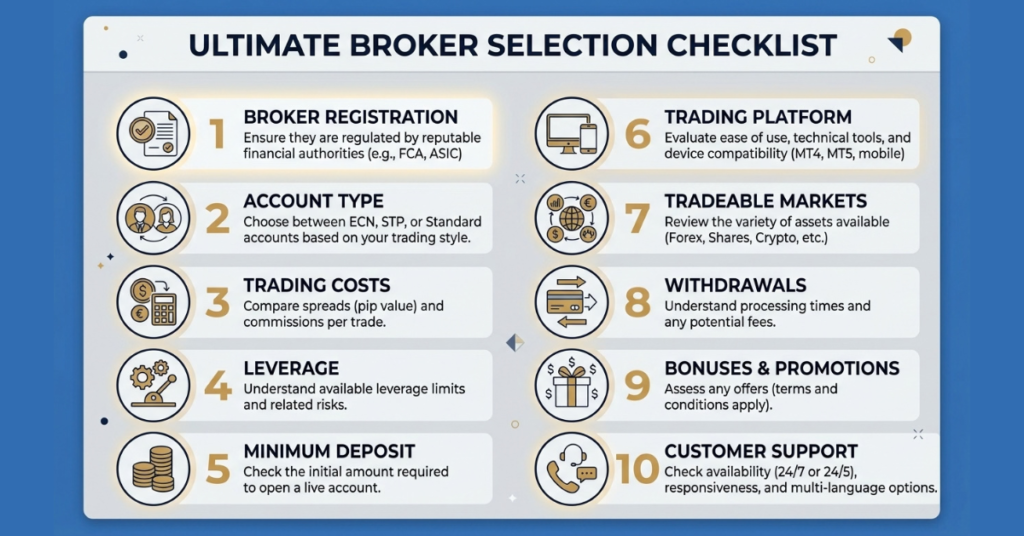
1. Regulatory authorisation and fund safeguards
Ask: Who runs this broker, where is it registered or regulated, and how is my money handled?
Look for: Verify the legal entity, licence and permission to serve your country on the relevant financial regulator’s register. Company incorporation alone does not establish financial authorisation. Read client-money, insolvency, complaint and withdrawal terms; a segregation claim alone is not a guarantee.
Avoid: Brokers that hide their company details or promise guaranteed profits.
Rules depend on jurisdiction, product and client classification. For example, FCA retail CFD rules set roughly 1:30 maximum leverage on major forex pairs and account-level margin close-out requirements. Those protections do not automatically apply to an offshore account. A higher advertised limit does not override local restrictions.
Ask how negative balance protection works, what exclusions apply, and which dispute or compensation arrangements cover your contracting entity. A segregation claim or company registration is not deposit insurance. For Pakistan residents, the State Bank of Pakistan circular prohibits relevant offshore forex, margin and CFD purchases and related remittances; a crypto payment method does not remove local restrictions.
2. Account type and pricing model
Most brokers offer a few account types. The names vary, but the pricing models are usually these:
| Account type | How you pay | Usually suits |
| Spread-only (standard) | Spread includes the broker’s pricing charge; no separate trading commission | Traders comparing simpler spread-based pricing |
| Raw spread pricing | Lower quoted spread, often plus commission; check the actual tariff | Scalpers and high-volume traders |
| Islamic / swap-free | No overnight swap; some brokers add a fee instead | Traders who cannot pay or receive interest, swing traders |
| Demo | Free, virtual money | Practice and testing strategies |
3. Total cost per trade
Ask: What does one round-turn trade really cost me?
This is where many traders get misled. A tiny spread looks cheap until you add the commission. Here is a simple comparison on 1 standard lot of EUR/USD, where 1 pip is about $10. The account terms are hypothetical examples in a USD account, with a standard lot of 100,000 EUR and no price movement between execution quotes:
| Account A | Account B | Account C | |
| Spread | 1.2 pips | 0.1 pips | 0.5 pips |
| Spread cost | $12 | $1 | $5 |
| Commission (round turn) | $0 | $7 | $0 |
| Total cost per lot | $12 | $8 | $5 |
| Cost for 50 lots a month | $600 | $400 | $250 |
Account C has the lowest illustrated spread-plus-commission cost. This example excludes swaps, slippage and other applicable fees; actual spreads vary. Always do this math. Our guide on how to calculate spread and the average spread in forex can help.
4. Leverage and margin rules
Ask: What is the maximum leverage, and at what level will positions be closed?
Leverage decides how much margin each trade needs. The stop-out level decides when the broker starts closing your trades. Margin level is equity divided by used margin, times 100. For an account that initially met its margin requirements, a fall in equity to $200 against $1,000 used margin produces a 20% margin level. That is a hypothetical close-out threshold, not a new-trade funding example. Defcofx’s conditions state liquidation begins below 20%; confirm the exact trigger and calculation for your account.
Read lot size vs leverage and what free margin is to understand how these pieces fit together.
Required margin can change with news, symbol limits or broker rules. Defcofx publishes a reduction from 1:2000 to 1:500 during the 15 minutes before and after specified high-impact news, covering existing and new positions. For a fixed position, lower leverage increases required margin without changing the dollar loss per pip.
5. Minimum deposit and position size
Ask: Can I start small and trade small?
A low minimum deposit does not make an account low-risk. Check the smallest permitted position and your planned stop distance. At 0.01 lots, each pip on EUR/USD is worth about $0.10, so a 30-pip stop on 0.01 lots has $3 of planned price risk, or 3% of a $100 account, before costs. A stop order is not a guaranteed execution price; gaps or slippage can increase the loss. Small accounts may be unable to meet a low risk percentage with a strategy-appropriate stop and the minimum lot size. See the best lot size for a $1,000 account for worked examples.
6. Trading platform and tools
Ask: Does the platform work on all my devices, and does it support the tools I use?
Look for: A reliable platform such as MetaTrader 5, mobile and web versions, Expert Advisor support, a built-in economic calendar, and VPS options if you automate. Compare platforms in MT4 vs MT5.
7. Available markets and instruments
Ask: Can I trade everything I want from one account?
Check the number of currency pairs and see if gold, indices, stocks, or crypto CFDs are included. Having them in one MT5 login saves you from managing several accounts.
8. Deposit and withdrawal conditions
Ask: How do I get money in and, more importantly, how fast can I get it out?
Look for: Payment methods that work in your country, clear fees, and a stated withdrawal processing time. Avoid: Brokers with vague withdrawal rules or long “review” periods with no time limit.
9. Bonus terms and restrictions
Ask: If there is a bonus, what are the rules?
A deposit bonus may add restricted trading credit, but every bonus has terms. Check the minimum deposit, how the bonus is credited, and what conditions apply before bonus funds or related profits can be withdrawn.
10. Customer support and escalation
Ask: Can I reach a real person during the hours I trade?
Send a question through live chat before you open an account. Ask about response hours, escalation routes and how trade or withdrawal disputes are handled. A clear initial reply is useful, but it does not prove future service quality or fund safety.
Open Free Demo AccountMatch account features to your strategy
| Trader profile | What matters most | Account features to look for |
| Beginner with $100 to $500 | Learning and affordable loss limits | Low minimum deposit, micro lots, demo account, simple pricing |
| Scalper | Cost per trade, speed | Lowest total cost, fast execution, no restrictions on short trades |
| Day trader | Cost and reliability | Tight spreads in London and New York hours, solid platform |
| Swing trader | Overnight costs | Swap-free or low-swap account, wide range of pairs |
| EA / algo trader | Automation | MT5 with EA support, suitable position limits and strategy permissions, VPS option |
If you are just starting, our guide to the best forex broker for beginners explains which features matter in your first year.
Red flags before funding an account
- Promises of guaranteed or fixed monthly returns.
- No company name, address, or registration number on the website.
- Pressure from “account managers” to deposit more or trade bigger.
- Withdrawal rules that are unclear or keep changing.
- Bonus terms that are hidden or impossible to find.
- No demo account and no way to test the platform first.
Compare Defcofx against the checklist
The table below summarises published terms, not an independent endorsement. Compare the account page, FAQ, trading conditions, promotion rules and withdrawal policy. Ask support to resolve conflicting terms before funding.
| Checklist point | Defcofx |
| Registration | Defcofx lists Saint Lucia company registration no. 2024-00205; this does not establish a forex regulatory licence |
| Account types | Silver (from $50, up to 1:2000) and Gold (from $1,000, up to 1:500, no advertised per-order lot cap; margin and symbol limits apply) |
| Cost per trade | Spreads from 0.5 pips, $0 commission |
| Swaps | Both tiers are advertised as swap-free and Islamic; assess the full terms if religious compliance matters |
| Stop-out level | 20% on Silver and Gold |
| Platform | MT5 desktop, web and mobile; features differ. The FAQ says EAs are enabled on Gold only; desktop MT5 or a suitable VPS is needed |
| Markets | Forex, metals, indices and stock CFDs; the current FAQ says crypto trading is no longer offered |
| Withdrawals | Typical processing target around 3 hours, not guaranteed wallet receipt. $10 USDT fee and possible wallet or unused-deposit fees; Saturday requests with positions open Friday must be resubmitted Monday |
| Deposit methods | The FAQ lists multiple crypto funding options. Confirm current coins, networks and fees in the portal; crypto funding does not imply crypto trading |
| Bonus | 40% conditional trading credit for eligible new clients with a first deposit of at least USD 1,000 or EUR 1,000. Request and receive it before trades or orders; identity documents and country exclusions apply. Bonus credit is not withdrawable; withdrawals or internal transfers cancel it |
| Support | The FAQ advertises 24/5 live chat, email and phone; the FAQ ties country acceptance to legal restrictions. Confirm local eligibility |
Compare the details on the accounts overview page, or follow our guide on how to open a forex trading account.
Open Live Trading AccountWhat do traders say about Defcofx?
Compare dated feedback on Trustpilot and Reviews.io. Read withdrawal experiences, complaint details and company responses. Customer reviews can identify questions to ask, but do not establish regulatory authorisation, solvency or guaranteed future outcomes.
Final checks before choosing an account
Choosing a forex trading account should start with the terms that directly affect your money, not the features that look impressive on a broker’s homepage. Regulatory authorisation, legal eligibility, total trading costs, leverage, stop-out rules, withdrawal conditions, and account structure should all be clear before you deposit.
The right account also depends on how you trade. A scalper may care most about the combined spread and commission, while a swing trader may focus more on swap costs. An EA trader needs reliable automation and VPS support, whereas a beginner may benefit more from a low minimum deposit, micro lots, and a demo account.
A useful comparison is to put every broker through the same 10-point checklist. Calculate the real cost of a typical trade, check how much margin you need, understand when positions can be closed automatically, and verify how deposits and withdrawals work in your country. This makes it easier to compare accounts based on practical conditions rather than marketing claims.
Frequently asked questions about account selection
Start with legal eligibility and independently verified regulatory authorisation for the contracting entity. Then compare costs, client-money safeguards, withdrawal terms and suitability. Company registration alone does not establish financial authorisation or guarantee protection of your money.
Begin with a demo account, clear pricing, suitable minimum position sizes and understandable risk controls. A low deposit or spread-only tariff is not automatically safest. Choose a live account only after understanding potential losses and eligibility.
No. Raw spread accounts often add commission, but pricing varies by provider. Compare spread cost plus round-turn commission for the same instrument and trade size, then include overnight charges, slippage and other applicable fees.
A stop-out level is a margin threshold that can trigger automatic position closure. Margin level equals equity divided by used margin, multiplied by 100. Exact triggers, liquidation sequence and execution prices depend on the broker’s terms.
Minimum deposits vary by broker and tier. Defcofx publishes $50 for Silver and $1,000 for Gold. Entry requirements do not establish an adequate trading budget; minimum position size, costs and planned losses also matter.
Published terms and primary sources checked on 9 October 2026. Recheck conditions before acting; advertised service outcomes are not independently guaranteed.