


Read a currency trading symbol from left to right: the first code is the base currency and the second is the quote. EUR/USD at 1.0850 means one euro equals 1.0850 US dollars. In forex CFDs, buying creates exposure to the base gaining against the quote.
Key takeaways for reading forex symbols
- Every forex symbol has two parts: base currency / quote currency. Read it as “1 base = X quote.”
- Codes come from the ISO 4217 standard, so USD, EUR, JPY and GBP mean the same thing at every broker.
- Brokers commonly use names such as EURUSD in MetaTrader 5 for EUR/USD. Exact names and suffixes are broker-defined.
- Every symbol has two prices, a bid (sell) and an ask (buy). The gap is the spread.
- A pip is the fourth decimal for most pairs and the second decimal for yen pairs.
- XAU and XAG denote gold and silver. An X prefix alone does not prove a symbol is a metal; ISO also uses X codes for other special units.
Identify the base and quote currencies
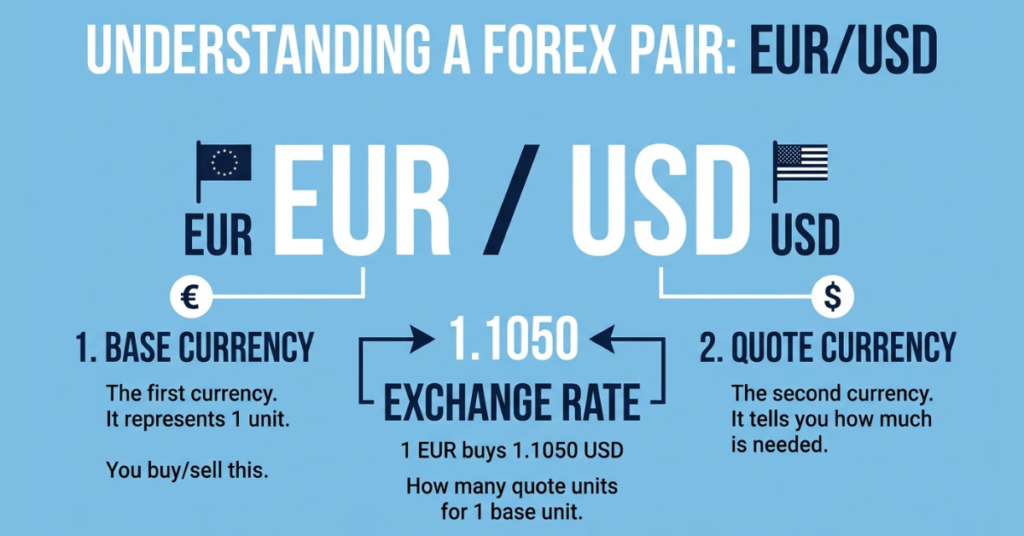
Think of a forex symbol as a short sentence. Take GBP/USD. The first code, GBP, is the base currency. The quote is expressed for one unit of it; this does not mean the currency has a fixed value. The second code, USD, is the quoted currency, and the price tells you how many units of it you need to buy that single pound.
So if GBP/USD shows 1.2700, one British pound costs 1.27 US dollars. If the price rises to 1.2800, the pound has strengthened (or the dollar has weakened, which is the same move seen from the other side).
Where the three-letter codes come from
Currency codes follow the ISO 4217 standard. In most cases the first two letters are the country code and the third letter is the first letter of the currency name. That is why you get US + D for the US dollar and JP + Y for the Japanese yen. This is a helpful pattern, but exceptions exist. Verify unfamiliar codes with ISO’s currency-code guidance and the SIX maintenance list rather than guessing.
| Code | Country code + letter | Currency | Common nickname |
| USD | US + D | US dollar | Greenback, Buck |
| EUR | EUR is a special euro code, not a country/currency-initial formula | Euro | Fiber (EUR/USD) |
| JPY | JP + Y | Japanese yen | Yen |
| GBP | GB + P | British pound sterling | Cable (GBP/USD), Sterling |
| CHF | CH + F | Swiss franc | Swissie (USD/CHF) |
| CAD | CA + D | Canadian dollar | Loonie (USD/CAD) |
| AUD | AU + D | Australian dollar | Aussie |
| NZD | NZ + D | New Zealand dollar | Kiwi |
Read exchange rates and price increments
The number next to the symbol is the exchange rate. The way you read its decimals decides how you measure profit, loss and cost.
Understand pips, pipettes and points
For most pairs quoted to four decimals, one pip is 0.0001. EUR/USD moving from 1.0850 to 1.0870 is a 20-pip move. Brokers on MT5 usually show a fifth decimal, called a pipette, which is one tenth of a pip. So 1.08503 is 1.08500 plus three pipettes, equal to 0.3 pip.
Yen pairs are different. USD/JPY is quoted to two or three decimals, and one pip is 0.01. If USD/JPY goes from 150.20 to 150.45, that is 25 pips.
A pip, platform point and tick size are related but different. On a five-decimal EUR/USD quote, a point is commonly 0.00001, while a conventional pip is 0.0001. The tick size is the permitted price increment and need not equal the point. Tick value and account-currency conversion determine the money value of a move.
Read bid, ask and spread
Every symbol shows two prices. The bid is the price you sell at. The ask is the price you buy at, and it is normally higher; the spread can vary or occasionally be zero. The difference is the spread, which is the main trading cost on a zero-commission account.
| What you see | What it means |
| EURUSD Bid 1.08500 Ask 1.08508 | You can sell at 1.08500 or buy at 1.08508 |
| Spread 0.8 pips | The bid-ask gap. An immediate buy at the ask and close at an unchanged bid produces this price loss, before other costs. |
| Daily change +0.25% | The displayed quote rose 0.25% relative to the platform’s daily comparison baseline; confirm its time zone and definition |
Prices in these examples are for illustration only. Always check live quotes on your platform.
Understand buying and selling a symbol
This is where most confusion happens. For deliverable spot forex, Buy EUR/USD means buying euros against dollars. For a retail forex CFD, it creates a long position in the exchange rate rather than delivering currency into your bank account. A long position gains before costs when its executable exit price exceeds its entry price. Sell creates the opposite exposure. A net profit depends on the executable entry and exit prices and all costs.
Here is a simple example. In a USD account, you buy one standard lot of EUR/USD, representing 100,000 EUR, at an executed ask price of 1.0850. You close at an executed bid price of 1.0900. The 50-pip difference is $500 gross, before commission or holding charges. Those entry and exit prices already include the spread; do not deduct it again.
Recognise common groups of trading symbols
Brokers commonly group symbols by asset class and currency-pair category. Categories give context, but do not reliably predict future volatility or execution costs. Check the actual symbol and trading conditions.
| Group | Example symbols | What to expect |
| Majors | EURUSD, USDJPY, GBPUSD, USDCHF, AUDUSD, USDCAD, NZDUSD | Include USD and another widely traded currency; commonly liquid, but spreads still vary |
| Minors (crosses) | EURGBP, EURJPY, GBPJPY, AUDNZD | No USD; liquidity and spreads vary substantially by pair and trading session |
| Exotics | USDTRY, USDZAR, EURPLN, USDSEK | Often include an emerging-market or less frequently traded currency; may have wider spreads or lower liquidity |
| Metals | XAUUSD, XAGUSD | Gold and silver priced in dollars per troy ounce |
| Indices | US30, NAS100, GER40 | CFDs referencing stock-market indices; contract names and terms vary by broker |
For a full breakdown, see our list of major and minor forex pairs and our 28-pair forex list, which includes crosses as well as the commonly named majors.
Why gold is XAU and not GLD
ISO 4217 also covers precious metals. The X prefix is used for precious metals and certain special monetary or accounting units. XAU is gold (Au is its chemical symbol), XAG is silver (Ag). If a gold instrument is quoted in USD per troy ounce, an illustrative XAUUSD price of 3,500.00 means $3,500 per ounce. The lot’s contract size is separate from this quote unit; check the broker’s specification. Our XAUUSD pips and lot size guide shows how gold pips are measured.
Check broker-specific index contract names
Index names are not standardized. The Dow Jones Industrial Average may appear as US30, DJ30 or WS30 depending on the broker. Our guide on what US30 means in forex explains how these index CFDs work.
Check suffixes and contract specifications
Some brokers add letters to the end of a symbol to separate account types or contract sizes. You might see EURUSD.m, EURUSD.pro or EURUSDi. The underlying pair is the same. The suffix may indicate account, pricing or contract variants, but its meaning is broker-specific; do not assume .m means a micro contract.
Put currency symbols in market context
The Bank for International Settlements (BIS) runs a global survey of currency trading every three years. The September 2025 release of its April survey gives useful context for the prevalence of USD pairs. These are global OTC turnover figures, not retail trading volumes or a forecast.
| Metric (April 2025, BIS Triennial Survey) | Figure |
| Average daily global OTC FX turnover, all instruments | $9.6 trillion |
| Share of trades with USD on one side | 89.2% |
| Share with EUR on one side | 28.9% |
| Share with JPY on one side | 16.8% |
| Share with GBP on one side | 10.2% |
| Share with CNY on one side | 8.5% |
Shares add up to 200% because every trade involves two currencies. Source: BIS April 2025 FX survey summary, published September 2025.
Practise decoding three currency pairs
Try reading these before checking the answer.
- AUDUSD 0.6600. One Australian dollar costs 0.66 US dollars. Buying this means you expect the Aussie to rise.
- USDJPY 150.20. One US dollar buys 150.20 yen. A move to 150.70 is 50 pips, because the pip is the second decimal.
- EURGBP 0.8550. One euro costs 0.8550 pounds. No dollar involved, so this is a minor (cross) pair.
Explore currency symbols on Defcofx MT5
The Defcofx account page lists MetaTrader 5, where every tradable symbol sits in the Market Watch window with live bid and ask prices. You can add or hide symbols, open a chart with one click, and check each contract specification before trading. MetaQuotes documents the fields in its Market Watch and symbol specification guide. If you are new to the platform, our step-by-step guide on how to use MetaTrader 5 walks you through the layout.
- The account page advertises spreads from 0.5 pips, $0 commission and no swaps. Spreads vary, and payment or other applicable fees can still affect total costs.
- Forex leverage up to 1:2000 on Silver and 1:500 on Gold; symbol limits and pre-news margin increases apply. Size positions by the loss budget, not maximum leverage.
- 61 currency pairs plus metals, indices and stock CFDs in one MT5 account. The current FAQ says crypto trading is no longer offered.
- The 40% welcome bonus is conditional trading credit for eligible new clients with a first deposit of at least USD 1,000 or EUR 1,000. Request and receive it before trades or orders. Identity documents and country exclusions apply; the credit is not withdrawable, and withdrawals or internal transfers cancel it.
- The withdrawal page advertises typical processing of around 3 hours, subject to conditions; this is not a guarantee of when funds will arrive. A $10 USDT fee and possible wallet or unused-deposit fees apply; Saturday requests with positions open Friday must be resubmitted Monday.
- The FAQ ties country acceptance to legal restrictions, not a blanket US exclusion. Confirm local eligibility and the contracting entity before funding; portal access does not establish regulatory authorisation.
What do traders say about Defcofx?
Compare dated feedback on Trustpilot and Reviews.io. Look at platform and withdrawal experiences, complaint details and company responses. Reviews describe individual experiences; they do not verify regulatory authorisation, fund safety or future trading results.
Final checks before trading unfamiliar symbols
Reading currency trading symbols becomes much easier once you stop treating them as complicated platform codes and read them as a simple relationship between two currencies. The first code is the base currency, the second is the quote currency, and the price tells you how much of the quote currency is needed for one unit of the base.
From there, bid and ask prices, spreads, pips, and position direction all become easier to understand. Knowing that Buy EUR/USD means buying euros against the dollar, or that XAUUSD represents gold priced in US dollars, helps you interpret what a trade actually represents before placing it.
It is also important to look beyond the main six characters. Suffixes can identify different account or contract versions, while metals and indices use symbols that may follow different conventions. Checking the contract specification in MT5 is therefore an important step before trading an unfamiliar instrument.
Frequently asked questions about currency symbols
The base currency is the first code. The rate expresses one unit of the base in units of the quote currency. In EUR/USD, EUR is the base and USD is the quote; neither has a fixed value.
Brokers commonly name the euro-dollar symbol EURUSD rather than EUR/USD. Both labels can describe the same currency pair. Exact names, prefixes and suffixes are broker-defined, so confirm the instrument description and contract specification in MT5.
Majors commonly pair USD with another widely traded currency. Minors usually pair major currencies without USD; exotic labels often involve smaller or emerging-market currencies. These are market conventions, not guarantees of liquidity, spreads or future volatility.
XAU is the ISO code for gold and USD denotes US dollars. XAUUSD commonly quotes gold in dollars per troy ounce. A broker’s CFD lot may represent multiple ounces, so check contract size and tick value.
For a typical forex quote, bid is the price used to sell and ask is the price used to buy. Their difference is the spread. Quotes change, and the actual execution price can differ through slippage.
Educational examples are hypothetical. Sources and published broker terms checked on 9 October 2026; confirm current specifications, eligibility and conditions before acting.