


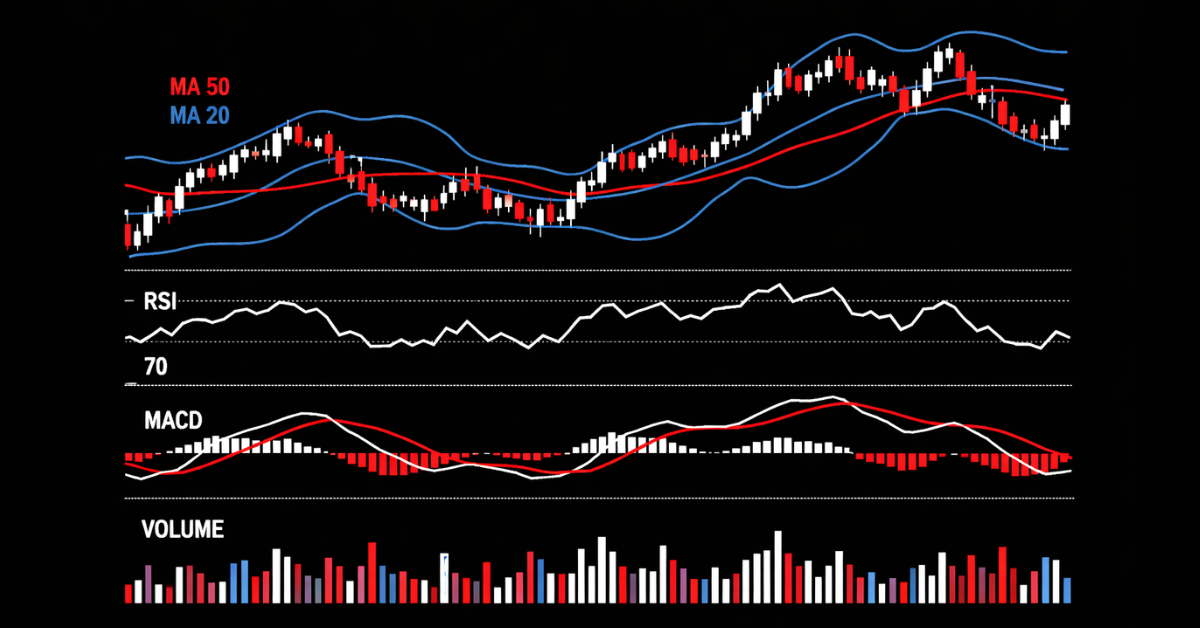
The best moving average for a 4-hour chart is the 50-period Exponential Moving Average (50 EMA). It reacts quickly to price changes, helps identify trend direction, and works well for swing and intraday trades. Traders often combine it with the 200 EMA for stronger trend confirmation.
Key Takeaways
- The 50 EMA is highly effective for trend direction and entry points on the 4H chart.
- The 200 EMA serves as a long-term trend filter and dynamic support/resistance.
- Combining EMAs helps spot reversals and ride sustained trends.
- Price action near moving averages offers high-probability trade setups.
- Brokers like Defcofx provide customizable moving average indicators on MT5.
Moving Averages on the 4H Chart
A 4-hour chart bridges the gap between fast-paced intraday trades and longer swing trades. It allows traders to capitalize on medium-term market moves without being glued to the screen all day.
Moving averages, when applied to this timeframe, provide powerful insights into:
- Trend direction
- Dynamic support/resistance levels
- Entry/exit confirmations
The smoother the average, the clearer the trend. That’s why the 50 EMA stands out; it filters out noise while still reacting fast enough to price shifts.
Why the 50 EMA Is the Best Moving Average for a 4H Chart
The 50-period exponential moving average is widely used by both institutional and retail traders. On a 4H chart, it delivers an ideal balance and quick responsiveness without being overly sensitive.
Here’s why traders prefer the 50 EMA:
- Clarity in trend direction: Price staying above the 50 EMA indicates a bullish trend, and vice versa.
- Smart entries: When price pulls back to the 50 EMA and shows bullish/bearish price action, it often signals a continuation.
- Swing-friendly: The 4H chart + 50 EMA combo is perfect for trades lasting several hours to a few days.
Platforms like Defcofx, with fast execution and real-time MA tools, let you fine-tune such setups with confidence.
Trade smarter with 4-hour precision. Join Defcofx and use advanced MT5 tools to customize your moving averages, analyze trends faster, and ride the markets like a pro.
Open AccountHow to Use the 50 and 200 EMA Together
Many traders don’t rely on a single moving average. Instead, they pair the 50 EMA with the 200 EMA:
- When the 50 EMA crosses above the 200 EMA, it signals a bullish trend.
- When the 50 EMA drops below the 200 EMA, it warns of a bearish shift.
This EMA crossover strategy works especially well on 4-hour charts, where signals are more reliable than lower timeframes.
You can enhance accuracy by looking for price action confirmation or confluence with support/resistance zones.
20 EMA for Aggressive Traders
While the 50 EMA offers balance, the 20 EMA suits more aggressive traders seeking quicker trades.
On a 4H chart, the 20 EMA:
- Responds faster to price moves.
- Offers tighter entries for short bursts of momentum.
- Can be used for tighter stop-losses and more frequent setups.
However, due to its sensitivity, it can give more false signals in choppy conditions. That’s why combining it with the 50 EMA provides better structure.
Whether you’re using the 20, 50, or 200 EMA, ensure your broker gives you charting flexibility, something Defcofx’s MT5 platform excels at.
Using Moving Averages as Dynamic Support/Resistance
One of the most powerful ways to use MAs is to treat them like floating support/resistance lines.
Here’s how:
- In uptrends, the 50 EMA often acts as support. When price returns to it and forms bullish candles, it’s a great place to enter.
- In downtrends, the same line acts as resistance, where cethe price gets rejected and resumes its fall.
You can even combine moving averages with tools like Fibonacci retracements or RSI divergence to confirm stronger swing setups.
Platforms like Defcofx provide all these features, enabling a fully integrated trading experience.
Open a Live Trading AccountFAQs
What is the most popular moving average for the 4-hour chart?
The 50 EMA is one of the most popular because it helps identify trends without reacting too slowly. It’s fast enough to capture swing opportunities but still smooth enough to avoid frequent false signals. Many traders rely on it as their go-to for entries, exits, and trend analysis.
Why do traders combine the 50 and 200 EMA?
Using both gives a clearer picture of short-term and long-term market direction. The 50 EMA helps with trade timing, while the 200 EMA acts as a trend filter. When the 50 is above the 200, traders focus on long positions, and vice versa. This combination reduces noise and aligns with market sentiment.
Is the 4-hour chart good for beginners?
Yes, the 4-hour chart offers a balanced pace that suits most beginner traders. It avoids the fast noise of lower timeframes like 1-minute or 5-minute charts and offers clearer trends. With proper use of moving averages, beginners can build structured, less stressful trading routines using the 4H chart.
What’s the difference between EMA and SMA on the 4H chart?
EMAs (Exponential Moving Averages) give more weight to recent price data, so they react faster to new price moves. SMAs (Simple Moving Averages) treat all data equally, making them slower but smoother. On a 4H chart, many traders prefer EMAs for quicker signals and momentum tracking.
How do you avoid false signals when using moving averages?
Use confirmation methods like candlestick patterns, support/resistance levels, or volume indicators. Also, avoid trading in choppy markets where the price moves sideways. Combining EMAs with filters like the RSI or MACD can also reduce fake signals. Brokers like Defcofx offer these tools within a single platform.
Can I use moving averages for forex pairs like EUR/USD or GBP/JPY?
Absolutely. Moving averages work well on all major and minor forex pairs. In fact, pairs like EUR/USD tend to respond very well to the 50 and 200 EMAs on the 4-hour chart. Whether you trade majors or exotics, moving averages remain one of the most reliable tools for analysis.
How do I place stop-losses using the 50 EMA?
You can place stop-losses just below the 50 EMA in an uptrend or just above it in a downtrend. The idea is to exit the trade if the price closes significantly beyond the average, which may signal a trend reversal. The 50 EMA provides a logical structure for risk placement.
Does Defcofx support custom moving average tools?
Yes. Defcofx offers full MT5 charting support where traders can customize indicators like moving averages based on their preferences. You can adjust the type (SMA, EMA) and period and apply them to close, open, high, or low prices. This flexibility is key to fine-tuning your edge on the 4-hour chart.
Defcofx Forex Articles You Shouldn’t Miss
Discover powerful forex strategies in these top reads from Defcofx.
- Is The Pound Is Stronger Than the Dollar?
- How to Use Moving Averages for Swing Trading
- How Much is 0.5 Lot Size in Dollars
- List of Major and Minor Forex Pairs
- What Is Considered the Greatest Risk Associated With Forex Settlement?
- Is NZD/USD a Major or Minor Pair?
- Trailing Stop Limit: Definition, Uses & Trading Guide