


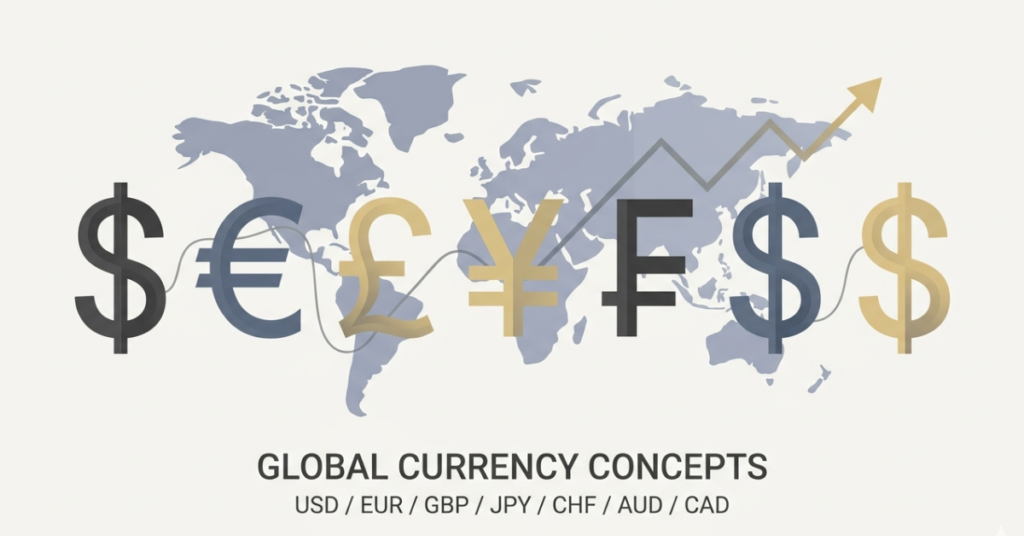
There are 180 recognized currencies in the world, each assigned a unique ISO 4217 three-letter code. From the US Dollar to the Kuwaiti Dinar, every currency serves a distinct economy and plays a specific role in global trade and forex markets.
Key Takeaways
- Most currencies are traded in pairs, and each pair has a base and a quote currency.
- 180+ currencies are officially recognized by the United Nations and ISO.
- The US Dollar (USD) is the world’s primary reserve currency, used on one side of roughly 89.2% of all forex transactions (BIS, April 2025).
- Currencies are grouped into majors, minors (crosses), and exotics based on liquidity and trading volume.
- ISO 4217 codes are the universal standard, e.g., EUR for Euro, JPY for Japanese Yen.
What Is a Currency?
A currency is the official medium of exchange in a country or group of countries. It’s issued by a central bank or monetary authority and used for trade, debt settlement, and storing value. In the forex market, currencies are bought and sold in pairs, and their relative values shift constantly based on economic data, interest rates, and global events.
Every currency traded in the forex market is identified by an ISO 4217 code. When you see EUR/USD, that means you’re trading the Euro against the US Dollar. Understanding the basics of forex trading starts with knowing the currencies involved.
Major World Currencies
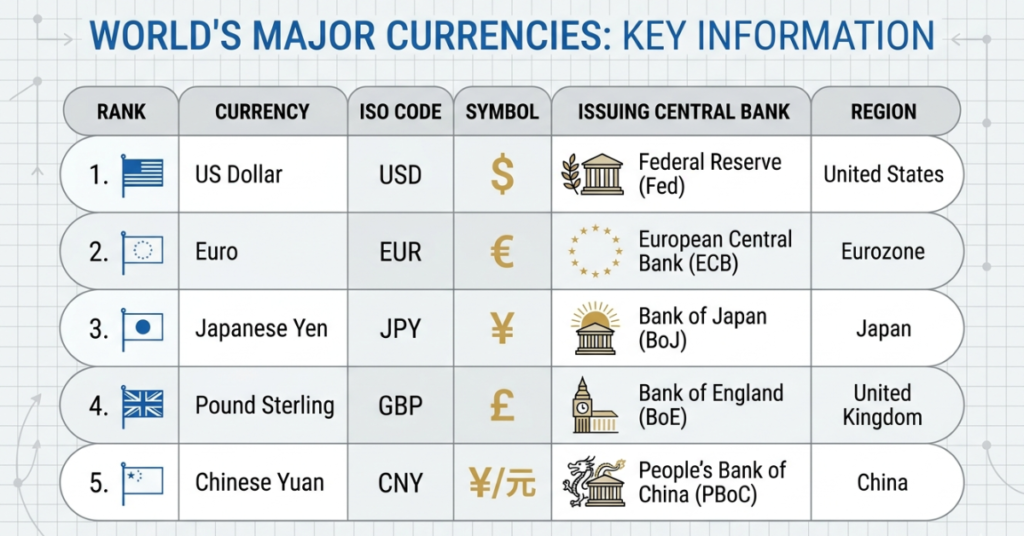
Major currencies are the most heavily traded in the world. They all pair with the USD and have high liquidity, tight spreads, and significant daily volume. These are the eight major currencies:
| Currency | ISO Code | Symbol | Country/Region | Central Bank |
| US Dollar | USD | $ | United States | Federal Reserve (Fed) |
| Euro | EUR | € | Eurozone (21 countries) | European Central Bank (ECB) |
| British Pound Sterling | GBP | £ | United Kingdom | Bank of England (BoE) |
| Japanese Yen | JPY | ¥ | Japan | Bank of Japan (BoJ) |
| Swiss Franc | CHF | Fr | Switzerland | Swiss National Bank (SNB) |
| Canadian Dollar | CAD | C$ | Canada | Bank of Canada (BoC) |
| Australian Dollar | AUD | A$ | Australia | Reserve Bank of Australia (RBA) |
| New Zealand Dollar | NZD | NZ$ | New Zealand | Reserve Bank of New Zealand (RBNZ) |
Minor (Cross) Currency Pairs
Minor currencies, also called crosses, are major currencies paired against each other without involving the US Dollar. Common examples include EUR/GBP, AUD/JPY, and GBP/CHF. They have decent liquidity but wider spreads than the majors.
Here are some commonly traded minor currency pairings:
| Pair | Base Currency | Quote Currency | Typical Spread |
| EUR/GBP | Euro | British Pound | Low |
| EUR/JPY | Euro | Japanese Yen | Low to Medium |
| GBP/JPY | British Pound | Japanese Yen | Medium |
| AUD/JPY | Australian Dollar | Japanese Yen | Medium |
| EUR/CHF | Euro | Swiss Franc | Medium |
| GBP/AUD | British Pound | Australian Dollar | Medium to High |
| CAD/JPY | Canadian Dollar | Japanese Yen | Medium |
Exotic Currencies: Full List by Region
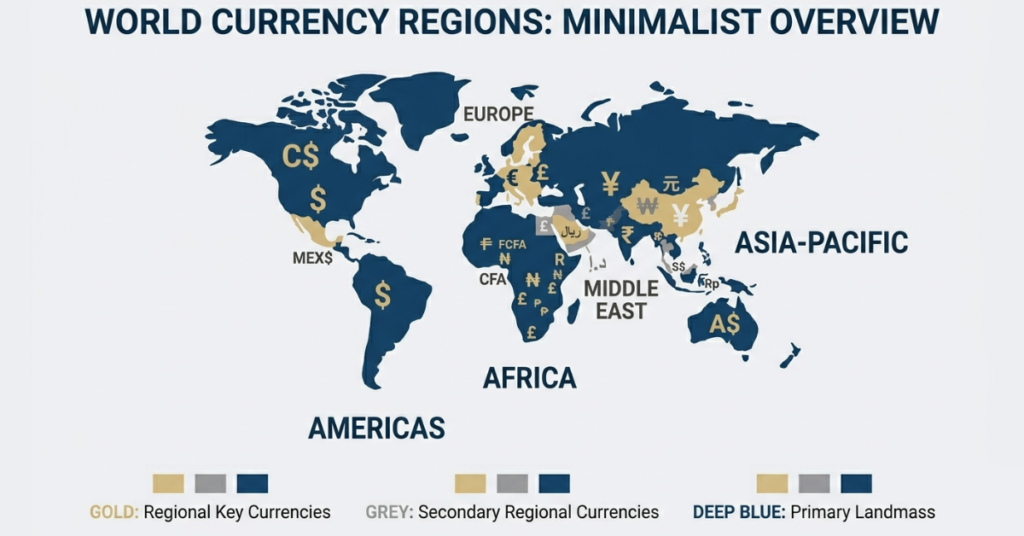
Exotic currencies belong to emerging or smaller economies. They’re less liquid, have wider spreads, and can be more volatile. However, they also offer unique trading opportunities driven by local political and economic events.
Asia-Pacific Exotic Currencies
| Currency | ISO Code | Country |
| Thai Baht | THB | Thailand |
| Indonesian Rupiah | IDR | Indonesia |
| Philippine Peso | PHP | Philippines |
| Vietnamese Dong | VND | Vietnam |
| Indian Rupee | INR | India |
| Pakistani Rupee | PKR | Pakistan |
| Sri Lankan Rupee | LKR | Sri Lanka |
| Bangladeshi Taka | BDT | Bangladesh |
| Malaysian Ringgit | MYR | Malaysia |
| Singapore Dollar | SGD | Singapore |
| Hong Kong Dollar | HKD | Hong Kong |
| Chinese Yuan (Renminbi) | CNY / CNH | China |
| South Korean Won | KRW | South Korea |
| Taiwan New Dollar | TWD | Taiwan |
Middle East & Africa Currencies
| Currency | ISO Code | Country |
| Saudi Riyal | SAR | Saudi Arabia |
| UAE Dirham | AED | United Arab Emirates |
| Kuwaiti Dinar | KWD | Kuwait |
| Qatari Riyal | QAR | Qatar |
| Bahraini Dinar | BHD | Bahrain |
| Omani Rial | OMR | Oman |
| Egyptian Pound | EGP | Egypt |
| South African Rand | ZAR | South Africa |
| Nigerian Naira | NGN | Nigeria |
| Kenyan Shilling | KES | Kenya |
| Moroccan Dirham | MAD | Morocco |
| Ghanaian Cedi | GHS | Ghana |
| Tanzanian Shilling | TZS | Tanzania |
| Israeli New Shekel | ILS | Israel |
| Turkish Lira | TRY | Turkey |
Americas Exotic Currencies
| Currency | ISO Code | Country |
| Mexican Peso | MXN | Mexico |
| Brazilian Real | BRL | Brazil |
| Colombian Peso | COP | Colombia |
| Chilean Peso | CLP | Chile |
| Argentine Peso | ARS | Argentina |
| Peruvian Sol | PEN | Peru |
| Uruguayan Peso | UYU | Uruguay |
| Jamaican Dollar | JMD | Jamaica |
| Trinidad & Tobago Dollar | TTD | Trinidad and Tobago |
Europe Exotic & Other Currencies
| Currency | ISO Code | Country |
| Norwegian Krone | NOK | Norway |
| Swedish Krona | SEK | Sweden |
| Danish Krone | DKK | Denmark |
| Polish Zloty | PLN | Poland |
| Czech Koruna | CZK | Czech Republic |
| Hungarian Forint | HUF | Hungary |
| Romanian Leu | RON | Romania |
| Russian Ruble | RUB | Russia |
| Ukrainian Hryvnia | UAH | Ukraine |
| Icelandic Krona | ISK | Iceland |
How Currencies Are Classified in Forex Trading
- In forex, currencies aren’t just listed alphabetically. They’re categorized by their role in the global economy and how actively they’re traded. Here’s how the classification breaks down:
- Reserve currencies: Held by central banks as foreign exchange reserves. The USD, EUR, JPY, GBP, CHF, AUD, and CAD fall into this category.
- Commodity currencies: AUD, CAD, and NZD tend to move with commodity prices like oil, gold, and iron ore.
- Pegged currencies: Some currencies are fixed to another, like the Bahraini Dinar and Qatari Riyal, which are pegged to the USD.
- Floating currencies: Most major and minor currencies float freely based on supply and demand in the open market.
Understanding how currencies behave is crucial before placing any trade. You can learn more about how to read currency exchange charts to get a practical edge.
The ISO 4217 Standard: Currency Codes Explained
Every currency in global use has a three-letter ISO 4217 code. The first two letters typically represent the country, and the third represents the currency name:
- USD = US (United States) + D (Dollar)
- GBP = GB (Great Britain) + P (Pound)
- JPY = JP (Japan) + Y (Yen)
- EUR = EU (European Union) + R (added for distinction)
There are also X-codes for special purposes. For example, XAU is the ISO code for gold and XAG for silver, which is why you’ll see these listed as tradable instruments on MT5 platforms.
At Defcofx, you can trade currency pairs alongside precious metals, all from a single MetaTrader 5 account.
How Many Currencies Can You Trade in Forex?
While there are 180 currencies in the world, not all are actively traded in the forex market. In practice, most retail traders focus on around 20 to 30 currency pairs. Here’s a rough breakdown:
| Category | No. of Pairs | Examples |
| Major Pairs | 7 | EUR/USD, USD/JPY, GBP/USD, USD/CHF, USD/CAD, AUD/USD, NZD/USD |
| Minor/Cross Pairs | 20–25 | EUR/GBP, AUD/JPY, GBP/JPY, EUR/CHF |
| Exotic Pairs | 30–50+ | USD/TRY, EUR/ZAR, GBP/THB, USD/MXN |
If you’re just getting started, focusing on major pairs is the smart move. Check out this guide on how to trade forex for beginners before diving into exotics.
Open a Live Trading AccountWorld Currency Statistics
| Stat | Data |
| Total recognized currencies globally | 180 (ISO 4217) |
| USD share of global forex transactions | ~89.2% (one side of each trade, BIS April 2025) |
| Daily forex market turnover | Over $9.6 trillion per day (BIS Triennial Survey, April 2025) |
| Most traded currency pair | EUR/USD (~21.2% of daily volume, BIS April 2025) |
| Number of countries using the Euro | 21 EU member states |
| Highest-valued currency by exchange rate | Kuwaiti Dinar (KWD) |
| Most held reserve currency | US Dollar (~57% of global reserves, IMF COFER Q4 2025) |
Trade World Currencies with Defcofx
Defcofx gives you direct access to major, minor, and exotic currency pairs, all from a single MT5 account. Whether you want to trade EUR/USD or explore USD/ZAR, the platform has the tools and conditions to support your strategy.
| Feature | Detail |
| Leverage | Up to 1:2000 |
| Spreads | From 0.3 pips |
| Commissions | Zero |
| Swap Fees | Zero |
| Welcome Bonus | 40% on first deposit (min. $1,000) |
| Withdrawal Speed | Within 4 business hours, including weekends |
| Platform | MetaTrader 5 (MT5) |
| Regulation | Registered in Saint Lucia |
| Account Types | Live & Demo accounts available |
Final Thoughts on List of World Currencies
Currencies are the foundation of the global financial system, facilitating trade, investment, tourism, and economic growth across every country and region. While there are around 180 officially recognized currencies worldwide, only a small group dominates global forex trading, international reserves, and cross-border transactions.
For traders, understanding the differences between major, minor, and exotic currencies is essential. Major currencies offer the highest liquidity and tightest spreads, making them ideal for most trading strategies. Minor and exotic currencies can provide unique opportunities, but they also come with higher volatility and wider trading costs.
Beyond trading, understanding currency classifications, ISO codes, central bank influence, and exchange rate dynamics helps build a stronger foundation for navigating financial markets. Whether you are trading EUR/USD, monitoring commodity currencies like AUD and CAD, or exploring emerging market pairs, success starts with knowing how currencies function and what drives their value.
FAQ
There are 180 currencies officially recognized under the ISO 4217 standard. Each is tied to a country or monetary union and has a unique three-letter code.
The US Dollar (USD) is the most traded currency, appearing on one side of around 89.2% of all forex transactions globally (BIS, April 2025). It’s the world’s primary reserve currency.
An exotic pair combines a major currency with one from an emerging market, such as USD/TRY (Dollar/Turkish Lira) or EUR/ZAR (Euro/South African Rand). They offer higher volatility but wider spreads.
Not all 180 currencies are available for forex trading. Most brokers, including Defcofx, offer a curated list of major, minor, and some exotic pairs. If a currency has very low liquidity, it likely won’t be available for retail trading.
ISO 4217 is an international standard published by the International Organization for Standardization (ISO) that defines three-letter codes for currencies. For example, USD for US Dollar, EUR for Euro, and JPY for Japanese Yen.