


A monetary commodity is a physical good valued for a monetary role, such as use in payment or as a reserve asset. Gold and silver are the best-known examples. When people widely accept the commodity itself as payment, it functions as commodity money. Its market value can still rise or fall.
Key Takeaways
- Gold and silver have both monetary histories and uses outside money.
- Commodity money, redeemable commodity-backed money and fiat money are different arrangements.
- Scarcity helps explain value, while acceptance and verification help an asset function as money.
- Central-bank gold holdings do not automatically make a currency convertible into gold.
- Gold can attract safe-haven demand, but inflation protection and positive returns are never assured.
- A metal CFD provides price exposure without ownership of bullion. Margin and costs depend on the instrument.
Monetary Commodity: The Basic Definition
A monetary commodity has value as a physical good and an established or historical monetary role. Gold can be made into jewelry, used in industry or held as bullion. A gold coin accepted in exchange also serves as money. Here, “intrinsic value” refers to the material’s value outside its payment role. It does not mean a guaranteed minimum price.
Gold is the clearest modern example because of its monetary history and use in official reserves. Under gold-standard arrangements, currencies were linked to specified quantities of gold, although the rules differed across countries and periods. Today, gold reserves and fiat currency issuance can coexist without a promise to redeem banknotes for metal.
Silver has also been widely used in coinage and remains an investment and industrial metal. Platinum and palladium are precious metals with investment markets, but industrial usefulness or scarcity alone does not give them the same monetary history as gold and silver.
Commodity Money vs. Commodity-Backed Money vs. Fiat Money
These terms answer different questions about the object used in payment and any redemption promise. The Federal Reserve’s explanation of money distinguishes the three forms.
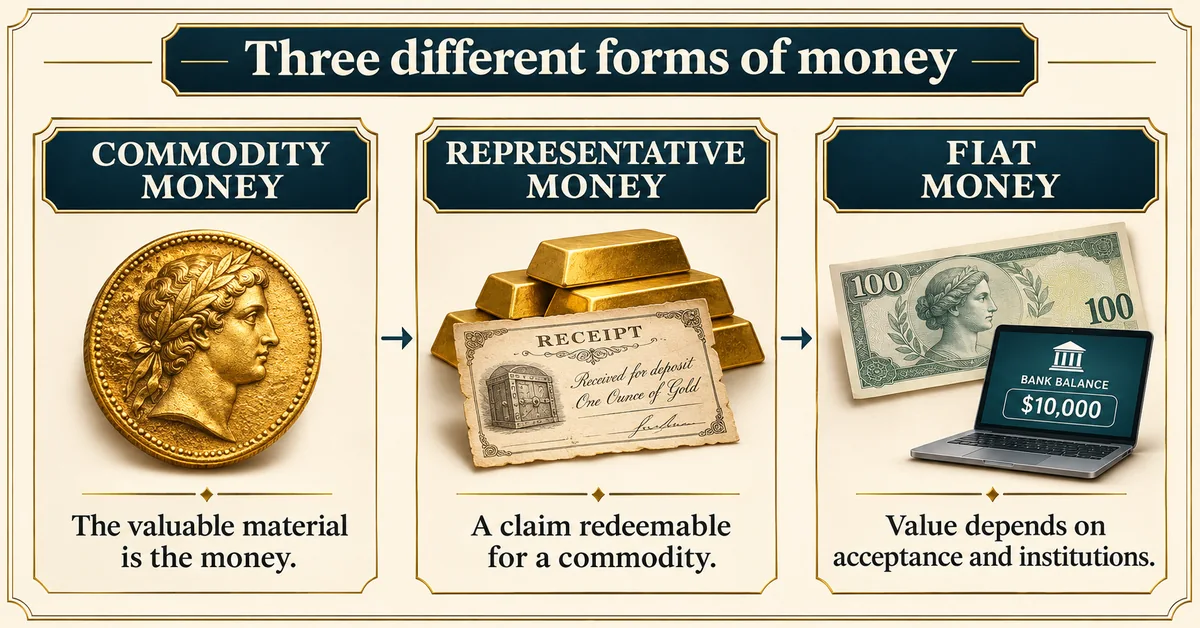
| Form | What is used | Simple example |
|---|---|---|
| Commodity money | The valuable physical commodity itself | A gold coin accepted as payment |
| Representative or commodity-backed money | A claim redeemable for a specified commodity | A historical receipt redeemable for gold |
| Fiat money | Currency whose value does not depend on commodity redemption | Modern US dollar or pound sterling |
Worked example. Imagine a merchant accepts a gold coin for goods. The coin is commodity money. If a vault stores the coin and issues a transferable receipt redeemable for it, the receipt is representative money. A modern banknote carries no equivalent gold-redemption promise. These examples explain the categories, rather than a sequence every society followed.
Money is usually described through three functions. It is a medium of exchange when people accept it in payment, a unit of account when prices are expressed in it, and a store of value when it carries purchasing power between transactions. A collectible or investment can store value without being widely accepted as everyday money.
Key Properties That Make a Commodity “Monetary”
For a commodity to function as a monetary asset, it typically needs the following characteristics:
| Property | Why It Matters |
| Durability | Does not corrode, rot, or degrade over time |
| Divisibility | Can be split into smaller units without losing value |
| Portability | Easy to move and transfer between parties |
| Scarcity | Supply is constrained, although scarcity alone cannot guarantee purchasing power |
| Fungibility | Each unit is interchangeable with another of the same type |
| Non-monetary value | The material has uses or demand outside payment |
| Acceptability | People are willing to receive it in exchange |
| Verifiability | Weight, purity and authenticity can be checked |

Gold combines many useful monetary properties. Yet a transaction still requires confidence in the coin’s weight and purity. A one-ounce bar from an unknown source may need verification before another person accepts it. This is why assaying, recognized refiners and trusted custody matter. The Bank of England’s money explainer also shows how practical handling problems helped encourage the use of redeemable receipts.
Benefits and Limitations of Commodity Money
A commodity with recognized weight and purity can be accepted beyond the reputation of a particular issuer. Physical supply also constrains how quickly new units can be produced. Those properties help explain the appeal of precious metals in monetary history.
The practical costs are substantial. Bullion must be transported, safeguarded and verified. Small purchases can be inconvenient, and debased or counterfeit coins undermine trust. Changes in mining output, hoarding or industrial demand can affect the quantity available for circulation. The Federal Reserve’s Types of Money reading explains why a commodity’s physical supply can become a constraint as an economy’s need for money changes.
Monetary Commodities vs. Economic Commodities
“Economic commodities” is a broad descriptive label here. Monetary commodities are economic goods too. The useful distinction is between demand arising from monetary or investment use and demand arising from consumption or production.
Economic commodities, like crude oil, natural gas, wheat, and soybeans, derive their value primarily from supply and demand in industrial and food production chains. Their prices fluctuate heavily based on harvests, geopolitical events, and energy demand.
Gold responds to investment demand, reserve management, interest rates and uncertainty, alongside jewelry and other uses. Silver combines investment demand with substantial industrial demand. These categories overlap, so neither metal is insulated from the wider economy.
Examples of Monetary Commodities
Gold (XAU)
Gold is held by central banks as a reserve asset and by private investors in several forms. Reserve holdings can support diversification and confidence, but do not by themselves make modern currencies gold-backed. In an XAU/USD quote, XAU denotes gold and USD denotes the quotation currency. The platform’s contract specification determines the actual trade size and settlement terms.

At Defcofx, gold trading is available with competitive spreads. You can check the XAUUSD pips and lot size guide to understand position sizing before you start.
Silver (XAG)
Silver serves a dual role as a metal with monetary history and an important industrial input. The Silver Institute’s April 2026 survey release reports industrial demand of 657.4 million ounces in 2025, against total demand of approximately 1.13 billion ounces. That is roughly 58%, calculated from the rounded total. Electronics, automotive uses and photovoltaics help explain why industrial conditions matter to silver prices.
Platinum & Palladium
Platinum and palladium have industrial applications and can also be purchased for investment. Their prices respond to vehicle technology, substitution, mine output and recycling. A supply shortage can increase their price without turning them into money. Treat them as related precious metals when comparing markets, while keeping their role distinct from gold’s official reserve use.
Historically: Salt, Tobacco, and Copper
Historical examples include salt, tobacco, copper and shells, used in particular societies and trading systems. Their monetary usefulness depended on local acceptance, standardization and supply. The Bank of England describes grain-account transfers in ancient Egypt and the use of cowrie shells across parts of Asia and Africa. Such examples also show why every historical monetary object did not meet the ideal properties equally well.
How Monetary Commodities Are Traded Today
Investors can own bullion or obtain exposure through financial products. Each route creates different rights, costs and risks. Choosing between them starts with whether the aim is physical ownership, investment exposure or a short-term price trade.
| Route | What you hold | What to check |
|---|---|---|
| Physical bullion | Coins or bars, directly or through custody | Purity, dealer premium, storage, insurance and resale spread |
| Spot metal arrangements | Rights depend on settlement and custody terms | Allocated versus unallocated holdings and delivery terms |
| Futures | An exchange-traded contract | Contract size, margin, expiry and delivery or cash-settlement rules |
| CFDs | A contract for the price difference | Spread, margin, financing terms and counterparty risk |
| ETFs or similar products | Shares or units in a vehicle | Physical or derivative backing, fees and redemption restrictions |
| Mining shares | Equity in a mining company | Operational costs, management, country and equity-market risks |
An XAU/USD symbol alone does not prove physical ownership. Read the product terms to understand whether it represents a CFD or another arrangement. Our guide to trading commodities through a forex broker explains the practical steps.
Why Monetary Commodities Matter for Forex Traders
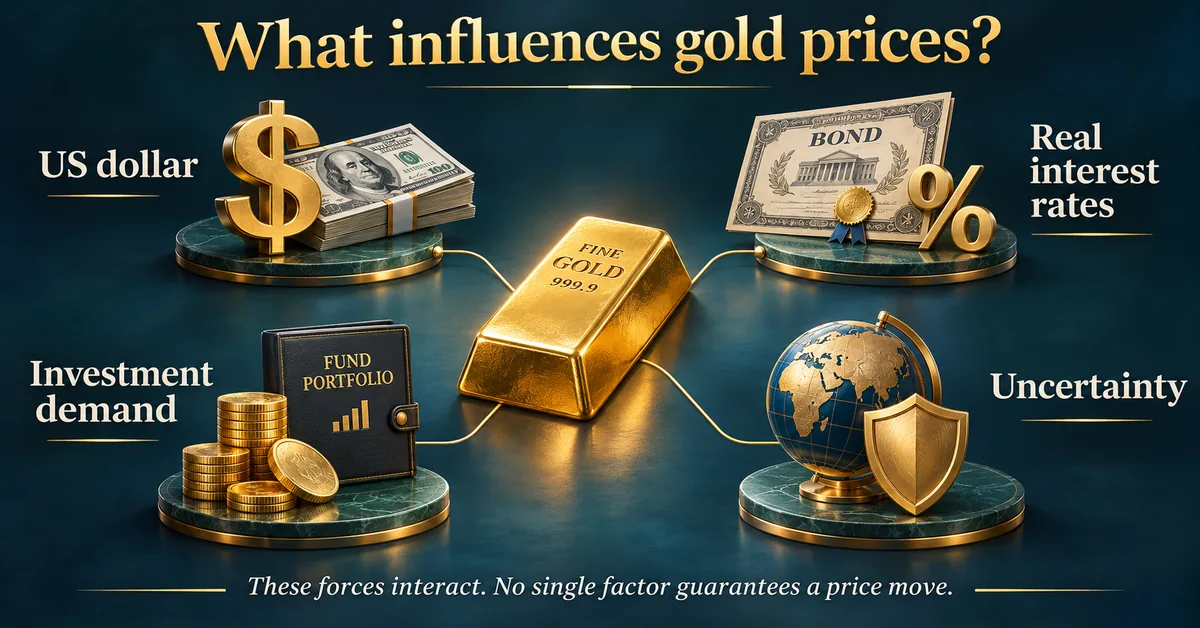
Forex traders pay close attention to monetary commodities, especially gold. Here is why:
First, the US dollar can influence dollar-denominated gold prices. A weaker dollar can make gold cheaper for buyers using other currencies, while a stronger dollar can create pressure. The relationship varies over time, and gold and the dollar can rise together.
Second, gold can attract safe-haven demand during financial or geopolitical uncertainty. It can also be sold to meet margin calls or raise cash. An asset’s defensive reputation does not prevent drawdowns.
Third, interest-rate expectations matter through opportunity cost. Higher real yields can make interest-bearing assets more attractive relative to gold, which pays no interest. Inflation, the dollar, positioning and central-bank demand interact, so no single factor determines the next price move. Apply forex risk-management principles when sizing a metal trade.
Monetary Commodity Statistics Worth Knowing
| Measure | Dated evidence | Why it matters |
|---|---|---|
| Gold in official reserves | 27% at end-2025, according to the ECB’s June 2026 report. The denominator includes foreign exchange and gold holdings. | This market-value share is affected by gold-price changes as well as quantities held. |
| Gold market activity | The World Gold Council’s trading-volume dataset, dated 4 November 2026, covers OTC, futures and ETF activity. Its estimates are revised over time. | Trading volume is different from annual physical demand or the value of gold reserves. |
| Silver industrial demand | 657.4 million ounces in 2025, reported in the World Silver Survey 2026 release. | Industrial applications account for a substantial part of silver demand. |
| Silver market balance | A 35-million-ounce deficit is forecast for 2026 in the 12 November 2026 update. | This is a forecast, and a deficit alone does not predict a price rise. |
Keep the units and periods together when comparing figures. Reserve shares measure stocks at a point in time. Annual demand measures a flow over a year. Trading turnover includes repeated transactions in financial and physical markets.
Trading Monetary Commodities at Defcofx
Defcofx’s metals page lists gold, silver, platinum and palladium and describes trading through MetaTrader 5. Check each instrument’s current contract specification before placing an order. A CFD trade provides exposure to price changes and does not transfer ownership of a bar or coin.
| Feature | What to verify before trading |
|---|---|
| Available metals | Confirm the instrument is enabled for your account in MT5. |
| Spread and commission | Use the current symbol quote and account fee schedule. Spread units and costs vary by metal. |
| Leverage and margin | Metal-specific limits apply. The account’s headline forex leverage does not automatically apply to metals. |
| Contract size | Check ounces per lot, minimum volume, volume step and tick value. |
| Holding costs | Read current financing or swap-free conditions for your account and instrument. |
| Trading hours and execution | Check sessions, holidays, margin rules and stop-out conditions. |
Review the current spreads and margin and leverage rules. Defcofx explicitly distinguishes forex account leverage from non-forex instrument limits. To learn the order controls and test position sizing, open a demo trading account. Demo results do not guarantee live outcomes.
Final Thoughts on Monetary Commodities
Monetary commodities connect the history of payment with the way investors and central banks hold value today. Gold and silver are the clearest familiar examples. Their usefulness rests on material characteristics, market demand and acceptance, while their prices remain variable.
For traders, the practical distinction is between the commodity’s monetary role and the financial product used to access it. Understand ownership, settlement, costs and margin before considering a position. Use inflation, real yields and currency movements as context rather than automatic trading instructions.
FAQ
A monetary commodity is a physical good valued for a monetary role, such as historical use in payment or use as a reserve asset. Gold and silver are common examples. Commodity money refers to the commodity itself being accepted as payment.
Yes. Gold has a long history in coinage and monetary systems, and central banks continue to hold it as a reserve asset. Its monetary role does not guarantee a stable price or positive investment returns.
Oil is generally discussed as an energy commodity. Its main uses are fuel and industrial inputs. The fact that oil is widely traded or priced in dollars does not make it a generally accepted payment medium.
Yes. Depending on the provider and location, access can include bullion services, funds, futures and CFDs. Check the product terms because ownership rights, settlement, fees and leverage differ.
No. Gold and silver can fall during inflation. Interest rates, currency movements, industrial demand and investor positioning also affect prices. Inflation protection is an uncertain outcome over a particular holding period.
Monetary commodity describes an economic role. Financial commodity is a context-dependent term that can refer to underlyings of financial contracts. Check the market or legal definition being used rather than treating the terms as interchangeable.
Silver can have sharp price swings. Suitability depends on experience, position size and the product used. Beginners can use a demo account to study tick value and order behavior before considering the financial risks of live trading.
Commodity money is the physical commodity used in exchange. Commodity-backed or representative money is a redeemable claim on a commodity. A gold coin and a historical gold-redeemable receipt therefore represent different forms of money.
Gold reserves alone do not create a redemption promise. A currency can be fiat money while its central bank owns gold. Convertibility requires a specific arrangement allowing the currency to be exchanged for the commodity.
The symbol identifies gold quoted in US dollars, but ownership depends on the contract. An XAU/USD CFD settles price differences without transferring physical bullion. Check custody and settlement terms for other gold products.