


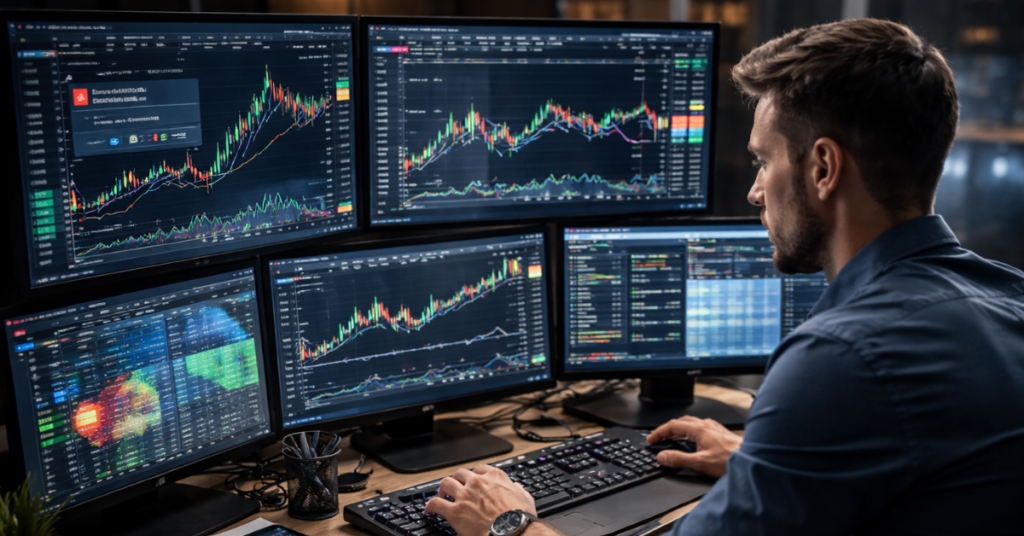
A trade assist is a trading support tool or system that helps traders analyze markets, identify opportunities, manage risk, and execute trades more efficiently. It combines data analysis, alerts, indicators, or automation to support decision-making without fully replacing the trader’s control.
Key Takeaways
- A trade assist helps traders make better trading decisions by providing analysis, alerts, and execution support rather than trading on their behalf.
- Trade assist tools can be manual, semi-automated, or automated, depending on how much control the trader wants.
- They are widely used in forex trading to improve timing, reduce emotional mistakes, and support risk management.
- A trade assist is not the same as copy trading or signal services; the trader remains in control of entries and exits.
- When used correctly, trade assist tools can improve consistency, efficiency, and discipline, but they still require trader judgment.
Trade Assist Meaning in Trading
In trading, the term trade assist refers to any tool, feature, or system designed to support a trader’s decision-making process rather than replace it. The core idea is assistance, not automation. A trade assist evaluates market data, highlights potential setups, and helps traders act with more structure and confidence.
Unlike basic indicators that show a single metric, a trade assist usually combines multiple inputs such as price action, indicators, volatility, or predefined rules. This allows traders to see clearer trade opportunities, confirm bias, and avoid impulsive decisions. The trader still chooses whether to enter, adjust, or exit a trade, keeping full control over execution.
Trade assist tools are commonly used by both beginners and experienced traders because they reduce cognitive load, especially in fast-moving markets, while still allowing personal strategy and discretion to remain central.
How a Trade Assist Works
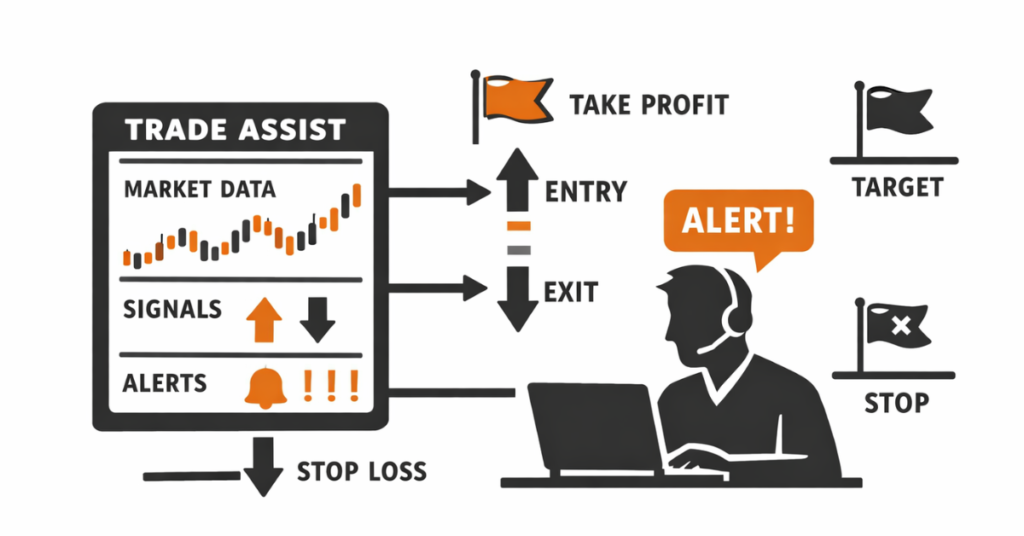
A trade assist works by continuously monitoring the market and processing price data based on predefined rules or analytical logic. It scans for conditions that align with a trader’s strategy, such as trend direction, support and resistance levels, momentum shifts, or volatility changes, and then highlights those conditions in real time.
Once relevant criteria are met, the trade assist may provide visual cues, alerts, or trade suggestions. Some systems go a step further by helping with position sizing, stop-loss placement, or take-profit levels, which supports disciplined risk management. Importantly, the trader remains responsible for confirming the setup and executing the trade.
Trade assist tools can function manually, where the trader interprets signals, or semi-automatically, where alerts and calculations are generated but final execution stays in the trader’s hands.
Trade Assist in Forex Trading
In forex trading, a trade assist is a valuable tool that helps traders identify profitable entry and exit points across currency pairs. By analyzing price movements, trend patterns, and market volatility, it provides actionable insights that reduce guesswork and enhance trading efficiency. Unlike automated trading systems, trade assist tools keep the trader in control, allowing flexible decision-making for both short-term and long-term strategies.
For example, a trader using MetaTrader 5 with a trade assist tool can quickly spot high-probability setups in volatile pairs like EUR/USD or GBP/JPY, making timely trades without missing opportunities. This combination of insight and control is especially beneficial for traders seeking high leverage options, such as up to 1:2000, to maximize potential returns while carefully managing risk.
Helps reduce emotional trading mistakes
Enables better risk management, especially with leveraged positions
Integrates seamlessly with platforms offering no commissions or swap fees and spreads from 0.3 pips
Trade assist tools are suitable for all traders, including beginners, and they work globally, complementing brokers like Defcofx that offer global reach, multiple language support, and fast support and withdrawals processed within four business hours even on weekends.
Open a Live Trading AccountTrade Assist Tools and Software Explained
Trade assist tools come in various forms, ranging from manual indicators to semi-automated and fully automated software.
Manual tools generate signals or alerts based on market conditions, requiring traders to analyze the information and make their own trading decisions. In contrast, semi-automated and automated tools can calculate trade setups, suggest stop-loss and take-profit levels, and send notifications when specific market conditions are met.
Most trade assist software is compatible with popular trading platforms such as MetaTrader 4 (MT4) and MetaTrader 5 (MT5), allowing traders to integrate these tools directly into their existing workflow.
When used with brokers like Defcofx, traders can further benefit from high leverage options up to 1:2000, low spreads starting from 0.3 pips, zero commissions and swap fees, and fast withdrawals, creating a smooth and efficient trading experience.
Open a Live Trading AccountTrade Assist Indicators and Signals
Trade assist indicators and signals are the backbone of any trade assist system. Indicators analyze price data, trends, momentum, and volatility, while signals alert traders to potential trade opportunities that match their strategy. Unlike basic indicators that provide raw data, trade assist indicators often combine multiple metrics to give more actionable insights.
Signals can be visual, such as chart markers or arrows, or auditory/notification-based, providing instant alerts when certain market conditions are met. This allows traders to respond quickly to opportunities without constantly monitoring charts.
Trade assist signals are designed to support decision-making, not replace it. The trader evaluates the signal, considers market context, and decides whether to enter, adjust, or exit a trade. Proper use of indicators and signals improves timing, accuracy, and consistency, making them essential tools for traders at any skill level.
Entry/Exit Signals: Suggest potential points to open or close trades
Volatility Signals: Highlight periods of high or low market activity
Risk Management Signals: Recommend stop-loss or take-profit levels
Trade Assist Strategies for Traders
Trade assist tools can be incorporated into a variety of trading strategies to improve decision-making and execution.
- For scalping, trade assist helps identify micro-trends and short-term price movements, allowing traders to enter and exit trades with precision.
- In intraday trading, it can track multiple currency pairs or assets, alerting traders to setups that align with their strategy.
- For swing trading, trade assist monitors trends over several days, helping traders spot reversal points and optimize entry and exit levels.
Using trade assist effectively requires aligning the tool’s alerts and indicators with your trading plan. Traders can combine it with technical analysis, chart patterns, or fundamental insights to make informed decisions. While trade assist reduces guesswork, it doesn’t eliminate risk, so strategies should always include risk management measures such as position sizing and stop-loss placement.
Trade Assist for Beginners
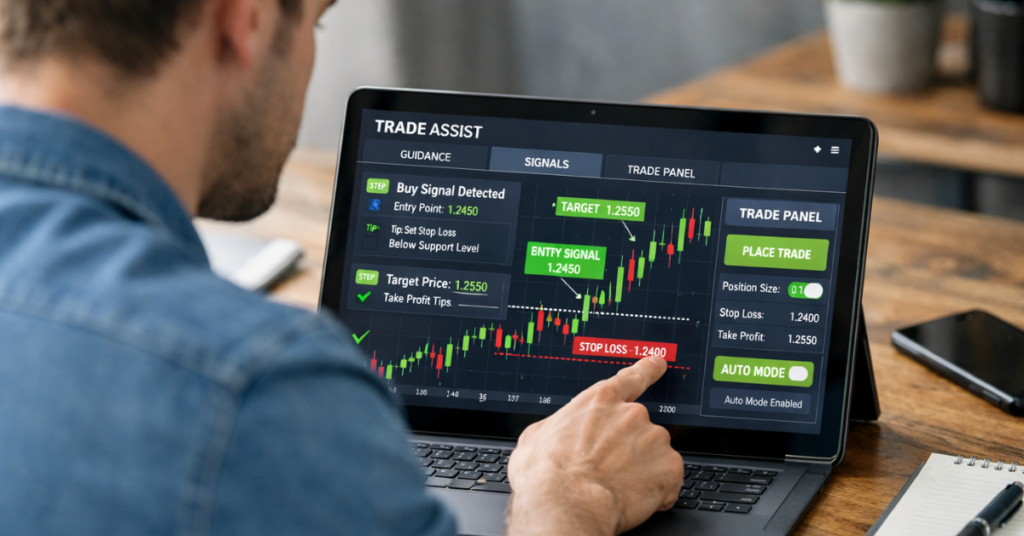
For beginners, a trade assist is an invaluable tool to navigate the complexities of financial markets. New traders often struggle with emotional decision-making, misinterpreting market movements, or entering trades at the wrong time.
A trade assist provides structured guidance, highlighting potential trade setups, alerting to market changes, and suggesting optimal entry or exit points without removing the trader’s control.
Beginners benefit from semi-automated trade assist tools that simplify analysis while still allowing hands-on learning. Trade assist support helps traders stay focused on how the market moves, how to manage risk, and how to trade with discipline. Over time, these tools help beginners gain confidence and improve their accuracy and consistency in executing trades.
Trade Assist and Risk Management
Trade assist tools play a key role in managing risk while trading. They don’t remove risk entirely, but they provide structured guidance that helps traders make informed decisions, set appropriate stop-loss and take-profit levels, and avoid overexposure to volatile markets.
Using trade assist effectively can help traders:
- Identify high-probability setups while avoiding impulsive trades.
- Calculate position sizes based on risk tolerance.
- Set stop-loss and take-profit levels more accurately.
- Monitor market volatility to prevent unexpected losses.
Benefits of Using a Trade Assist
Using a trade assist offers several advantages for traders across all experience levels. It provides a structured approach to analyzing markets, identifying high-probability setups, and executing trades efficiently. Trade assist tools reduce guesswork and reinforce discipline, improving consistency and confidence in trading decisions.
5 key benefits include:
- Improved decision-making through clear market signals
- Reduced emotional trading mistakes by providing structured alerts
- Enhanced timing and accuracy for entries and exits
- Better risk management with suggested stop-loss and take-profit levels
- Flexibility to integrate with multiple trading strategies, including scalping, intraday, and swing trading
Limitations and Risks of Trade Assist Tools
While trade assist tools provide valuable support, they aren’t foolproof and come with limitations that every trader should understand.
- One major limitation is over-reliance; some traders may blindly follow alerts or signals without evaluating market context, which can lead to poor trade decisions. Trade assist can’t account for every sudden market event, such as unexpected economic announcements or geopolitical developments, which can cause volatility that exceeds the tool’s predictive capabilities.
- Another risk is misinterpretation of signals. Beginners or traders who don’t fully understand how the trade assist works may take trades that are not aligned with their strategy or risk tolerance. Additionally, not all trade assist tools are created equal; differences in software quality, update frequency, and compatibility with trading platforms can affect performance.
Trade assist tools also can’t replace the trader’s judgment. While they highlight potential opportunities and provide alerts, final decision-making must remain with the trader. Ignoring this principle can lead to inconsistent results and unnecessary losses.
Is Trade Assist Reliable?
The reliability of a trade assist depends on several factors, including the quality of the software, the accuracy of its underlying indicators, and the trader’s ability to interpret and act on its signals. Trade assist tools are generally reliable for highlighting potential trading opportunities, but they aren’t a guarantee of success. Traders who understand the market and use the tool as a decision-support system tend to see the best results.
Reliability also varies based on market conditions. For example, highly volatile or unpredictable markets can produce false signals, even from advanced trade assist systems. Similarly, older or poorly maintained software may lag in data updates, reducing effectiveness.
Final Thoughts on What is a Trade Assist?
A trade assist is a powerful support tool for traders looking to improve accuracy, timing, and overall trading discipline. It provides alerts, signals, and analytics that simplify decision-making without taking control away from the trader. Both beginners and experienced traders can benefit, as it reduces emotional trading mistakes and enhances risk management.
However, trade assistance isn’t a replacement for personal judgment. Its effectiveness depends on the trader’s ability to interpret signals, validate setups, and integrate the tool into a well-structured trading plan. Over-reliance or misuse can lead to losses, so it’s important to combine the tool with proper market analysis, risk management, and ongoing learning.
FAQs
A trade assist in forex trading is a tool or system that provides alerts, signals, and analytical insights to help traders make informed decisions while keeping full control over their trades.
It works by monitoring market conditions, analyzing price data, and highlighting potential trade setups. Some tools also suggest stop-loss, take-profit, and position sizing to support risk management.
Trade assist tools can be manual, semi-automated, or fully automated, but even automated versions require the trader to confirm and execute trades to maintain control.
Yes, beginners can benefit greatly from trade assist as it reduces emotional mistakes, provides structured guidance, and helps them learn market patterns while practicing risk management.
Trade assist is reliable for highlighting potential opportunities but is not foolproof. Its effectiveness depends on market conditions, software quality, and the trader’s ability to interpret signals correctly.
Trade assist provides guidance and alerts while keeping the trader in control, whereas copy trading automatically replicates another trader’s trades, giving less personal control over strategy and execution.
Look for platform compatibility, signal accuracy, customizable settings, regular updates, and reputation among traders. Testing in a demo account is recommended before live trading.
Defcofx Forex Articles You Shouldn’t Miss
Discover powerful forex strategies in these top reads from Defcofx.