


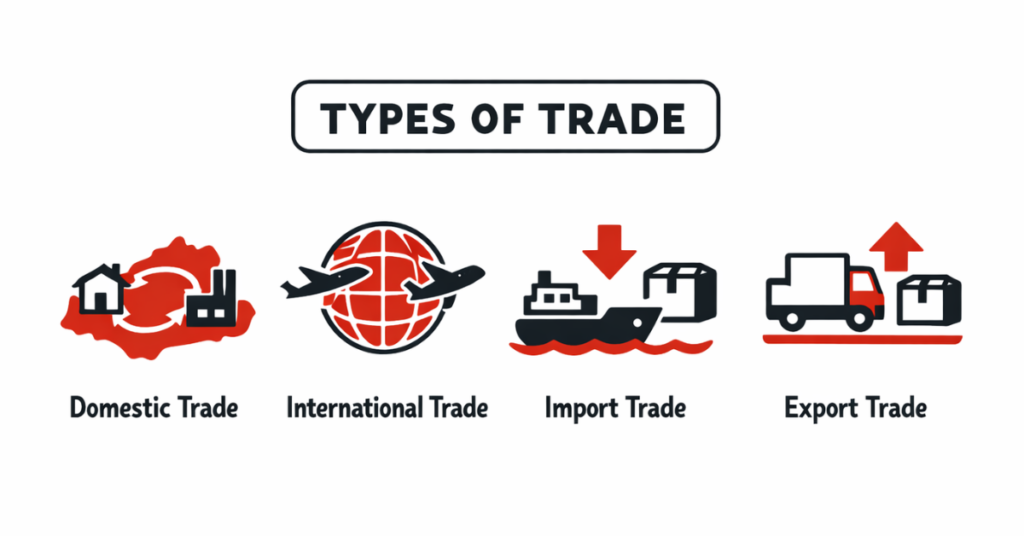
The 4 types of trade are Domestic Trade, International Trade, Wholesale Trade, and Retail Trade. Domestic trade occurs within a country, international trade involves cross-border transactions, wholesale trade focuses on bulk selling to retailers, and retail trade sells goods directly to consumers.
Key Takeaways
- There are 4 main types of trade: Domestic, International, Wholesale, and Retail.
- Domestic trade occurs within a single country, supporting local businesses.
- International trade involves cross-border transactions and global markets.
- Wholesale trade deals with bulk sales to retailers, while retail trade sells directly to consumers.
- Understanding trade types is essential for businesses, commerce, and financial trading decisions.
Introduction to the 4 Types of Trade
Trade plays an important role in business and the global economy. It involves the exchange of goods and services between producers, wholesalers, retailers, and consumers. The four main types of trade are:
- Domestic Trade – Buying and selling goods within the same country. It supports local businesses and strengthens the national economy.
- International Trade – Exchange of goods and services between different countries. It allows access to products and resources not available locally.
- Wholesale Trade – Selling goods in large quantities to retailers or other businesses.
- Retail Trade – Selling goods directly to final consumers for personal use.
Understanding these types of trade helps entrepreneurs, students, and traders see how markets operate and where business opportunities can grow.
Domestic Trade (Internal Trade)
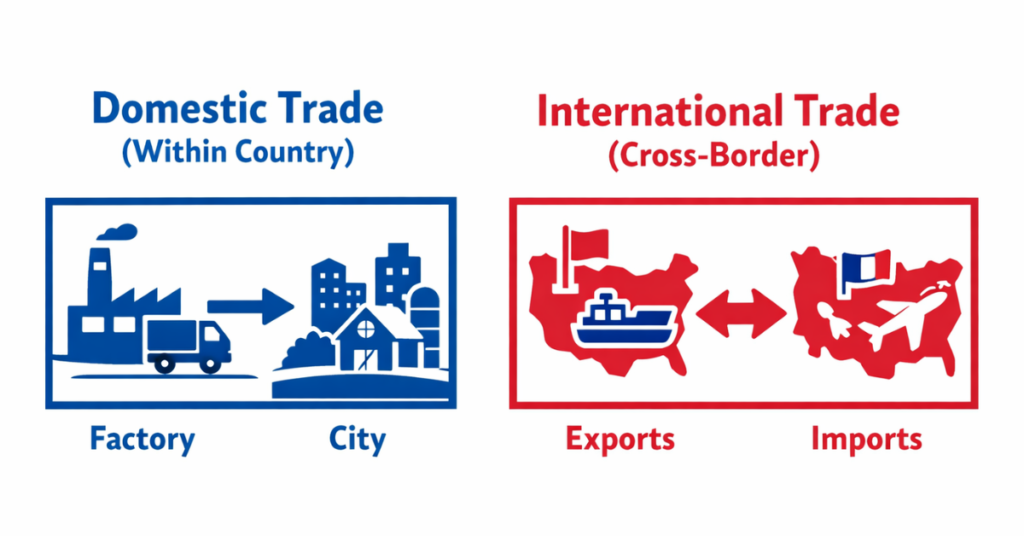
Domestic trade, also known as internal trade, refers to the buying and selling of goods and services within the borders of a single country. It forms the foundation of a nation’s economy by connecting producers, wholesalers, retailers, and consumers locally. Domestic trade is often regulated by national policies, taxes, and local market standards, ensuring fair pricing and smooth operations.
Examples:
- Local farmers sell produce to city markets.
- Manufacturers supplying goods to retailers in the same country.
- Online marketplaces serving domestic customers.
Why it matters: Domestic trade helps strengthen local economies, supports small businesses, and creates job opportunities. It is also the first step for businesses before entering international markets, making it critical for sustainable growth.
Defcofx’s Global Reach allows users to eventually expand trading beyond borders, connecting domestic strategies to international markets.
International Trade (External Trade)
International trade, also called external trade, involves the exchange of goods and services between countries. It allows nations to access resources, products, and services that are unavailable or limited domestically, promoting economic growth and global business relationships. International trade can include imports (buying from other countries) and exports (selling to foreign markets).
Examples:
- Exporting electronics from China to the United States.
- Importing coffee from Colombia to Europe.
- Cross-border e-commerce platforms connecting global buyers and sellers.
Importance: International trade fuels globalization, enhances competitiveness, and offers businesses access to larger markets. For traders, understanding international trade dynamics is crucial, as it influences currency exchange, tariffs, and market volatility.
Wholesale Trade
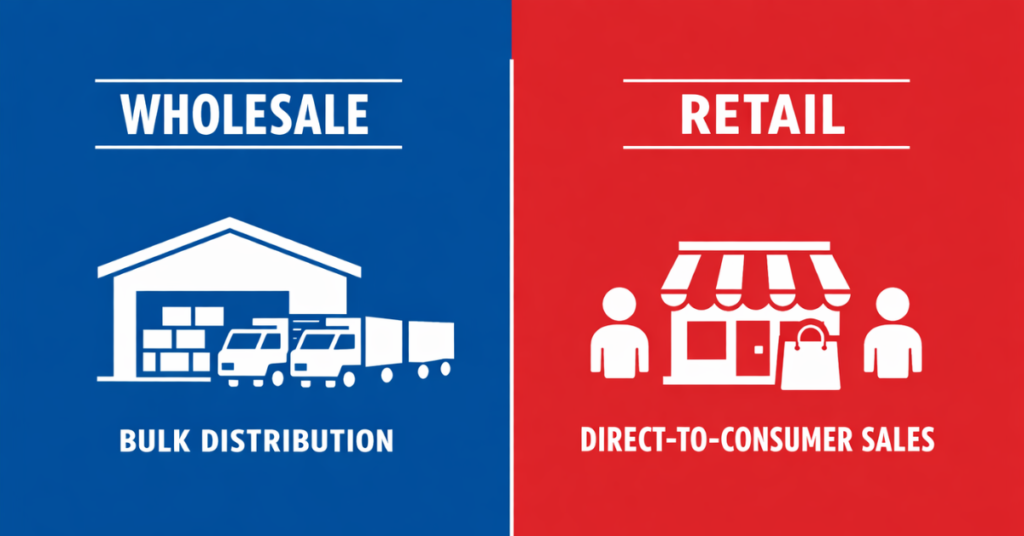
Wholesale trade refers to the buying and selling of goods in large quantities, mainly from manufacturers or producers to retailers rather than directly to consumers. It plays an important role in the supply chain by linking production with retail distribution. By purchasing in bulk, wholesalers can secure lower prices, which allows retailers to sell products at competitive rates.
Wholesale trade supports efficient market operations in several ways:
- It allows manufacturers to focus on production instead of distribution.
- It distributes goods to multiple retail outlets quickly and efficiently.
- It reduces storage and logistics burdens for producers.
- It helps maintain steady product availability in different regions.
For example, a clothing manufacturer may supply large shipments to retail stores across the country instead of handling individual customer orders. In industries such as electronics and food, wholesalers simplify distribution, lower handling costs, and speed up the movement of goods from factories to stores.
Retail Trade
Retail trade is the sale of goods and services directly to final consumers. It represents the last stage of the supply chain, where products reach the people who use them. Unlike wholesale trade, which handles bulk sales to businesses, retail focuses on serving individual customers through physical stores, online shops, or a mix of both.
Retail trade plays an important role in the economy because it reflects customer preferences, buying habits, and demand trends. Businesses use this information to adjust pricing, product selection, and marketing strategies.
Retail trade includes:
- Small local shops and neighborhood stores
- Supermarkets and large department stores
- Online stores and e-commerce platforms
- Businesses that combine physical and online sales
For example, a grocery store selling fresh produce to nearby residents is part of retail trade. An online store delivering electronics to individual buyers also operates in the retail sector. The rise of digital commerce has expanded retail markets worldwide, allowing businesses to reach customers in different cities and countries.
Comparison Table (4 Types of Trade)
To provide a clear and scannable reference, the following table summarizes the key aspects of the 4 types of trade. This not only enhances user understanding but also helps with answer engine optimization by presenting structured information.
| Type of Trade | Definition | Examples | Key Benefits |
| Domestic Trade | Buying and selling goods within a single country. | Local farmers selling produce to city markets, manufacturers supplying retailers. | Strengthens local economy, supports small businesses, regulated by national policies. |
| International Trade | Exchange of goods and services between countries. | Exporting electronics from China to the U.S., importing coffee from Colombia. | Access to global markets, economic growth, diversification of products. |
| Wholesale Trade | Selling goods in bulk from producers to retailers. | Clothing manufacturers supplying multiple stores, electronics distributors. | Cost efficiency, smooth supply chain, supports retailers with product variety. |
| Retail Trade | Selling goods directly to end consumers. | Local grocery stores, online e-commerce platforms. | Direct customer engagement, revenue generation, insights into consumer behavior. |
Final Thoughts on What are the 4 types of trade?
Understanding the 4 types of trade Domestic, International, Wholesale, and Retail is essential for businesses, students, and traders alike. Each type serves a distinct purpose in the supply chain and market dynamics. Domestic trade strengthens local economies, international trade opens global opportunities, wholesale trade ensures cost-efficient distribution, and retail trade connects directly with consumers.
For traders, comprehending these trade types provides valuable insights into market trends, pricing, and demand fluctuations, which can be applied to financial trading strategies.
Defcofx — Trade with Global Markets
Trade is no longer limited to physical goods moving between wholesalers and retailers. Today, trade also includes financial markets, where currencies, commodities, indices, and other assets are exchanged globally. Just as retail trade connects products to consumers, financial trading platforms connect traders to international markets.
Defcofx provides access to global financial markets through the MetaTrader 5 (MT5) platform. Traders can participate in forex, commodities, indices, stocks, and cryptocurrency markets, allowing them to engage in international trade in a digital format.
For individuals interested in understanding international trade from a financial perspective, online trading platforms create opportunities to interact with global price movements and market trends.
Open a Live Trading AccountFAQs
Profitability depends on the business model and market conditions. International trade often offers higher profit potential due to access to larger markets and diversified products. However, it comes with higher risks like tariffs, shipping costs, and currency fluctuations. Domestic or retail trade may provide consistent returns with lower risk for smaller businesses.
Wholesale trade involves selling goods in bulk to retailers, while retail trade sells directly to end consumers. Wholesale ensures wider distribution and cost efficiency for producers, whereas retail focuses on customer engagement, immediate sales, and revenue generation.
International trade expands market reach, allows access to scarce resources, and promotes competitive pricing. Businesses must account for import/export regulations, taxes, and currency exchange risks, which can impact profitability and supply chain efficiency.
Yes. Knowledge of domestic, international, wholesale, and retail trade provides insights into market demand, pricing trends, and supply chain dynamics. Traders can leverage this understanding to make informed decisions in forex, commodities, and CFD markets.