



Day trading can be profitable, but success depends on skill, strategy, and risk management. Traders who use disciplined strategies, control leverage, and monitor market conditions consistently can earn profits, while beginners without proper knowledge may face significant losses. Understanding risks is essential before starting day trading.
Key Takeaways
- Day trading can be profitable, but results depend on skill, strategy, and risk management.
- High leverage and low spreads improve profit potential but increase risk if misused.
- Consistent strategies and disciplined trading are essential for long-term success.
- Beginners should start with demo accounts and focus on education before live trading.
- Choosing the right platform like Defcofx ensures fast execution, reliable support, and access to global markets.
What Is Day Trading?
Day trading is the practice of buying and selling financial instruments such as stocks, forex, commodities, or cryptocurrencies within a single trading day. The goal is to profit from short-term price movements rather than long-term market trends. Trades are opened and closed on the same day, often within minutes or hours.
Day traders rely on technical analysis, market news, and price patterns to make quick decisions. Unlike long-term investing, day trading requires constant monitoring, fast execution, and disciplined risk management. While it offers potential for significant gains, the short-term nature increases exposure to market volatility.
How Profitable Is Day Trading?
Day trading can be profitable, but earnings vary widely depending on experience, strategy, market conditions, and risk management. Experienced traders who follow disciplined strategies and manage leverage effectively can earn consistent profits, while beginners may experience losses. Profitability is not guaranteed and requires continuous learning and practice.
Market volatility presents opportunities for gains but also increases the likelihood of losses. Traders must account for transaction costs, spreads, and potential slippage, which can reduce overall profits if not managed carefully.
6 Factors That Affect Day Trading Profitability
Day trading profitability depends on several key factors. Understanding these helps traders improve decision-making, reduce mistakes, and manage risk more effectively.
1. Market Volatility
Volatility means how much the market moves within a short time.
- High volatility creates more trading opportunities because prices move faster
- But it also increases risk because losses can happen quickly
Beginner note: Volatility is not always “good.” It is only useful if you have a clear plan and risk control.
2. Trading Strategy
Your strategy directly affects results. Different strategies work in different market conditions.
Common day trading strategies include:
- Scalping (small, fast trades)
- Momentum trading (following strong moves)
- News-based trading (trading around economic events)
To improve profitability:
- Use a consistent strategy
- Test it on demo or past data
- Avoid random and impulsive trades
3. Leverage And Capital Management
Leverage can increase profits, but it also increases losses.
- High leverage makes small market moves more powerful
- But it can also wipe out an account quickly if risk is not controlled
Key points for safe leverage use:
- Use proper position sizing
- Set stop-loss orders
- Risk only 1% to 2% per trade
Important clarification: High leverage options (such as 1:2000) should only be used with strict risk management. Beginners should start with low leverage.
4. Spreads And Transaction Costs
Trading costs directly reduce profit. Even small fees can add up after many trades.
Costs may include:
- Spread (difference between buy and sell price)
- Commission fees
- Swap/overnight fees (if trades are held overnight)
Lower costs improve net profitability because traders keep more of their earnings.
Important clarification: Claims such as “spreads from 0.3 pips” or “no commissions” depend on the broker, account type, and market conditions. Always verify the broker’s fee structure before trading
5. Psychological Discipline
Day trading requires emotional control. Many traders lose money due to poor discipline, not lack of knowledge.
Common psychological mistakes include:
- Overtrading
- Chasing losses
- Trading while stressed or angry
- Breaking the trading plan
Sticking to a clear plan improves long-term consistency.
6. Trading Platform And Execution Speed
A reliable platform helps traders enter and exit trades smoothly.
A good platform should offer:
- Fast execution
- Low slippage
- Stable performance (minimal downtime)
Responsive support also matters because it helps resolve:
- Account issues
- Technical problems
- Withdrawal or verification questions
Clarification: Withdrawal speed can depend on verification (KYC), payment method, and broker policies.
Day Trading Strategies That Work
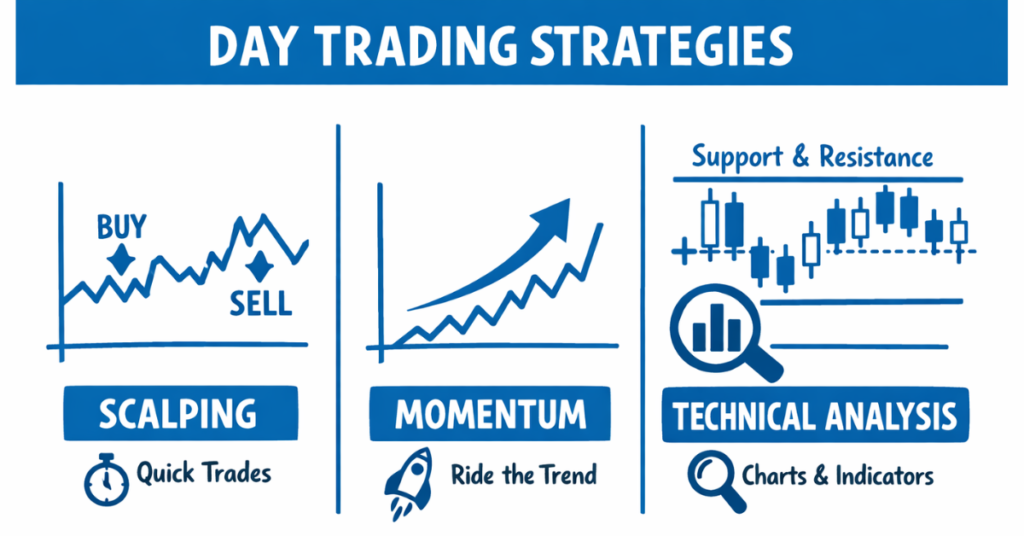
Using the right strategy is one of the most important parts of day trading. A clear approach helps traders take advantage of short-term market moves while controlling risk and avoiding emotional decisions.
Below are proven day trading strategies used by many traders.
1. Momentum Trading
Momentum trading focuses on assets that are moving strongly in one direction.
How it works:
- Traders enter when price shows strong movement and volume
- They aim to ride the trend for short-term gains
Best for:
- Trending markets
- High volatility sessions
Beginner tip:
- Always use a stop-loss because momentum can reverse quickly.
2. Scalping
Scalping is one of the most popular day trading strategies. It focuses on small profits from many quick trades.
How it works:
- Traders enter and exit within minutes (or even seconds)
- They target small price moves repeatedly
Best for:
- Forex and crypto (high liquidity pairs)
- Tight spread brokers
Beginner tip:
- Scalping requires low spreads and fast execution, otherwise fees will eat profits.
3) Breakout Trading
Breakout traders look for price to break important levels such as support or resistance.
How it works:
- Traders wait for price to break above resistance or below support
- They enter when the breakout is confirmed
Best for:
- High volatility sessions
- Major news events (with caution)
Beginner tip:
- Watch out for fake breakouts. Confirm with volume or candle close.
4. Range Trading
Range trading works best when the market is moving sideways.
How it works:
- Traders buy near support and sell near resistance
- They repeat trades inside the same range
Best for:
- Low volatility periods
- Stable market conditions
Beginner tip:
- Avoid range trading during major news because ranges can break suddenly.
5) News-Based Trading
News-based trading uses major economic events to trade fast market reactions.
Examples include:
- Interest rate decisions
- Inflation reports (CPI)
- Employment reports (NFP)
- Central bank announcements
Best for:
- Experienced traders with fast execution
Beginner tip:
- News trading is risky due to slippage and sudden spikes. Beginners should avoid trading during major news until experienced.
6. Technical Analysis Trading
This strategy uses charts and indicators to identify trade setups.
Common tools include:
- Moving averages
- RSI
- Bollinger Bands
- Support and resistance
- Trendlines and chart patterns
Best for:
- Traders who want structured and rule-based entries
Beginner tip:
- Do not overload your chart with indicators. Use 1–2 tools and focus on price action.
7. Algorithmic / Automated Trading
Automated trading uses bots or algorithms to execute trades based on preset rules.
Benefits include:
- Faster execution
- Less emotional trading
- Consistent strategy rules
Risks include:
- Poorly coded bots can lose money fast
- Bots may fail in changing market conditions
- Requires testing and monitoring
Beginner tip:
- Always backtest and demo test before using automation with real money.
Note For Beginners
The best strategy is not the one that makes the most trades. It is the one you can follow consistently with controlled risk.
- A smart beginner path:
- Focus on risk management before profit
- Start with one strategy
- Use a demo account first
Day Trading: Advantages vs Limitations (Complete Table)
| Topic | Advantage | Why It Matters | Limitation / Risk | Beginner Clarification |
|---|---|---|---|---|
| Profit Potential | Opportunity to profit from small intraday price movements | Many trades per day can create frequent profit chances | High losses can happen just as fast | Profit is possible, but not guaranteed. Small mistakes can quickly erase gains |
| Leverage | Can increase returns when used correctly | Leverage lets traders control bigger positions with smaller capital | Can multiply losses and cause fast account wipeouts | High leverage (such as 1:2000) is very risky. Beginners should use low leverage or avoid it |
| Flexibility And Independence | Trade on your own schedule and make your own decisions | Suitable for people who want independence and self-control | Requires self-discipline and consistency | Freedom can lead to overtrading if rules are not followed |
| Immediate Results | Results (profit/loss) happen the same day | Traders get fast feedback and can improve quickly | Fast losses can create emotional stress | Beginners may rush decisions because outcomes happen quickly |
| Skill Development | Improves market understanding, discipline, and strategy execution | Frequent practice builds experience in analysis and psychology | Steep learning curve for new traders | Most beginners lose money at first. Learning takes time, testing, and patience |
| Access To Global Markets | Ability to trade forex, indices, commodities, and crypto | More markets mean more opportunities | Too many options can cause confusion | Beginners should focus on 1–2 markets first instead of trading everything |
| Emotional Control | Can build strong mental discipline over time | Trading teaches patience, control, and decision-making | Emotional pressure is high | Stress, fear, and greed are common reasons traders fail |
| Time Requirement | Can be done full-time or part-time depending on strategy | Flexible styles allow different schedules | Requires time for charts, planning, and monitoring | Day trading is not “easy money.” It requires daily effort and focus |
| Platform And Execution | Fast execution improves trade quality and reduces slippage | Good platforms support quick entries and exits | Bad execution causes slippage and missed entries | Choose reliable platforms with stable performance and strong support |
| Costs And Fees | Low spreads and low fees improve net profit | Trading costs directly impact results | High spreads/fees can destroy profitability | Scalping and frequent trading require very low spreads and transparent fee structure |
6 Tips for Maximizing Profitability
Maximizing profitability in day trading requires a combination of disciplined strategies, risk management, and the use of reliable tools. Implementing these tips can improve consistency and reduce unnecessary losses.
1. Start with a Demo Account: Practice trading in a risk-free environment to test strategies, understand market behavior, and develop confidence before committing real funds.
2. Develop a Trading Plan: Create a structured plan outlining entry and exit points, risk tolerance, and position sizes. Following a plan helps prevent impulsive decisions influenced by market emotions.
3. Manage Risk Carefully: Limit potential losses by using stop-loss orders, appropriate leverage, and position sizing. Avoid risking more than a small percentage of your capital on a single trade. Brokers like Defcofx with High Leverage Options (up to 1:2000) can be useful but must be used responsibly.
4. Focus on Low-Cost Execution: Select brokers like Defcofx offering no commissions or swap fees and tight spreads to reduce transaction costs. Lower fees directly contribute to net profitability over time.
5. Leverage Technology and Tools: Use reliable trading platforms, technical indicators, and real-time market data. Brokers with Fast Support and Withdrawals and Global Reach provide the infrastructure needed to execute strategies efficiently.
6. Continuous Learning: Markets evolve constantly. Stay updated with financial news, economic events, and emerging trading techniques to refine strategies and maintain an edge.
Open a Live Trading AccountFinal Thoughts on Is Day Trading Profitable
Day trading can be profitable for those who combine knowledge, discipline, and the right strategies. Success depends on understanding market dynamics, managing risk, and maintaining emotional control. While high leverage, low fees, and fast execution can boost profitability, losses are possible, especially for beginners.
Careful planning, consistent strategy implementation, and choosing a reliable broker with supportive tools and global access improve the chances of achieving steady results. Day trading is not a guaranteed path to wealth, but with proper preparation and discipline, it can be a rewarding approach for experienced traders.
FAQ’s
Day trading carries high financial risk, but disciplined traders who use effective strategies, risk management, and reliable tools can achieve consistent profits. Beginners should start cautiously and practice on demo accounts before investing real money.
Earnings vary widely. Beginners may initially experience losses while learning, but consistent practice, education, and strategy refinement can gradually improve profitability. High leverage and low-cost platforms can enhance returns when used responsibly.
The best brokers offer fast execution, low spreads, high leverage, global market access, and reliable support. Platforms providing High Leverage Options (up to 1:2000), No Commissions or Swap Fees, and Fast Support and Withdrawals enhance trading efficiency and profitability.
Yes, high leverage can increase profit potential, but it also magnifies losses. Proper risk management, position sizing, and disciplined strategies are essential to use leverage safely.
Effective strategies include scalping, momentum trading, news-based trading, technical analysis, and algorithmic trading. Combining a well-tested strategy with disciplined execution and risk management increases the likelihood of profitability.
Recommended Defcofx Forex Articles
Discover powerful forex strategies in these top reads from Defcofx.
- Intrinsic Value of a Stock: Definition & Calculation
- What is the Big 5 Currency?
- What Is the 3 Strongest Currency?
- What is a Good Profit Factor in Trading?
- How to Start Investing in the Stock Market
- What Is Backtesting in Trading?
- Top 10 Currencies in the World
- What is a Good Profit Factor in Trading?
- What Is a Trade Assist?
- What Are the Golden Rules of Trading?