


The forex instruments that pay the most are typically high-volatility, liquid assets such as GBP/JPY, GBP/USD, EUR/USD, and gold (XAU/USD). These pairs offer the highest profit potential because they experience larger daily price movements (pips), allowing traders to capture bigger gains especially when combined with effective strategy and risk management.
Key Takeaways
- Forex pairs that “pay the most” are those with high volatility and strong liquidity, such as GBP/JPY and XAU/USD.
- Higher profit potential comes from larger pip movements, not fixed payouts.
- Volatility increases both profit opportunities and risk, so proper risk management is essential.
- Trading style matters: some pairs are better for scalping, while others suit swing trading.
- Trading costs like spreads and fees directly impact your net profit, even on high-moving pairs.
What Does “Pay the Most” Mean in Forex?
In forex trading, the term “pay the most” can be misleading because the market does not offer fixed returns. Instead, profits are generated from price movements measured in pips. The more a currency pair moves within a given time, the greater the potential profit for traders.
For example, highly active pairs like GBP/JPY or XAU/USD often experience large daily swings. This means traders can capture bigger gains compared to slower-moving pairs but only if their trades are correctly timed.
What Determines the Most Profitable Forex Pairs?
Not all forex pairs offer the same earning potential. The pairs that “pay the most” are influenced by a combination of market factors that directly affect how much price movement and therefore profit opportunity they provide.
- The most important factor is volatility. Currency pairs that move frequently and with larger price swings create more opportunities to capture profits. For example, pairs involving the British pound often show stronger movements compared to more stable currencies.
- Another key factor is liquidity. Highly traded pairs like EUR/USD have constant buying and selling activity, which ensures smoother trade execution and tighter spreads. While they may not always be the most volatile, their consistency makes them reliably profitable for many strategies.
- Trading costs, especially spreads, also play a major role. Even if a pair moves significantly, high spreads can reduce actual profits. This is why traders often prefer pairs with a balance of good movement and low trading costs.
- Market timing is equally important. Forex pairs behave differently depending on the trading session. For instance, the London and New York session overlap is known for higher volatility, which increases profit potential.
Which Forex Pairs Pay the Most? (Detailed Breakdown)
The forex pairs that “pay the most” are those that consistently generate larger price movements (pips) within a trading session. These movements create more opportunities for traders to enter and exit positions with meaningful profit potential. Below is a clearer, user-focused breakdown of the most profitable and commonly traded high-movement pairs.
GBP/JPY (British Pound / Japanese Yen)
GBP/JPY is widely regarded as one of the most volatile major pairs. It often experiences sharp and rapid price swings due to the economic differences between the UK and Japan.
- Known for strong trends and sudden reversals
- High daily pip range compared to other majors
- Suitable for experienced traders who can manage volatility
EUR/USD (Euro / US Dollar)
EUR/USD is the most traded forex pair in the world. While it is less volatile than GBP/JPY, it offers consistent movement and high liquidity, making it reliable for many strategies.
- Tight spreads and smooth execution
- Predictable behavior during major sessions
- Ideal for both beginners and professionals
GBP/USD (British Pound / US Dollar)
GBP/USD combines liquidity with relatively high volatility. It often reacts strongly to economic news from both the UK and the US.
- Frequent directional moves
- Responsive to macroeconomic data
- Popular among day traders and swing traders
XAU/USD (Gold vs US Dollar)
Gold is not a traditional currency pair but behaves like one in trading platforms. It is highly sensitive to global economic uncertainty, inflation, and interest rate changes.
- Large intraday price movements
- Influenced by geopolitical and economic events
- Often used as a hedge asset
Comparison Overview
| Pair | Volatility Level | Liquidity | Profit Potential | Risk Level |
| GBP/JPY | Very High | Medium | Very High | High |
| EUR/USD | Moderate | Very High | Stable | Low–Medium |
| GBP/USD | High | High | High | Medium |
| XAU/USD | Very High | High | Very High | High |
Most Volatile Forex Pairs (High Risk, High Reward)
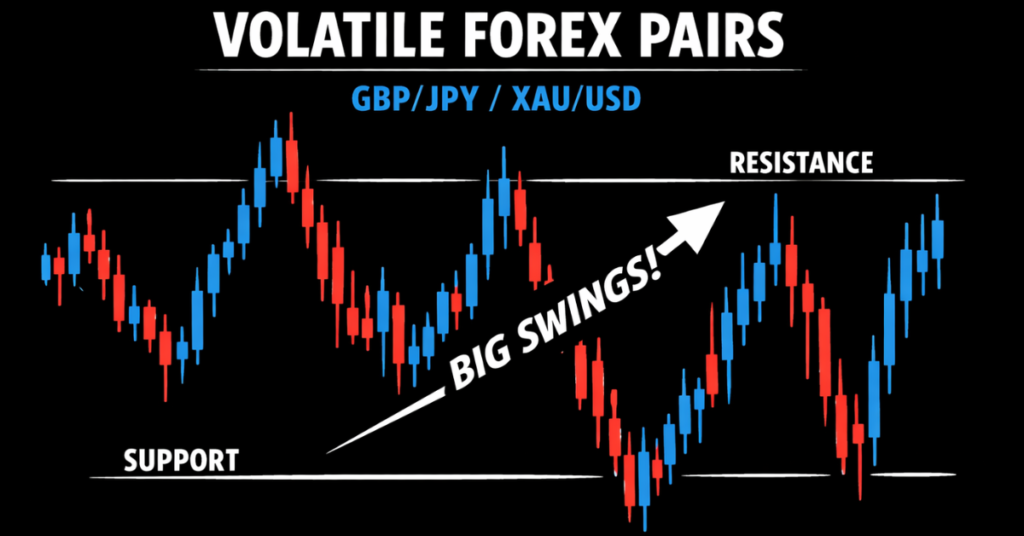
Volatility is one of the main reasons certain forex pairs “pay more” than others. Highly volatile pairs experience larger and faster price movements, which can create significant profit opportunities but they also come with increased risk.
Some of the most volatile forex pairs include cross pairs and exotic pairs, which are less stable than major pairs and often react strongly to economic news, geopolitical events, and market sentiment.
Examples of highly volatile pairs include:
- GBP/JPY
- GBP/NZD
- GBP/AUD
- EUR/TRY
- USD/TRY
These pairs tend to move more aggressively due to factors such as lower liquidity (in some cases), economic differences between the currencies, and sensitivity to global market conditions.
A key characteristic of these pairs is that they often produce wide intraday ranges, meaning the price can move significantly within a single trading day. This makes them attractive for strategies like scalping and day trading, but less suitable for traders who prefer stability.
Best Forex Pairs Based on Trading Style
Different forex pairs perform better depending on the trading strategy being used. Rather than asking only which forex pairs pay the most, traders should also consider which pairs align with their trading style, as this directly impacts profitability and consistency.
Scalping (Short-Term, Quick Trades)
Scalping focuses on small price movements executed within minutes. For this strategy, traders typically prefer pairs with:
- Tight spreads
- High liquidity
- Fast execution
Best suited pairs:
- EUR/USD
- USD/JPY
These pairs are popular because their tight spreads help reduce trading costs, allowing scalpers to retain more of their small but frequent gains.
Day Trading (Intraday Opportunities)
Day traders aim to capture larger intraday moves while closing positions before the market ends.
Best suited pairs:
- GBP/USD
- EUR/USD
- XAU/USD (Gold)
These pairs provide a good balance between volatility and liquidity, making them suitable for identifying clear intraday trends.
Swing Trading (Multi-Day Positions)
Swing traders hold positions for several days or even weeks, focusing on broader market trends.
Best suited pairs:
- GBP/JPY
- GBP/USD
- XAU/USD
These pairs tend to show strong directional moves, which align well with longer-term trend strategies.
How Trading Conditions Impact Strategy Success
The effectiveness of any trading style depends not only on the pair but also on trading conditions such as spreads, execution speed, and costs.
For example, a trading environment with:
- Low spreads (starting from 0.3 pips)
- No commission or swap fees
- Fast execution
can significantly improve profitability, especially for scalping and high-frequency strategies where costs quickly add up.
Open a Live Trading AccountWhich Forex Pairs Move the Most Daily?
Understanding daily movement is essential when identifying which forex pairs pay the most, because larger daily ranges create more opportunities to capture profit. The pairs that move the most each day are typically those with higher volatility and stronger reactions to market events.
- Among major and widely traded instruments, GBP/JPY is known for having one of the largest daily price ranges. It often moves significantly within a single trading session due to its sensitivity to both UK and Japanese economic factors.
- Another highly active instrument is XAU/USD (Gold). Gold frequently experiences strong intraday swings driven by inflation data, interest rate expectations, and geopolitical uncertainty. These movements can create multiple trading opportunities throughout the day.
- GBP/USD also tends to show consistent daily movement. It reacts strongly to economic announcements from both the UK and the US, often producing clear trends during major trading sessions.
- Meanwhile, EUR/USD, although more stable, still offers steady daily movement due to its high liquidity and constant trading volume. Its movements may be smaller compared to more volatile pairs, but they are often more predictable.
Which Forex Pairs Are Best for Beginners?
For beginners, the best forex pairs are not necessarily the ones that “pay the most,” but those that offer stable behavior, lower volatility, and predictable price movements. This helps new traders learn market structure, practice strategies, and manage risk more effectively.
EUR/USD (Euro / US Dollar)
EUR/USD is widely considered the best starting point for beginners because of its:
- High liquidity (easy to enter and exit trades)
- Tight spreads (lower trading costs)
- Relatively stable and predictable movement
Its behavior is influenced by major economic data from both the Eurozone and the United States, making it easier to follow with fundamental and technical analysis.
USD/JPY (US Dollar / Japanese Yen)
USD/JPY is another beginner-friendly pair due to its smoother trends and moderate volatility.
- Less erratic compared to cross or exotic pairs
- Responds well to macroeconomic trends
- Often respects technical levels
Why Beginners Should Avoid Highly Volatile Pairs (Initially)
Pairs like GBP/JPY or XAU/USD can move very quickly, which increases both profit potential and risk. Without proper experience, beginners may find it difficult to:
- Time entries and exits
- Handle sudden reversals
- Control emotional decision-making
How Trading Costs Affect Your Profit
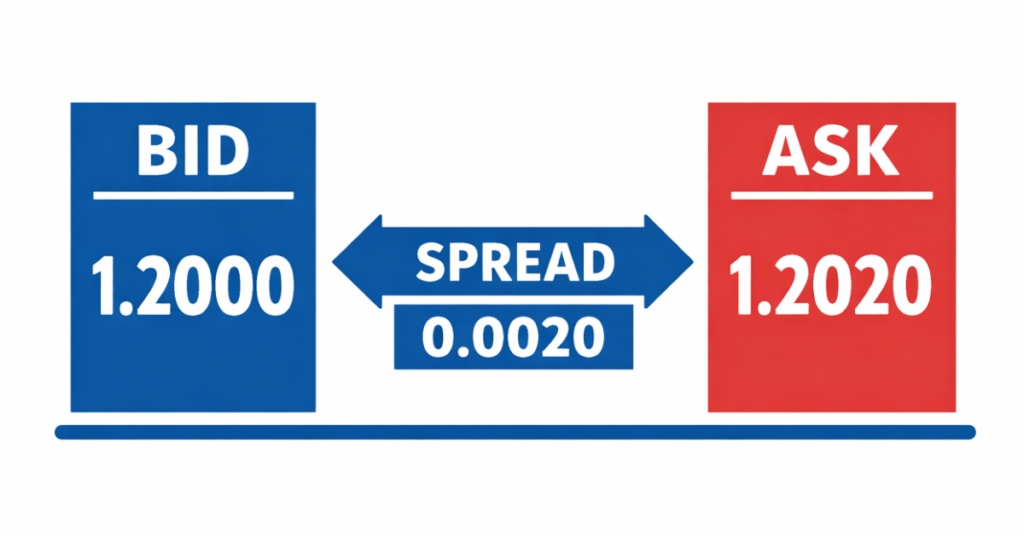
Trading costs play a crucial role in determining how much you actually earn from forex trading. Even if a forex pair moves significantly, costs such as spreads, commissions, and swap fees can reduce your net profit.
The spread is the difference between the buy (ask) and sell (bid) price of a currency pair. Every trade starts at a slight loss equal to the spread, so tighter spreads allow traders to reach profitability faster. This is especially important for strategies like scalping, where trades target small price movements.
Commissions are fees charged per trade by some brokers. These can add up quickly for active traders, reducing overall returns if not carefully managed. Similarly, swap fees (overnight holding costs) apply when positions are kept open for longer periods and can either add to costs or provide credits depending on the trade direction.
Role of Leverage in Increasing Forex Profits
Leverage is one of the most important tools in forex trading because it allows traders to control a larger position size with a relatively small amount of capital. This can significantly amplify both potential profits and potential losses.
For example, with higher leverage, even small price movements in a forex pair can translate into noticeable gains. This is particularly relevant when trading highly volatile pairs that already have strong daily movements. However, leverage does not increase the probability of winning trades; it simply magnifies the outcome of each trade.
When used responsibly, leverage can help traders:
- Maximize capital efficiency
- Take advantage of small price movements
- Diversify across multiple trades with limited funds
In practice, leverage becomes most effective when combined with:
- A clear trading plan
- Proper position sizing
- Controlled risk per trade
- Understanding of market volatility
For traders who seek greater flexibility in capital usage, access to high leverage options (such as the 1:2000 offered by Defcofx) can enhance their ability to participate in the market more actively. However, it is essential to use leverage wisely rather than aggressively.
Risks of Chasing High-Paying Forex Pairs
While forex pairs that “pay the most” can offer strong profit potential, they also come with increased risks that traders must understand before participating in the market. High volatility, which creates opportunities, can just as easily lead to rapid and unexpected losses.
- One of the main risks is price unpredictability. Highly volatile pairs like GBP/JPY and XAU/USD can move sharply within minutes due to economic news, geopolitical events, or market sentiment. These sudden movements can trigger stop-loss orders quickly if trades are not carefully planned.
- Another important risk is over-leveraging. When traders use high leverage without proper position sizing, even small adverse price movements can result in significant drawdowns. This risk becomes more pronounced when trading pairs with large daily ranges.
- Emotional trading is also a common issue. Fast-moving markets can lead to impulsive decisions such as chasing trades, closing positions too early, or failing to follow a strategy consistently.
How to Choose the Right Forex Pair for You
Choosing the right forex pair is not only about identifying which pairs pay the most, but also about finding a pair that aligns with your trading style, risk tolerance, and experience level. A well-matched pair can significantly improve consistency and overall trading performance.
- The first factor to consider is your experience level. Beginners typically perform better with stable and highly liquid pairs such as EUR/USD or USD/JPY, as these pairs have more predictable movements and lower volatility. This allows new traders to focus on learning analysis and execution without being overwhelmed by sudden price swings.
- The second factor is your risk tolerance. If you are comfortable with higher risk and larger price fluctuations, more volatile pairs like GBP/JPY or XAU/USD may provide greater profit opportunities. However, these pairs require strict risk management due to their rapid movements.
Your trading strategy also plays a major role. For example:
- Scalpers prefer pairs with tight spreads and high liquidity
- Day traders look for consistent intraday movement
- Swing traders focus on pairs with strong trends over several days
Another important consideration is trading time and market sessions. Some pairs perform better during specific sessions, such as the London or New York overlap, when liquidity and volatility are higher. Aligning your trading schedule with these periods can improve opportunities.
Finally, traders should evaluate cost efficiency and execution quality. Lower spreads and fast execution can make a significant difference, especially for active traders. Conditions such as tight spreads starting from low levels and efficient withdrawal processes can enhance the overall trading experience.
Choosing the Right Trading Conditions
While selecting the right forex pair is essential, the overall trading conditions you operate under can significantly influence your profitability and efficiency. Factors such as execution speed, cost structure, accessibility, and withdrawal reliability all contribute to a smoother trading experience.
A trading environment with low spreads allows traders to enter the market closer to their desired price, which is especially important when trading frequently or targeting small price movements. Similarly, the absence of commissions and swap fees helps reduce cumulative costs over time, preserving more of the gains generated from successful trades.
Another important aspect is execution speed. Fast order execution ensures that trades are opened and closed at intended price levels, reducing the risk of slippage during volatile market conditions. This becomes particularly relevant when trading high-volatility forex pairs that move quickly.
Accessibility also plays a role in modern forex trading. Platforms that offer global reach and support multiple regions allow traders from different countries to participate without unnecessary barriers. Additionally, ease of account funding and withdrawals contributes to a more seamless experience.
Example of Supportive Trading Environment
Some brokers like Defcofx provide features such as:
- High leverage options (up to 1:2000) to increase market exposure
- Low spreads starting from 0.3 pips to minimize trading costs
- No commissions or swap fees for cost-efficient trading
- Fast withdrawals (within hours, even on weekends) for quicker access to funds
- Global availability with multilingual support
FAQ
Forex pairs that “pay the most” are typically those with higher volatility and larger daily price movements. Examples include GBP/JPY and XAU/USD. These pairs offer more trading opportunities, but they also carry higher risk, requiring strong risk management and proper strategy execution.
Major pairs like EUR/USD and USD/JPY are generally more stable and predictable, while exotic pairs can move more aggressively. Exotic pairs may offer higher profit potential due to volatility, but they also involve wider spreads and greater risk, making them less suitable for beginners.
Profitability depends on several factors including volatility, liquidity, trading costs, and how well a pair aligns with your trading strategy. A pair that moves consistently and has tight spreads can often provide better net results than one with extreme but unpredictable movement.
Beginners can trade high-volatility pairs, but it is not recommended initially. These pairs can move quickly, making them harder to manage without experience. New traders are usually better off starting with stable pairs like EUR/USD before progressing to more volatile instruments.
Trading costs such as spreads, commissions, and swap fees directly impact your net profit. Lower costs mean you need smaller price movements to break even and become profitable. Over time, minimizing trading costs can significantly improve overall returns.
Yes, leverage amplifies both profits and losses. Higher leverage allows traders to control larger positions with less capital, increasing potential gains from forex pair movements. However, it also increases risk, so it must be used carefully with proper risk management.
You should consider volatility, liquidity, trading session activity, and your own experience level. Beginners often prefer stable pairs, while advanced traders may choose more volatile pairs for higher profit potential. The key is matching the pair to your strategy and risk tolerance.
Final Thoughts on the Most Profitable Forex Pairs
Forex pairs that pay the most are typically those with higher volatility, strong daily price movements, and sensitivity to economic and geopolitical factors. Pairs such as GBP/JPY and instruments like XAU/USD often provide greater profit opportunities because they move more aggressively compared to stable pairs like EUR/USD. However, higher potential returns come with increased risk, requiring careful strategy, discipline, and risk management.
The most profitable forex pair differs for every trader, it depends on your strategy, experience, and how well you manage risk. Beginners may find more consistency with major pairs, while experienced traders may prefer volatile pairs for larger price swings. Ultimately, success in forex trading depends on aligning the right pair with proper analysis, controlled leverage, and efficient trading conditions.