


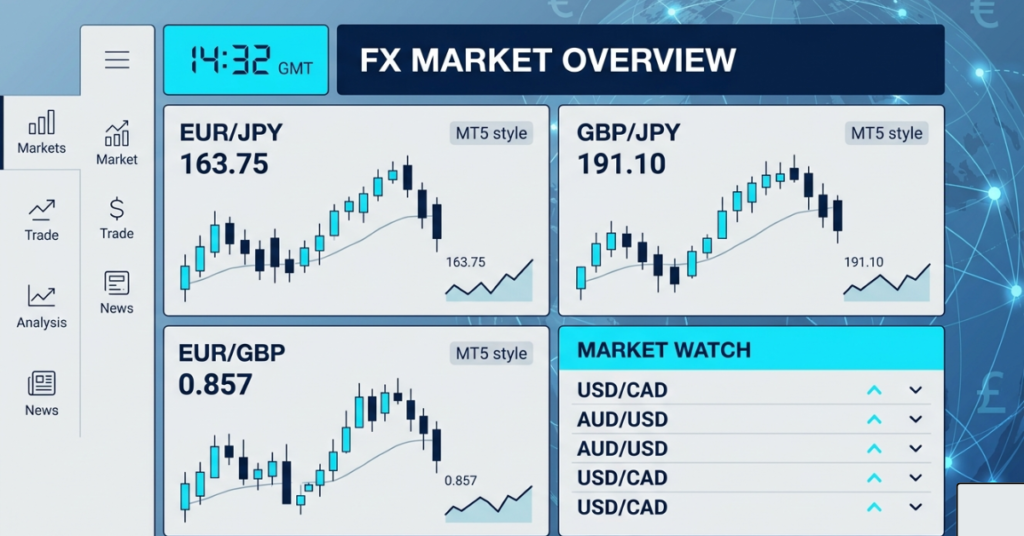
Cross currency pairs are forex pairs that do not include the US dollar. Examples include EUR/GBP, EUR/JPY, and GBP/JPY. They are also called minor pairs or crosses. Traders use them to gain exposure to two non-USD economies at the same time, often finding unique opportunities that major pairs don’t offer.
Key Takeaways
- Cross currency pairs exclude the US dollar from both base and quote currency.
- They are also called minor pairs or crosses.
- EUR/JPY, EUR/GBP, GBP/JPY, AUD/JPY, and CHF/JPY are among the most traded crosses.
- Crosses often have wider spreads than major pairs but offer more diverse trading opportunities.
- They are useful when USD market sentiment is neutral but other economies are moving.
What Are Cross Currency Pairs?
A cross currency pair is any forex pair where neither currency is the US dollar. That’s the simplest definition. When you trade EUR/GBP, you’re exchanging euros for British pounds, with no dollar involved. Same goes for EUR/JPY, AUD/NZD, or GBP/CHF.
Before modern electronic trading, most forex conversions went through the USD first. If you wanted to exchange euros for yen, a bank would convert EUR to USD, then USD to JPY. Now, that process happens directly through cross rate calculations, but the USD still influences pricing in the background.
Cross Currency Pairs vs. Major Pairs vs. Exotic Pairs
Understanding the three main categories helps put crosses in context.
| Category | Definition | Examples |
| Major Pairs | Always include USD | EUR/USD, GBP/USD, USD/JPY |
| Cross Pairs (Minors) | No USD involved | EUR/GBP, EUR/JPY, GBP/JPY |
| Exotic Pairs | USD + emerging market currency | USD/TRY, USD/ZAR, USD/MXN |
Cross pairs sit in the middle in terms of liquidity and spread cost. They are less liquid than majors but far more accessible than exotics.
Most Traded Cross Currency Pairs
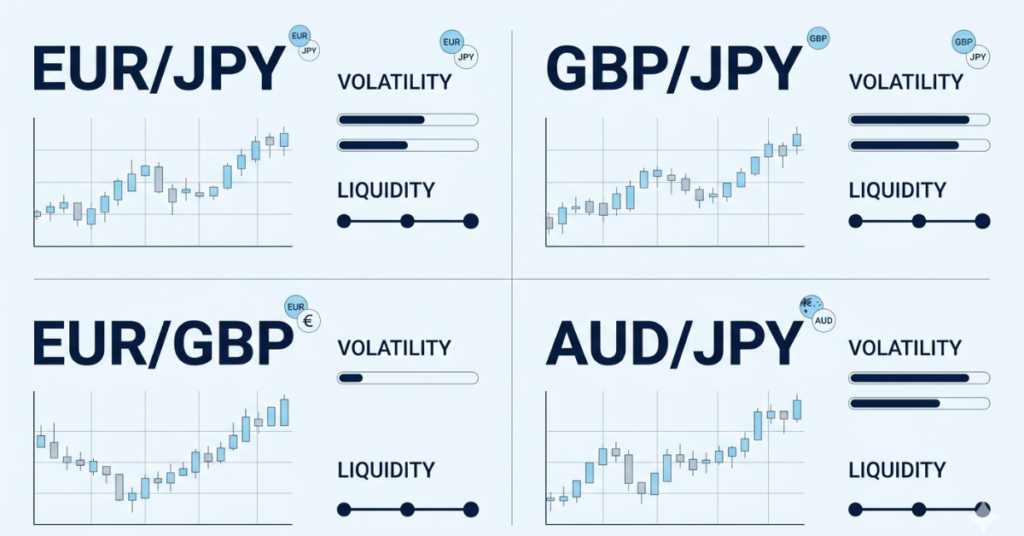
Not all crosses are created equal. Some are highly liquid and move cleanly with technical patterns. Others are thin and can gap unpredictably. Here are the most commonly traded crosses:
EUR/JPY (Euro / Japanese Yen)
EUR/JPY is one of the most popular crosses globally. It moves with both European economic data and Japanese monetary policy decisions. The pair is known for strong trends and is widely used by swing traders. Daily volume makes it relatively liquid among crosses.
GBP/JPY (British Pound / Japanese Yen)
GBP/JPY is often called ‘the dragon’ because of its sharp, fast moves. It has high volatility, which means more pip potential but also more risk. This pair is favored by experienced traders who can handle rapid price swings.
EUR/GBP (Euro / British Pound)
EUR/GBP tends to be slower moving but very technically clean. It reflects the economic relationship between the Eurozone and the UK, and often reacts sharply to Bank of England decisions, UK inflation data, and ECB policy announcements.
AUD/JPY (Australian Dollar / Japanese Yen)
AUD/JPY is a popular risk sentiment indicator. When global risk appetite is strong, AUD/JPY tends to rise. When markets go risk-off, it often falls sharply. Commodity prices, especially iron ore, can also influence this pair.
EUR/CHF (Euro / Swiss Franc)
EUR/CHF is tied closely to European economic health. The Swiss franc is considered a safe-haven currency, so during market stress, CHF often strengthens. This pair can be quiet for long stretches, then move sharply on geopolitical events.
GBP/CHF and CHF/JPY
These pairs combine safe-haven currencies with high-yield or risk-sensitive ones. They are less liquid than the pairs above but still actively traded by professionals.
How Cross Currency Rates Are Calculated
Cross rates are derived from two major pairs that both include the USD. Here’s a simple example:
If you want to find the EUR/JPY rate, you combine EUR/USD and USD/JPY.
EUR/JPY = EUR/USD x USD/JPY
If EUR/USD = 1.0850 and USD/JPY = 147.50, then:
EUR/JPY = 1.0850 x 147.50 = 160.09
This is how brokers and liquidity providers calculate cross rates in real time. The USD doesn’t appear in the pair, but its value underpins the calculation.
Why Trade Cross Currency Pairs?
There are real, practical reasons why traders include crosses in their strategies.
1. Avoid Dollar Noise
When USD news is driving markets, major pairs can become erratic. Crosses let you trade based on the fundamentals of two non-USD economies, which can offer cleaner setups. For example, if the Bank of England raises rates unexpectedly, GBP crosses will react sharply while EUR/USD might just drift.
2. Access Different Economic Stories
EUR/GBP captures the EU vs UK economic relationship. AUD/NZD lets you trade the commodity-driven economies of Australia against New Zealand. Each cross tells a different economic story.
3. Portfolio Diversification
Mixing major pairs with crosses can reduce correlation in your trading portfolio. EUR/USD and GBP/USD often move in sync. Adding EUR/JPY or AUD/JPY introduces different dynamics.
4. Strong Trending Moves
Some crosses, like GBP/JPY and EUR/JPY, are known for sustained trends. When monetary policy divergence is wide between two economies, crosses can trend for weeks or months.
Risks of Trading Cross Currency Pairs
Crosses come with a few challenges that you should be aware of before trading them.
| Risk | What It Means |
| Wider Spreads | Crosses generally have higher spreads than major pairs, increasing trading costs. |
| Lower Liquidity | Some crosses have less depth, which can lead to slippage on large orders. |
| Double Exposure | A move in USD can affect both currencies in a cross simultaneously, amplifying or distorting moves. |
| Complex Fundamentals | You need to track the economic calendar for two non-US economies at the same time. |
| Volatility Spikes | Pairs like GBP/JPY can spike rapidly, hitting stop-losses before reversing. |
Cross Currency Pair Trading Strategies
The same strategies that work on major pairs apply to crosses, but with some adjustments.
Trend Following
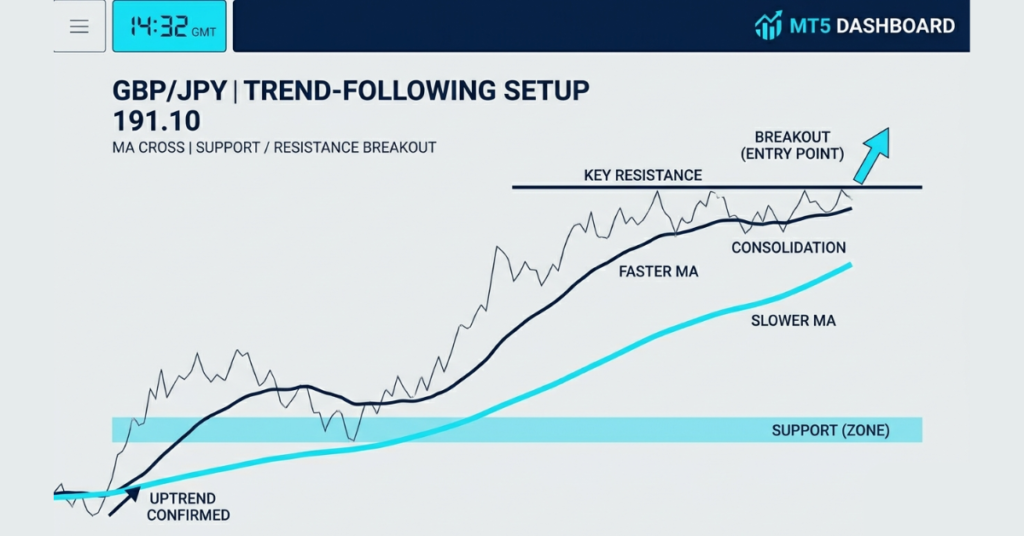
Cross pairs like EUR/JPY and GBP/JPY can form strong, clean trends when monetary policy divergence is significant. A simple approach is to use the 50 EMA and 200 EMA on the daily chart. When the 50 crosses above the 200, look for long entries. When it crosses below, watch for short setups.
Breakout Trading
EUR/GBP is known for long consolidation periods followed by sharp breakouts, often triggered by UK or Eurozone economic data. Setting alerts around key support and resistance levels on the H4 chart can help capture these moves.
News-Driven Trading
Central bank decisions, inflation data, and GDP releases can create fast, directional moves in crosses. For example, a hawkish Bank of Japan statement will typically push JPY crosses lower quickly. Being prepared ahead of key data releases matters a lot here.
Carry Trading
Carry trades involve selling a low-interest-rate currency and buying a higher-yield one. AUD/JPY has historically been a carry trade favourite because Australia tends to have higher interest rates than Japan. When market sentiment is positive, these pairs can trend strongly.
For more on technical tools to use across these strategies, check out best technical indicators for forex and best technical indicators for swing trading.
Open a Demo Trading AccountCross Pairs and the Forex Trading Session
Timing matters when trading crosses. Each pair tends to be most liquid during the sessions of the countries involved.
| Cross Pair | Best Session | Reason |
| EUR/JPY | Tokyo / London overlap | Both European and Asian markets active |
| EUR/GBP | London session | Both European pairs, highest liquidity in London hours |
| GBP/JPY | London session | UK and Asian currencies, London open most active |
| AUD/JPY | Tokyo / Sydney overlap | Both Asia-Pacific currencies |
| EUR/CHF | London / Frankfurt open | Both European currencies |
For a full breakdown of when to trade, see best time to trade currency.
Cross Currency Pairs on MetaTrader 5
Defcofx runs on MetaTrader 5, which gives you full access to cross currency pairs alongside majors, commodities, indices, and cryptocurrencies. Here’s what you get when trading crosses on MT5:
- Real-time cross rate calculation and pricing
- Full access to technical indicators including MACD, RSI, Bollinger Bands, and moving averages
- One-click trading and pending orders on all cross pairs
- Economic calendar integration to track relevant non-USD data releases
- Custom alerts on price levels for breakout and news-driven setups
If you’re new to the platform, this guide on how to use MetaTrader 5 walks you through the essentials.
Defcofx and Cross Currency Trading
- Defcofx is a Saint Lucia-registered forex and CFD broker that gives traders full access to a wide range of cross currency pairs through MT5. Here’s why traders choose Defcofx for cross pair trading:
- Leverage up to 1:2000 – This gives traders significant flexibility when managing position sizes on cross pairs, including volatile ones like GBP/JPY.
- Spreads from 0.3 pips – Competitive pricing across all instruments, no hidden fees or swap charges.
- 40% Welcome Bonus – First-time depositors with a minimum of $1,000 get a 40% bonus, applicable to all clients globally.
- Fast withdrawals – Processed within 4 business hours, including weekends, so you’re never locked out of your funds.
- Global access – Clients from all countries are welcome, with multi-language support available.
Statistics: Cross Currency Pair Trading
A few data points that put cross currency trading in perspective:
- The BIS Triennial Central Bank Survey (2022) reported global forex daily turnover of $7.5 trillion, with cross currency pairs accounting for a meaningful share outside of the dominant EUR/USD pair.
- EUR/JPY is consistently ranked among the top 10 most traded forex pairs globally, reflecting strong institutional interest beyond USD pairs.
- GBP/JPY can see intraday ranges of 150-200 pips on active London sessions, making it one of the most volatile cross pairs in regular trading.
- Carry trade strategies, often executed on AUD/JPY and NZD/JPY, have historically been among the most consistently profitable strategies during risk-on market environments.
Final Thoughts on Cross Currency Pairs
Cross currency pairs expand your forex trading options beyond the dollar. They let you trade the economic relationship between two countries directly, access different volatility profiles, and diversify away from USD-centric moves. EUR/JPY, GBP/JPY, EUR/GBP, and AUD/JPY are the most widely traded, and each offers distinct behavior depending on the market environment.
Whether you’re looking for a slow, technically clean pair like EUR/GBP or a fast, trending pair like GBP/JPY, crosses have something to offer. The key is understanding the economic drivers behind each pair and adjusting your strategy to match the pair’s behavior.
FAQ
A cross currency pair is any forex pair that does not include the US dollar. Examples include EUR/GBP, EUR/JPY, GBP/JPY, and AUD/NZD. They are also known as minor pairs or crosses.
They can be, mainly because spreads are wider and liquidity is lower than on major pairs. You also need to follow the economic data for two non-US economies simultaneously. That said, crosses often offer cleaner technical setups and strong trend moves.
EUR/GBP is often recommended for beginners because it tends to move slowly and predictably, with clean technical patterns. EUR/JPY is also popular for its trend-following behavior, though it is faster moving.
Cross rates are calculated using two major USD pairs. For example, EUR/JPY = EUR/USD multiplied by USD/JPY. Brokers handle this calculation automatically in their trading platforms.
Yes, generally. Because crosses are less liquid than major pairs, brokers charge slightly wider spreads. The exact spread depends on the pair and the broker’s pricing model.
GBP/JPY is widely regarded as the most volatile major cross pair. It can move 150-200 pips or more on active trading days, especially around UK or Japanese economic releases.
Yes. Defcofx offers leverage up to 1:2000 on forex pairs, including crosses. High leverage amplifies both gains and losses, so proper risk management is essential.