


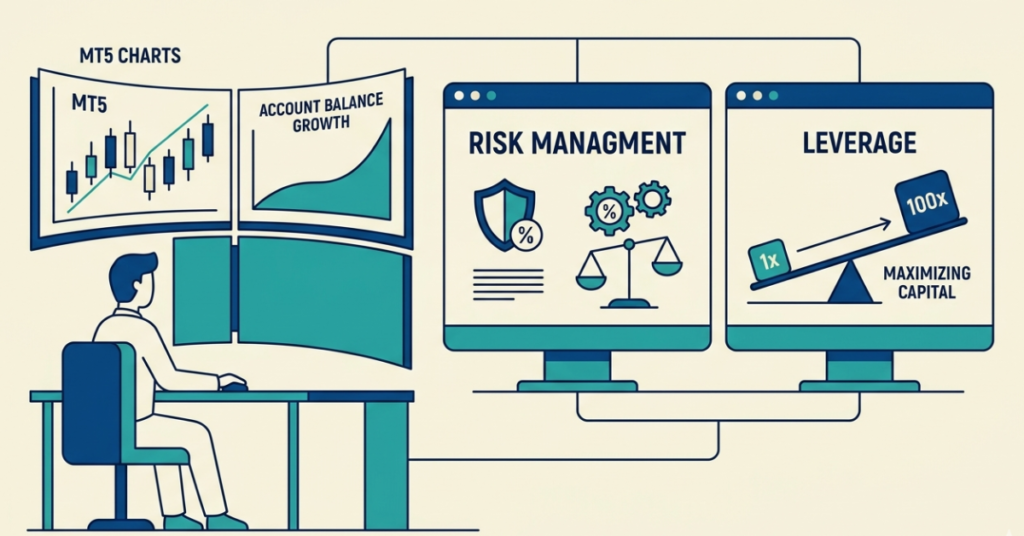
You can technically start trading forex with as little as $10 to $100 at brokers that allow micro or nano lots. But to trade seriously, with proper risk management and room for error, most traders need a minimum of $500 to $1,000. Professional or full-time traders typically work with $5,000 or more.
Key Takeaways
- Minimum deposit to start: as low as $10 to $100 at many brokers.
- Practical minimum for risk management: $500 to $1,000.
- Full-time trading minimum: $5,000 to $10,000+.
- Leverage amplifies buying power but does not remove capital requirements.
- Trading too small reduces your ability to absorb normal market drawdowns.
- Starting on a demo account before risking real money is always recommended.
The Real Answer: It Depends on What You Want to Achieve
The question of how much money you need for forex does not have one clean answer because it depends on your goals. Are you testing the markets for the first time? Are you supplementing income? Or are you trying to trade full-time?
Each scenario has a different capital requirement. Let us walk through each one honestly.
Starting Forex With $10 to $100: Is It Worth It?
Many brokers accept very small deposits and allow you to trade nano or micro lots. Technically, this works. Practically, it limits you severely.
With $100, even a 1% risk per trade means risking only $1. This is fine for learning how the platform works and getting used to the emotional side of real-money trading. But you cannot use proper position sizing, absorb drawdowns, or realistically grow the account without taking on extreme risk.
The $500 to $1,000 Range: The Practical Starting Point
For most traders, $500 to $1,000 is where real forex trading becomes viable. At this range, you can:
- Trade micro lots (0.01 lots) with proper position sizing
- Risk 1% to 2% per trade without your stop loss being smaller than the spread
- Absorb a series of losing trades before hitting a margin call
- Begin to get meaningful feedback on your trading strategy
At $1,000 with 1% risk per trade, you are risking $10 per trade. With a 1:20 risk-reward ratio on a EUR/USD micro lot, you could make $20 on a winning trade. That is real money with real discipline.
See also: How Much Can You Make in Forex with $1,000
Open a Demo Trading AccountHow Leverage Affects Your Capital Requirement
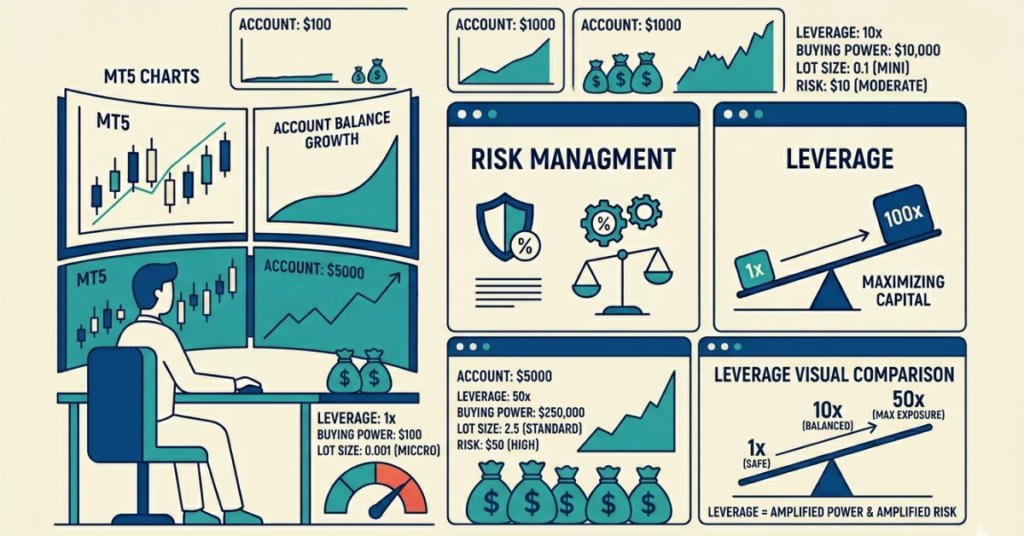
Forex brokers offer leverage, which means you can control a larger position than your actual deposit. With 1:100 leverage, a $1,000 deposit can control $100,000 in the market.
This sounds appealing, but leverage cuts both ways. It amplifies gains and losses equally. Higher leverage means smaller capital requirements to open positions, but it also increases the speed at which losses accumulate.
Defcofx offers leverage up to 1:2000, one of the highest available in the market. This gives traders more flexibility in position sizing, especially with smaller starting capital. But use leverage carefully.
Related: Forex Trading Without Leverage
Capital Needed by Trading Style
| Trading Style | Practical Minimum | Recommended Minimum | Why? |
| Scalping | $500 | $1,000 | Tight stops need room for spread + slippage |
| Day Trading | $1,000 | $2,500 | Multiple intraday positions need buffer |
| Swing Trading | $2,000 | $5,000 | Wider stops need larger account base |
| Position Trading | $5,000 | $10,000+ | Long holds and drawdowns require depth |
For swing trading capital guidance specifically: How Much Money Is Required for Swing Trading
Understanding Lot Sizes and Capital
Lot sizes directly determine how much capital you need per trade:
- Standard lot (1.0): Controls 100,000 units of base currency. High capital requirement.
- Mini lot (0.1): Controls 10,000 units. More accessible.
- Micro lot (0.01): Controls 1,000 units. Suitable for small accounts.
- Nano lot (0.001): Some brokers offer this for very small accounts.
Most beginner traders start with micro lots. At 0.01 lots on EUR/USD, each pip is worth about $0.10. This means a 50-pip stop loss risks only $5.
Learn more about lot sizing: Lot Sizes in Forex
Also see: Best Lot Size for $1,000 Account
Forex Capital Statistics
Here is a look at some data points that reflect how traders actually approach capital in forex:
| Statistic | Data Point |
| Average retail forex account size (global estimate) | $1,000 to $5,000 |
| Percentage of retail traders who lose money (FCA/ESMA data) | 70% to 80% |
| Minimum deposit at most retail brokers | $10 to $200 |
| Professional traders’ typical account size | $25,000+ |
| Most common starting deposit for serious beginners | $500 to $2,000 |
The 1% Rule: Why Capital Matters More Than Leverage
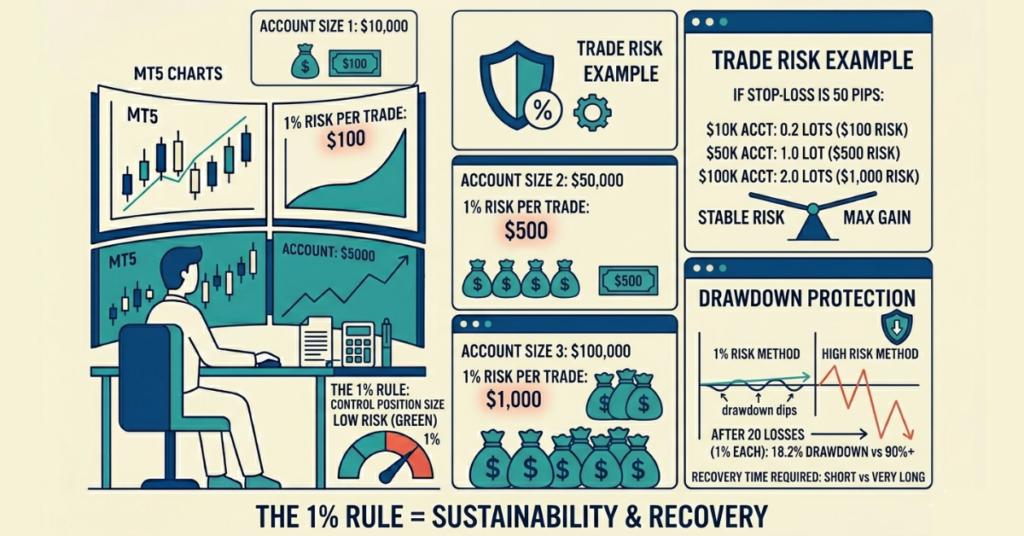
Professional forex traders almost universally apply the 1% rule, never risking more than 1% of total account balance on any single trade. This rule exists to ensure that even a long losing streak cannot destroy your account.
With a $500 account: 1% risk = $5 per trade. That is very tight.
With a $5,000 account: 1% risk = $50 per trade. You have room to breathe.
With a $10,000 account: 1% risk = $100 per trade. This is where consistent trading really becomes viable.
The bigger your account, the more cushion you have to follow proper risk rules without the stops being dictated by the size of your spread.
For a deeper dive: Forex Risk Management
Can You Trade Forex With $100?
Yes, you can open an account and place trades with $100. Some brokers even accept less. But at $100, you will face several practical problems:
- Position sizes will be extremely small (nano lots only at most brokers)
- Any reasonable stop loss in pips will represent a large percentage of your account
- A few losing trades will leave you close to a margin call
- Profits will be very small in dollar terms even on winning trades
The value of a $100 account is primarily educational. It gets you comfortable with a live platform and real money psychology without risking much. Many experienced traders recommend starting on a demo account for this purpose.
See: How to Trade Forex with $100
Open a Live Trading AccountTrading at Defcofx: What Your Capital Gets You
- Defcofx is a MetaTrader 5 broker registered in Saint Lucia, built for traders at every capital level.
- Key conditions that matter for your starting capital:
- Spreads from 0.3 pips: Tight spreads mean less of your capital is consumed by entry and exit costs.
- Leverage up to 1:2000: Smaller accounts can still access meaningful position sizes.
- No commissions or swap fees: Every pip you win is yours.
- 40% Welcome Bonus: On first deposits of $1,000 or more. This gives you an extra buffer to manage risk during the learning phase.
- Fast withdrawals in 4 business hours: Including weekends. Your profits are accessible quickly.
- Multiple account types: Suited to traders with different capital sizes and experience levels.
- Global reach: Accepts clients from all countries.
Final Thoughts on How Much Money You Need to Trade Forex
The amount of money you need to trade forex depends entirely on your goals, strategy, and risk tolerance. While it is technically possible to start with as little as $10 to $100, small accounts leave very little room for proper risk management and often encourage over-leveraging. For most traders, $500 to $1,000 is the practical starting range where disciplined trading becomes realistic.
The key is understanding that success in forex is not about starting with huge capital. It is about protecting the capital you do have. A trader with strong risk management and patience will outperform an over-leveraged trader almost every time, regardless of account size. Focus on consistency first, not quick profits.
FAQ
Most brokers accept deposits as low as $10 to $100. Defcofx allows you to start with a flexible minimum. However, for practical trading with proper risk management, $500 to $1,000 is the recommended minimum.
Yes, but your dollar returns will be small at first. With $500 and conservative risk management (1% per trade, micro lots), you can build consistent habits. The goal at this stage is learning to trade correctly, not generating large income.
Generally, yes. Swing trades hold longer, meaning you need to absorb larger price swings without getting stopped out. Day traders can use tighter stops and smaller capital, but they need to be active during trading hours.
Yes, but it takes time and discipline. Consistently applying a 1% to 2% risk rule and a positive risk-reward ratio can grow a small account steadily. Trying to rush growth by over-leveraging is the fastest way to lose it.
The broker will issue a margin call and may automatically close your open positions to prevent further losses. This is why maintaining adequate free margin is critical, especially on smaller accounts.
Yes. Defcofx offers a 40% Welcome Bonus on first deposits of $1,000 or more, available to all clients. This bonus increases your effective trading balance, giving you more margin buffer during your initial learning phase.