


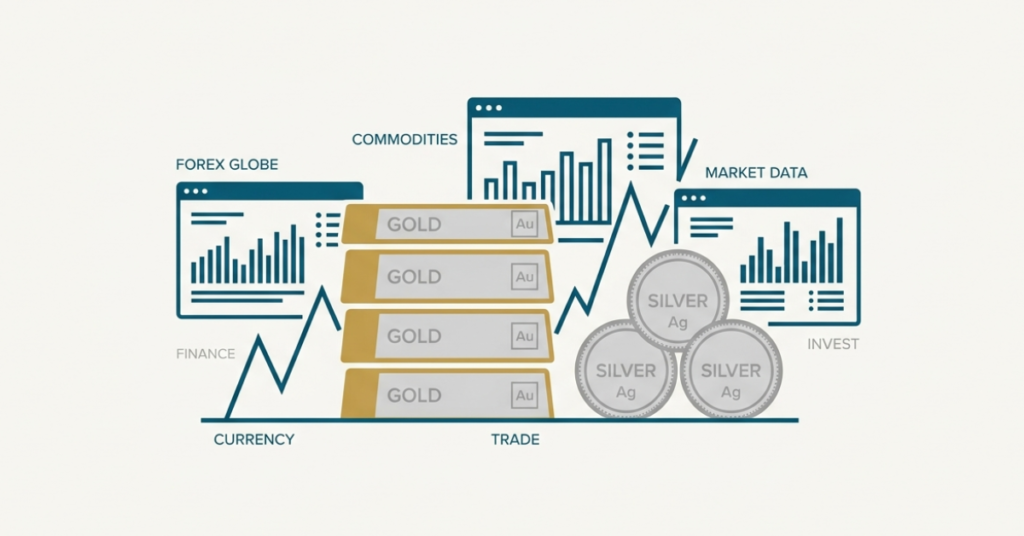
A monetary commodity is a physical good that holds value and has historically been used as money or a store of value. Gold and silver are the most common examples. These assets retain purchasing power over time, making them critical tools for wealth preservation, hedging, and global trade.
Key Takeaways
- A monetary commodity is a tangible asset used as a store of value, medium of exchange, or inflation hedge.
- Gold and silver are the most recognized monetary commodities, with a history dating back thousands of years.
- Commodities like oil and agricultural products serve economic roles but may not qualify as monetary commodities in the strictest sense.
- Traders use monetary commodities via CFDs to speculate on price movements without owning the physical asset.
- With Defcofx, you can trade gold, silver, and other commodities with leverage up to 1:2000 and spreads from 0.3 pips.
Monetary Commodity: The Basic Definition
A monetary commodity is any commodity that markets and governments have historically used as a form of money or an instrument to store economic value. Unlike fiat currencies backed by government decree, monetary commodities have intrinsic worth tied to their physical properties, scarcity, and demand.
Gold is the clearest example. For centuries it served as the universal basis for national currencies through the gold standard. Even after most countries abandoned the gold standard in the 20th century, gold continued to be held by central banks worldwide as a reserve asset.
Silver shares similar characteristics, though its industrial applications make it more volatile than gold. Other metals, such as platinum and palladium, can also take on monetary characteristics in specific market environments.
Key Properties That Make a Commodity “Monetary”
For a commodity to function as a monetary asset, it typically needs the following characteristics:
| Property | Why It Matters |
| Durability | Does not corrode, rot, or degrade over time |
| Divisibility | Can be split into smaller units without losing value |
| Portability | Easy to move and transfer between parties |
| Scarcity | Limited supply preserves purchasing power over time |
| Fungibility | Each unit is interchangeable with another of the same type |
| Intrinsic Value | Has worth beyond its monetary function |
Gold checks all these boxes, which is why it remains the benchmark monetary commodity. You can learn more about trading gold at Defcofx on the metals trading page.
Monetary Commodities vs. Economic Commodities
The distinction between monetary commodities and economic commodities is important for traders and investors.
Economic commodities, like crude oil, natural gas, wheat, and soybeans, derive their value primarily from supply and demand in industrial and food production chains. Their prices fluctuate heavily based on harvests, geopolitical events, and energy demand.
Monetary commodities, by contrast, derive a significant portion of their value from investor sentiment, central bank policy, and macroeconomic uncertainty. When financial crises hit, investors flow into gold and silver because these assets are perceived as safe stores of value, regardless of industrial demand.
Examples of Monetary Commodities
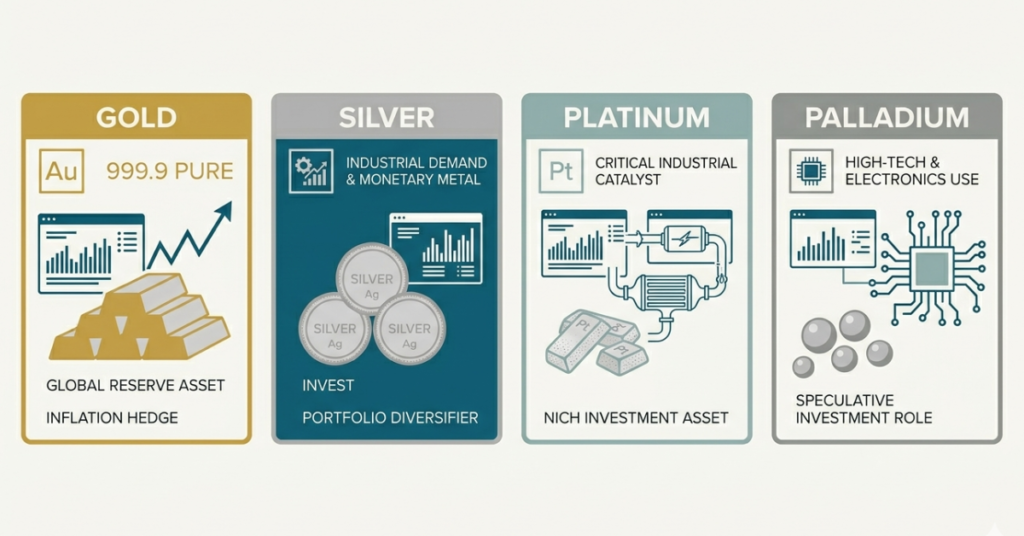
Gold (XAU)
Gold is the world’s most traded monetary commodity. Central banks in countries like the United States, Germany, and China hold substantial gold reserves to back their currencies and diversify away from dollar-denominated assets. For retail traders, gold is available as XAU/USD and other pairs on platforms like MetaTrader 5.
At Defcofx, gold trading is available with competitive spreads. You can check the XAUUSD pips and lot size guide to understand position sizing before you start.
Silver (XAG)
Silver serves a dual role: it is both a monetary commodity and an industrial metal. Around 50% of silver demand comes from industrial uses in electronics and solar panels, while the rest comes from investment and jewelry. This dual demand makes silver more volatile than gold, which creates both opportunities and risks for traders.
Platinum & Palladium
Platinum and palladium are rarer than gold and silver. Their primary use is in catalytic converters for vehicles. However, when industrial demand spikes or supply from major mining regions like Russia and South Africa is disrupted, these metals take on monetary commodity characteristics for investors seeking alternatives to gold.
Historically: Salt, Tobacco, and Copper
Throughout history, various cultures used salt, tobacco, copper, and even shells as monetary commodities. These examples highlight that the definition of a monetary commodity is context-dependent: an asset becomes monetary when a group of people agree to assign it value and use it as a medium of exchange or store of wealth.
How Monetary Commodities Are Traded Today
Modern traders rarely buy and store physical bars of gold or silver. Instead, they access monetary commodities through:
- Spot markets: Trading at the current live price, typically quoted as XAU/USD or XAG/USD.
- Futures contracts: Agreements to buy or sell a commodity at a predetermined price on a specific future date.
- CFDs (Contracts for Difference): Speculating on price movements without owning the underlying asset, allowing both long and short positions.
- ETFs (Exchange-Traded Funds): Funds that track commodity prices and trade on stock exchanges.
- Mining stocks: Indirect exposure through shares in companies that extract or process the commodity.
For most retail traders, CFDs offer the most flexible and accessible route. You can explore how to trade commodities in forex for a detailed breakdown of the process.
Why Monetary Commodities Matter for Forex Traders
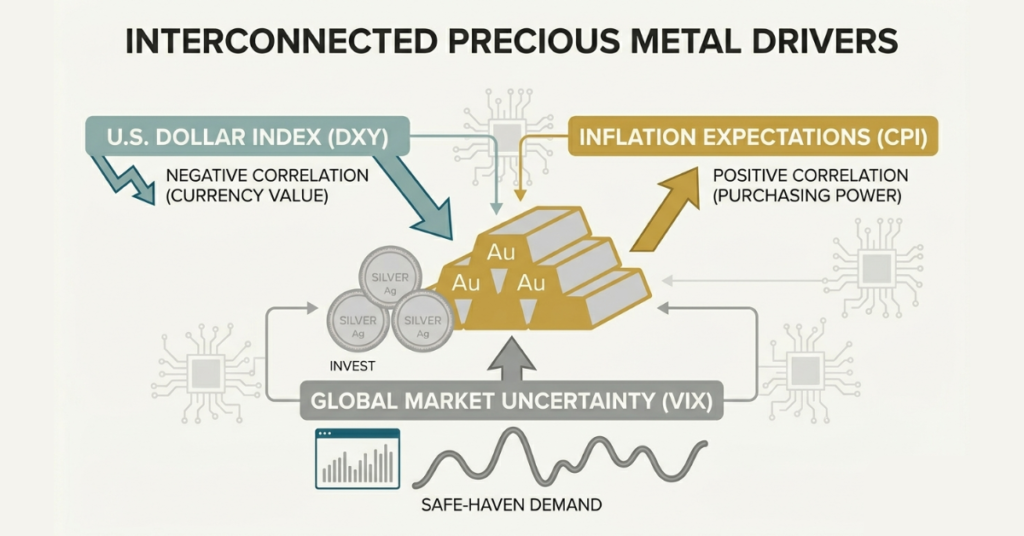
Forex traders pay close attention to monetary commodities, especially gold. Here is why:
First, the price of gold tends to move inversely to the US dollar. When the dollar weakens, gold typically rises, and vice versa. This makes XAU/USD a go-to instrument for traders who want to capitalize on macro dollar trends.
Second, gold is a classic safe-haven asset. During geopolitical uncertainty, financial crises, or sharp equity sell-offs, traders rotate into gold. Being aware of these dynamics helps forex traders understand sudden shifts in currency markets.
Third, since gold is denominated in dollars, its price has a direct relationship with inflation and interest rate expectations. A good understanding of forex risk management is essential when trading commodities, as price swings can be sharp and fast.
Monetary Commodity Statistics Worth Knowing
- Central banks globally hold over 35,000 metric tonnes of gold in reserves as of recent data.
- Gold accounts for roughly 10-15% of total global forex reserves, making it the third-largest reserve asset after the US dollar and euro.
- The global gold market sees an estimated $130–$150 billion in daily trading volume across spot, futures, and OTC markets.
- Silver’s industrial demand accounts for approximately 50% of total consumption, with the remainder split between investment and jewelry.
- Platinum production is concentrated in South Africa (over 70% of global supply) and Russia, making it susceptible to supply disruptions.
Trading Monetary Commodities at Defcofx
Defcofx provides direct access to gold, silver, platinum, and palladium as CFDs on MetaTrader 5. Whether you are hedging against inflation or actively speculating on price trends, the platform is built to support both strategies.
| Feature | Defcofx Detail |
| Spreads | From 0.3 pips |
| Leverage | Up to 1:2000 |
| Commissions | None |
| Swap Fees | None |
| Platform | MetaTrader 5 (MT5) |
| Welcome Bonus | 40% on first deposits of $1,000+ |
| Withdrawal Speed | Within 4 business hours, including weekends |
You can also review the full spreads page or check the leverage options available at Defcofx before opening your account.
Final Thoughts on Monetary Commodities
Monetary commodities have played a central role in global finance for thousands of years. Unlike ordinary commodities that derive value primarily from consumption or industrial use, monetary commodities are valued for their ability to preserve wealth, hedge against inflation, and provide stability during periods of economic uncertainty. Gold remains the most prominent example, while silver, platinum, and palladium can also take on monetary characteristics under specific market conditions.
For traders and investors, understanding the difference between monetary and economic commodities is important because the factors that drive their prices are often very different. While oil or agricultural commodities are heavily influenced by supply and demand fundamentals, monetary commodities respond strongly to inflation expectations, interest rates, currency movements, central bank policies, and investor sentiment.
FAQ
A monetary commodity is a physical asset, most commonly a metal like gold or silver, that holds intrinsic value and has historically been used as money or a store of value. It differs from fiat currency in that its value is not backed by government decree but by physical scarcity and market demand.
Yes. Gold is the most recognized monetary commodity in the world. It was the foundation of the gold standard monetary system and is still held by central banks globally as a reserve asset. Its price often inversely correlates with the US dollar.
Oil is an economic commodity, not a monetary commodity. While oil prices influence global currencies and economies significantly, it does not function as a store of value or medium of exchange in the way gold does. It is perishable in the sense that it is consumed rather than held.
Yes. Through a broker like Defcofx, you can trade gold, silver, and other monetary commodities as CFDs on MetaTrader 5. This means you can go long or short on price movements without owning the physical metal. Visit defcofx.com to see all available instruments.
When inflation rises, the purchasing power of fiat currencies falls. Investors move into monetary commodities like gold because these assets tend to maintain their real value over time. Gold has historically been a reliable inflation hedge, which is why central banks hold it as a reserve.
A monetary commodity is a physical good with intrinsic value used as a store of wealth. A financial commodity is a broader category that can include financial instruments like currencies or interest rate products. The two categories can overlap but are not identical.
Silver is a popular trading instrument because of its dual demand from both investors and industry. It tends to be more volatile than gold, which means higher risk but also greater profit potential. You can learn more about the gold vs forex debate to decide which suits your strategy.