



You may be able to write off qualifying day trading losses, but the answer depends on your tax jurisdiction, the instrument and account, and how the activity is classified. A loss may offset capital gains, qualify for another form of relief, carry to another year, or be disallowed. Calling yourself a day trader does not settle the tax treatment.
This guide explains the decision process and gives separately labelled US, UK, Canadian and Australian examples. These examples concern individuals under the stated rules, not every country, entity or account. Guidance was checked on 24 November 2026; use the forms and instructions for the tax year you are filing. This is general education, not an individual filing determination.
Key Takeaways
- A deduction reduces an eligible tax base; it does not reimburse the loss or guarantee a refund.
- Trading frequency, tax residence, product type and account rules all matter. A foreign broker’s location alone does not determine your tax obligations.
- Capital-loss relief and trading-business expense deductions are separate questions.
- In the US, qualifying securities-trader status alone does not remove capital-loss limits or wash-sale rules; a valid Section 475(f) election changes covered treatment.
- A closed trading loss is not automatically the same as an allowable tax loss. Repurchase rules, currency conversion and other adjustments can change it.
- Keep complete trade records, statements and receipts, and have the final treatment checked by a qualified tax professional in the relevant jurisdiction.
What Does “Write Off” a Trading Loss Mean?
A write-off normally means using an allowable loss or expense in a tax calculation. It might reduce taxable capital gains, reduce another category of income where permitted, or become a carryforward. These are different outcomes. A trading loss, a deduction and a tax refund are not interchangeable amounts.
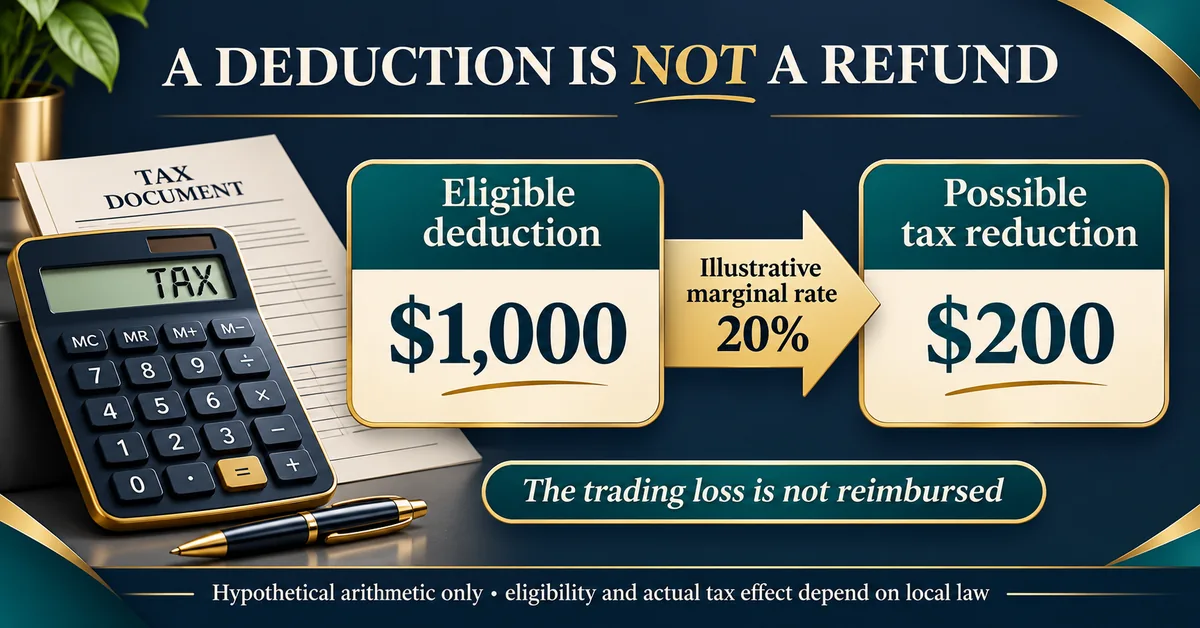
For illustration only, if a $1,000 deduction were fully available against income taxed at an unchanged 20% marginal rate, the reduction would be $200. You would not receive the $1,000 trading loss back. Actual effects depend on rates, income, restrictions and other provisions. This example is arithmetic, not a country-specific entitlement.
How Do Tax Authorities Classify Traders?
Authorities may distinguish investing from carrying on a trading business, but the tests differ. The same description—“active trader” or “professional”—does not have identical meaning in every country. Working full-time at trading is neither a universal requirement nor a guarantee of business treatment.
- The purpose and nature of the activity, including the intended source of returns.
- Frequency, scale and typical holding periods.
- Continuity, regularity and time devoted to the activity.
- Organization, records and businesslike methods where relevant.
- The specific instrument, account, taxpayer and applicable local law.
For US securities trading, the IRS identifies substantial activity, continuity and regularity, and seeking profit from daily market movements. It considers the facts and circumstances. There is no universal safe number of trades in that guidance that automatically grants trader status.
Capital Losses vs. Business Losses
| Question | Capital-loss treatment | Business / ordinary-loss treatment |
|---|---|---|
| What creates it? | A transaction treated as a capital disposal under local rules. | An activity or instrument for which local law provides revenue or ordinary treatment. |
| What can it offset? | Usually capital gains, with jurisdiction-specific exceptions. | Potentially a broader income category, subject to eligibility and restrictions. |
| Is full-time trading enough? | No. Classification follows the applicable tests. | No. Elections, product rules and loss limitations may still apply. |
| Does it guarantee immediate relief? | No. Recognition, restrictions and carryforward rules matter. | No. Other limits can defer or restrict relief. |
Expenses and trade results can also follow different reporting paths. For example, a qualifying US securities trader without a Section 475(f) election can generally report qualifying business expenses on Schedule C while securities gains and losses remain on the capital reporting route. A business label does not move every number onto the same form.
Country Examples: How Trading-Loss Relief Differs
The table below is a starting point for ordinary capital-loss rules for individuals. It is not a classification of every day trading, forex or derivative contract. Special accounts, business activities and elections can change the answer.
| Jurisdiction | General capital-loss starting point | Important qualification |
|---|---|---|
| United States — federal | Offset capital gains; excess net loss may reduce other income up to $3,000 annually, or $1,500 if married filing separately. Unused loss can carry forward. | Subject to netting, carryover and wash-sale rules. Covered Section 475(f), forex and Section 1256 positions require separate analysis. |
| United Kingdom | Allowable losses reduce chargeable gains; unused losses may carry forward. | Claim and use rules apply. CFD and spread-bet treatment must be distinguished; business-income rules are separate. |
| Canada | Net capital losses generally apply against taxable capital gains, with a three-year carryback and indefinite carryforward. | Capital inclusion adjustments and superficial-loss rules matter. Business-income treatment is a separate question. |
| Australia | Capital losses generally reduce capital gains and can carry forward without a time limit. | They cannot reduce salary or other assessable income under the capital rules. Share-trading business and non-commercial-loss rules are separate. |
Sources: IRS capital gains and losses, HMRC allowable losses, CRA capital losses and ATO capital-loss guidance. Do not carry the US $3,000 rule into another country’s return. Local filing years, residency rules and account exemptions also differ.
US Example: How the $3,000 Capital-Loss Limit Works
Assume a US individual who is not married filing separately has $10,000 of allowable capital losses and $4,000 of capital gains. For this simplified example, there are no wash-sale adjustments, no prior carryovers, no special contracts, and sufficient income for the full annual deduction.
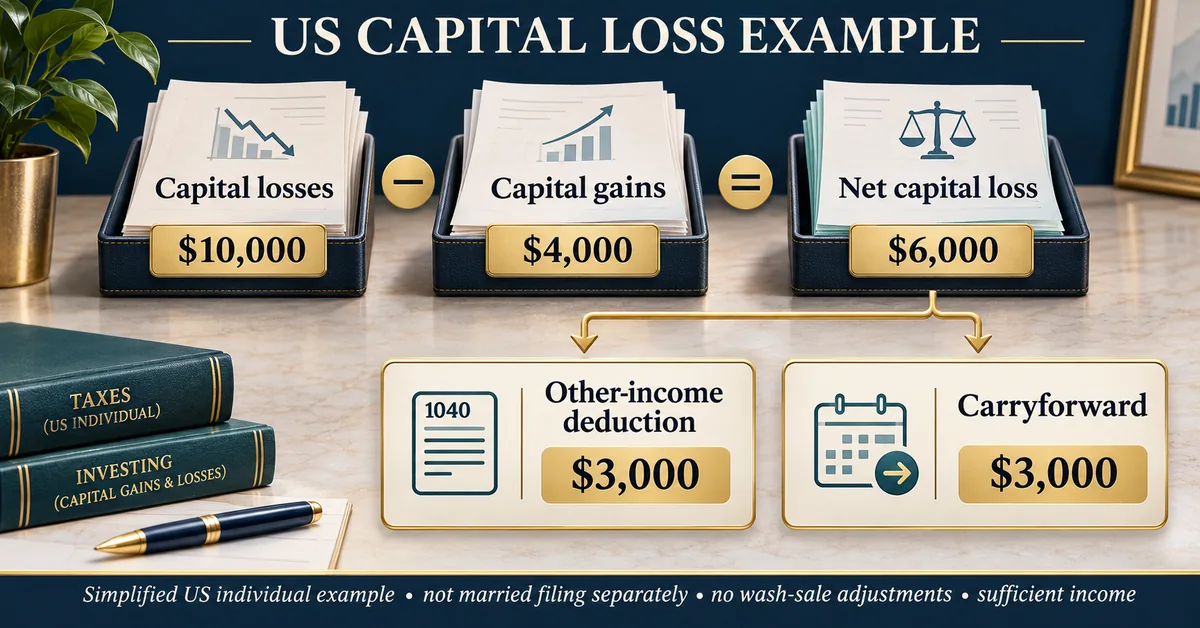
- Offset $4,000 of gains against $10,000 of losses, leaving a $6,000 net capital loss.
- Use $3,000 of that excess against other income under the usual annual limit.
- Carry the remaining $3,000 forward, subject to the carryover calculation.
The annual limit applies to the excess net loss used against other income, not to all losses used against capital gains. The IRS requires the appropriate short-term and long-term netting and carryover calculations; the example does not replace those worksheets. See IRS Topic 409.
US Securities Traders and the Section 475(f) Election
Qualifying as a trader in securities and making a valid mark-to-market election are separate steps. Without the election, the IRS generally retains capital treatment and wash-sale rules. A timely, valid Section 475(f) election generally produces ordinary gains and losses for covered trading-business securities, including year-end mark-to-market results. Investment holdings are excluded when properly identified.

Covered results generally go to Part II of Form 4797, while qualifying business expenses follow their appropriate route. Removing the capital-loss limitation does not mean every business loss is unrestricted: other provisions, including the excess business loss rules, may affect the return. Avoid treating “ordinary” as a synonym for an unlimited immediate deduction.
The IRS election guidance generally requires an election by the unextended due date of the return for the preceding tax year, with special rules for new taxpayers. A filing extension does not generally extend the election deadline. Method-change procedures, including Form 3115 where required, also matter. It is not normally an election to make retrospectively after discovering a large loss.
Realized Losses, Floating Losses and Repurchases
A position showing a loss on a trading screen is a floating or unrealized result until a relevant realization or deemed-disposal rule applies. Under ordinary realization-based capital rules, merely holding an asset that has fallen in price does not normally establish a deductible disposal loss. Mark-to-market, worthless-asset and other special rules can create different outcomes.
For example, paying $5,000 for an investment now worth $4,000 produces a $1,000 paper decline. Selling it for $4,000 may realize a $1,000 loss before costs, but its tax allowability still needs review. The loss shown in the account and the amount recognized in the return may differ.
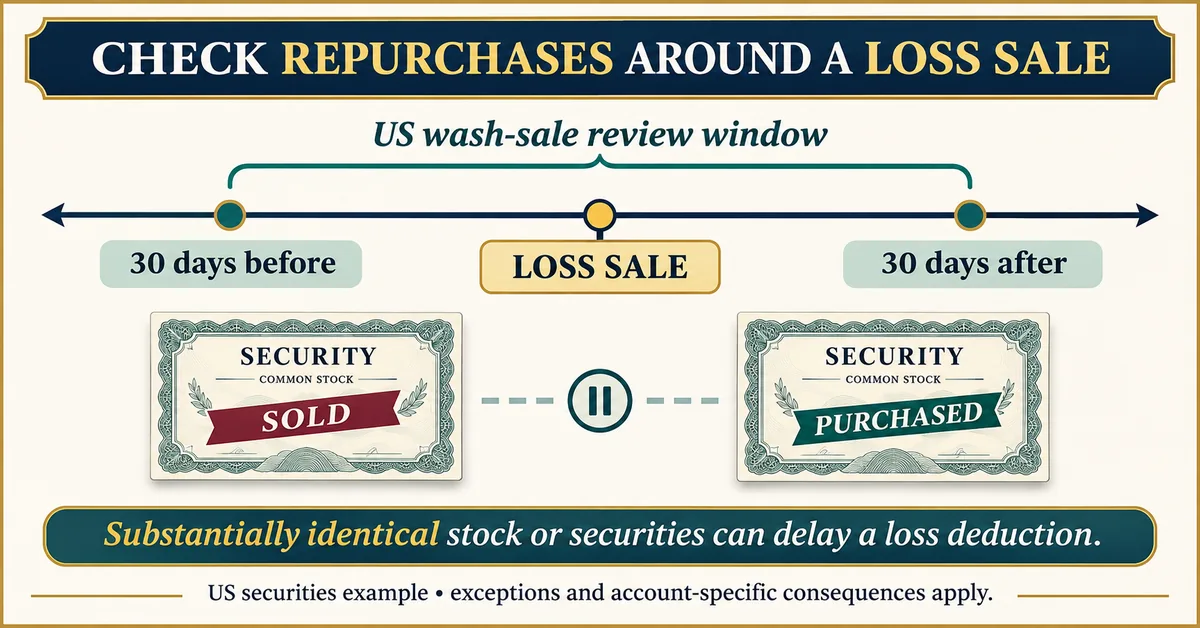
For US stock and securities capital losses, the wash-sale rule can apply when substantially identical stock or securities are acquired within 30 days before or after the loss sale. A normal taxable replacement can defer the loss through a basis adjustment; replacement through certain retirement accounts can have different consequences. Broker reporting may not capture every cross-account or related-person transaction. See IRS Publication 550.
Other jurisdictions have their own mechanisms. Canada’s superficial-loss rules include both an acquisition window and an ownership condition after the sale. UK share identification includes same-day and subsequent 30-day matching rules. These are not simply the US wash-sale rule under another name; check the local calculation before repurchasing.
Are Forex, Futures and CFD Losses Deductible?
Possibly, but product names alone do not determine the rule. Identify the legal contract, tax jurisdiction, purpose and any valid elections. A stock, a currency holding, a futures contract and a CFD referencing the same market can receive different treatment.
| Product / situation | What needs checking |
|---|---|
| US foreign-currency transactions | Section 988 can provide ordinary treatment for covered foreign-currency transactions, with exceptions and elections. Not every forex-labelled product follows one universal rule. |
| US Section 1256 contracts | Special mark-to-market and reporting rules can apply. Form 6781 covers qualifying contracts and straddles; it is not the form for every currency trade. |
| UK retail CFDs | Generally within capital gains unless trading-income treatment applies. Financing-equivalent and other contract debits/credits can form part of the contract computation. |
| UK spread betting | Gambling or wagering treatment can put gains and losses outside the income-tax framework, with exceptions such as commercial hedging. Do not assume losses can offset other gains. |
| Tax-advantaged / exempt accounts | The account wrapper can change or prevent relief. Do not apply ordinary taxable-account loss examples automatically. |
Sources: US Section 988, IRS Form 6781, HMRC CFD guidance and HMRC financial-trading and spread-betting guidance. These rules explain why an international broker article cannot promise one deduction treatment for all clients.
UK, Canadian and Australian Examples: What to Watch
UK: HMRC says allowable losses reduce gains for the same tax year; qualifying brought-forward losses then have their own use rules. A loss claim can generally be made up to four years after the end of the disposal tax year. That claim window does not replace other return or payment deadlines. A qualifying CFD loss and a spread-betting loss should not be treated as interchangeable.
Canada: capital-loss relief is generally against taxable capital gains, with adjustments where inclusion rates differ. The CRA guidance describes carrying a net capital loss back three years or forward to a future year. First determine whether the transactions belong on capital or income account; do not assume every day trading account is capital.
Australia: an investor’s net capital loss cannot offset salary and wages, but can generally carry forward for capital gains. The ATO distinguishes share investing from a share-trading business. Business losses can face non-commercial-loss restrictions. The distinction is based on facts, not merely selecting a preferred result.
Can You Deduct Trading Expenses?
Some qualifying trading businesses can deduct ordinary, necessary or otherwise eligible costs under local law. Investors can face different restrictions. A receipt proves that money was spent, but not that the cost is deductible or belongs in the current year.
| Cost | Important distinction |
|---|---|
| Software and market data | Identify the business purpose, relevant period and personal use. |
| Internet and home office | Only qualifying use may be eligible; home-office tests differ by jurisdiction. |
| Computers and equipment | Capital allowances, depreciation or other asset rules may replace an immediate full deduction. |
| Education | Eligibility can depend on its relationship to an existing activity; introductory training is not automatically deductible. |
| Commission and transaction costs | They may enter basis, proceeds or a contract P/L calculation rather than being a separate general expense. Avoid double-counting. |
| Accounting and professional fees | Check the service’s purpose, allocation and local deduction rules. |
Keep personal and business use separate and retain the calculation behind any allocation. A dedicated account can simplify evidence, but opening an account or forming an entity does not automatically establish trader status or create a deduction.
Why Keeping Records Matters
A tax-ready record should let another person reconcile every amount from the transaction through the account statement to the return. A broker’s annual profit figure is a starting point. It may use a different currency, timing convention or adjustment policy from your tax system.

- Trade IDs, legal product names, opening and closing dates/times, quantity and actual execution prices.
- Realized P/L, open positions at year-end, commission, financing, adjustments and any other charges.
- Deposits, withdrawals, transfers, credits and bonuses, kept distinct from trading results.
- Account currency, required reporting currency, exchange-rate source and conversion method.
- Repurchases across relevant accounts, basis or matching adjustments, and losses carried from earlier years.
- Election statements, filing acknowledgments, expense receipts and supporting classification records.
A cash withdrawal is not automatically a trading expense, and a deposit is not automatically trading revenue. Reconcile opening balance, cash movements, posted results and closing balance without treating the whole change as deductible P/L. Preserve the original statements as well as your working spreadsheet.
How Defcofx Can Help With Trading Records
Defcofx clients can review trading history through MetaTrader 5. Select the relevant account and reporting period and retain the available history report, statements and transaction details. Make sure the period matches the tax year you need and that commissions, financing and cash movements are included or reconciled separately. Report options vary by platform version.
A platform report does not decide tax residence, trader status, loss eligibility or whether an election was valid. Nor should it be assumed to replace a country-specific tax form. Ask your tax adviser what additional records are required, especially for foreign-currency accounts and multiple brokers.
Keep Your Trading History Organized
Review the Defcofx MT5 platform and retain your account history for the period your adviser needs. Platform records support reporting; they do not establish tax deductibility.
Explore Defcofx MetaTrader 5Common Mistakes When Claiming Day Trading Losses
- Assuming all losses qualify: confirm jurisdiction, product, account and recognition rules first.
- Confusing trader status with an election: classification alone may not change the treatment of trade results.
- Ignoring repurchases: wash-sale, superficial-loss or share-matching rules can change the calculation.
- Claiming expenses twice: transaction costs already included in the trade calculation should not be deducted again.
- Using only the broker’s headline P/L: reconcile currency conversion, adjustments and cash movements.
- Missing timing or foreign-account obligations: losses do not necessarily remove reporting requirements or extend filing deadlines.
Best Practices Before Filing Your Return
- Identify the relevant tax jurisdiction, tax year, taxpayer type and account wrapper.
- Classify the instruments and activity using the applicable official guidance.
- Reconcile allowable losses, costs, repurchases and prior-year carryovers.
- Check election and filing deadlines separately; do not assume an extension covers both.
- Have a qualified local tax professional review material uncertainties before filing.
A possible tax benefit should not be the reason to take an otherwise unsuitable trade. A deduction may reduce the after-tax cost of an eligible loss, but the remaining economic loss is still real. Keep risk decisions separate from the hope of tax relief.
Final Thoughts
You may be able to claim relief for day trading losses, but the useful answer comes from matching your jurisdiction, activity, instrument and account to the right rules. Capital losses, ordinary losses, business expenses and carryovers are distinct categories with different conditions.
Keep accurate records throughout the year, read official guidance for the filing year, and get professional review where classification or special contracts are involved. Defcofx history records can support that work, while the tax determination remains specific to your circumstances.
Frequently Asked Questions
Not automatically. Eligibility, annual limits, carryovers, account rules and product classification differ. An economic loss may be deferred, disallowed or treated differently from the broker’s P/L.
For an individual under ordinary capital-loss rules, excess net capital losses can generally offset up to $3,000 of other income annually, or $1,500 if married filing separately. Losses offset capital gains first. Special regimes require separate analysis.
US securities-trader status alone does not. Without a valid Section 475(f) election, capital-loss limits and wash-sale rules generally remain. A timely election changes covered trading-business treatment, while other loss limitations can still matter.
Generally, the US election has an earlier deadline tied to the unextended due date of the preceding year’s return. New-taxpayer rules and accounting-method procedures need review. Do not assume the election is available retrospectively.
Under ordinary realization-based capital rules, a price decline alone is generally insufficient. A disposal, mark-to-market rule or another recognition provision may be relevant. Check the specific product and tax system.
It depends on the jurisdiction and circumstances. HMRC generally treats retail CFD outcomes under capital gains unless trading-income treatment applies. That UK treatment should not be applied automatically to another country or to spread bets.
No. Some foreign-currency transactions have special rules, such as Section 988 in the US. Futures and other contracts may follow different provisions. Identify the legal instrument and applicable elections rather than relying on a forex label.
Qualifying costs may be deductible under the rules for your activity, but personal use, asset treatment and local restrictions matter. A receipt alone does not establish eligibility, and transaction costs should not be deducted twice.
Repurchases can change loss recognition. US wash-sale rules, Canadian superficial-loss rules and UK share-matching rules have different conditions. Review all relevant accounts and local rules before claiming the loss.
They document trading activity, but taxable P/L can differ because of currency conversion, basis, repurchases, timing and other adjustments. Retain statements, transaction details and the reconciliation to the return.
Often, subject to local rules. US capital losses can carry forward; Canadian net capital losses generally carry back three years or forward indefinitely; UK and Australian capital-loss carryforwards have their own conditions.
No. A deduction changes an eligible tax calculation. Its actual benefit depends on rates, income and restrictions, and may be deferred. It does not reimburse the original economic loss.