


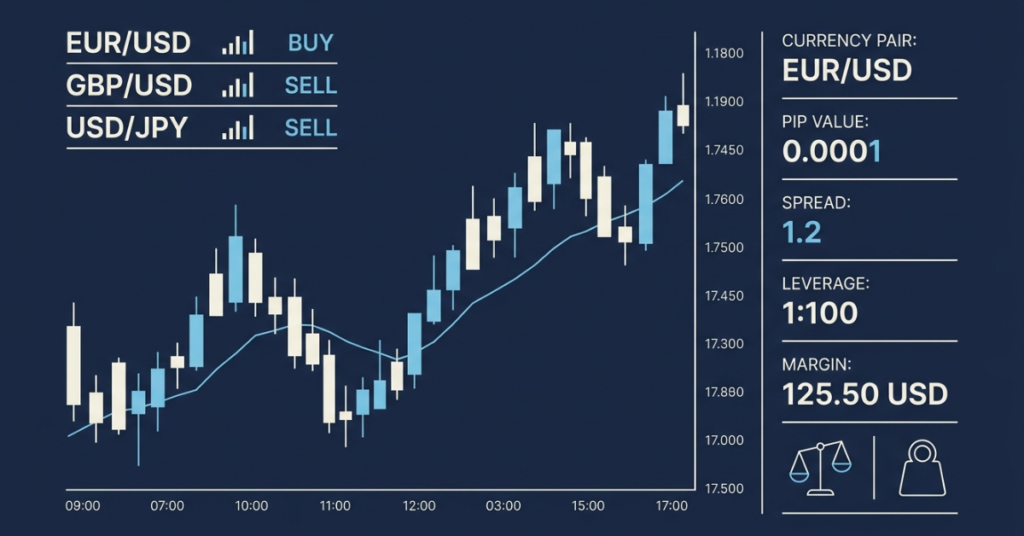
Forex trading terms are the words traders use to describe prices, positions, and risk. The most common ones are pip, spread, lot, leverage, margin, and pips value. Learning these terms first makes charts, orders, and account screens far easier to read.
Important Insights
- A pip is the standard unit of price movement in a currency pair. Learn more about pips in forex trading.
- The spread is the gap between the buy and sell price, and it is your main trading cost. See what a spread is.
- A lot sets your trade size. Read how lot sizes work.
- Leverage lets you control a larger position with a smaller deposit, and it raises both profit and risk.
- Margin, free margin, and a margin call describe how much of your balance is tied up and when a broker closes trades.
Account and Money Terms
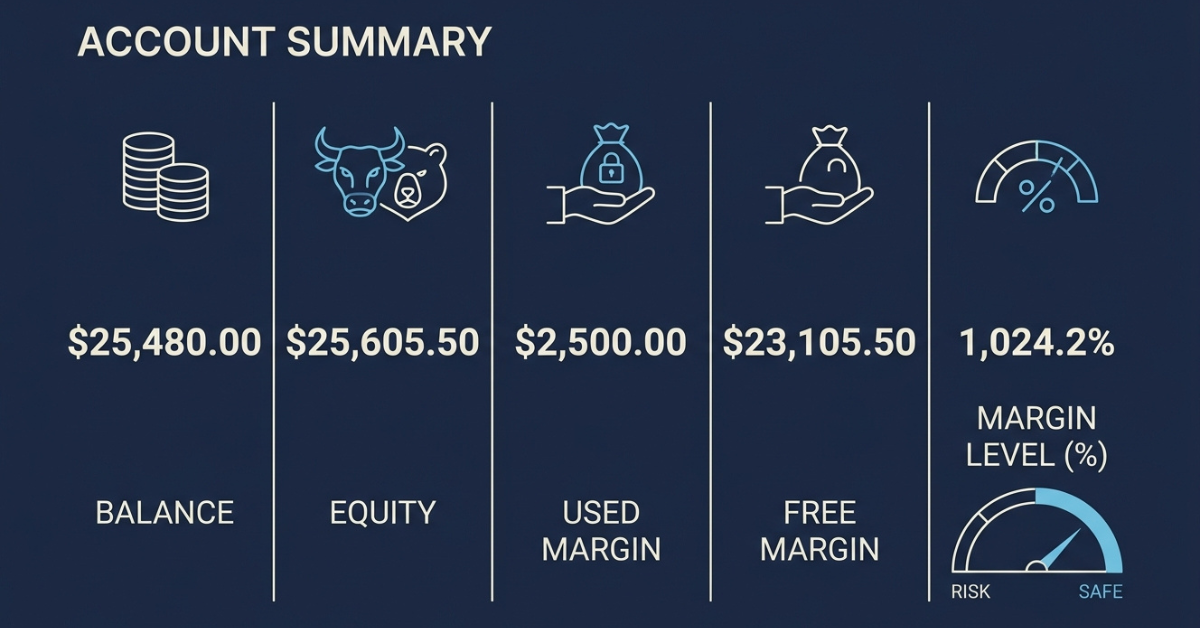
These terms describe the money in your account and how much of it a trade uses. They appear on every trading screen, so they are the ones to learn first.
| Term | What it means |
| Balance | The total cash in your account when no trades are open. |
| Equity | Your balance plus or minus the profit and loss of open trades, updated live. |
| Margin | The deposit set aside to keep a leveraged position open. |
| Free margin | Equity that is not tied up in margin and is available for new trades. |
| Margin level | Equity divided by used margin, shown as a percentage. A falling level warns of risk. |
| Margin call | A warning that your equity is too low to support open trades. |
Example: you deposit $1,000, that is your balance. You open one trade using $100 of margin, so your free margin is roughly $900. If the trade moves against you, equity falls and your margin level drops. For a deeper look, see free margin in forex.
Price and Quote Terms
Every currency pair shows two prices that move constantly. These 7 terms explain what those numbers mean and how movement is measured.
| Term | What it means |
| Currency pair | Two currencies quoted together, like EUR/USD. The first is the base, the second is the quote. |
| Bid | The price at which you can sell the base currency. |
| Ask | The price at which you can buy the base currency. |
| Spread | The difference between the bid and the ask, and your cost to enter. |
| Pip | The standard smallest price move, usually the fourth decimal place. |
| Pipette | A fractional pip, the fifth decimal place, used for finer pricing. |
| Quote | The current bid and ask shown for a pair at a moment in time. |
Trade Size and Cost Terms
| Term | What it means |
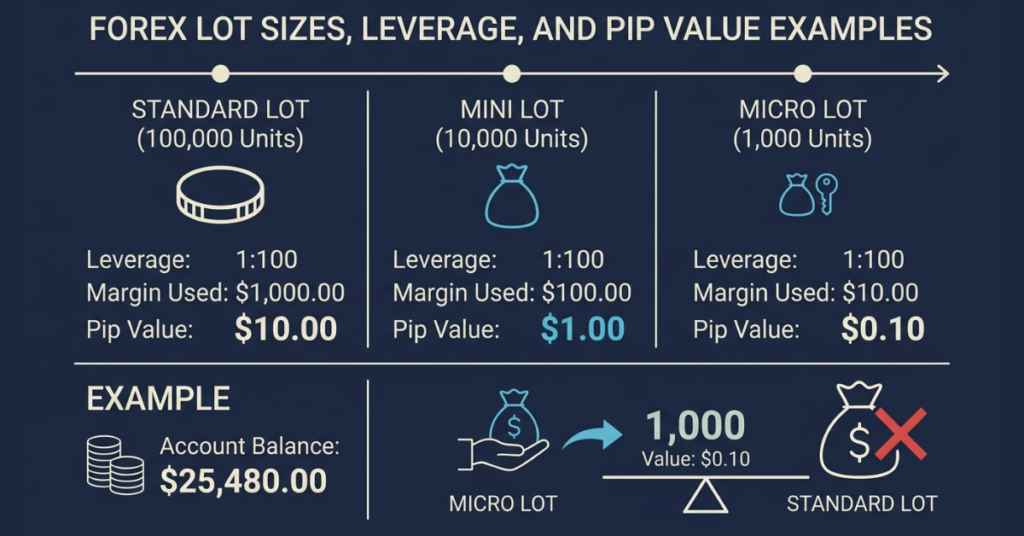
| Lot | The unit of trade size. A standard lot is 100,000 units of the base currency. |
| Mini lot | One-tenth of a standard lot, or 10,000 units. |
| Micro lot | One-hundredth of a standard lot, or 1,000 units, good for small accounts. |
| Leverage | A ratio, such as 1:100, showing how much position size a deposit controls. |
| Pip value | The money gained or lost per pip, based on lot size and the pair. |
| Commission | A per-trade fee some brokers charge. Defcofx charges zero commission. |
| Swap | An overnight financing charge for holding a trade. Defcofx applies zero swap fees. |
Example: on a standard lot of EUR/USD, one pip is worth about $10. On a micro lot it is closer to $0.10. Choosing the right lot size is how you control risk. See how lot sizes work before you scale up.
Order and Execution Terms
| Term | What it means |
| Market order | An instruction to buy or sell right now at the best available price. |
| Limit order | An order to trade only at a set price or better. |
| Stop loss | An exit order that closes a losing trade at a level you choose. |
| Take profit | An exit order that locks in gains at a target level. |
| Slippage | The gap between the price you expected and the price you got. |
| Long | A buy position that profits when the price rises. |
| Short | A sell position that profits when the price falls. |
A limit order and a stop loss are the two orders most new traders should learn early, because they handle both entry and risk without watching the screen.
Analysis and Market Terms
| Term | What it means |
| Technical analysis | Studying price charts and patterns to plan trades. |
| Fundamental analysis | Using economic data and news to judge currency value. |
| Volatility | How much and how fast a price moves over a period. |
| Liquidity | How easily a pair can be traded without moving the price. |
| Trend | The general direction of price, up, down, or sideways. |
| Support | A price level where buying tends to slow a fall. |
| Resistance | A price level where selling tends to cap a rise. |
| Drawdown | A drop from a peak in account value, measured as a percentage. |
Learning Forex Terms With Defcofx
Defcofx is an online forex and CFD broker built on the MetaTrader 5 platform, where every term above appears in a live setting. Trying the terms in a real interface, first on a demo, is the fastest way to make them stick.
- Spreads from 0.5 pips, so the spread term stays a small, clear cost.
- Zero commissions and zero swap fees, which keeps your cost math simple while learning.
- Leverage up to 1:2000, shown live so you see how margin and free margin respond.
- MetaTrader 5 platform, where market, limit, stop loss, and take profit orders are all built in.
- Withdrawals within 3 hours, including weekends, so balance and equity stay easy to manage.
Defcofx conditions at a glance
| Minimum spread | From 0.5 pips |
| Maximum leverage | Up to 1:2000 |
| Commission | $0, zero commission |
| Swap fees | $0, zero swap |
| Welcome bonus | 40% on qualifying first deposits |
| Platform | MetaTrader 5 (MT5) |
FAQ
The pip. It is the unit that measures price movement, and almost every other term, from spread to pip value, depends on it. Once you can read a pip, the rest of the vocabulary falls into place.
A pip is a single unit of price movement. A spread is the gap between the buy and sell price, and it is measured in pips. So the spread is counted in pips, but they are not the same thing.
No. Balance is your total cash. Margin is only the part of it set aside to hold an open trade. The rest is your free margin, available for new positions.
It means every $1 of your own money can control $100 of position size. Higher leverage increases both potential profit and potential loss, so it should be used with care.
A lot is the size of your trade. A standard lot is 100,000 units of the base currency, with mini and micro lots for smaller sizes. See lot sizes in forex for the full breakdown.
Slippage is the small difference between the price you expected and the price your order filled at, common in fast markets. It is normal and usually minor, but a limit order can help you avoid it.
On a demo account, which uses virtual funds in live market conditions. You can open a Defcofx demo account and see every term in action without risking money.
Final Thoughts on Common Forex Trading Terms and Their Meanings
Understanding common forex trading terms gives beginners a much clearer view of how the market works. Terms such as pips, spreads, lots, leverage, margin, orders, and drawdown are not just technical vocabulary; they directly affect how trades are opened, managed, and measured. Once these basics become familiar, reading a trading platform and evaluating risk becomes much easier.
The most important step is to connect each term with practical risk management. Start with smaller position sizes, understand how margin and pip value affect your account, and practice using orders such as stop loss and take profit. A demo account can help you build this foundation before committing real capital.