


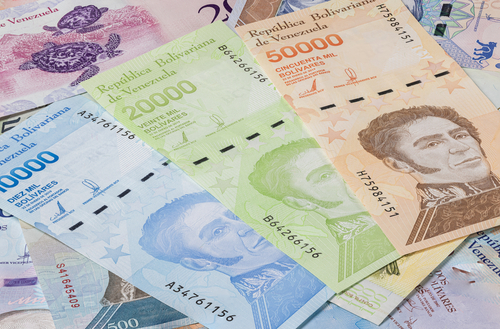
Venezuela uses the Venezuelan bolívar. Its current currency code is VES, and its symbol is Bs. The country has changed its currency system several times because very high inflation made older versions of the bolívar difficult to use.
So, if you see VES on a currency list or financial platform, it means the Venezuelan bolívar.
Key Takeaways
- Venezuela uses the Venezuelan bolívar.
- The current international currency code is VES.
- The currency is commonly shown with the symbol Bs.
- Venezuela has replaced or redenominated the bolívar several times.
- Very high inflation was a major reason for these changes.
- U.S. Dollars are also widely used for many everyday transactions in Venezuela.
- The Venezuelan bolívar is not considered a major forex currency.
- USD/VES compares the U.S. Dollar with the Venezuelan bolívar.
What is the currency of Venezuela?
The official currency of Venezuela is the bolívar.
Pretty simple.
If you’re reading about the Venezuelan economy and see the letters VES, that’s the currency code for the bolívar.
Here’s the easiest way to remember it:
| Term | Venezuela |
| Currency | Venezuelan Bolívar |
| Currency Code | VES |
| Common Symbol | Bs. |
| Country | Venezuela |
| Central Bank | Central Bank of Venezuela |
The currency gets its name from Simón Bolívar, one of the most famous historical figures in South America.
He played a major role in the independence movements that freed several South American territories from Spanish rule.
Why is Venezuela’s money called the bolívar?
The name comes from Simón Bolívar.
If you’ve studied South American history, you’ve probably heard the name before.
Bolívar was an important military and political leader during the independence movements of the early 1800s.
Because of his importance to Venezuela’s history, the country’s currency was named after him.
The bolívar has been used in Venezuela in different forms for a very long time.
But there’s an important detail here.
Today’s bolívar isn’t exactly the same version people were using decades ago.
Venezuela has changed its currency system several times.
Why has Venezuela changed its currency so many times?
This is where Venezuela becomes much more interesting from a currency point of view.
The country has experienced extremely high inflation.
Inflation simply means prices are going up and money is buying less.
A little inflation happens in many countries.
But when inflation becomes extremely high, everyday money can become difficult to use.
Here’s a made-up example.
Imagine a bottle of water costs 10 bolívares.
Later, it costs 100.
Then 1,000.
Then 100,000.
Eventually, prices can end up with so many zeros that paying for normal things becomes confusing.
That’s one reason governments sometimes change their currencies or remove zeros from prices.
Example:
Imagine having to say your coffee costs 5,000,000 units of currency every morning. Removing some zeros makes prices easier to write and understand. It doesn’t magically make the coffee cheaper.
What does removing zeros from a currency mean?
This is called redenomination.
It sounds complicated, but the idea is actually really easy.
A government basically creates a simpler version of the currency.
Imagine:
1,000 old bolívares = 1 new bolívar.
Now imagine something previously cost 10,000 old bolívares.
After the change, it might be written as 10 new bolívares.
The number looks much smaller.
But the product hasn’t suddenly become cheaper.
The currency has simply been rewritten using fewer zeros.
Think about changing 1,000 grams into 1 kilogram.
The number changes, but the actual amount doesn’t.
Venezuela has had different versions of the bolívar
This is why researching Venezuela’s currency can get confusing.
You may find different names and currency codes depending on which year you’re reading about.
Venezuela has introduced several versions of its currency as it tried to deal with inflation and very large numbers.
For example, older versions included the bolívar fuerte and later the bolívar soberano.
Another redenomination followed in 2021, removing six zeros from monetary amounts.
So when you see old Venezuelan prices online, don’t automatically compare them directly with modern prices.
They may be referring to an older version of the currency.
| Period | Currency Name/Version | Why It Changed |
| Earlier system | Bolívar | Original modern system |
| 2008 | Bolívar Fuerte | Removed 3 zeros |
| 2018 | Bolívar Soberano | Removed 5 more zeros |
| 2021 | New monetary scale | Removed another 6 zeros |
That’s a lot of zeros removed over time.
And it shows just how serious Venezuela’s inflation problem became.
What is inflation?
Since inflation is such a big part of Venezuela’s currency story, it’s worth making sure this part is clear.
Inflation means prices increase over time.
Let’s say you have 100 units of currency.
Today, that buys you 10 bottles of water.
After a period of high inflation, the same 100 might only buy you two bottles.
Your money didn’t physically disappear.
It just buys less.
That’s called losing purchasing power.
For normal levels of inflation, the change usually happens much more slowly.
When inflation becomes extremely high and prices rise incredibly quickly, it’s sometimes called hyperinflation.
Venezuela experienced a major hyperinflation crisis.
Why did Venezuela experience such high inflation?
There’s no single reason.
Venezuela’s economic problems developed over many years.
The country depends heavily on oil.
Oil is extremely important because Venezuela has some of the world’s largest oil reserves.
When oil brings in lots of money, that can provide major income for the country.
But depending heavily on one industry can also create problems.
Changes in oil production and oil prices, government spending, economic policies, political instability, sanctions, shortages, and falling production all played roles in Venezuela’s wider economic crisis.
As the economy struggled, the bolívar lost a huge amount of purchasing power.
That made foreign currencies, especially the U.S. Dollar, increasingly important in everyday life.
Can you use U.S. Dollars in Venezuela?
Yes, U.S. Dollars are widely used in Venezuela even though the bolívar remains the official currency.
This can sound strange at first.
How can a country use one official currency while people regularly pay with another?
It happens when people trust the foreign currency more for keeping value or find it easier for certain transactions.
Imagine you’re selling something today.
You receive payment in bolívares.
But you’re worried those bolívares might buy much less in the future because prices are rising quickly.
You might prefer receiving U.S. Dollars instead.
Over time, more businesses and customers can start thinking the same way.
That’s one reason Dollars became widely used in Venezuela.
What is USD/VES?
Now let’s connect all of this with forex.
USD/VES compares the U.S. Dollar with the Venezuelan bolívar.
USD = U.S. Dollar
VES = Venezuelan Bolívar
The first currency is the Dollar.
The second is the bolívar.
If USD/VES goes higher, it generally means you need more bolívares to buy one U.S. Dollar.
In simple terms, the Dollar is getting stronger against the bolívar.
If USD/VES goes lower, fewer bolívares are needed to buy one Dollar.
Here’s the easy version:
| USD/VES Movement | Simple Meaning |
| Goes Up | USD becomes stronger against VES |
| Goes Down | VES becomes stronger against USD |
Sounds easy enough.
But USD/VES is very different from something like EUR/USD.
Is the Venezuelan bolívar commonly traded in forex?
Not really.
The bolívar isn’t one of the normal major currencies you’ll see forex traders focusing on every day.
Major forex currencies include currencies such as:
- U.S. Dollar
- Euro
- British Pound
- Japanese Yen
- Swiss Franc
- Australian Dollar
- Canadian Dollar
These currencies have huge international markets.
VES is different.
Venezuela has had currency controls and a complicated exchange-rate system, and access to the bolívar in international financial markets isn’t comparable with freely traded major currencies.
So a beginner shouldn’t look at USD/VES and assume it works exactly like EUR/USD.
It doesn’t.
Official exchange rates and other exchange rates
Here’s another important thing to understand about currencies going through major economic problems.
You might see different exchange rates mentioned.
An official rate could say one thing.
People actually exchanging money might sometimes see something different.
Why?
Currency controls and restrictions can create differences between official exchange rates and rates found outside official channels.
This is one reason Venezuela’s currency situation has historically been more complicated than simply opening a normal forex chart and checking the price.
For beginners, the main lesson is simple:
Not every currency trades as freely as the U.S. Dollar, Euro, or British Pound.
Why isn’t a weaker currency automatically cheaper?
Here’s a common beginner mistake.
People see that one U.S. Dollar buys a lot of units of another currency and think:
“Wow, everything there must be super cheap.”
Not necessarily.
Exchange rates don’t work like that.
If the local currency has lost value, prices inside the country may also have risen massively.
For example, your Dollars might buy more bolívares than before.
But food, transport, rent, and other products may also cost far more bolívares.
That’s why you can’t judge how expensive a country is simply by looking at the number of currency units you get for $1.
Example:
Getting 1,000 units of a currency for $1 doesn’t automatically make that currency or country “cheap.” You also need to know what those 1,000 units can actually buy.
What can forex beginners learn from Venezuela?
Venezuela gives us a really clear example of why currencies matter.
Money isn’t just paper.
People need to trust that their money will still have reasonable buying power.
When inflation gets out of control, that trust can weaken.
People may start looking for alternatives.
Businesses may prefer foreign currencies.
Saving money becomes harder.
Prices become difficult to predict.
And exchange rates can move dramatically.
That’s why forex traders care so much about things like inflation, interest rates, government policy, and central banks.
They can all affect how people value a currency.
How is VES different from major forex currencies?
Here’s a simple comparison:
| Feature | VES | Major Currencies |
| Country | Venezuela | Countries/regions like U.S., UK, Japan, Eurozone |
| Widely traded globally? | Limited | Yes |
| Common in forex trading? | No | Yes |
| Examples | VES | USD, EUR, GBP, JPY |
| Exchange market | More restricted/complex | Generally highly liquid |
The big word here is liquidity.
Liquidity basically means how easy it is to buy and sell something.
EUR/USD has enormous liquidity because huge numbers of people, banks, companies, and institutions trade it.
The Venezuelan bolívar doesn’t have the same kind of global market.
Explore global currencies with DefcoFX
Understanding currencies such as the Venezuelan bolívar can help you understand why inflation, central banks, and economic conditions matter in forex.
For actual forex trading, traders usually focus on more liquid global currency pairs.
DefcoFX provides access to forex markets through MetaTrader 5, where traders can follow currency movements, study charts, use technical indicators, and manage their positions.
Want to explore major forex currencies? Open a DefcoFX account and access forex markets through MetaTrader 5, with spreads from 0.3 pips and professional charting and analysis tools.
Open a Live Trading Account with DefcofxWhat should you remember about Venezuela’s currency?
Keep it simple.
Venezuela uses the bolívar.
Its current currency code is VES.
The country has changed its currency system several times because extremely high inflation created huge numbers and reduced the bolívar’s purchasing power.
U.S. Dollars have also become widely used in everyday transactions.
And if you’re learning forex, remember that VES isn’t like EUR, GBP, or JPY.
It’s not a normal major forex currency with the same level of international trading and liquidity.
Frequently Asked Questions
What currency does Venezuela use?
Venezuela uses the Venezuelan bolívar.
What is the currency code for Venezuela?
The current international currency code for the Venezuelan bolívar is VES.
What is the symbol for the Venezuelan bolívar?
The bolívar is commonly shown using Bs.
Does Venezuela use U.S. Dollars?
U.S. Dollars are widely used for many transactions in Venezuela, although the bolívar remains the country’s official currency.
Why did Venezuela remove zeros from its currency?
Extremely high inflation caused prices to become very large. Removing zeros made monetary amounts easier to write, calculate, and use.
What does USD/VES mean?
USD/VES compares the U.S. Dollar with the Venezuelan bolívar. If USD/VES rises, more bolívares are generally needed to buy one U.S. Dollar.
Is the Venezuelan bolívar a major forex currency?
No. The bolívar isn’t considered a major forex currency and doesn’t have the same type of liquid international market as currencies such as USD, EUR, GBP, or JPY.