


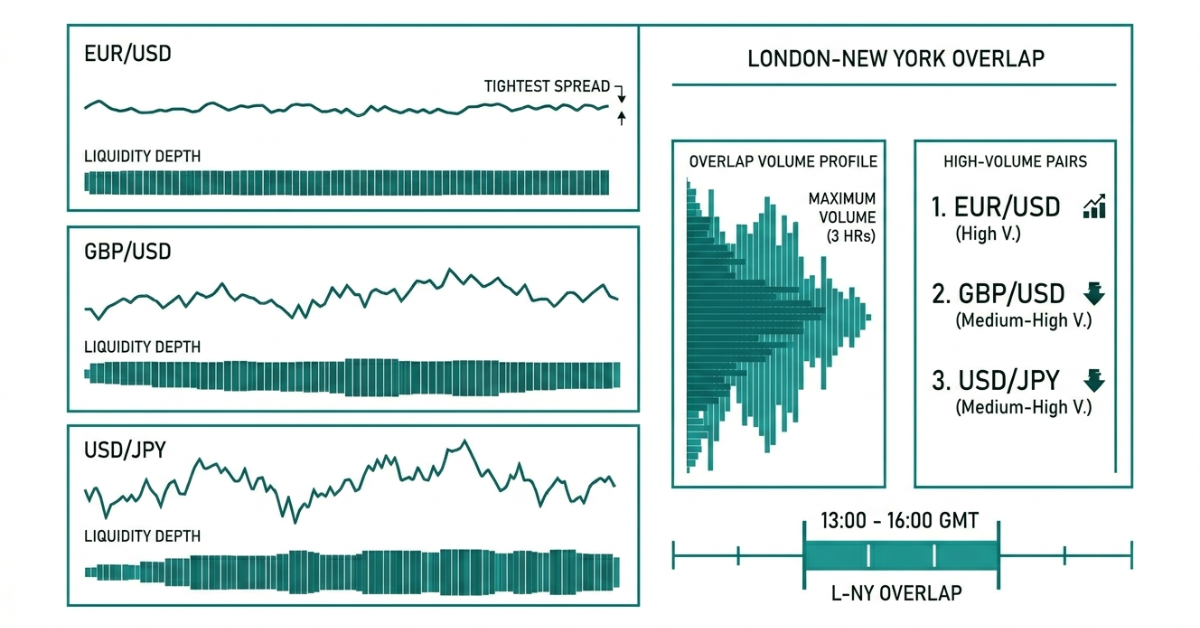
The currency pairs with the lowest spreads are usually EUR/USD, USD/JPY, GBP/USD, USD/CHF, and AUD/USD. EUR/USD often has one of the lowest spreads because so many people trade it every day. Simply put, the more active a currency pair is, the easier it usually is for brokers to offer a smaller spread.
Key Takeaways
- EUR/USD usually has one of the lowest spreads in forex.
- Other low-spread pairs often include USD/JPY, GBP/USD, AUD/USD, and USD/CHF.
- Major currency pairs usually have lower spreads than exotic pairs.
- Spreads can change throughout the day.
- Busy trading hours usually offer better spreads.
- News events can suddenly make spreads much wider.
- A lower spread means a lower trading cost, which can be especially useful for frequent traders.
First, What Is a Forex Spread?
Let’s keep this really simple.
When you look at a currency pair on your trading platform, you’ll normally see two prices.
- One is the price you can buy at.
- The other is the price you can sell at.
The small difference between those two prices is called the spread.
For example, imagine EUR/USD looks like this:
| Price | EUR/USD |
| Buy | 1.1051 |
| Sell | 1.1050 |
| Difference | 0.0001 |
That difference is 1 pip.
So, in very basic terms, the spread is one of the costs of opening a forex trade.
A smaller spread usually means it costs less to enter the trade.
Why Does EUR/USD Usually Have Such a Low Spread?
EUR/USD is one of the most heavily traded currency pairs in the world.
It combines the euro and U.S. dollar, two of the world’s biggest currencies. There are huge numbers of buyers and sellers trading it throughout the day.
That creates something called liquidity.
Don’t worry about the fancy word. Liquidity basically means there are plenty of people ready to buy and sell.
When there’s lots of trading activity, the gap between the buying and selling prices can usually stay small.
That’s why EUR/USD is often one of the first pairs beginners come across.
It doesn’t mean EUR/USD is easy to trade or that you’ll automatically make money. It simply means trading costs can be relatively low compared with less popular currency pairs.
USD/JPY Is Another Popular Low-Spread Pair
USD/JPY is the U.S. dollar against the Japanese yen.
It’s another major forex pair with a huge amount of daily trading activity.
Because both currencies are extremely important to global financial markets, USD/JPY generally has good liquidity and competitive spreads.
The pair can become particularly active when traders are reacting to news from the Federal Reserve in the United States or the Bank of Japan.
If you’re completely new to forex, there’s one thing that looks a little different with JPY pairs.
You may see a price such as 147.25 instead of something like 1.1050.
That’s completely normal. Japanese Yen pairs are simply quoted differently from many other currency pairs.
What About GBP/USD?
GBP/USD is another major currency pair that often has fairly low spreads.
It combines the British pound with the U.S. dollar and is sometimes nicknamed “Cable.”
It’s very actively traded, particularly during the London and New York sessions.
But there’s a small catch.
GBP/USD can move quite quickly.
So even though its spread may be low, that doesn’t necessarily make it less risky.
For example, unexpected news from the Bank of England could cause GBP/USD to move sharply within minutes.
This is a good reminder that spread is only one thing to consider when choosing what to trade.
AUD/USD Can Also Have Competitive Spreads
AUD/USD is the Australian Dollar against the U.S. Dollar.
It’s another major pair, which means there’s generally plenty of trading activity.
AUD/USD can be affected by things like Australian interest rates, commodity prices, the U.S. economy, and economic developments in China.
Why China?
Australia sells a lot of goods and natural resources to China. So when China’s economy changes, traders often pay attention to what that could mean for Australia and the Australian dollar.
For beginners, the important point is simply that AUD/USD is a major pair and usually has better liquidity than many less commonly traded currencies.
USD/CHF Is Worth Knowing Too
USD/CHF is the U.S. dollar against the Swiss franc.
Like the other pairs we’ve talked about, it’s a major forex pair and usually comes with relatively competitive spreads.
The Swiss Franc is also known as a safe-haven currency.
That means traders sometimes become more interested in it when financial markets are nervous.
So while USD/CHF can offer relatively low spreads, world events can still make the pair move quickly.
Which Forex Pairs Normally Have the Lowest Spreads?
Here’s an easy way to compare them.
| Currency Pair | Typical Spread Level | Good to Know |
| EUR/USD | Very Low | One of the most heavily traded pairs |
| USD/JPY | Very Low | Highly liquid major pair |
| GBP/USD | Low | Can be more volatile |
| AUD/USD | Low | Sensitive to commodities and China |
| USD/CHF | Low | Swiss Franc can react to risk sentiment. |
These are general patterns, not fixed spreads.
Your actual spread depends on your broker, account type, market conditions, and the time you’re trading.
Why Are Exotic Currency Pairs More Expensive To Trade?
Now let’s look at the opposite side.
Imagine trading USD/TRY, which is the U.S. dollar against the Turkish lira.
Far fewer people trade this pair compared with EUR/USD. That means there’s less liquidity. And when liquidity is lower, spreads are generally wider.
Other exotic pairs may involve currencies such as the South African rand or Mexican peso.
That doesn’t mean exotic pairs are “bad.” They simply work differently.
Their wider spreads and potentially bigger price movements can make them harder for beginners to manage.

Why Do Spreads Keep Changing?
Here’s something that can confuse beginners.
You check EUR/USD in the afternoon and see a tiny spread.
Later that night, you check again, and it’s bigger.
Nothing is necessarily wrong.
Forex spreads can be either fixed or variable depending on the broker and account, and variable spreads naturally move as market conditions change.
When lots of people are trading, liquidity is generally high and spreads can become tighter.
When fewer people are trading, liquidity falls and spreads may become wider.
It’s a bit like buying something in a busy marketplace compared with trying to find the same thing when almost every shop is closed.
What Time of Day Usually Has the Lowest Spreads?
Forex trading happens across various major sessions.
The main ones are generally associated with:
- Sydney
- Tokyo
- London
- New York
For major pairs, spreads are often more competitive when their main markets are active.
One particularly busy period happens when the London and New York sessions overlap.
During this time, traders from two major financial centers are active at the same time.
That can create very high liquidity in pairs such as EUR/USD and GBP/USD.
But again, there are exceptions.
If a major economic report comes out during those hours, spreads can suddenly widen even though the market is busy.
News Can Make a Tiny Spread Much Bigger
Let’s say EUR/USD normally has a very small spread.
Then the Federal Reserve announces its latest interest rate decision.
Suddenly, huge numbers of orders hit the market.
Prices start moving quickly.
For a short period, the difference between the buy and sell prices may become much wider.
This can also happen around:
- U.S. inflation reports
- Non-Farm Payrolls
- Central bank announcements
- Elections
- Unexpected political news
- Major global events
This is why experienced traders usually know what’s on the economic calendar before opening a position.
Example: EUR/USD might have a very tight spread during normal trading. A major U.S. announcement comes out, the market starts jumping around, and the spread gets wider. Once things calm down, it may become smaller again.
Why Do Low Spreads Matter So Much for Day Traders?
Imagine you make one forex trade every few weeks.
A small difference in spread may not be the biggest part of your overall strategy.
Now imagine you’re a day trader making several trades every day.
You’re paying that spread again and again.
Those small costs start adding up.
That’s why scalpers and day traders often pay very close attention to spreads.
A scalper may only be trying to capture a tiny price movement. If the spread already takes up a big part of that movement, the trade becomes much harder to make worthwhile.
Longer-term traders usually still care about spreads, but the impact may be smaller compared with their much larger profit targets.
Is the Pair With the Lowest Spread Always the Best One to Trade?
No. This is probably the most important part of the whole article.
Low spreads are nice, but they don’t tell you whether a trade is actually good.
Let’s say EUR/USD has the smallest spread available, but you have absolutely no idea what the market is doing.
Meanwhile, you’ve spent weeks studying AUD/USD and have a clear setup that matches your strategy.
Choosing EUR/USD only because its spread is slightly smaller doesn’t automatically make sense.
Think about the whole trade.
Look at the trend, volatility, upcoming news, your strategy, and how much you’re risking.
Spread is just one piece of the puzzle.
Trade Major Forex Pairs With Defcofx
If you’re looking at low-spread currency pairs, major pairs are usually a natural place to start. They’re widely traded, easy to find on forex platforms, and generally have strong liquidity.
Defcofx gives traders access to major forex pairs through MetaTrader 5, with spreads starting from 0.3 pips, commission-free trading, leverage of up to 1:2000, and professional charting tools.
Want to start exploring the forex market? Open a DefcoFX account and access popular currency pairs through MetaTrader 5. Compare markets, check spreads, analyze charts, and choose the trades that fit your strategy.
Open a Live Forex Trading AccountA Few Things To Check Besides the Spread
Before choosing a forex pair, ask yourself a few simple questions.
- Do I understand what makes this currency pair move?
- Is there any big economic news coming?
- How volatile is the pair?
- Does it fit my trading strategy?
- How much am I risking?
These 5 questions matter much more than simply finding the smallest number in the spread column.
You should also look at your broker’s overall trading costs. Depending on the account, there may be commissions or overnight financing charges in addition to the spread.
So when comparing trading costs, look at the full picture.
Frequently Asked Questions
Which forex pair usually has the lowest spread?
EUR/USD is generally one of the lowest-spread forex pairs because it has extremely high trading activity and liquidity.
What does a low spread mean?
A low spread means there is a small difference between the price you can buy at and the price you can sell at. This generally means a lower trading cost.
Why do major currency pairs have lower spreads?
Major pairs are traded by huge numbers of people and institutions. More buyers and sellers usually mean better liquidity, which helps keep spreads smaller.
Are spreads always the same?
No. Variable spreads can change throughout the day depending on liquidity, volatility, news, and overall market conditions.
Why do spreads get bigger during news?
Big announcements can cause prices to move very quickly and create uncertainty. During these moments, spreads may temporarily become wider.
Are exotic forex pairs more expensive to trade?
They often have wider spreads because fewer people trade them compared with major currency pairs. They can also experience larger price movements.
Is a low-spread currency pair safer to trade?
No. A low spread reduces one trading cost, but it doesn’t reduce normal market risk. Even a pair with a tiny spread can move sharply against your position.
Final Thoughts
So, which currency pairs have the lowest spreads? EUR/USD is usually among the lowest, followed by other heavily traded major pairs such as USD/JPY, GBP/USD, AUD/USD, and USD/CHF.
The reason is simple: lots of people trade them, which creates high liquidity and helps keep the gap between buying and selling prices small.
Just remember that spreads aren’t fixed in every situation. They can change depending on the time of day, market activity, your broker, and major news events. A low spread is useful, but it should never be the only reason you choose a currency pair.