


Japan uses the Japanese yen. Its currency code is JPY, and its symbol is ¥. So, if you visit Japan and want to buy food, pay for a train ticket, or go shopping, you’ll normally be paying in yen.
The yen is also widely used outside Japan. It’s one of the major currencies traded in the forex market, so you’ll often see pairs like USD/JPY, EUR/JPY, and GBP/JPY on trading platforms.
You can easily trade with the help of Defcofx. If you’re new to Defcofx, simply research our website and learn about our services before you start trading.
Get Started with DefcofxImportant Insights About Japan’s Currency
- Japan uses the Japanese yen.
- The currency code for the yen is JPY.
- The symbol for the yen is ¥.
- One yen is written as ¥1.
- Japan officially introduced the yen as its main currency unit in 1871.
- The Bank of Japan is Japan’s central bank.
- USD/JPY is one of the best-known yen pairs in forex trading.
What Is the Japanese Yen?
The yen is simply Japan’s money.
Just like the United States uses dollars and the United Kingdom uses pounds, Japan uses yen.
Pretty easy.
If something in a Japanese shop costs ¥1,000, that means it costs 1,000 Japanese yen.
You’ll usually see three different ways of referring to it:
| Term | What You’ll See |
| Currency | Japanese Yen |
| Currency Code | JPY |
| Symbol | ¥ |
The currency code is especially important if you’re interested in forex.
Trading platforms normally use three-letter codes instead of writing out the full currency name. So you won’t usually see “U.S. Dollar against Japanese Yen” on your chart.
You’ll see USD/JPY.
Why Is It Called the Yen?
The name has a pretty simple meaning.
“Yen” is connected to the idea of a round or circular object, referring to the shape of coins. The Bank of Japan’s Currency Museum notes that one explanation for choosing the name is that “yen” means “circle” in Japanese.
Japan didn’t always use yen.
Before the modern yen system, the country had several different types of money. Older units included the ryo, bu, and shu.
That made the money system much more complicated.
Japan eventually decided it needed something simpler and more modern.
And that’s how the yen came in.
When Did Japan Start Using the Yen?
Japan officially introduced the yen in 1871.
The Japanese government passed the New Currency Act and made the yen the country’s basic currency unit. The new system also introduced sen and rin as smaller units.
At the time:
1 yen = 100 sen
And:
1 sen = 10 rin
So:
1 yen = 1,000 rin.
You don’t really need to worry about Sen and Rin today. They’re part of the currency’s history, not something you’ll use when buying in modern Japan.
Quick Fact: Japan has been using the yen as its modern currency unit since 1871. That means the yen has been around for more than 150 years.
Who Controls the Japanese Yen?
The Bank of Japan is Japan’s central bank.
If “central bank” sounds complicated, consider it to be the main bank responsible for the country’s monetary system.
The Bank of Japan has responsibilities connected to things like issuing banknotes, monetary policy, and keeping the financial system stable.
You’ll often see traders call it the BOJ.
That’s just short for Bank of Japan.
The BOJ is crucial in forex because its decisions can affect the value of the yen.
For example, traders pay close attention when the Bank of Japan talks about interest rates.
Why?
Because interest rates can make a currency more or less attractive to investors.
And when people start buying or selling a currency in large amounts, its price can move.
What Japanese Yen Notes and Coins Are There?
If you actually visit Japan, you won’t be thinking about forex charts every time you see yen.
You’ll be using physical money too.
Japan has both coins and banknotes.
You may come across coins such as
- ¥1
- ¥5
- ¥10
- ¥50
- ¥100
- ¥500
There are also larger banknotes for everyday spending.
Something that can initially confuse visitors is how large the numbers look.
A coffee might cost hundreds of yen.
Dinner might cost thousands.
That doesn’t automatically mean Japan is incredibly expensive.
The yen simply uses different-sized units compared with currencies such as the U.S. Dollar or British pound.
Why Doesn’t the Yen Use Decimals Like Dollars?
This is another thing beginners sometimes notice.
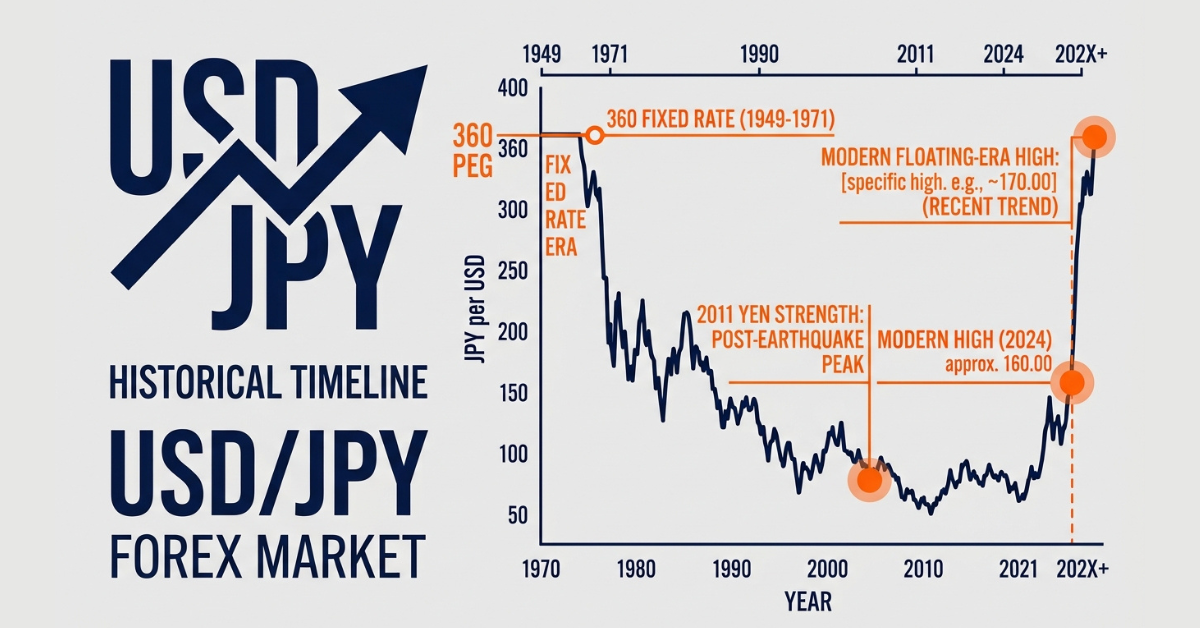
You might see USD/JPY trading somewhere around 150 or 160 and wonder why it looks so different from EUR/USD at something around 1.10.
That’s simply how the currencies are valued against each other.
The yen has a much smaller value per individual unit.
So you need many yen to equal one U.S. dollar.
Think about it like centimeters and meters.
100 centimeters sounds like a much higher number than 1 meter, but you’re still talking about the same distance.
Currency units can work in a similar way.
The size of the number itself doesn’t tell you whether a currency is “good” or “bad.”
What is USD/JPY?
Now we’re getting into the forex side.
USD/JPY means:
U.S. Dollar / Japanese Yen
The first currency is USD.
The second is JPY.
Let’s imagine USD/JPY is trading at 150.00.
In very simple terms, that means one U.S. dollar is worth around 150 Japanese yen.
If USD/JPY rises to 155.00, the dollar has become stronger against the yen, or the yen has become weaker against the dollar.
If USD/JPY falls to 145.00, the opposite has happened.
That’s the basic idea.
| USD/JPY Movement | Simple Meaning |
| Goes Up | USD is strengthening against JPY. |
| Goes Down | JPY is strengthening against USD. |
Once you understand the basics, reading forex pairs gets much easier.
Why is USD/JPY so popular?
USD/JPY brings together two critical currencies.
The U.S. dollar is the world’s main reserve currency, while the Japanese yen plays a major role in global financial markets.
That means many banks, businesses, investors, and traders need to buy and sell these currencies.
More activity usually means better liquidity.
And remember from our other forex topics: liquidity basically means there are plenty of buyers and sellers in the market.
That’s one reason major pairs such as USD/JPY can often have tighter spreads than less commonly traded currency pairs.
The Bank of Japan itself publishes daily foreign-exchange information for USD/JPY, showing how closely followed the pair is in Japan’s financial markets.
If you want to trade USD/JPY, you can get started on our platform, where we facilitate trading in this forex pair. You can also check the current spread for USD/JPY by visiting our Spreads page. To open a live trading account, simply click the call-to-action button.
Open a Live Trading Account for USD/JPYWhat Makes the Japanese Yen Move?
Currencies don’t randomly move up and down for no reason.
Many things can affect the yen.
One of the biggest is interest rates.
Traders watch what the Bank of Japan is doing with Japanese interest rates and compare that with what central banks in other countries are doing.
They also watch:
- Inflation
- Japan’s economy
- U.S. economic data
- Bank of Japan announcements
- Federal Reserve announcements
- Global market fear
- Political events
You don’t need to understand every economic report to start learning forex.
Just remember this:
Currencies react to what’s happening in their economies.
And because forex always compares two currencies, you need to think about both countries.
Is the Yen Considered a Safe-Haven Currency?
You’ll often hear traders describe the Japanese yen as a “safe-haven” currency.
What does that mean?
Basically, during certain periods of fear or uncertainty in global markets, investors may move money toward currencies or assets they believe are safer.
Historically, the yen has sometimes strengthened during these periods. But don’t take “safe haven” too literally.
It doesn’t mean the yen always rises whenever something negative happens. Markets change, and many other factors can affect currency prices at the same time.
Explore Japanese Yen Forex Pairs with Defcofx
Now that you know what JPY actually means, forex charts involving the Japanese yen should make a lot more sense.
Defcofx gives traders access to forex markets through MetaTrader 5, where you can follow major currencies such as the Japanese yen, U.S. dollar, euro, and British pound.
Want to see how the Japanese yen moves against other currencies? Open a DefcoFX account and explore forex pairs through MetaTrader 5, with spreads from 0.3 pips, commission-free trading, leverage of up to 1:2000, and easy-to-use charting tools.
Open a Live Account with DefcofxFrequently Asked Questions
What currency does Japan use?
Japan uses the Japanese yen.
What is the currency code for Japan?
The currency code is JPY.
What is the symbol for Japanese yen?
The symbol is ¥.
When did Japan start using the yen?
Japan officially adopted the yen as its basic modern currency unit in 1871 under the New Currency Act.
What does USD/JPY mean?
USD/JPY shows the value of the U.S. Dollar compared with the Japanese yen. If the pair is at 150.00, one U.S. Dollar is worth around 150 yen.
Who controls the Japanese yen?
The Bank of Japan is Japan’s central bank and is responsible for issuing banknotes and carrying out monetary policy.
Is the Japanese yen traded in forex?
Yes. The yen is a major forex currency. Popular JPY pairs include USD/JPY, EUR/JPY, GBP/JPY, and AUD/JPY.