


The EUR/GBP is often viewed as a stable currency pair, moving with less drama than GBP/JPY or EUR/USD. Still, timing matters. Knowing the best time to trade EUR/GBP can be the difference between flat results and capturing profitable moves, especially during key sessions and news events.
Key Takeaways
- EUR/GBP is moderately volatile with tighter spreads, making it ideal for steady trades.
- The London session is the most active time for EUR/GBP trading.
- The London–New York overlap adds liquidity but less volatility than majors.
- ECB and BoE announcements often trigger strong moves.
- Use breakout and range strategies with tighter stop-losses.

EUR/GBP Characteristics
The EUR/GBP is often described as a steady mover in the forex market. Unlike pairs such as GBP/JPY, which regularly swing 100–150 pips a day, the EUR/GBP typically trades within 40–80 pip daily ranges. This moderate volatility makes it especially appealing to traders who value consistency and stability over high-risk, unpredictable swings.
Tighter Spreads
One of the reasons EUR/GBP attracts many traders is its low transaction cost. Because it is a cross between two highly liquid currencies, brokers often provide spreads as tight as 0.5–1 pip. This makes it a cost-effective pair for intraday traders who enter and exit frequently, since smaller spreads reduce overall trading costs.
Economic Sensitivity
While EUR/GBP does not move as violently as some pairs, it is highly sensitive to economic data from both the Eurozone and the UK. Key events include:
- Inflation reports (CPI),
- GDP releases,
- Employment figures, and
- Central bank statements (ECB or BoE)
These events can create sharp intraday moves, sometimes pushing the pair outside of its normal range. Traders often look to trade EUR/GBP during these events, as they inject temporary volatility into an otherwise steady pair.
Trend-Like Movement
The EUR/GBP is not known for explosive spikes, but it does often form cleaner, more gradual trends. For example, if the Eurozone economy outperforms the UK consistently over weeks, EUR/GBP tends to trend higher in a smoother fashion compared to more erratic pairs like GBP/USD.
A Balance Between Euro and Pound
Because EUR/GBP represents two regional economies that are closely tied together, the pair reflects the relative strength of the euro vs. the pound rather than global risk sentiment. This means:
- It is less influenced by U.S. data than pairs like EUR/USD.
- It often reacts more directly to policy differences between the European Central Bank (ECB) and the Bank of England (BoE).
- It provides a useful way for traders to express a view on UK vs. Eurozone performance without external noise from the U.S. dollar.
Best Trading Sessions
London Session (8 AM – 4 PM GMT)
The London session is the best time to trade EUR and GBP, as both economies are fully active. Average pip movement often reaches 50–70 pips daily here. Traders can capture intraday trends fueled by economic releases like PMI, inflation reports, or BoE commentary.
London–New York Overlap (1 PM – 4 PM GMT)
During this period, liquidity increases, and spreads are at their tightest. However, volatility in EUR/GBP is typically moderate compared to USD pairs. Moves here are steadier, making it a good time for traders seeking controlled entries.
Low-Activity Hours (Asian & Late U.S.)
The Asian session and very late U.S. hours tend to be quiet for EUR/GBP. With limited economic drivers, the pair often consolidates. This is a poor time for day traders seeking volatility but can be useful for swing traders looking for range setups.
Volatility by Session
| Session | Average Range | Characteristics |
| London (8 AM – 12 PM GMT) | 40–70 pips | Highest activity, driven by UK/EU news releases. |
| London–NY Overlap (1–4 PM GMT) | 30–50 pips | Strong liquidity, steady but moderate moves. |
| Asian Session | 15–25 pips | Low volatility, often range-bound. |
| Late U.S. | 10–20 pips | Minimal movement, best avoided for day trading. |
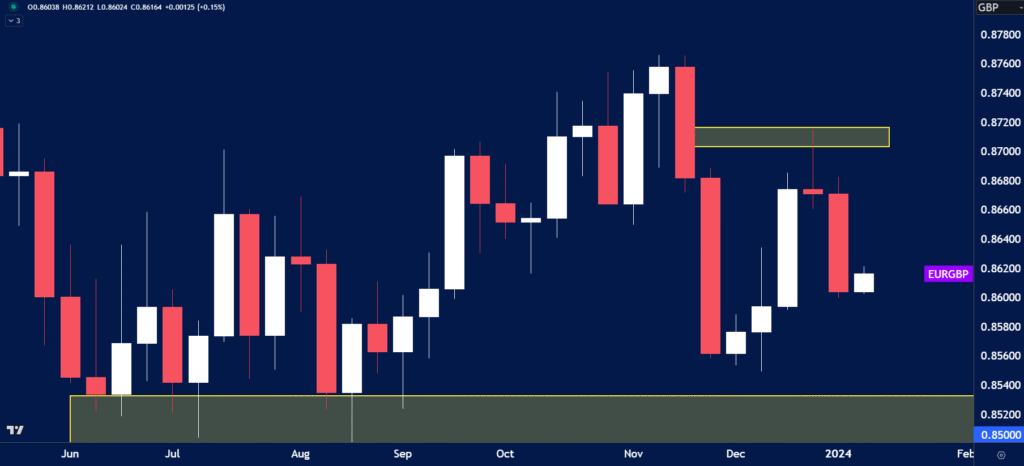
Risk & Strategy Tips for Trading EUR/GBP
Because EUR/GBP doesn’t swing as aggressively as GBP/JPY or GBP/USD, trading strategies should be adapted to its calmer, more measured volatility profile. Traders who understand this can avoid unnecessary losses and use EUR/GBP as a stable complement to more volatile pairs.
Tighter Stop-Losses
Unlike high-volatility pairs that require 60–100 pip stops, EUR/GBP typically moves in smaller, smoother ranges. A 20–40 pip stop-loss is often sufficient for intraday setups. This allows traders to:
- Keep risks smaller per trade.
- Avoid overexposing capital on a pair that doesn’t need wide breathing room.
- Focus on precision entries near support and resistance levels.
Example: If you’re range-trading EUR/GBP between 0.8600 and 0.8650, placing a stop 25 pips outside the boundary provides protection without unnecessary risk.
Range Trading
Because EUR/GBP often consolidates and respects clear support/resistance zones, range trading is a highly effective strategy, particularly during quieter sessions or when there are no major economic releases.
Traders can:
- Buy near support levels.
- Sell near resistance levels.
- Use oscillators like RSI or Stochastics to confirm overbought/oversold conditions.
This approach works well for traders who prefer consistency and don’t want to rely on sharp news-driven volatility.
Breakout Strategies
When volatility does spike, typically during the London open or around major ECB/BoE announcements, EUR/GBP is prone to strong breakout moves. These events can push the pair beyond its normal 40–80 pip range.
Example: If EUR/GBP consolidates tightly around 0.8700 and the BoE unexpectedly raises interest rates, a breakout below support can trigger a 70–100 pip move in a single session.
To capture these moves:
- Identify consolidation zones before the event.
- Place pending orders slightly outside the range.
- Use smaller lot sizes to account for potential whipsaws.
Correlation Awareness
EUR/GBP doesn’t exist in isolation. It often mirrors movements in EUR/USD and GBP/USD because both share the dollar as a common counter currency. For example:
- If EUR/USD rises while GBP/USD falls, EUR/GBP may surge.
- If both EUR/USD and GBP/USD rise together, EUR/GBP may remain flat.
This correlation can double your risk if you trade multiple pairs simultaneously without realizing it.
To avoid overexposure:
- Monitor correlations daily.
- Limit the number of open trades that depend on the same driver (e.g., BoE decisions).
- Diversify into uncorrelated pairs when possible.
Looking to trade EUR/GBP with low spreads and fast execution? Start trading with Defcofx and capture opportunities in the most active sessions.
Open Account
Conclusion
The best time to trade EUR/GBP is during the London session, when volatility and liquidity are highest. The London–New York overlap also offers opportunities, though with steadier moves. By timing trades with ECB/BoE events and applying breakout or range strategies, you can trade EUR/GBP more effectively.
With brokers like Defcofx, offering tight spreads, fast execution, and global access, traders gain the tools to make the most of EUR/GBP volatility.
Open a Trading Live AccountFAQs
The London session (8 AM – 4 PM GMT) is the most active and profitable for EUR/GBP traders.
The pair trades 24/5, but the most active hours are during the London session and London–New York overlap.
EUR/GBP is much less volatile, averaging 40–80 pips daily, compared to GBP/JPY’s 100–150 pips.
Day traders should focus on London hours for volatility, while swing traders benefit from ECB and BoE policy-driven trends.
Defcofx offers tight spreads starting from 0.3 pips, no commissions, and fast withdrawals, making it easier to trade EUR/GBP profitably during active hours.
Defcofx Forex Articles You Shouldn’t Miss
Discover powerful forex strategies in these top reads from Defcofx.