


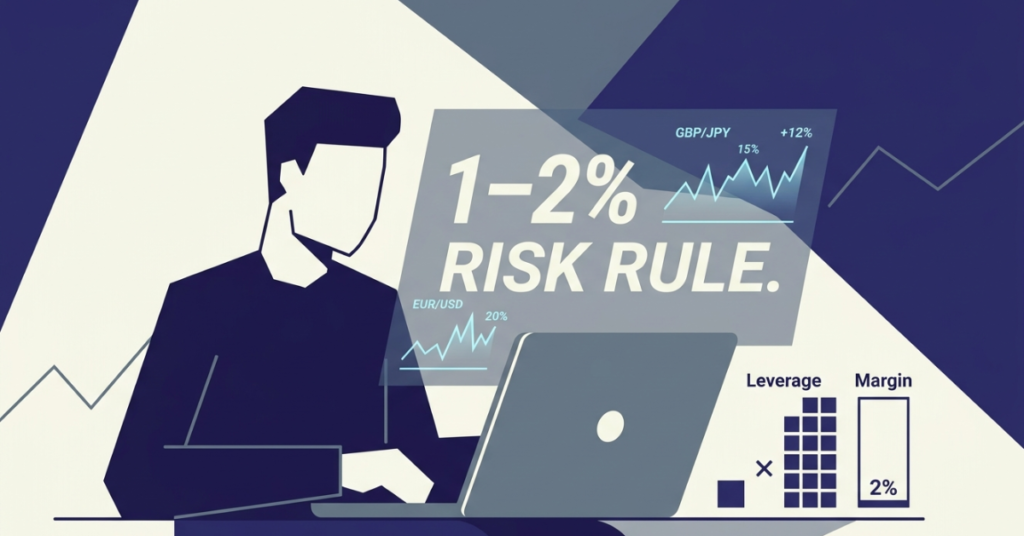
The golden rule of margin trading is simple: never risk more than you can afford to lose. More specifically, most professional traders cap their risk at 1% to 2% of their total account balance per trade. This keeps you in the game long enough to recover from losses and grow your account over time.
Key Takeaways
- The golden rule of margin trading: never risk more than 1–2% of your account per trade.
- Margin amplifies both profits and losses. High leverage is not the same as high risk, if managed correctly.
- A margin call happens when your account equity drops below the required margin level.
- Free margin, used margin, and margin level are three numbers every margin trader must track.
- Stop-loss orders and proper position sizing are non-negotiable tools in margin trading.
What Is Margin Trading?
Margin trading means trading with borrowed capital. When you open a leveraged position, you only need to put up a fraction of the full trade value, and your broker covers the rest. That fraction is your margin.
For example, if you want to open a $10,000 trade with 1:100 leverage, you only need $100 in margin. Your broker effectively extends you the remaining $9,900. This is what makes margin trading powerful, and also what makes it risky if you ignore basic rules.
Want to understand how margin works in detail? Read: What Is Free Margin in Forex and MetaTrader 4 Margin Level Meaning.
The Golden Rule: Risk No More Than 1–2% Per Trade
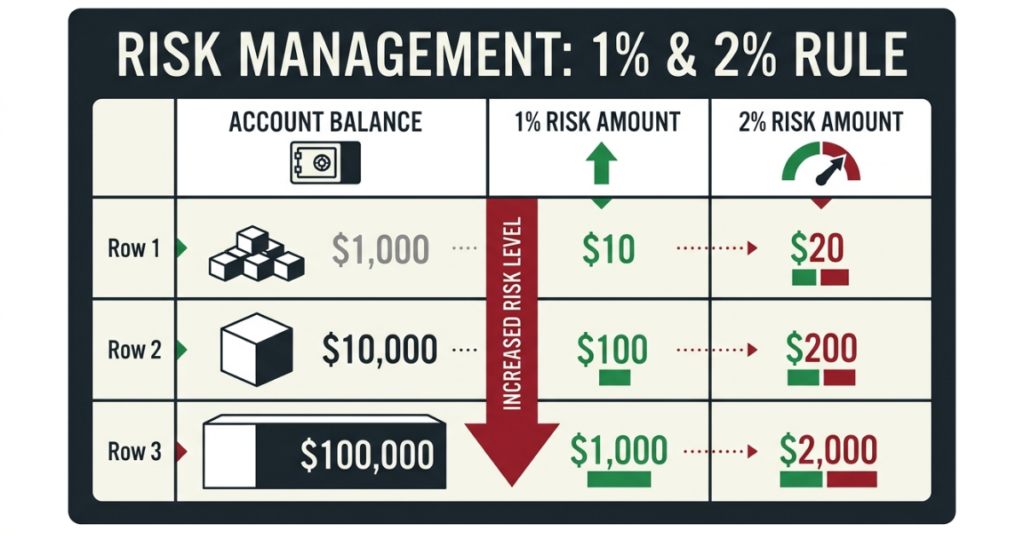
This is the single most repeated rule in professional trading circles, and for good reason. Here is what it means in practice:
| Account Balance | 1% Risk Per Trade | 2% Risk Per Trade |
| $1,000 | $10 | $20 |
| $5,000 | $50 | $100 |
| $10,000 | $100 | $200 |
| $50,000 | $500 | $1,000 |
Why does this rule matter so much? Because losses are part of trading. Even the best traders face losing streaks. If you risk 10% per trade, ten consecutive losses, which is not unusual in volatile markets, wipe out your entire account. At 1–2% risk, you would need 50 to 100 consecutive losses to wipe out before you hit zero. That gives you room to learn, adapt, and recover.
The Five Core Rules of Margin Trading
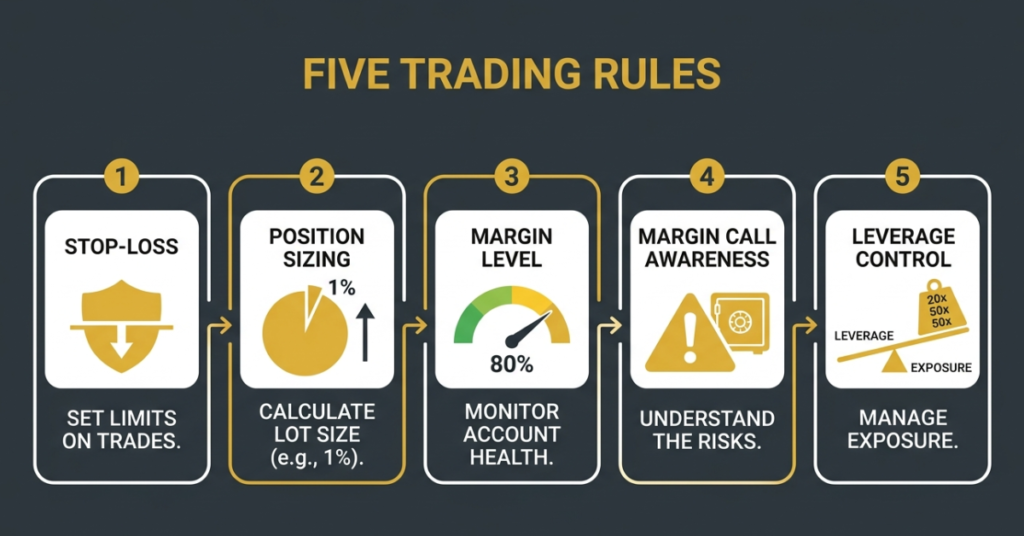
Beyond the 1–2% rule, experienced traders live by a few more principles. All of them connect to the same idea: protect the account first, grow it second.
1. Always Use a Stop-Loss
A stop-loss closes your trade automatically when the market moves against you by a set amount. Without it, a single bad trade can blow a big chunk of your account, especially on margin where losses are amplified. Set it before you enter the trade, not after.
Learn more: Trailing Stop Loss vs Trailing Stop Limit
2. Size Your Position Correctly
Position size determines how much money you actually put at risk per pip of movement. It is not just about how many lots you open. It is about aligning the lot size with your stop-loss distance and your account balance.
Use the Defcofx Position Size Calculator to get this right before you trade.
Related: Position Sizing in Trading | Best Lot Size for a $1,000 Account
3. Monitor Your Margin Level at All Times
Margin level is calculated as (Equity / Used Margin) × 100. Most brokers issue a margin call when this drops to 100% and auto-close positions when it hits a stop-out level, typically 50%.
If your margin level is low, you have limited room to absorb price fluctuations. Keeping it above 200–300% gives your open trades space to breathe.
Track it easily with the MT4 Balance Equity Margin Indicator.
4. Understand the Margin Call Before It Happens to You
A margin call is your broker’s warning that your account equity has fallen below the required level to maintain open positions. It does not mean the broker is taking your money. It means your positions are at risk of being closed.
If you receive a margin call, your options are to deposit more funds, close some positions to free up margin, or reduce exposure. Ignoring it results in automatic position closures at whatever price is available, often at a loss.
Full guide: What Is a Margin Call?
5. Never Over-Leverage
High leverage multiplies gains, but it equally multiplies losses. The temptation to use maximum leverage on every trade is one of the most common mistakes traders make, especially beginners. Use leverage proportional to how well you understand the trade and the market conditions.
Having access to 1:2000 leverage does not mean using all of it on every trade. Think of it as a tool available when needed, not a default setting.
See also: Lot Size vs Leverage | 100x Leverage Forex
Open a Live Trading AccountMargin Trading Mistakes That Kill Accounts
Most traders do not lose because they are wrong about market direction. They lose because of poor margin management. These are the most common mistakes:
| Mistake | Why It Destroys Accounts |
| Opening too many positions at once | Uses up free margin fast, leaves no buffer |
| No stop-loss on leveraged trades | Single loss can be 5x to 10x larger than planned |
| Adding to a losing trade (averaging down) | Increases exposure when you are already wrong |
| Ignoring margin level warnings | Gets you to stop-out before you can react |
| Treating a demo win as a live win | Demo has no emotional or margin pressure |
Margin Trading Statistics Worth Knowing
Numbers help put the risks into perspective. Here is what the data says about retail margin trading:
- Around 70–80% of retail CFD and forex traders lose money, based on broker disclosures required by regulators in the EU and UK.
- The primary cause of account blowups cited by traders is overleveraging, not poor market analysis.
- Traders who use a fixed risk percentage (1–2% per trade) have statistically longer trading lifespans than those who trade by intuition or flat lot sizes.
- Accounts with a documented trading plan and risk management rules outperform unplanned accounts by a wide margin in long-term backtests.
- A 50% account drawdown requires a 100% gain just to break even. A 10% drawdown only needs an 11% recovery.
A Practical Example of the Golden Rule in Action
Let’s say you have a $5,000 trading account. You want to trade EUR/USD and your analysis shows a setup with a stop-loss 30 pips away.
Step 1: Calculate 1% of account balance = $50 maximum risk.
Step 2: On EUR/USD, 1 pip on a standard lot (1.0) = $10. So 30 pips x $10 = $300 per standard lot.
Step 3: To keep risk at $50, you calculate: $50 / $300 per lot = 0.17 lots (roughly a micro lot and a mini lot).
This is position sizing in action. You are not guessing the lot size. You are calculating it from your risk rules. The market can go 30 pips against you and you lose exactly $50, which is 1% of your account. Nothing more.
Use the Defcofx Margin Calculator to run these numbers before you place any trade.
How Defcofx Supports Responsible Margin Trading
Defcofx is a forex and CFD broker registered in Saint Lucia, built for traders who want professional-grade tools without unnecessary complexity. Here is how the platform supports the golden rule of margin trading:
| Feature | How It Helps Traders |
| Up to 1:2000 Leverage | Flexible leverage means you choose your exposure, not the broker |
| Spreads from 0.3 pips | Lower trading costs reduce the break-even threshold per trade |
| No commission or swap fees | Keeps your risk calculations clean and predictable |
| MetaTrader 5 (MT5) | Built-in margin monitoring, stop-loss tools, and risk indicators |
| Demo Account | Practice margin trading risk-free before going live |
| 40% Welcome Bonus | Extra buffer on first deposit of $1,000+ (all clients eligible) |
| Withdrawals in 4 business hours | Including weekends, so you control your capital on your schedule |
Final Thoughts on What Is the Golden Rule of Margin Trading?
The golden rule of margin trading is not a suggestion. It is the foundation of every trader who has stayed in this business long-term. Risk 1–2% per trade, use a stop-loss on every position, manage your margin level, and size your positions based on math, not emotion.
Leverage is not your enemy. Ignoring risk management is. Defcofx gives you the tools to trade with leverage responsibly, including MT5 risk controls, a position size calculator, a margin calculator, and the option to start with a demo account to get your process right before going live.
FAQs
The golden rule is to never risk more than 1–2% of your total account balance on a single trade. This protects your account during losing streaks and keeps drawdown manageable over time.
If you risk too much per trade, a few consecutive losses can wipe out a large portion of your account. Recovery from deep drawdowns requires disproportionately large gains. For example, a 50% loss requires a 100% gain to break even.
Not necessarily. High leverage is dangerous when combined with large position sizes and no stop-loss. If you use leverage correctly with tight risk control and proper position sizing, it becomes a tool, not a hazard.
A margin call happens when your equity falls below the required margin to keep positions open. You avoid it by keeping your margin level above 200%, using stop-losses, not over-trading, and sizing positions correctly relative to your account balance.
Multiply your account balance by your risk percentage (e.g., 1%). Divide that dollar amount by the pip value multiplied by your stop-loss in pips. This gives you the correct lot size for the trade.
Yes. Defcofx offers a free demo account where you can practice margin trading with virtual funds. It is the best way to test your risk management strategy before committing real capital.
Used margin is the amount locked up as collateral for your open positions. Free margin is the remaining equity available to open new trades or absorb losses. Keeping enough free margin is essential to avoid a margin call.