



The Nasdaq has roughly 3,300 to 3,700 listed companies, though total listed securities run closer to 7,000 once you count multiple share classes, ADRs, and other instruments. The headline Nasdaq-100 index narrows this to about 100 large non-financial firms.
Key Takeaways
- The Nasdaq exchange lists roughly 3,300 to 3,700 companies, a figure that moves with new listings and delistings.
- Total listed securities are higher, around 7,000, because one company can have more than one type of share.
- The Nasdaq Composite index tracks most of these common stocks, while the Nasdaq-100 covers only about 100 of the largest non-financial names.
- The exact number changes daily, so any precise count is a snapshot rather than a fixed value.
- You can trade the Nasdaq-100 as an index CFD rather than tracking thousands of individual stocks.
It Depends on What You Are Counting
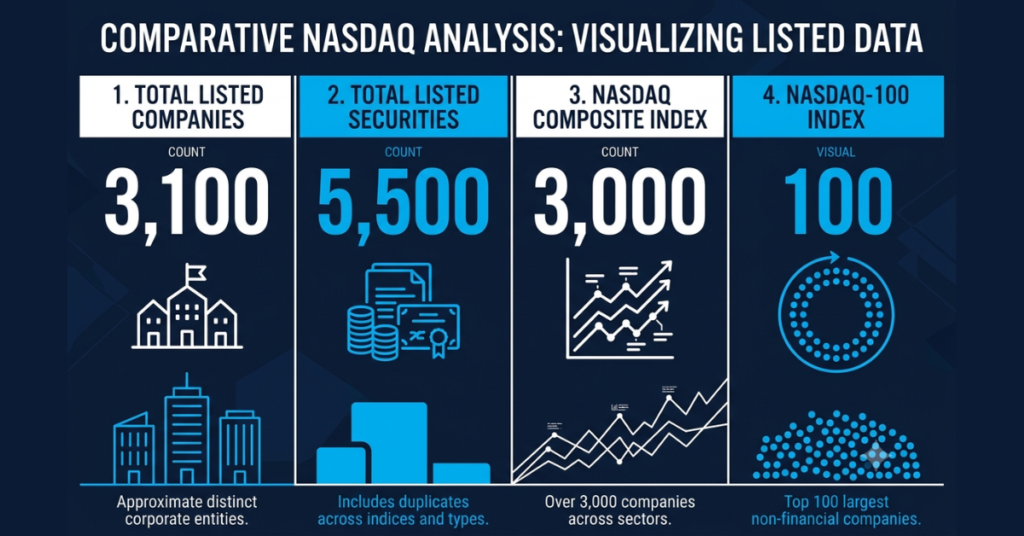
The reason you see different numbers everywhere is that “stocks on the Nasdaq” can mean three separate things. Counting companies gives one figure. Counting tradable securities gives a higher one. Counting the stocks inside a named index gives a much smaller one. Sorting out which you want makes the answer simple.
1. Listed Companies
If you count distinct companies whose shares trade on the Nasdaq exchange, the number sits in the range of about 3,300 to 3,700. This figure shifts constantly as businesses go public through IPOs or leave the exchange through delistings, mergers, or buyouts.
2. Listed Securities
Counting securities instead of companies pushes the total higher, often cited around 7,000. The gap exists because a single company can issue more than one class of shares, and the exchange also lists instruments like American Depositary Receipts (ADRs) for foreign firms. Each of these is a separate security, even when it belongs to the same business.
3. Stocks Inside an Index
This is where the number drops sharply. The Nasdaq-100, the index most CFD traders follow, holds only around 100 of the largest non-financial companies on the exchange. The broader Nasdaq Composite covers nearly all listed common stocks, but the Nasdaq-100 is the one quoted as NAS100 or US100. If you want the full picture of how indexes work, the guide on what indices are in forex explains it clearly.
The Numbers Side by Side
| What You Are Counting | Approximate Number | Notes |
| Listed companies | 3,300 to 3,700 | Changes with IPOs and delistings |
| Listed securities | Around 7,000 | Includes multiple share classes and ADRs |
| Nasdaq Composite stocks | Roughly 3,300+ | Nearly all common stocks on the exchange |
| Nasdaq-100 components | About 100 | Largest non-financial companies |
Why the Composite Feels Top-Heavy
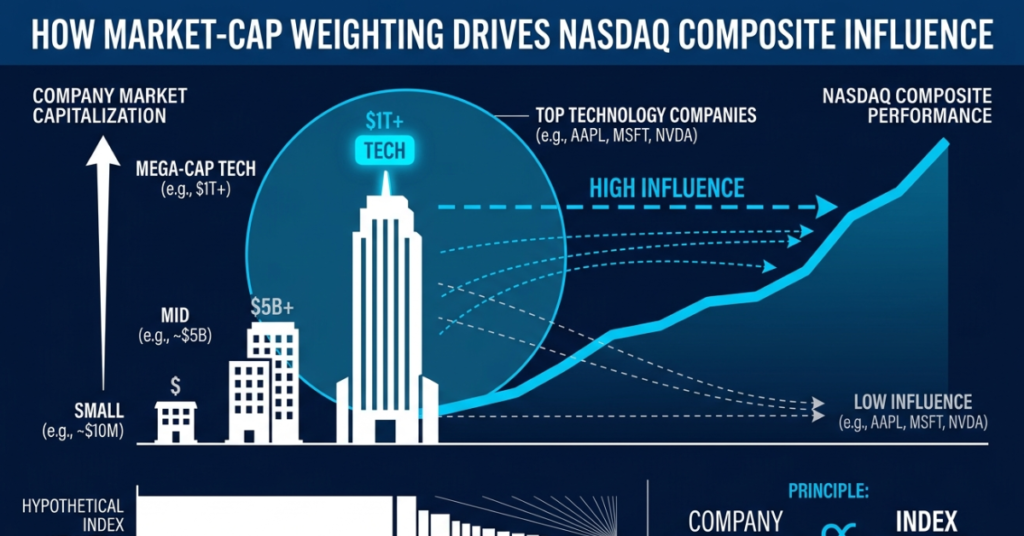
Even though thousands of stocks sit inside the Nasdaq Composite, a small group of giant companies drives most of its movement. The index is market-cap-weighted, so the largest firms carry the most influence. In practice, the top handful of mega-cap names can account for more than half of the index’s performance.
That concentration is worth understanding before trading. It means the Nasdaq can swing hard on the back of just a few earnings reports or tech headlines. If you are deciding between index exposure and single shares, the comparison of forex, stocks, and crypto is a helpful read.
Do You Need to Track Every Nasdaq Stock?
For most traders, no. Trying to follow thousands of individual stocks is impractical. Instead, the Nasdaq-100 index packages the largest and most active names into a single instrument. Through index CFDs, you can trade that one instrument up or down without buying any shares directly.
This is why NAS100 is so popular. It gives broad exposure to U.S. tech leaders in one position. If you are new to the idea of buying and selling without owning the asset, the overview on how to start investing in the stock market covers the basics.
Trading the Nasdaq-100 With Defcofx
Rather than counting every stock on the exchange, you can trade the Nasdaq-100 index directly as a CFD on Defcofx, with conditions designed for active traders.
| Feature | What Defcofx Offers |
| Trading platform | MetaTrader 5 (MT5) |
| Spreads | From 0.3 pips |
| Commissions | Zero commissions |
| Swap fees | Zero swap fees |
| Leverage | Up to 1:2000 |
| Welcome bonus | 40% on first deposits of $1,000 or more |
| Withdrawals | Processed within 4 business hours, including weekends |
| Instruments | Indices, forex, metals, energies, stocks, crypto CFDs |
Nasdaq by the Numbers
A few figures that put the scale of the Nasdaq into perspective. These shift over time, so they are best read as a current snapshot.
- Listed companies: roughly 3,300 to 3,700, depending on the source and date.
- Listed securities: around 7,000 once multiple share classes and ADRs are included.
- Nasdaq Composite: includes nearly all listed common stocks, the broadest measure of the exchange.
- Nasdaq-100: about 100 of the largest non-financial companies, the index behind NAS100/US100.
- Concentration: the top 10 Nasdaq Composite stocks can drive more than half of its movement.
Final Thoughts on How Many Stocks Are on the Nasdaq
The Nasdaq is one of the largest stock exchanges in the world, but the exact number of stocks it contains depends on what you are counting. If you mean listed companies, the figure typically falls between 3,300 and 3,700. If you include every tradable security, such as multiple share classes and ADRs, the total rises to around 7,000. Meanwhile, traders often focus on the Nasdaq-100, which contains only about 100 of the largest non-financial companies and serves as the benchmark behind the popular NAS100 and US100 trading instruments.
For most traders and investors, the precise stock count matters less than understanding the structure behind it. The Nasdaq Composite offers broad exposure to thousands of companies across technology, healthcare, consumer services, and other sectors, while the Nasdaq-100 concentrates on the largest market leaders that drive much of the index’s performance. This concentration is one reason why major earnings announcements from a handful of mega-cap technology firms can have a significant impact on overall Nasdaq performance.
FAQ
Roughly 3,300 to 3,700 companies are listed on the Nasdaq exchange. The exact number changes as companies are added through IPOs or removed through delistings.
That figure counts listed securities rather than companies. One company can have multiple share classes, and the exchange also lists ADRs, so securities outnumber companies.
The Nasdaq-100 holds about 100 of the largest non-financial companies on the exchange. It is the index commonly traded as NAS100 or US100.
Nearly. The Nasdaq Composite includes almost all common stocks listed on the exchange, though it excludes certain security types like ETFs and preferred shares.
Yes. IPOs, delistings, mergers, and buyouts change the count regularly, so any precise number is only accurate for a specific point in time.
Not individually, but you can gain broad exposure through the Nasdaq-100 index CFD, which reflects the movement of its largest components in one position.