


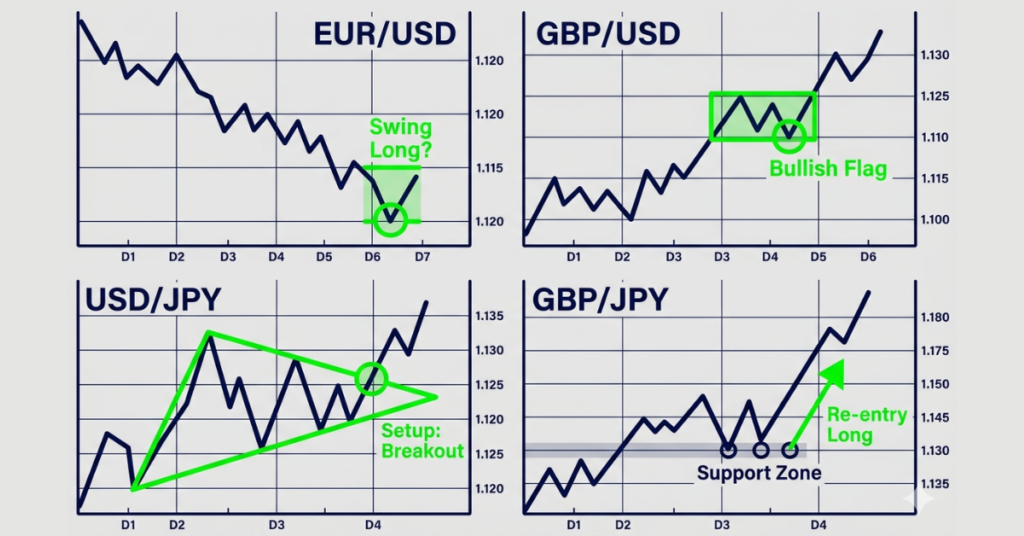
The best forex pairs for swing trading are EUR/USD, GBP/USD, USD/JPY, AUD/USD, USD/CAD, and GBP/JPY. They combine clean, trending behavior with a healthy average daily range, so multi-day moves develop in a readable way without the chaos of thin, erratic pairs.
Key Takeaways
- Swing trading holds positions for days to weeks, so you want pairs that trend cleanly rather than chop sideways. See how this differs in swing trading vs day trading.
- Major pairs like EUR/USD and USD/JPY give you tight spreads and deep liquidity, which keeps your entry and exit costs low across the list of 28 major forex pairs.
- Average daily range matters. Pairs that move 100 pips a day give a swing trade room to breathe toward its target.
- Because you hold overnight, swap fees and forex risk management are central to keeping a swing strategy profitable.
- A new swing trader can start small. Here is how much money is required for swing trading and whether a beginner should do swing trading at all.
What Makes a Forex Pair Good for Swing Trading
Swing trading sits between scalping and long-term position trading. You enter on a setup, then hold for several days up to a few weeks while a move plays out. That holding window changes what you look for in a pair. A scalper cares about the spread on a single tick. A swing trader cares about whether a pair can string together a clean directional move and stay in it.
Three qualities separate good swing pairs from poor ones:
- Trend persistence: The pair respects direction once a move starts, instead of reversing every session. Clean trends let you ride a swing toward a sensible target.
- Average daily range: There has to be enough movement to make a multi-day hold worth the risk. Too little range and your stop-to-target math stops working.
- Liquidity and tight spreads: Deep liquidity keeps slippage low and makes technical levels more reliable, which is why most swing traders stay with majors and the busier crosses.
The Best Forex Pairs for Swing Trading
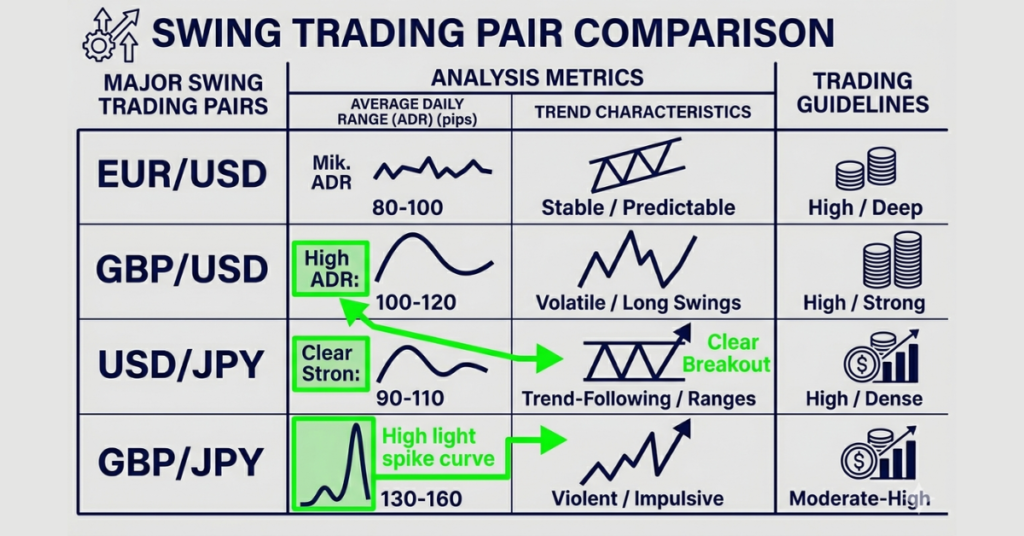
Here is a quick comparison of the pairs most swing traders rely on, with their typical average daily range and the trait that makes each one suited to holding for days. Ranges are approximate and shift with market conditions.
| Pair | Typical Daily Range | Why It Suits Swing Trading |
| EUR/USD | 70 to 90 pips | Tightest spreads, cleanest technicals, the most liquid pair in the market |
| GBP/USD | 100 to 130 pips | Strong, extended trends with good range for multi-day targets |
| USD/JPY | 70 to 90 pips | Trends smoothly and tracks interest-rate differentials well |
| AUD/USD | 60 to 80 pips | Clear risk-on and risk-off trends tied to commodities and China data |
| USD/CAD | 70 to 90 pips | Oil-linked trends that often run for several sessions in one direction |
| GBP/JPY | 120 to 160 pips | Large range and powerful trends, best for experienced swing traders |
EUR/USD: the dependable starting point
EUR/USD is the natural first pick. It carries the deepest liquidity of any pair, its spread is usually the tightest you will find, and it respects support, resistance, and moving averages in a way that makes setups readable. For a swing trader learning to hold through pullbacks, that reliability is worth more than raw speed. It also reacts in an orderly way to scheduled US and eurozone data, so you can plan around the calendar.
GBP/USD and GBP/JPY: range when you want it
When EUR/USD feels too quiet, the pound delivers more range. GBP/USD trends strongly and gives a swing trade enough room to reach a wider target. GBP/JPY takes that further, with daily ranges that can stretch past 150 pips. That extra movement cuts both ways, so it pairs best with disciplined position sizing in trading and wider stops.
USD/JPY, AUD/USD, and USD/CAD: trend-followers
These three reward trend-following. USD/JPY tracks the gap between US and Japanese interest rates and tends to grind in one direction for weeks at a time. AUD/USD swings with risk sentiment and commodity flows. USD/CAD moves with oil. Each one gives you a fundamental story to lean on while a technical swing develops, which is exactly what you want when you check charts once or twice a day.
forex currency pairs universe.
Overnight Holds, Swap Fees, and Why They Matter
This is the part many guides skip. Swing trading means holding overnight, often for many nights. On most brokers, every overnight position is charged a swap fee based on the interest-rate difference between the two currencies. Hold a position for two weeks and those nightly charges add up, quietly eating into a winning trade.
Defcofx removes that friction with zero swap fees, so the cost of holding a swing trade overnight does not work against your target. Combined with spreads from 0.3 pips and no commissions, the math on a multi-day hold stays clean. That is a meaningful edge for a style built entirely around holding positions through the night.
How to Approach Swing Setups on These Pairs
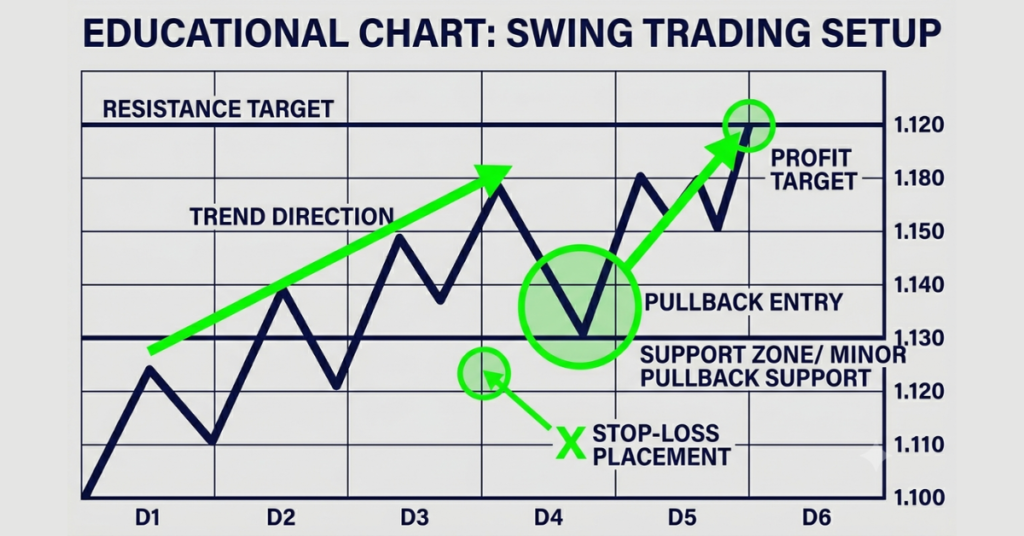
A swing trade is built on a few repeatable pieces. None of them are complicated, but they need to work together.
- Identify the trend first. Use moving averages for swing trading to define direction, then only take trades in line with it.
- Wait for a pullback. Enter when price retraces to a support level or moving average inside the trend, not at the extreme of a move.
- Confirm with an indicator. Pair price action with one of the best technical indicators for swing trading to time the entry.
- Set a stop and a realistic target. Base both on the pair’s average daily range so your reward genuinely fits its movement.
- Follow the 2 percent rule. Never risk more than a small slice of your account per trade. Here is the golden rule of swing trading applied to sizing.
Why Trade Swing Setups With Defcofx
Defcofx is built around MetaTrader 5 and offers trading conditions that suit a hold-overnight style. Here is what matters most for swing traders:
| Feature | What Defcofx Offers |
| Spreads | From 0.3 pips, keeping entry and exit costs low |
| Swap fees | Zero, so overnight and multi-day holds carry no rollover cost |
| Commissions | None on trades |
| Leverage | Up to 1:2000 for flexible position sizing |
| Platform | MetaTrader 5 with fast execution and full charting |
| Welcome bonus | 40% on first deposits of $1,000 or more |
| Withdrawals | Processed within 3 hours, including weekends |
Forex Market Statistics Worth Knowing
- Swing trading works because the forex market is enormous and liquid, which keeps the major pairs orderly. A few figures from the 2025 BIS Triennial Central Bank Survey put the scale in context:
- Global forex turnover reached about $9.6 trillion per day in April 2025, a record and roughly 28% higher than in 2022.
- The US dollar sits on one side of nearly 9 in 10 trades, which is why USD pairs dominate any swing-trading shortlist.
- The euro is the second most traded currency, followed by the Japanese yen and the British pound, exactly the currencies behind the best swing pairs.
- Around three quarters of all forex trading runs through four hubs, with London handling close to 38% of global volume.
Final Thoughts on Best Forex Pairs for Swing Trading
Swing trading sits in the middle ground between fast-paced day trading and long-term investing, making it an attractive style for traders who want to capture meaningful market moves without spending all day in front of a chart. The best forex pairs for swing trading EUR/USD, GBP/USD, USD/JPY, AUD/USD, USD/CAD, and GBP/JPY have earned their place because they combine strong liquidity, reliable trends, and enough daily movement to support profitable multi-day setups.
Success in swing trading is less about finding the most volatile pair and more about finding pairs that move consistently. A steady trend that develops over several days often provides better opportunities than a highly volatile market that changes direction repeatedly. This is why major currency pairs remain the preferred choice for many experienced swing traders. Their deep liquidity helps technical levels hold more reliably, while tighter spreads keep trading costs manageable.
FAQ
EUR/USD is the most reliable choice for most swing traders. It has the tightest spreads, the deepest liquidity, and the cleanest technical behavior, which makes multi-day setups easier to read. GBP/USD is the usual next step when you want more range.
Swing trades are typically held from two days to a few weeks. The exact length depends on how long the trend runs and where your target sits, not on a fixed clock. You exit when price hits your target or your stop.
Usually not. Exotic pairs have wider spreads, thinner liquidity, and erratic moves that make technical levels unreliable. Most swing traders stick to majors and a few liquid crosses. The most volatile forex pairs can tempt you, but their volatility is hard to manage on a multi-day hold.
Yes, and a lot. Because swing trades are held overnight, swap charges accumulate every night and can erode a winning trade over a one or two week hold. Trading with a broker that charges zero swap fees, like Defcofx, removes that drag entirely.
You can start with a modest amount, especially with flexible lot sizes and leverage. The right figure depends on your risk per trade and the pairs you trade. This guide on how much money is required for swing trading breaks it down.
Neither is better outright, they suit different lifestyles. Swing trading needs less screen time and fewer trades, while day trading closes everything before the day ends. Compare them directly in swing trading vs day trading.
Moving averages, RSI, and MACD are common because they help confirm trend and time pullback entries. See the best technical indicators for swing trading and how to combine moving averages for swing trading for entries.