


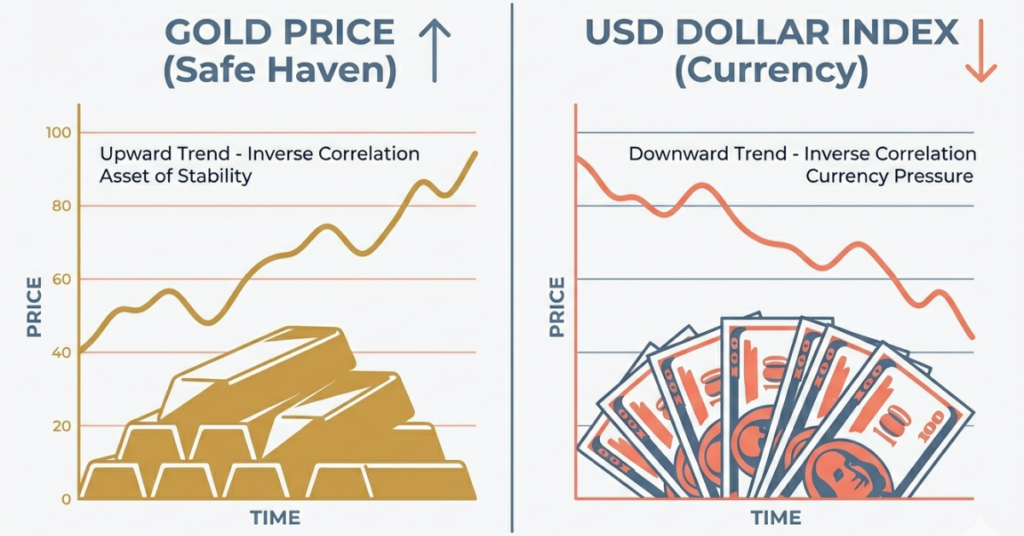
Yes, gold prices often rise when the US dollar weakens because gold is priced in dollars globally. A weaker dollar makes gold cheaper for foreign buyers, increasing demand. However, this relationship is not absolute, as interest rates, inflation, and market sentiment can also influence gold prices significantly.
Key Takeaways
- Gold and the US dollar typically have an inverse relationship, meaning when the dollar weakens, gold often rises.
- A weaker dollar makes gold more affordable globally, increasing demand.
- This relationship is common but not guaranteed other factors can override it.
- Interest rates and inflation play a major role in gold price movements.
- Gold is widely seen as a safe-haven asset, attracting investors during economic uncertainty.
What Is the Relationship Between Gold and the US Dollar?
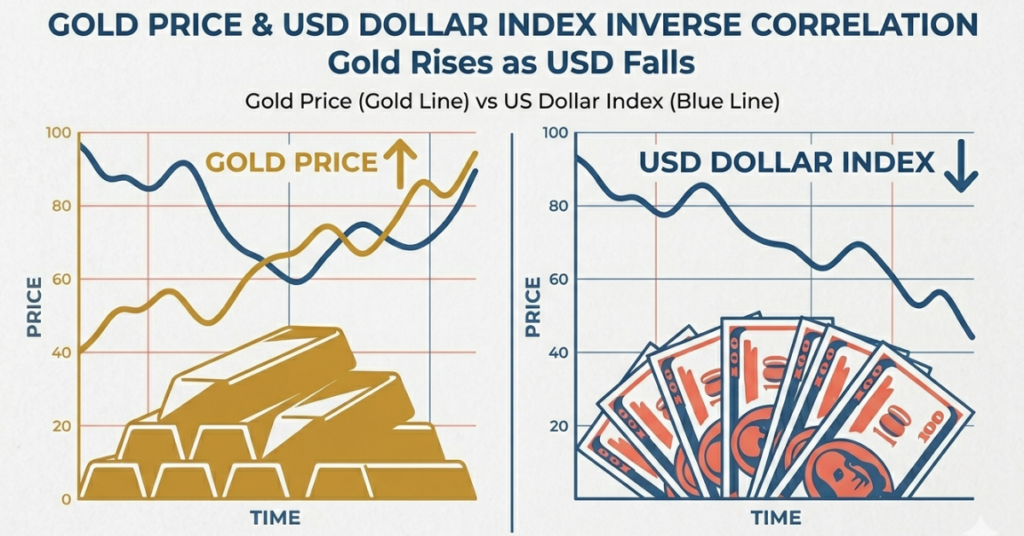
The relationship between gold and the US dollar is generally inverse, meaning they tend to move in opposite directions. When the dollar weakens, gold often becomes more attractive, and when the dollar strengthens, gold prices may face downward pressure.
To understand this clearly, it’s important to know that gold is priced globally in US dollars. This creates a direct link between the value of the dollar and the price of gold.
Example for Better Understanding
Imagine:
- The US dollar weakens against the euro
- European investors now need fewer euros to buy the same amount of gold
However, while this inverse relationship between gold and USD is widely observed, it is not a fixed rule. Other economic forces can sometimes weaken or override this connection.
Why Does Gold Rise When the US Dollar Weakens?
Gold often rises when the US dollar weakens due to a combination of pricing mechanics, investor behavior, and economic expectations. These factors work together to increase demand for gold when the dollar loses strength.
Pricing Effect (Currency Mechanics)
Gold is traded globally in US dollars, so any change in the dollar’s value directly impacts its price.
When the dollar weakens:
- Gold becomes cheaper for foreign investors
- Demand increases globally
- Higher demand can push prices upward
Demand Shift (Investor Behavior)
When the US dollar weakens, investor confidence in it may decline. As a result:
- Investors look for alternative stores of value
- Gold becomes more attractive as a reliable asset
- Demand rises, which can increase prices
This is why gold is often linked to risk-off sentiment in financial markets.
Inflation Expectations
A weaker dollar is often associated with rising inflation or loose monetary policy.
- Inflation reduces the purchasing power of money
- Investors turn to gold as a hedge against inflation
- Increased buying activity can drive prices higher
Does Gold Always Go Up When the Dollar Falls?
No, gold doesn’t always rise when the US dollar falls. While the inverse relationship is common, it can break due to other powerful economic factors influencing the market at the same time.
Why the Relationship Can Break
Several situations can cause gold and the US dollar to move in the same direction or behave unexpectedly:
- Interest Rates Rising: Even if the dollar weakens, higher interest rates can make bonds and savings more attractive than gold, reducing demand.
- Strong Economic GrowthIf the global economy is performing well, investors may prefer riskier assets like stocks instead of gold.
- Market Liquidity Needs: During financial stress, investors sometimes sell gold to raise cash—even if the dollar is weak.
Example for Clarity
- The US dollar weakens
- But central banks increase interest rates sharply
- Investors shift funds into interest-bearing assets instead of gold
Assuming “gold always rises when the dollar falls” is a myth. Smart investors always analyze multiple factors together, not just one relationship.
The gold–USD relationship works best as a supporting indicator, not a standalone signal. To truly understand gold price movements, you must also consider interest rates, inflation, and overall market sentiment.
Important Factors That Influence Gold Prices Beyond the Dollar
While the US dollar plays an important role, gold prices are also driven by several major economic and market factors. Knowing these helps you see the full picture instead of relying on just one relationship.
5 Core Factors Explained
| Factor | How It Affects Gold | Why It Matters |
| Interest Rates | Higher rates → gold may fall | Investors prefer interest-bearing assets |
| Inflation | Higher inflation → gold may rise | Gold protects purchasing power |
| Central Bank Policies | Money printing → gold rises | Weakens currency value |
| Geopolitical Events | Crises → gold rises | Safe-haven demand increases |
| Market Sentiment | Risk-off → gold rises | Investors seek stability |
Among all factors, interest rates often have the strongest impact on gold. When rates rise, gold becomes less attractive because it does not generate income like bonds or savings accounts.
Real-World Example of Gold vs USD Movement
To clearly understand the relationship between gold and the US dollar, it helps to look at real market behavior. While the inverse relationship is common, actual market movements show that context matters more than a single factor.
Example Scenario: Weak Dollar Environment
- The US Federal Reserve signals lower interest rates
- The US dollar begins to weaken
- Investors expect inflation to rise
In this situation:
- Gold demand increases globally
- Investors move into gold as a store of value
- Gold prices often trend upward
This is a textbook case where a weakening dollar supports higher gold prices.
Example Scenario: When Gold Doesn’t Follow the Dollar
- The US dollar weakens slightly
- But global stock markets are performing strongly
- Investors prefer equities over safe-haven assets
In this case:
- Gold demand remains flat or decreases
- Gold may not rise despite a weaker dollar
Why Gold Is Considered a Safe-Haven Asset
Gold is widely known as a safe-haven asset, meaning investors tend to move into gold during times of uncertainty, economic stress, or financial instability. This behavior is one of the key reasons gold often rises when confidence in currencies like the US dollar weakens.
What Does “Safe-Haven” Mean?
A safe-haven asset is something that:
- Holds or increases value during market uncertainty
- Is trusted across countries and economic systems
- Is not directly dependent on any single government or currency
Gold fits these characteristics because it is globally accepted and historically valuable.
Why Investors Choose Gold in Uncertain Times
When markets become unstable, investors often:
- Reduce exposure to risky assets like stocks
- Look for stability and long-term value preservation
- Move capital into gold to protect wealth
This shift in behavior increases gold demand and can push prices higher.
Connection to US Dollar Weakness
When the US dollar weakens:
- Confidence in fiat currency may decline
- Inflation concerns may rise
- Investors seek alternative stores of value
How Traders Use the Gold–USD Relationship (XAUUSD Strategy)
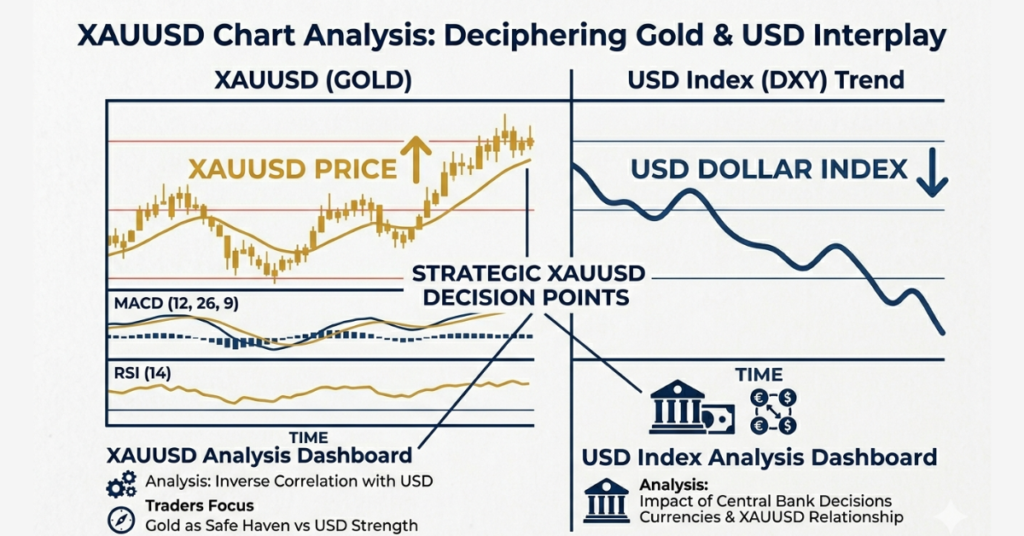
Traders use the relationship between gold and the US dollar as a market context tool when analyzing XAUUSD. Since gold is priced in USD, a weakening dollar often creates a supportive environment for gold, while a strengthening dollar can create downward pressure. However, this is never used alone and is always combined with broader analysis.
In real trading conditions, participants look at the US dollar trend alongside inflation data, interest rate expectations, and overall market sentiment. For example, if the dollar weakens due to expectations of lower interest rates while inflation remains elevated, traders may view gold as a potential buy opportunity. On the other hand, even with a weak dollar, strong economic optimism or rising yields can limit gold’s upside.
It’s important to understand that this relationship is probabilistic, not predictive. Professional traders use it as a guiding framework rather than a signal on its own. Charts, technical levels, and risk management play an equally important role in decision-making.
Trading Perspective
For active traders, execution conditions matter as much as analysis. Many rely on platforms like Defcofx that offer low trading costs, fast order execution, and flexible leverage to manage short-term gold movements effectively.
In such environments, features like:
- High leverage up to 1:2000 (for flexible position sizing)
- Spreads starting from 0.3 pips with no commission structure
- Fast execution for reacting to USD-driven volatility
- Quick withdrawals (within hours, including weekends)
can support active trading strategies, especially in fast-moving XAUUSD markets.
3 Common Myths About Gold and USD
There are several misunderstandings about how gold and the US dollar interact. While the relationship between them is important, it is often oversimplified, leading to incorrect assumptions in both investing and trading.
Myth 1: “Gold always rises when the US dollar falls”
This is the most common misconception. While gold often moves inversely to the US dollar, it doesn’t do so in every situation.
In reality:
- Interest rates, inflation, and market sentiment can override the dollar effect
- Gold may remain flat or even fall despite a weaker USD
Myth 2: “Gold is a risk-free asset”
Gold is considered a safe-haven asset, but it isn’t risk-free.
- Gold prices can be highly volatile
- It does not generate interest or dividends
- It can decline during liquidity crunches or strong economic growth phases
Myth 3: “The US dollar is the only factor that matters”
While the dollar is important, it is only one part of a much larger system.
Gold prices are also influenced by:
- Central bank policies
- Inflation expectations
- Global geopolitical events
- Investor sentiment
FAQ
No. Gold often rises when the US dollar weakens, but it is not guaranteed. Other factors like interest rates, inflation, and market sentiment can override this relationship.
Gold is priced in US dollars globally. When the dollar weakens, gold becomes cheaper for international buyers, which can increase demand and push prices higher.
The most important factors include interest rates, inflation expectations, central bank policies, geopolitical events, and overall market sentiment. The US dollar is only one part of this system.
Yes, gold is widely considered a hedge against inflation because it tends to hold value when the purchasing power of currency declines. However, performance can vary depending on economic conditions.
A weaker US dollar can create favorable conditions for gold, but it should not be used as a standalone trading signal. Always confirm with technical analysis and risk management before trading.
Final Thoughts on Does Gold Price rise when us Dollar Weakens
The relationship between gold and the US dollar is generally inverse, meaning gold often rises when the dollar weakens. This happens because gold is priced in USD, and a weaker dollar makes it more affordable globally, increasing demand.
However, this relationship is not fixed, as factors like interest rates, inflation, and global sentiment can significantly influence gold prices. Understanding this broader economic context is essential for making informed decisions in both investing and trading.
Open a Live Trading Account