


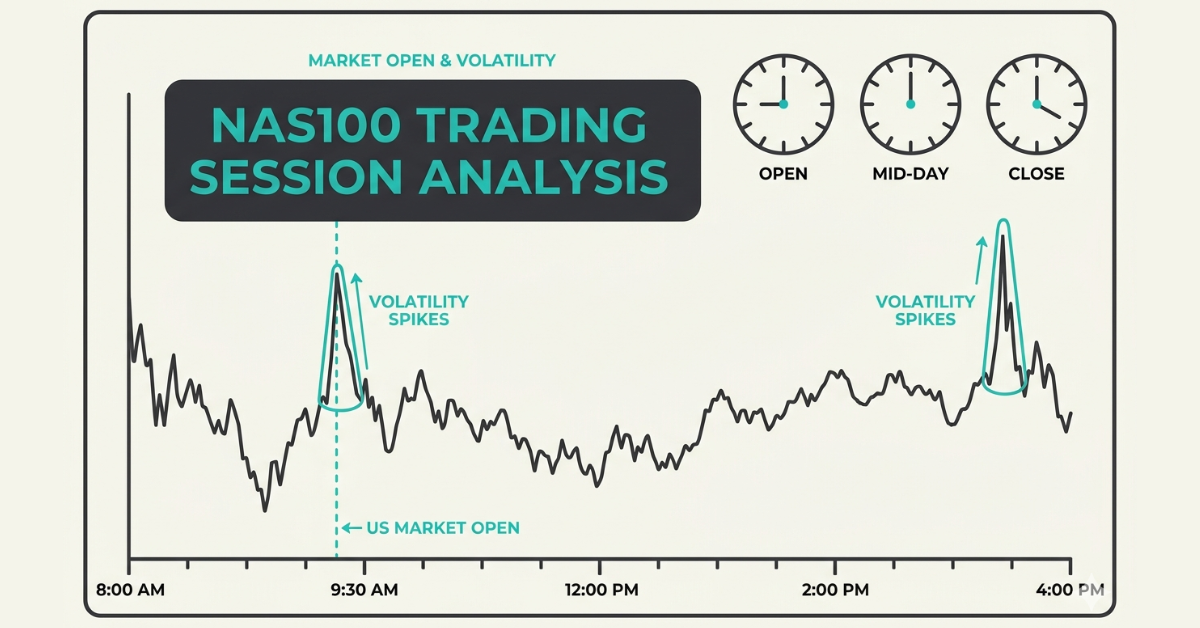
Trading NAS100 involves analyzing the Nasdaq-100 Index, identifying high-probability setups, managing risk carefully, and executing trades using a structured trading plan. Since NAS100 is known for its strong trends and high volatility, successful traders focus on market structure, momentum, and disciplined risk management rather than trying to predict every price movement.
Key Takeaways
- NAS100 is one of the most actively traded stock indices in the world.
- Strong trends make it popular among day traders and swing traders.
- Technical analysis and risk management are essential for consistent trading.
- The US trading session typically offers the highest liquidity.
- A trading plan is more important than trying to catch every market move.
Why So Many Traders Choose NAS100
If you’re looking for a market that offers regular trading opportunities, you’ve probably come across NAS100.
While many financial instruments can spend days moving sideways, NAS100 is known to produce strong directional moves and healthy daily volatility. These characteristics have made it one of the most popular instruments among both beginner and experienced traders.
But here’s something many new traders misunderstand.
They assume that because NAS100 moves a lot, it’s easier to make money.
In reality, volatility is a double-edged sword.
Large price movements can create excellent opportunities, but they can also magnify losses if you don’t have a clear trading plan. That’s why learning how to trade NAS100 isn’t about finding a magic indicator; it’s about understanding how the market behaves and developing a structured approach that you can follow consistently.
Step 1: Understand What You’re Trading
Before placing your first trade, you should understand what NAS100 actually represents.
NAS100 tracks the performance of 100 of the largest non-financial companies listed on the Nasdaq exchange. Because many of these companies operate in the technology sector, the index is heavily influenced by major technology businesses, corporate earnings, investor confidence, and the overall health of the US economy.
This means NAS100 doesn’t move for the same reasons that EUR/USD or GBP/USD might move.
While forex pairs are driven largely by interest rates, inflation, and currency demand, NAS100 also responds strongly to the following:
- Corporate earnings reports
- Technology sector performance
- Federal Reserve decisions
- Inflation expectations
- Investor risk appetite
Step 2: Choose a Trading Style That Fits You
One of the biggest mistakes beginners make is trying every trading style they see online.
Professional traders usually specialize. Instead of constantly changing strategies, they choose an approach that suits their personality, available time, and risk tolerance.
| Trading Style | Typical Holding Time | Best For | Characteristics |
| Scalping | Seconds to minutes | Experienced traders | Very fast decisions and frequent trades |
| Day Trading | Minutes to hours | Active traders | Positions closed before the trading day ends |
| Swing Trading | Several days | Part-time traders | Captures larger market swings |
| Position Trading | Weeks to months | Long-term investors | Focuses on major trends |
If you have a full-time job, swing trading may be more practical than scalping. If you enjoy monitoring the markets throughout the day, day trading might suit you better. The goal isn’t to find the “best” trading style. It’s to find the one you can execute consistently.
Step 3: Learn to Read Market Structure
One of the most valuable skills you can develop is understanding market structure.
Rather than relying solely on indicators, professional traders often begin by asking simple questions:
- Is the market making higher highs and higher lows?
- Is the trend bullish or bearish?
- Where are the key support and resistance zones?
- Has price recently broken an important level?
These questions help determine who currently controls the market.
For example, if NAS100 continues forming higher highs and higher lows, buyers are generally in control. In that environment, many traders look for buying opportunities on pullbacks rather than attempting to sell against the trend.
On the other hand, if the market consistently forms lower highs and lower lows, sellers may have the advantage.
Understanding market structure gives every other part of your analysis more meaning.
Step 4: Wait for High-Probability Setups
One of the biggest differences between professional traders and beginners is patience.
Beginners often feel they need to be in the market all the time.
Professionals understand that not trading is sometimes the best decision.
Instead of forcing trades, they wait for setups that meet predefined criteria.
For example, a quality NAS100 trade might include the following:
- A clear overall trend
- Price pulling back into a support or resistance zone
- Momentum returning in the trend direction
- A favorable risk-to-reward ratio
When all these factors align, the probability of success generally improves.
Notice that this isn’t about predicting every market move. It’s about waiting until the odds are more favorable.
When you’re ready to trade high-probability NAS100 setups, Defcofx offers access to NAS100 with average spreads from 3 points, zero commission, a minimum trade size of 0.01 lots, and leverage up to 1:200. Start with a demo account or move directly to a live trading account when you’re ready.
Trade NAS100 with DefcofxStep 5: Manage Risk Before Thinking About Profit
Many new traders ask:
“How much can I make trading NAS100?”
Professional traders ask a different question:
“How much am I willing to lose if I’m wrong?”
This mindset shift is what separates long-term traders from those who quickly lose their accounts.
Before every trade, you should know:
- Your entry price
- Your stop-loss
- Your profit target
- Your position size
Here’s a simple example of a risk management framework:
| Risk Rule | Example |
| Risk per Trade | 1% of account balance |
| Minimum Risk-to-Reward | 1:2 |
| Maximum Daily Loss | 3% |
| Maximum Open Trades | 2–3 positions |
| Stop-Loss | Always predefined before entry |
Notice that every rule focuses on protecting capital. Successful trading isn’t about avoiding losses completely. It’s about ensuring that no single trade has the power to significantly damage your account.
Step 6: Trade During High-Liquidity Hours
Timing matters when trading NAS100.
Although many brokers allow extended trading hours, the index generally experiences its highest activity during the official US market session.
This is when:
- Institutional traders are active
- Trading volume increases
- Volatility improves
- Execution quality is often better
Many traders also pay close attention to the first hour after the US market opens because this period frequently produces strong momentum and breakout opportunities.
However, increased volatility also means increased risk.
Rather than rushing into the market, wait for price to establish direction before making decisions.
Step 7: Build a Routine Instead of Chasing Trades
One habit that separates experienced traders from beginners is consistency.
Instead of opening charts randomly, professional traders usually follow the same daily routine.
A simple routine might look like this:
| Trading Routine | Purpose |
| Review economic calendar | Identify high-impact news |
| Analyze overall trend | Understand market direction |
| Mark support and resistance | Prepare potential trade zones |
| Wait for confirmation | Avoid emotional entries |
| Journal completed trades | Improve future performance |
Following the same process every day helps reduce emotional decision-making and creates valuable data that you can use to improve over time.
5 Common Mistakes to Avoid When Trading NAS100
Many losses don’t happen because traders lack knowledge.
They happen because traders ignore basic principles.
Some of the most common mistakes include:
- Chasing price after large moves instead of waiting for pullbacks.
- Trading without a stop-loss because you “feel” the market will reverse.
- Increasing position size after a losing trade in an attempt to recover quickly.
- Ignoring economic events that can dramatically increase volatility.
- Changing strategies every week instead of mastering one proven approach.
Every experienced trader has made these mistakes at some point.
The difference is that successful traders learn from them instead of repeating them.
Why Your Broker Matters When Trading NAS100
Even the best trading strategy can be affected by poor execution. Because NAS100 is capable of moving quickly, factors such as spreads, execution speed, platform stability, and access to liquidity become especially important.
Many traders choose brokers like Defcofx because they offer access to NAS100 alongside forex and other global markets, with competitive spreads, fast execution, leverage of up to 1:2000, and responsive customer support. New eligible clients can also benefit from a 40% welcome bonus on qualifying deposits, while low trading costs and fast withdrawals help create a smoother overall trading experience.
Frequently Asked Questions
Is NAS100 good for beginners?
Yes, NAS100 can be suitable for beginners because it often forms clear trends and is widely covered by educational resources. However, its volatility means new traders should start with small position sizes and focus heavily on risk management. Practicing on a demo account before trading with real money is also a good idea.
What is the best strategy for trading NAS100?
There isn’t a single strategy that works in every market condition. Many traders prefer trend-following, pullback, or breakout strategies because NAS100 often produces strong directional moves. The key is to choose one strategy, test it thoroughly, and apply it consistently rather than constantly switching approaches.
What is the best time to trade NAS100?
The most active period is usually during the official US market session, particularly shortly after the market opens. This is when trading volume and liquidity tend to be highest, creating more opportunities. However, increased activity also means greater volatility, so careful risk management is essential.
Can you day trade NAS100?
Yes, NAS100 is one of the most popular instruments for day trading due to its liquidity and price movement. Many traders look for opportunities during the first few hours of the US trading session when volatility is elevated. Successful day trading requires discipline, preparation, and a clearly defined trading plan.
Why is NAS100 so volatile?
NAS100 contains many technology and growth-oriented companies, which often react strongly to earnings reports, economic data, and interest rate expectations. Investor sentiment can also change quickly, causing significant price swings. While this volatility creates opportunities, it also increases trading risk.
How much money do I need to trade NAS100?
The amount you need depends on your broker’s minimum deposit requirements, leverage, position size, and risk management approach. Some traders begin with relatively small accounts, while others prefer larger balances to manage risk more comfortably. Regardless of account size, you should avoid risking more than a small percentage of your capital on a single trade.
Is NAS100 better than forex trading?
Neither market is universally better. NAS100 often offers stronger trends and larger daily price movements, while forex provides a wider selection of instruments and nearly 24-hour trading during the week. The better choice depends on your trading style, experience, and personal preferences.
What are the biggest mistakes when trading NAS100?
Some of the most common mistakes include chasing price, ignoring stop-losses, overleveraging, trading during major news without preparation, and abandoning a trading plan after a few losing trades. Long-term success usually comes from consistency and disciplined execution rather than trying to win every trade.
Final Thoughts
Learning how to trade NAS100 is about much more than identifying buy and sell signals. It requires understanding how the index behaves, recognizing the factors that drive its price, following a structured trading plan, and managing risk on every trade. While NAS100 offers excellent opportunities because of its strong trends and volatility, long-term success comes from patience, discipline, and consistency, not from trying to catch every market move.