


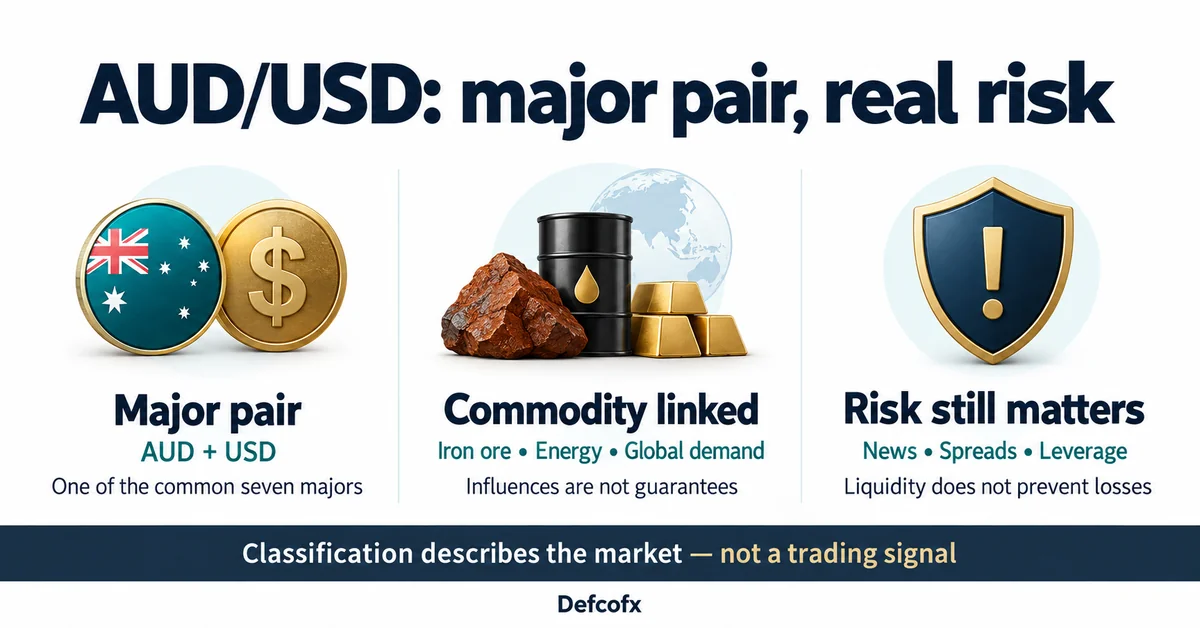
Yes, AUD/USD is a major forex pair. It pairs the Australian dollar with the US dollar and belongs to the commonly used list of seven majors. Its substantial trading activity supports liquidity, but being a major does not make it predictable, low risk, or profitable to trade.
Key takeaways
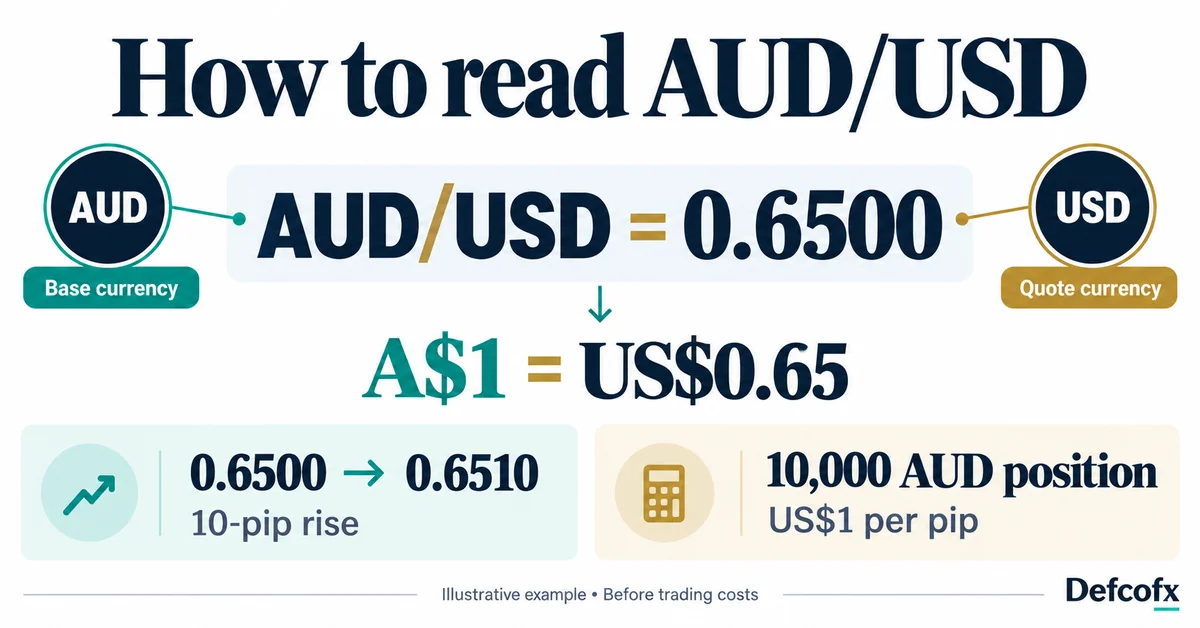
- AUD is the base currency; USD is the quote currency. AUD/USD tells you the US dollar price of A$1.
- AUD/USD is both a major pair and a commodity-linked pair. Those descriptions refer to different features.
- In April 2025, AUD/USD averaged about US$467 billion in daily global OTC FX turnover, representing 4.9% of the market.
- Interest rate expectations, Australian export prices, Chinese demand, and US dollar movements can influence the exchange rate.
- Spreads, execution conditions, and leverage still affect trading results, even in a liquid market.
Why is AUD/USD a major currency pair?
In common retail forex terminology, the majors are seven established, heavily traded pairs involving the US dollar: EUR/USD, USD/JPY, GBP/USD, USD/CHF, USD/CAD, AUD/USD, and NZD/USD. AUD/USD qualifies because it combines two widely traded currencies in an active international market.
You may also see the term four traditional majors, which refers to EUR/USD, USD/JPY, GBP/USD, and USD/CHF. Under that narrower convention, AUD/USD is discussed separately with the commodity currencies. This explains why lists differ; AUD/USD is included in the familiar seven-pair classification. See BabyPips’ currency-pair guide and IG’s explanation of traditional and commodity majors.
The practical distinction is between market classification and trade suitability. A major label describes the pair’s market role. It does not tell you whether a particular entry, position size, or trading strategy makes sense.
How much is AUD/USD traded?
The Reserve Bank of Australia’s February 2026 review of the BIS survey, Table A.2, reports the following global daily averages for April 2025:
| Currency pair | Daily global OTC FX turnover | Share of global turnover |
|---|---|---|
| AUD/USD | US$467 billion | 4.9% |
| EUR/USD | US$1,970 billion | 20.7% |
| USD/JPY | US$1,370 billion | 14.4% |
These figures cover OTC foreign exchange instruments, including spot and derivatives. They are survey-month averages, not today’s volume, retail-only trading, or the value of open positions. The source writes the Australian dollar pair as USD/AUD; that is the same currency combination, irrespective of quotation direction. Figures are rounded.
AUD/USD therefore has substantial market activity, although EUR/USD and USD/JPY trade in larger volumes. Global turnover is useful context, but it cannot establish the spread or available liquidity on an individual broker’s platform.
How do you read an AUD/USD quote?
Read AUD/USD from left to right: the first currency is what is being priced, and the second is what its price is expressed in. At an illustrative rate of AUD/USD = 0.6500, A$1 is worth US$0.65. A$1,000 would therefore equal US$650 before conversion charges or spreads.
If the quote rises to 0.6600, one Australian dollar buys more US dollars: AUD has strengthened relative to USD. If it falls to 0.6400, AUD has weakened relative to USD. The pair can move because of developments affecting either currency, or both.
A worked pip and profit example
For AUD/USD, one pip conventionally equals 0.0001. A move from 0.6500 to 0.6510 is 0.0010, or 10 pips. A fifth decimal place, if displayed, represents a fraction of a pip.
For a position measured in AUD units, pip value in USD = position size in AUD × 0.0001. A 10,000 AUD position therefore has a pip value of US$1. A long position opened at 0.6500 and closed at 0.6510 would gain US$10 before costs; a fall to 0.6490 would produce a US$10 loss before costs. Short positions have the opposite directional exposure.
This calculation assumes a straightforward linear FX contract. If your account uses another currency, the result must be converted. Always check the broker’s contract size and calculation rules rather than assuming that a lot label represents a particular exposure.
What moves AUD/USD?
The RBA’s exchange-rate explainer identifies interest rate differences, terms of trade, and risk sentiment among the Australian dollar’s influences. For AUD/USD, watch both economies:
- RBA and Federal Reserve expectations: changes in expected relative returns can shift demand for the currencies. A decision already anticipated by markets may have a different effect from a surprise.
- Commodity prices and export demand: prices for Australian exports, such as iron ore and energy, influence export income and the terms of trade.
- Chinese economic conditions: changes in demand from an important export market can affect expectations for Australia.
- Risk appetite and USD demand: international uncertainty can affect capital flows and the dollar side of the pair.
These influences can conflict. Higher commodity prices do not guarantee a higher AUD/USD rate if the US dollar is strengthening at the same time. Avoid treating a correlation as a standalone buy or sell signal.
AUD/USD versus an Australian dollar cross pair
| Feature | AUD/USD | AUD/JPY |
|---|---|---|
| Common classification | Major pair | Minor or cross pair |
| Base currency | Australian dollar | Australian dollar |
| Quote currency | US dollar | Japanese yen |
| Central banks to follow | RBA and Federal Reserve | RBA and Bank of Japan |
A cross pair combines currencies without USD. Both examples contain AUD, but their second currencies introduce different economic drivers. Do not assume a trade in AUD/JPY duplicates the exposure of an AUD/USD position.
When should you monitor AUD/USD?
Monitor the pair around scheduled Australian and US releases rather than relying on a universal “best hour.” Australian inflation, employment, and RBA announcements deserve attention, as do US inflation, employment, and Federal Reserve announcements. Chinese releases can also matter for the Australian outlook.
Asian trading hours can capture Australian and regional news, while London and New York trading brings additional participation and US releases. Activity and spreads vary with the day, holidays, and news. More movement is not automatically a better trading condition.
Use Defcofx’s economic calendar and the official RBA meeting schedule. Check the calendar’s timezone and daylight-saving changes before planning around an event. The RBA Monetary Policy Board currently has eight scheduled meetings per year.
Does being a major pair make AUD/USD easier to trade?
AUD/USD provides a useful setting for learning currency quotation, pip values, and economic-event analysis. However, liquidity does not remove losing trades, sudden reversals, price gaps, or execution slippage. There is no fixed “moderate volatility” level that applies in every market environment.
Consider the worked example above: a 30-pip adverse move on a 10,000 AUD position is US$30 before costs. On a 100,000 AUD position it is US$300. Leverage changes the margin needed to hold exposure; it does not reduce the loss per pip for an unchanged position size. A stop-loss order also may execute beyond its requested level in a fast or gapping market.
Before comparing spreads, identify the complete cost: bid–ask spread, any commission, overnight financing or applicable account charges, and currency conversion. A broker’s advertised minimum across its products is not necessarily the current AUD/USD spread. Learn more about comparing forex spreads.
Explore AUD/USD with Defcofx
Start with a practical check of the instrument. On desktop MetaTrader 5, open Market Watch, locate the AUD/USD symbol, and choose Specification from its context menu. Review contract size, minimum volume and step, spread information, trading sessions, and margin conditions. The official MT5 guide explains these broker-set fields.
Then use a demo to practise the 10-pip example and record the result. Demo execution and trading psychology can differ from live trading. Review Defcofx’s current account options and trading conditions before considering a live account.
Practise with a Defcofx demo account
Ready to consider live trading? Review the Defcofx live account application after checking eligibility, costs, and the risk disclosure. Leveraged derivatives can produce substantial losses. This article provides general education, not a personal trading recommendation.
Frequently asked questions
Is AUD/USD a major, minor, or exotic pair?
AUD/USD is a major under the common seven-pair convention. It combines the Australian dollar and US dollar. AUD/JPY and AUD/NZD are examples of Australian dollar crosses, commonly grouped as minor pairs.
Why is AUD/USD called the Aussie?
“Aussie” is market shorthand for the Australian dollar and often for the AUD/USD pair. Check the context: a reference to the Aussie alone does not always specify the currency pair.
Is AUD/USD both a major and a commodity pair?
Yes. “Major” describes its established place in forex trading, while “commodity-linked” describes Australia’s exposure to export prices. The labels can apply together without implying a fixed relationship with any commodity.
How much is one pip worth on AUD/USD?
One pip is 0.0001 USD per AUD. It equals US$0.10 for 1,000 AUD, US$1 for 10,000 AUD, and US$10 for 100,000 AUD of exposure, before costs. Check contract specifications and convert the result if your account currency is not USD.
Does AUD/USD always move with gold?
No. Correlations change across timeframes and market conditions. Interest rate expectations, US dollar demand, and other factors can outweigh gold-price movements. A gold move alone cannot establish the direction of AUD/USD.
Is AUD/USD safer than an exotic pair?
Major pairs commonly offer deeper liquidity, but that does not make an individual trade safe. Position size, leverage, execution, and event risk all matter. Compare actual trading conditions rather than relying on the pair’s classification.
Can you trade AUD/USD at the weekend?
Conventional retail forex trading generally follows a five-day trading week. Broker sessions, holidays, and maintenance periods determine when orders are available. Check the AUD/USD specification on your platform; weekend news can cause a gap when trading resumes.
Does a rising AUD/USD mean the Australian dollar is stronger?
Yes, relative to the US dollar. A higher AUD/USD quote means A$1 buys more USD. It does not establish that AUD has strengthened against every other currency.