


The key strategies for successful forex trading are pretty simple: have a clear trading plan, manage your risk, trade with the trend when it makes sense, and don’t let emotions run the show. You don’t need a chart packed with indicators or a complicated system. What matters more is having a strategy you understand and being consistent with it.
Key Takeaways
- Always have a plan before entering a trade.
- Risk management matters just as much as finding good entries.
- Trend trading, breakout trading, and support and resistance are popular forex strategies.
- Pay attention to economic news, as it can quickly move currencies.
- Don’t change your strategy every time you have a losing trade.
- A trading journal can help you figure out what’s actually working.
- Successful forex trading is more about consistency than trying to win every trade.
Start with a trading plan
Let’s start with the part that sounds boring but makes a huge difference: having a plan.
A trading plan is basically your set of rules. It tells you what to look for before entering a trade, how much you’re willing to risk, and when to exit.
Before opening a position, you should ideally know:
- What currency pair you’re trading
- Why you’re entering
- Where your stop-loss will go
- Where you might take profit
- How much you’re risking
- What would prove your original idea wrong
Without a plan, it’s effortless to make decisions based on whatever the market happens to be doing at that moment.
EUR/USD drops suddenly? You sell. It bounces five minutes later? You panic and buy. Before you know it, you’re reacting to every candle instead of actually trading a strategy.
A plan helps stop that.
Learn how to trade with the trend
You’ve probably heard “the trend is your friend” before. It’s a cliché, but there’s a reason traders keep saying it.
Trend trading simply means looking at the overall direction of the market and trying to trade with it.
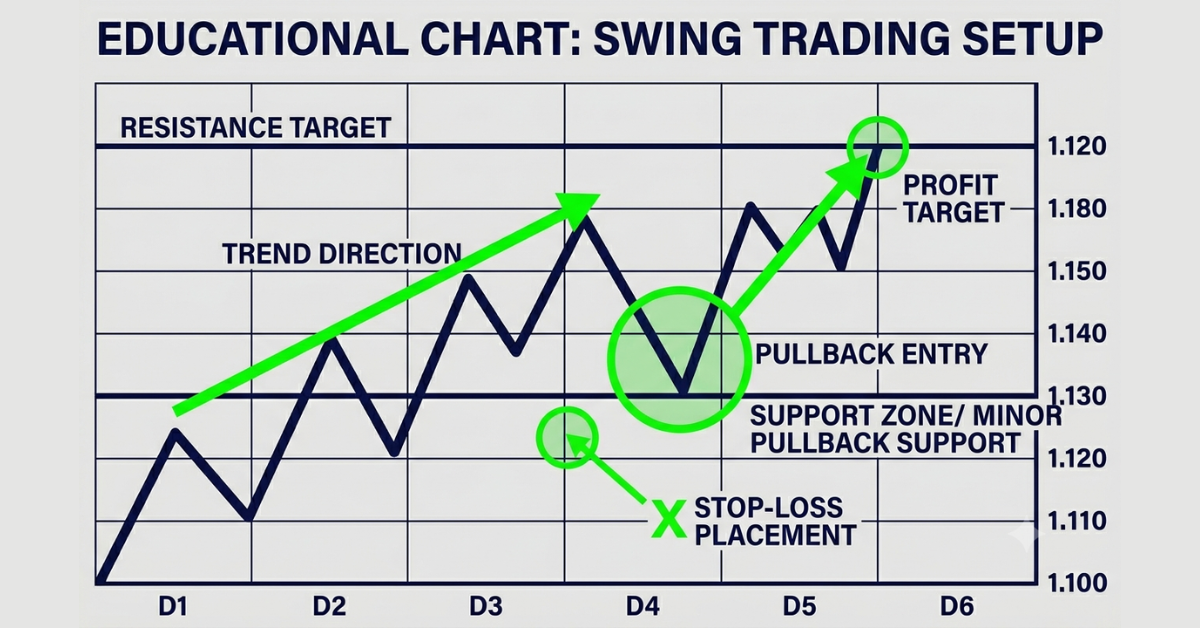
If EUR/USD has been making higher highs and higher lows, the market is generally trending upward. Rather than trying to guess exactly where that trend will end, a trader might wait for a pullback and look for another buying opportunity.
The same idea works in reverse during a downtrend.
Moving averages can make trends easier to spot, but you don’t necessarily need an indicator. Looking at the basic price structure can tell you a lot.
The tricky part is knowing when the market isn’t trending. Sometimes prices just move sideways. Trying to force a trend strategy during those periods can lead to one false signal after another.
Use support and resistance
Support and resistance are two of the simplest concepts in forex trading, and they’re still incredibly useful.
Support is an area where price has previously struggled to move lower. Resistance is an area where price has previously struggled to move higher.
Think of them more like zones than exact prices.
Let’s say GBP/USD has reached the same area around 1.3000 several times and bounced lower each time. Traders may start watching that area as resistance.
If the price reaches it again, there are a couple of possibilities. It might reject the level again, or it could finally break through.
That’s where your strategy comes in.
You don’t need to automatically buy at support or sell at resistance. Wait and see what price actually does when it gets there.
Don’t ignore breakout trading
Sometimes the market spends hours or even days stuck inside a range. Then suddenly, the price breaks through one side and starts moving quickly.
That’s a breakout.
Breakout traders look for these moments and try to catch the move as momentum picks up.
For example, EUR/USD might trade between 1.1500 and 1.1550 for several hours. If the price breaks clearly above 1.1550 with strong momentum, a trader might look for a buying opportunity.
Sounds easy, right?
The problem is false breakouts.
Price can move above resistance, pull traders into the market, and then immediately fall back into the range.
That’s why many traders wait for confirmation. Some wait for the candle to close above the level. Others wait for the price to break out and then come back to test the old resistance as new support.
There’s no perfect method, but blindly chasing every breakout is usually not a great idea.
Risk management is where everything comes together
You can have an amazing trading strategy and still run into serious trouble if you don’t manage risk.
This is one of the most significant differences between gambling on a market move and approaching trading with a proper system.
Before entering a trade, decide how much you’re comfortable losing if you’re wrong.
Yes, losing.
It’s much easier to manage a trade when you’ve already accepted the possible loss before clicking buy or sell.
Some traders choose to risk a small percentage of their account on each position. The exact amount depends on the trader, but the basic idea stays the same: don’t allow one bad trade to seriously damage your account.
Position size matters here too.
A 30-pip stop on a large position can risk far more money than a 100-pip stop on a small position.
| Risk Tool | What It Helps With |
| Stop-loss | Limits potential loss |
| Position sizing | Controls how much money is at risk |
| Risk-to-reward ratio | Compares possible loss with potential profit |
| Maximum daily loss | Helps prevent revenge trading |
| Leverage control | Keeps overall exposure manageable |
Pay attention to the economic calendar
Technical analysis is useful, but forex isn’t happening in a bubble.
Currencies represent economies.
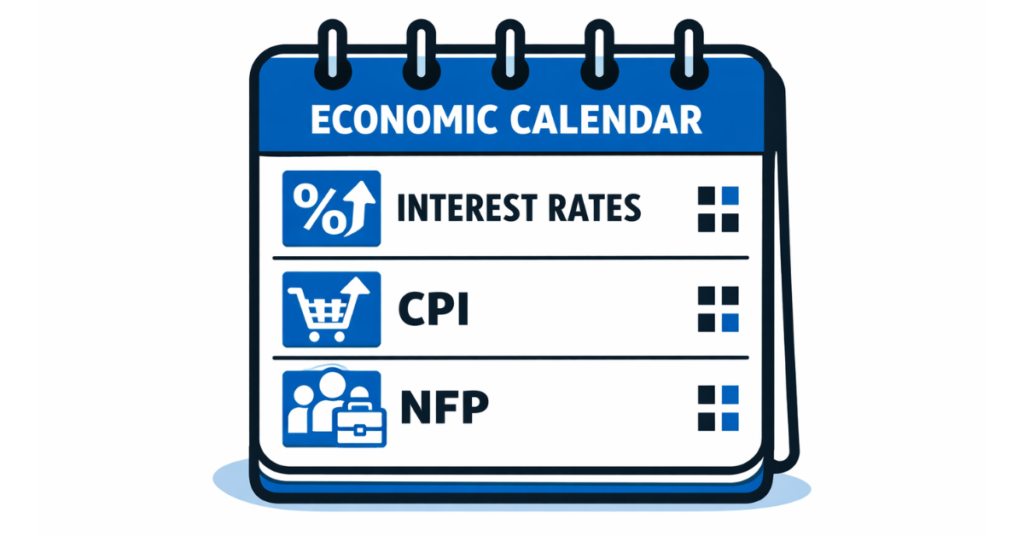
That means things like interest rates, inflation, employment figures, and central bank comments can have a giant impact on price.
Imagine you’ve found what looks like a perfect technical setup on GBP/USD. Your indicators line up, the price is sitting at support, and you’re ready to enter.
Then you realize the Bank of England is announcing its interest rate decision in ten minutes.
That’s pretty important information.
Major events worth watching include:
- Central bank interest rate decisions
- Inflation reports
- Non-Farm Payrolls
- GDP releases
- Employment figures
- Central bank speeches
You don’t necessarily need to become an economist. Just know what’s coming up before you trade.
Try combining technical and fundamental analysis
You don’t have to choose between being a technical trader and a fundamental trader.
They can work really well together.
Say the Federal Reserve sounds more likely to cut interest rates. Fundamentally, that could put pressure on the U.S. dollar.
Then you look at EUR/USD and notice the price has broken through an important resistance level.
Now you have a fundamental reason for potential USD weakness and a technical signal showing that buyers are taking control.
That doesn’t mean the trade will definitely work. Nothing does.
But you’ve got more information supporting the idea than if you were simply following one indicator.
Example
Think of fundamental analysis as the bigger story and technical analysis as the timing. Fundamentals can help explain why a currency is moving, while the chart can help you decide where you might enter or exit.
Keep your emotions out of the driver’s seat
This approach might be one of the hardest trading strategies to master because there’s no indicator you can add to your chart to fix it.
Forex trading can get emotional rapidly.
You lose a trade and immediately want your money back. So you open another position.
That loses too.
Now you’re annoyed, so you increase your lot size.
That’s revenge trading, and it can turn one normal losing trade into a very bad trading day.
Fear can cause problems too. A trader might close a winning position far too early because they’re scared of losing the small profit they’ve made.
Having predefined rules makes these moments easier to manage.
If your stop, target, and risk were decided before entering the trade, there’s less reason to make emotional changes halfway through.
Keep a trading journal
A trading journal sounds like homework, but it can tell you things about your trading that you’d probably never notice otherwise.
Write down what you traded, why you entered, where you exited, and what happened.
You can also note how you felt.
Were you calm? Rushing? Trying to recover another loss?
After 50 or 100 trades, patterns can start appearing.
Maybe your EUR/USD trades are consistently better than your GBP/JPY trades. Maybe your morning trades perform well, but your late-night trades don’t. Or perhaps your breakout strategy is working, while your reversal trades are still losing.
Without a journal, you’re mostly guessing.
Don’t keep jumping between strategies
This scenario happens to a lot of new traders.
They learn a strategy. It loses three trades.
So they find another strategy online.
That one loses twice.
Then they change indicators, timeframes, currency pairs, and everything else.
Soon, they have no idea whether any strategy actually worked because they never tested one properly.
Losing trades are normal. Even a good trading system will have losing streaks.
Instead of changing everything immediately, track your results over a meaningful number of trades and see whether there’s actually a problem.
Choose a strategy that actually suits you
There’s no single “best” forex strategy for everyone.
Your strategy needs to fit your schedule, personality, and risk tolerance.
| Trading Style | Typical Holding Period | Best For |
| Scalping | Seconds to minutes | Very active traders |
| Day trading | Minutes to hours | Traders available during the day |
| Swing trading | Days to weeks | Traders who can’t watch charts constantly |
| Position trading | Weeks to months | Long-term market views |
If you work full-time, for example, trying to scalp EUR/USD all day probably isn’t realistic.
Swing trading may make much more sense.
The best strategy isn’t necessarily the one that looks most profitable online. It’s one you can actually follow consistently.
Put your forex strategy into practice with Defcofx
Once you’ve built a strategy, you need a platform where you can analyze the market, manage your positions, and actually execute your plan.
Defcofx provides access to forex markets through MetaTrader 5, where traders can use advanced charts, technical indicators, multiple order types, and other tools to build and manage their strategies.
Open a Trading AccountWhat successful forex trading really comes down to
Here’s the thing: successful forex trading usually isn’t about finding some secret indicator or strategy nobody else knows about.
It’s about doing the basics well.
Have a plan. Wait for good setups. Control your risk. Know what’s happening in the market. Keep track of your results. And don’t let one bad trade change everything you’re doing.
Some trades will lose. That’s part of trading.
The goal is to build a process you can repeat without needing to guess what to do every time the market moves.
Frequently Asked Questions
What is the most successful forex trading strategy?
There isn’t one strategy that works best for everyone. Trend trading, breakout trading, support and resistance, and swing trading are all popular approaches. The best choice depends on your experience, schedule, and risk tolerance.
How much should beginners risk per trade?
Many traders choose to risk only a small portion of their account on each trade. The important part is choosing a level you can manage consistently rather than risking large amounts on individual positions.
Is forex trading difficult to learn?
The basic concepts are fairly easy to understand, but becoming consistent takes time. Risk management, emotional discipline, and experience are usually harder to develop than learning how indicators work.
Should I use technical or fundamental analysis?
You can use both. Technical analysis helps you study price movements and potential entry points, while fundamental analysis helps explain the economic reasons behind currency movements.
How many forex pairs should beginners trade?
You don’t need to follow every currency pair. Starting with a few major pairs can make it easier to learn how those markets behave without becoming overwhelmed.
Do professional forex traders lose trades?
Absolutely. Losing trades are a normal part of trading. What matters is controlling how much you lose when you’re wrong and maintaining a strategy that has a positive overall result over time.
Can forex trading be consistently profitable?
It can be profitable for some traders, but there are no guaranteed returns. Consistency requires a tested strategy, disciplined risk management, realistic expectations, and the ability to stick to a trading plan.