


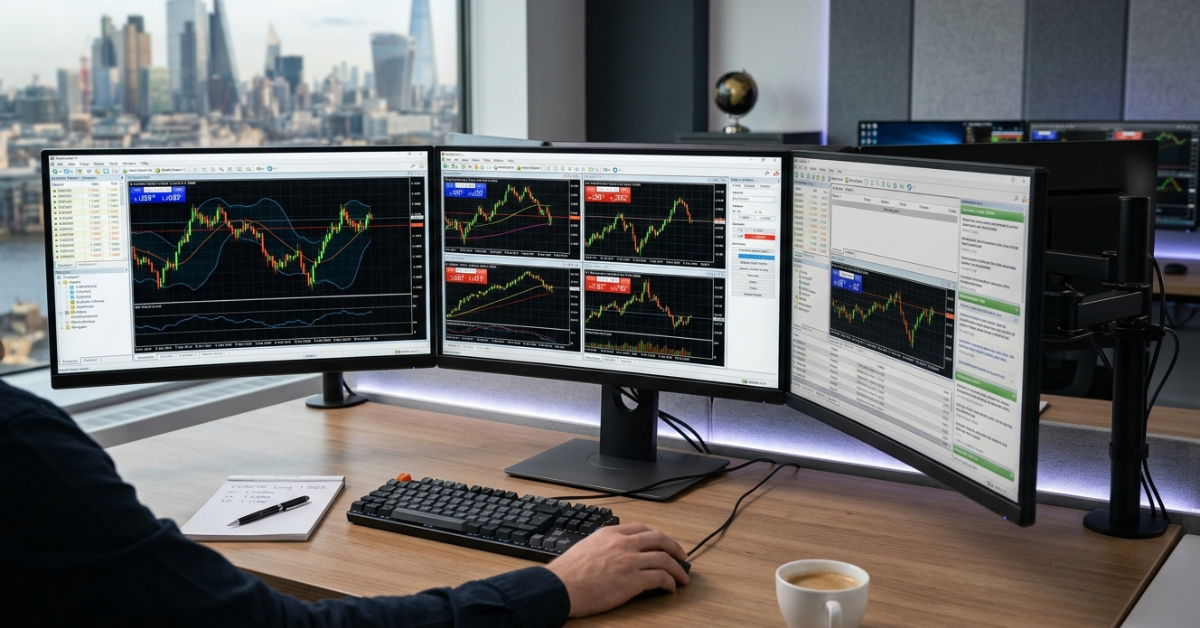
The most popular forex tools among professional traders include advanced trading platforms, economic calendars, technical indicators, charting software, position size calculators, market news feeds, sentiment tools, and trading journals. Professionals rarely depend on one tool alone. Instead, they combine several resources to analyze markets, manage risk, execute trades, and evaluate their performance.
Key Takeaways
- MetaTrader 5 and other advanced platforms provide charting, analysis, and trade execution tools.
- Economic calendars help traders prepare for market-moving announcements.
- Technical indicators are commonly used to analyze trends, momentum, and volatility.
- Position size and risk calculators help traders control exposure before entering a trade.
- News feeds and sentiment tools provide additional insight into fundamental market conditions.
- Trading journals help professional traders identify patterns and improve their strategies over time.
Trading Platforms for Analysis and Execution\
Most professional trading setups are built on a stable trading platform.
Market analysis and order execution are combined in one environment in platforms like MetaTrader 5 (MT5). Traders can track multiple currency pairs, open and close positions, apply technical indicators, create chart templates, and utilize a variety of order types.
MT5 also supports multiple time frames and automated tools, making it suitable for various approaches, from short-term day trading to longer-term strategies.
Most professional traders do not trade with the default platform settings; they customize their platform. A scalper may focus on shorter time frames and quick execution, while a swing trader might create a cleaner workspace around daily and four-hour charts.
Economic Calendars for Fundamental Events
An economic calendar is one of the most useful tools available to forex traders because currencies frequently react to scheduled economic announcements.
Calendars display upcoming events such as:
- Central bank interest rate decisions
- Inflation reports
- Non-Farm Payrolls
- GDP releases
- Employment figures
- Retail sales
- PMI data
- Central bank speeches
They commonly show the scheduled release time, previous result, market forecast, and actual figure once the data is published.
Suppose a trader identifies a strong technical buy setup on EUR/USD. Before entering, they check the economic calendar and discover that a European Central Bank interest rate announcement is due in 15 minutes. Rather than entering immediately, the trader may choose to wait because the announcement could dramatically change the market.
This is a good example of how fundamental tools can complement technical analysis.
Technical Indicators for Market Analysis
Technical indicators remain popular among professional traders, although experienced market participants generally use them selectively rather than filling charts with dozens of signals.
Some widely used indicators include:
| Indicator | Primary Use | What Traders Look For |
| Moving Average | Trend | Market direction |
| RSI | Momentum | Strength and potential exhaustion |
| MACD | Trend & momentum | Momentum shifts |
| ATR | Volatility | Stop and position planning |
| Bollinger Bands | Volatility | Expansion and contraction |
| Volume/Tick Volume | Participation | Confirmation of price moves |
Moving Averages, for example, can help determine whether a currency pair is generally trending higher or lower. ATR can provide information about current volatility, while RSI may help assess whether momentum is strengthening or weakening.
The important point is that professionals typically choose indicators according to their strategy rather than expecting an indicator to generate automatic answers.
Position Size Calculators for Risk Management
Position size calculators may not be as exciting as charts or indicators, but they are among the most practical tools for professional trading.
Before entering a position, a trader needs to know how much money could be lost if the stop-loss is reached.
A position size calculator typically considers:
- Account balance
- Percentage or amount being risked
- Stop-loss distance
- Currency pair
- Account currency
For example, two traders may identify exactly the same EUR/USD setup with a 50-pip stop. If one has a $5,000 account and another has a $50,000 account, using the same position size would create very different levels of risk.
Calculating position size before entering helps keep risk consistent regardless of the trade setup.
Real-Time Market News Feeds
Forex markets can react within seconds to important news.
Professional traders therefore rely on financial news feeds to monitor developments that may not appear on a scheduled economic calendar.
These can include:
- Unexpected central bank comments
- Political developments
- Geopolitical tensions
- Government policy announcements
- Commodity market developments
- Major economic headlines
News is particularly important for currencies because forex markets reflect the relative expectations for two economies.
For example, unexpected comments suggesting that the Federal Reserve may maintain higher interest rates could strengthen the U.S. Dollar even if no official interest rate announcement is scheduled that day.
Sentiment Indicators
Technical analysis tells traders what the price is doing. Sentiment tools can give clues to how market participants are positioned or feeling.
Common sentiment resources include positioning reports, institutional surveys, volatility measures and retail positioning data.
Suppose a currency has been rallying for weeks and market positioning gets very one-sided A professional trader may not jump in the direction of that trend immediately, but the sentiment data may encourage a little more caution.
Sentiment is therefore best used as context rather than a stand-alone buy or sell signal.
Correlation Tools
Currencies rarely move in complete isolation.
Correlation tools allow traders to study the possible movements of currency pairs or financial markets in relation to each other.
For example, a trader could accidentally open multiple positions that all rely heavily on U.S. dollar weakness. The trades are in different pairs, but the portfolio is effectively one large USD position.
Correlation analysis reveals hidden concentrations.
It can also be helpful for traders to look at the relationships between currencies and other markets, such as the Australian dollar and commodities or the Canadian dollar and oil.
Trading Journals and Performance Analytics
Professional traders don’t only analyze markets. They also analyze themselves.
A trading journal records information about completed positions, including:
- Entry and exit prices
- Position size
- Stop-loss and take-profit
- Trading strategy
- Market conditions
- Trade result
- Reasons for entering
- Mistakes or lessons learned
Over time, this information can reveal patterns that are difficult to notice from memory alone.
A trader may discover, for example, that their trend trades perform consistently but their attempts to trade news events generate repeated losses. That information can be used to refine the strategy.
Modern performance analytics can take this further by measuring win rate, average profit, average loss, drawdown, and other statistics.
Which Forex Tools Do You Actually Need?
The ideal toolkit depends on your trading style, but most traders don’t need dozens of subscriptions or complicated systems.
A practical, professional-style setup might include:
| Tool | Role in Trading |
| Trading Platform | Analysis and execution |
| Economic Calendar | Event preparation |
| Technical Indicators | Market confirmation |
| Position Size Calculator | Risk control |
| News Feed | Fundamental developments |
| Trading Journal | Performance improvement |
A day trader may place greater emphasis on live news and short-term charts, while a swing trader may rely more heavily on economic analysis and higher timeframes.
The goal is not to own the most tools. It is to have the right tools for a repeatable trading process.
How Professionals Combine Forex Tools
The real value lies in the combination of tools, not in each tool by itself.
For example, a trader is considering GBP/USD. The daily chart has a defined uptrend, and the moving average confirms positive market structure. There are no major UK or U.S. announcements on the economic calendar in the next few hours.
The trader sees a pullback to support and uses ATR to set his stop loss at a good distance. Then the position size calculator determines the trade size according to the maximum acceptable risk of the trader.
When a position is closed, the result is logged in a trading journal.
This workflow combines technical analysis, fundamental awareness, volatility analysis, risk management, and performance tracking into one structured process.
Access Professional Trading Tools With DefcoFX
Good tools can’t eliminate market risk, but they can help traders approach the forex market with more structure. Also, having the analysis and execution on a reliable platform makes it easier to build a consistent workflow.
MetaTrader 5 offers traders access to forex markets globally with advanced charts, technical indicators, multiple order types, and tools to analyze and execute their strategies.
Put professional trading tools to work with DefcoFX. Access forex markets through MetaTrader 5 with advanced charting and technical analysis tools, spreads from 0.3 pips, commission-free trading, leverage of up to 1:2000, and fast trade execution. Open your DefcoFX account and start building a more structured trading approach.
Open Account Today!Frequently Asked Questions
What forex tools do professional traders use?
Professional traders commonly use trading platforms, economic calendars, technical indicators, news feeds, position size calculators, sentiment data, correlation tools, and trading journals.
What is the most important forex trading tool?
A reliable trading platform is usually the foundation because it provides market data, charts, analysis features, and trade execution. However, risk-management tools are equally important for protecting capital.
Is MetaTrader 5 suitable for professional forex trading?
Yes. MetaTrader 5 provides advanced charting, technical indicators, multiple timeframes, different order types, and support for automated trading strategies.
Do professional traders use technical indicators?
Yes, many do, but indicators are generally used as part of a wider trading process rather than as automatic buy and sell signals.
Why do forex traders need an economic calendar?
An economic calendar helps traders identify upcoming events such as interest rate decisions, inflation reports, and employment data that could increase currency market volatility.
Are forex trading signals considered professional tools?
Trading signals can provide additional information, but professionals generally evaluate the underlying analysis and risk rather than following signals blindly.
Do I need expensive software to trade forex professionally?
No. Professional trading depends more on having a tested strategy, disciplined risk management, reliable execution, and a consistent process than on purchasing expensive software.