


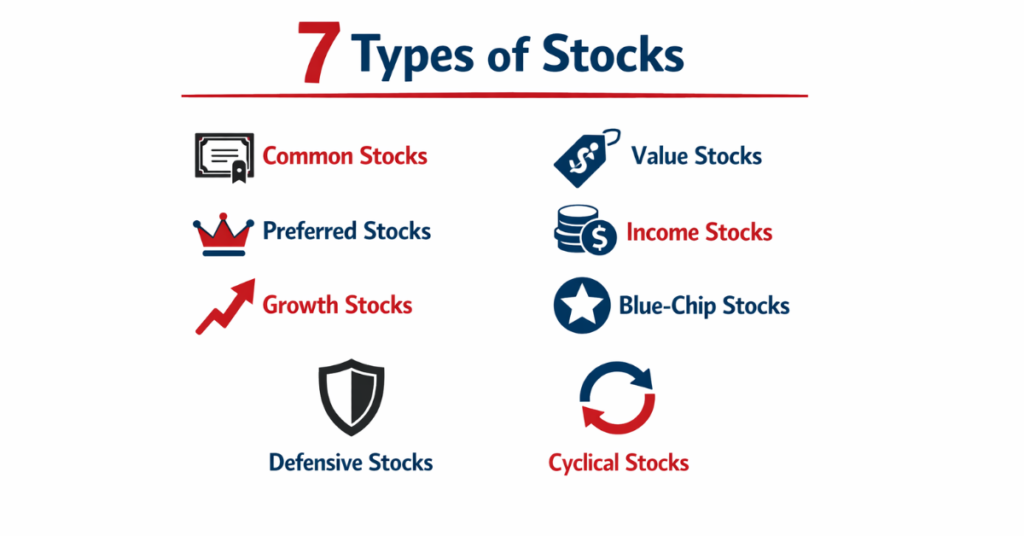
The 7 main types of stocks are common stocks, preferred stocks, growth stocks, value stocks, income stocks, blue-chip stocks, and defensive or cyclical stocks. Each type is classified based on ownership rights, risk level, return potential, and how it performs under different market conditions.
Key Takeaways
- There are 7 main types of stocks, each classified based on ownership rights, income potential, growth outlook, and market behavior.
- Common and preferred stocks define ownership structure, while growth, value, and income stocks reflect investment goals.
- Blue-chip, defensive, and cyclical stocks are influenced by company size and economic cycles.
- Understanding stock types helps investors choose options that align with risk tolerance, time horizon, and financial objectives.
Why Stocks Are Classified Into Different Types
Stocks are classified into different types to help investors understand how a company’s shares behave in terms of risk, returns, income generation, and market performance.
Not all stocks offer the same benefits, some focus on long-term growth, others provide steady income, while certain stocks are designed to perform better during specific economic conditions. This classification makes it easier for investors to align their choices with personal goals, whether they aim for capital appreciation, regular dividends, or portfolio stability.
When you really understand the different types of stocks, it becomes much easier to manage your risk. You can spread your investments more wisely, build a balanced portfolio, and feel more confident knowing it’s better prepared to handle the ups and downs of the market.
Type 1: Common Stocks
Common stocks represent ownership in a company and give shareholders the right to vote on corporate matters, such as electing the board of directors. These stocks offer the potential for capital appreciation as the company grows, making them popular among long-term investors.
However, common stockholders are last in line when it comes to dividend payments and asset claims if a company is liquidated. While they carry higher risk compared to other stock types, common stocks generally provide higher return potential over time, especially in expanding markets.
Type 2: Preferred Stocks
Preferred stocks are a type of stock that provides fixed dividends and typically has priority over common stocks when it comes to dividend payments and asset distribution during liquidation.
Preferred stockholders typically don’t have voting rights, which means they usually aren’t involved in major company decisions. While they may enjoy certain financial advantages, they have little influence over how the business is run.
These stocks are considered less risky than common stocks because of their stable dividend payouts, making them attractive to investors seeking steady income. Preferred stocks often appeal to income-focused investors or those who want a balance between capital preservation and consistent returns.
Type 3: Growth Stocks
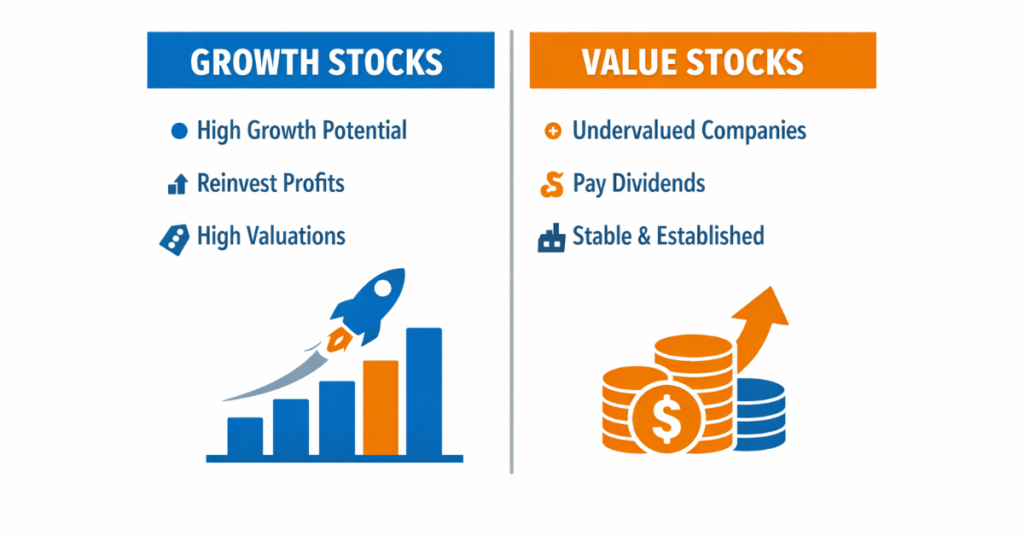
Growth stocks are shares of companies that are expected to grow faster than the overall market. These companies typically reinvest their earnings back into the business to fuel expansion rather than paying high dividends. Investors buy growth stocks hoping for capital appreciation over time, even though dividends may be minimal or absent.
Examples: Companies like Tesla, Amazon, and Netflix are classic growth stocks because they focus on innovation and market expansion rather than immediate profits.
Key Characteristics:
- High potential returns: Growth stocks can see significant price increases if the company performs well.
- Higher risk: Because profits are often reinvested, the stock price can be volatile, especially in market downturns.
- Best for long-term investors: Ideal for those who can withstand short-term fluctuations for potential long-term gains.
Type 4: Value Stocks
Value stocks are shares of companies that appear undervalued in the market compared to their fundamental worth, such as earnings, assets, or growth potential. Investors buy value stocks believing the market has underestimated the company, offering an opportunity to profit when the stock price eventually reflects its true value.
Examples: Companies like Johnson & Johnson, JPMorgan Chase, and Procter & Gamble are often considered value stocks because they have stable earnings, strong fundamentals, and lower price-to-earnings ratios compared to their peers.
Key Characteristics:
- Lower risk than growth stocks: These stocks tend to be more stable and less volatile.
- Dividend opportunities: Many value stocks pay regular dividends, providing steady income.
- Long-term potential: While the stock may not grow as quickly as a growth stock, careful selection can yield consistent returns over time.
Type 5: Income Stocks
Income stocks are shares of companies that are primarily purchased for their regular dividend payments rather than rapid price appreciation. These stocks are typically issued by well-established companies with stable earnings, making them a reliable source of passive income for investors.
Income stocks are favored by investors who want a predictable cash flow, such as retirees or those seeking consistent returns from their investments. They tend to be less volatile than growth stocks, providing stability in uncertain markets.
Type 6: Blue-Chip Stocks
Blue-chip stocks are shares of large, well-established, financially stable companies with a strong market reputation. These companies are leaders in their industries and are known for consistent performance, reliable dividends, and lower volatility compared to smaller companies.
Investors often choose blue-chip stocks for long-term stability and steady income, as these stocks tend to withstand economic downturns better than other stock types.
Blue-chip stocks are suitable for risk-averse investors, providing a solid foundation for a diversified portfolio while benefiting from a platform that supports global reach and multilingual access.
Type 7: Defensive and Cyclical Stocks
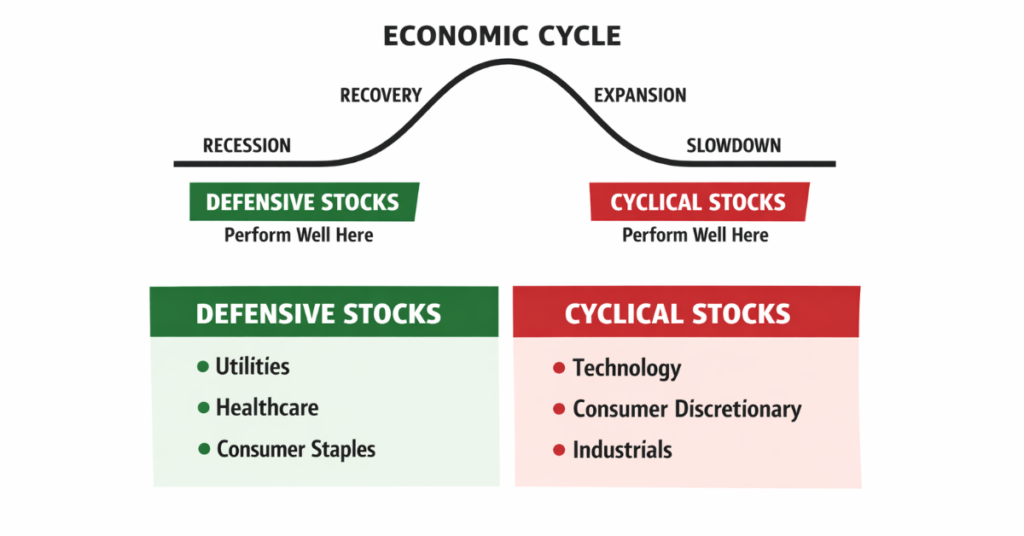
Defensive and cyclical stocks behave differently depending on the economic cycle.
- Defensive stocks belong to industries like utilities, healthcare, and consumer staples. They maintain stable performance even during economic downturns because demand for their products or services remains relatively constant.
- Cyclical stocks, on the other hand, belong to sectors such as luxury goods, travel, and automobiles. Their performance rises and falls with the economy doing well in expansions but struggling during recessions.
Comparison of the 7 Types of Stocks
To better understand the differences between the 7 types of stocks, the following table summarizes their risk, return potential, dividend behavior, and investor suitability:
| Stock Type | Risk Level | Return Potential | Dividend | Best For |
| Common Stocks | Medium-High | High | Variable | Long-term growth investors |
| Preferred Stocks | Low-Medium | Moderate | Fixed | Income-focused investors |
| Growth Stocks | High | Very High | Low/None | Long-term growth seekers |
| Value Stocks | Medium | Moderate | Often | Conservative growth investors |
| Income Stocks | Low-Medium | Low-Moderate | High | Passive income investors |
| Blue-Chip Stocks | Low | Moderate | Stable | Risk-averse & stable portfolio |
| Defensive & Cyclical Stocks | Varies | Varies | Varies | Portfolio balancing based on economic cycles |
Which Type of Stock Is Best for Beginners?
For beginners, the ideal stock type often depends on risk tolerance, investment goals, and time horizon. Generally, blue-chip and income stocks are recommended because they offer stability, steady dividends, and lower volatility, making them easier to manage for new investors.
Beginners may also consider value stocks to learn how to spot undervalued companies without taking excessive risk. While growth and cyclical stocks can provide higher returns, they come with greater price fluctuations, which may be challenging for those just starting.
7 Risks Involved Across Different Stock Types
Each stock type carries specific risks that investors must understand before investing:
- Common Stocks: Higher volatility and last claim on assets during liquidation.
- Preferred Stocks: Limited capital appreciation and dividend payments may be skipped in financial distress.
- Growth Stocks: Price can fluctuate significantly; dividends are minimal.
- Value Stocks: May remain undervalued for extended periods, limiting short-term gains.
- Income Stocks: Dividend cuts can occur if a company’s profits fall.
- Blue-Chip Stocks: Generally stable but can still lose value in major market downturns.
- Defensive & Cyclical Stocks: Cyclical stocks are highly sensitive to economic cycles; defensive stocks may underperform in booming markets.
How Investors Can Buy and Trade Different Stock Types
Investors can access various stock types through online brokerage accounts, which provide platforms for buying, selling, and managing investments. Stocks can be purchased via:
- Stock exchanges: Such as the NYSE, NASDAQ, or other global exchanges.
- Online brokerage platforms: Allowing individual investors to trade stocks from their computer or mobile device.
- Mutual funds or ETFs: These funds often include a mix of stock types, providing diversification without selecting individual stocks.
When trading, investors should consider:
- Market conditions: Growth and cyclical stocks are more sensitive to economic trends, while blue-chip and defensive stocks are more stable.
- Investment goals: Whether seeking capital appreciation, income, or portfolio stability.
- Risk management: Diversifying across stock types helps reduce potential losses.
5 Important Factors to Consider Before Choosing a Stock Type
Before investing, it’s important to evaluate several factors to ensure the stock aligns with your financial goals and risk tolerance:
- Risk Appetite: Determine how much volatility you can tolerate; growth and cyclical stocks carry higher risk, while blue-chip and income stocks are more stable.
- Investment Horizon: Long-term investors may benefit from growth or value stocks, while short-term investors may prefer stable, dividend-paying stocks.
- Income Needs: If regular income is a priority, focus on income, preferred, or blue-chip stocks with consistent dividends.
- Market Conditions: Economic cycles influence cyclical and defensive stocks differently; being aware helps in strategic selection.
- Diversification: Combining multiple stock types across sectors reduces overall portfolio risk and enhances stability.
Final Thoughts on Choosing the Right Stock Type Based on Your Goals
When investors take the time to understand the seven main types of stocks, it becomes much easier to build a portfolio that truly fits their goals, comfort with risk, and time horizon.
- Common and preferred stocks determine ownership structure and dividend priority.
- Growth and value stocks focus on building wealth over time.
- Income and blue-chip stocks offer stability and steady payouts, while defensive and cyclical stocks help investors respond to changing economic conditions.
Blending these stock types in a thoughtful way creates a better balance between risk and return. It strengthens diversification and leads to more confident, informed decisions. When each stock has a clear role, such as supporting growth, generating income, or adding stability, the portfolio becomes more resilient and better positioned for long-term success.
FAQ’s
The 7 main types of stocks are common stocks, preferred stocks, growth stocks, value stocks, income stocks, blue-chip stocks, and defensive or cyclical stocks. Each type differs in ownership rights, risk, return potential, and suitability for different investors.
Blue-chip and income stocks are generally safest for beginners due to their stability, lower volatility, and regular dividends, providing a solid foundation for learning and building a portfolio.
Growth stocks focus on capital appreciation and reinvest profits to expand the business, often paying little or no dividends. Value stocks are undervalued compared to their fundamentals and may provide dividends, offering more stability but moderate growth.
Defensive stocks perform consistently during economic downturns (e.g., utilities, healthcare).
Cyclical stocks fluctuate with the economy, doing well during expansions and underperforming in recessions (e.g., luxury goods, travel).
Yes, all stock types can be traded online through stock exchanges, online brokers, or ETFs. Platforms offering features like high leverage, low spreads, and fast withdrawals make trading more accessible and efficient.
Understanding stock types helps investors choose stocks aligned with their financial goals, risk tolerance, and investment horizon, enabling diversification and more informed decision-making for long-term wealth growth.