


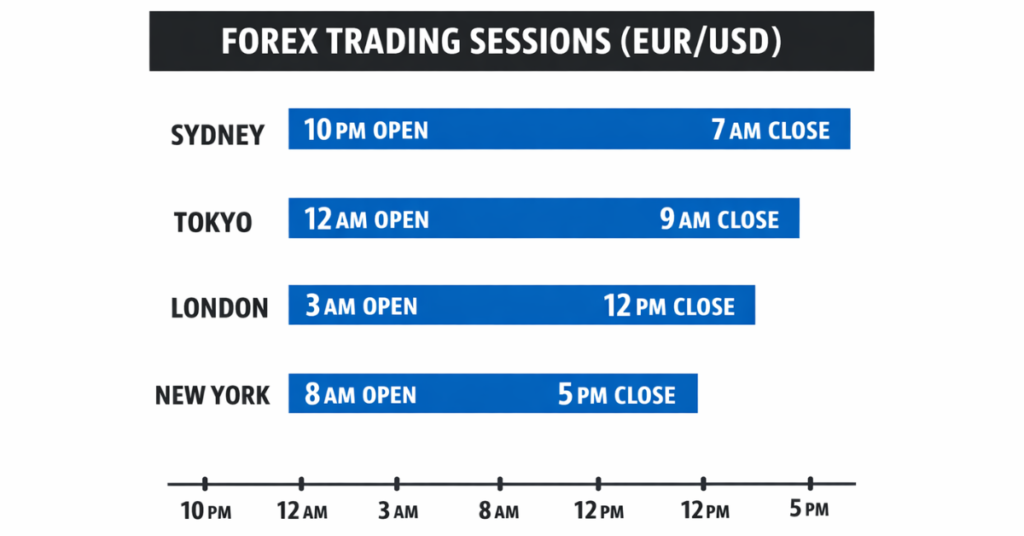
The EUR/USD market opens at 10:00 PM UTC on Sunday, when the global forex market begins the new trading week with the Sydney session. It then trades continuously for 24 hours a day, five days a week, until it closes at 10:00 PM UTC on Friday.
Key Takeaways
- EUR/USD trading typically resumes at 10:00 PM UTC on Sunday with the start of the Sydney session.
- It trades 24 hours a day, five days a week, and closes at 10:00 PM UTC on Friday.
- There is no daily opening or closing time like stock markets.
- The London and New York session overlap is typically the most active period for EUR/USD.
- Liquidity and volatility vary throughout the day depending on global trading sessions.
Does EUR/USD Have a Daily Opening Time?
No, EUR/USD doesn’t have a daily opening time like stock markets. Unlike exchanges such as the New York Stock Exchange that open and close at fixed hours, the forex market operates continuously for 24 hours a day from Monday to Friday.
Once the market opens at 10:00 PM UTC on Sunday, EUR/USD trades non-stop as global financial centers rotate through their business hours. When one major market closes, another opens, creating a seamless cycle of liquidity across time zones.
However, there is a daily rollover time, typically around 5:00 PM New York time (which equals 10:00 PM UTC during Eastern Standard Time and 9:00 PM UTC during Daylight Saving Time). This is when trading accounts reset for interest calculations and swap adjustments. Importantly, this isn’t a market close trading continues without interruption.
When you understand how the forex market is structured, it clears up a common misconception: EUR/USD doesn’t “open” fresh every morning. It’s already trading.
The pair stays active throughout the entire week. What really changes is the pace of the market, activity rises and falls depending on which major financial center, like London or New York, is open at the time.
What Time Does EUR/USD Open on Sunday?
The EUR/USD market opens at 10:00 PM UTC on Sunday, marking the start of the new forex trading week. This opening coincides with the beginning of the Sydney session, which is the first major financial center to resume trading after the weekend.
Although trading technically begins at 10:00 PM UTC, liquidity is usually lower during the first few hours because European and U.S. markets are still closed. As a result, price movements may be slower, and spreads can be slightly wider compared to peak trading hours.
It’s also important to understand that broker platform time may differ from UTC. Some brokers display server time based on GMT+2 or other time zones, but the global forex market itself always reopens at 10:00 PM UTC.
Knowing exactly when EUR/USD opens on Sunday helps traders prepare for potential volatility and plan their entries more strategically.
Full EUR/USD Trading Hours (GMT Reference Table)
The EUR/USD pair is traded across multiple global sessions, each with distinct opening and closing times. Understanding these sessions helps traders identify periods of high liquidity and volatility.
| Session | Opens (GMT/UTC) | Closes (GMT/UTC) | Impact on EUR/USD |
| Sydney | 10:00 PM | 7:00 AM | Low to moderate liquidity; early market movements |
| Tokyo | 12:00 AM | 9:00 AM | Moderate liquidity; Asian market influence |
| London | 8:00 AM | 5:00 PM | High liquidity; significant EUR/USD volatility |
| New York | 1:00 PM | 10:00 PM | High liquidity; overlap with London increases volatility |
EUR/USD Market Opening Time in Different Time Zones
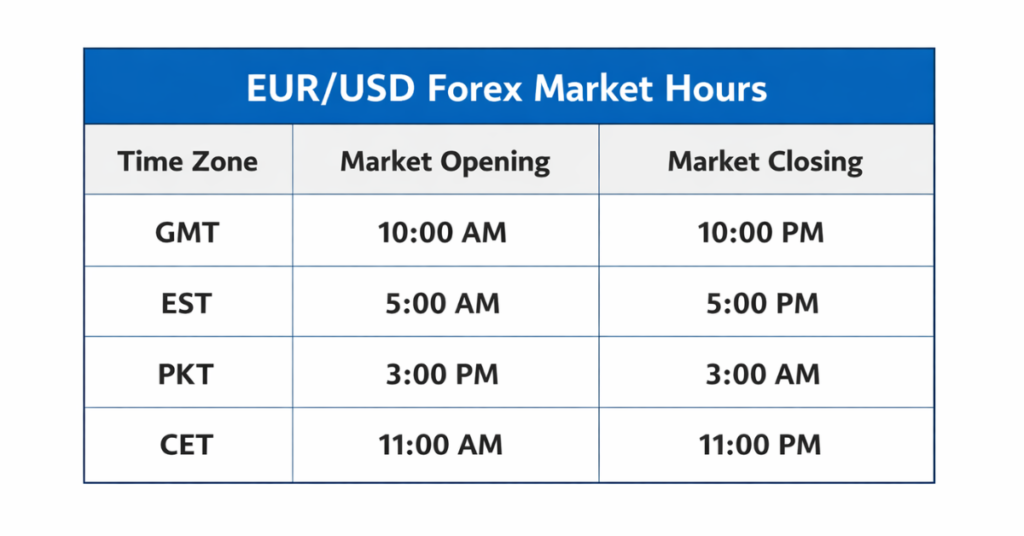
Traders around the world need to convert the EUR/USD opening time to their local time zones to plan trading strategies effectively. Here’s how the Sunday market open and daily session times translate globally:
| Time Zone | Sunday Open | Monday Close | Notes |
| GMT/UTC | 10:00 PM | 10:00 PM | Base reference for all sessions |
| EST (New York) | 5:00 PM | 5:00 PM | U.S. traders often start monitoring during the London session |
| PKT (Pakistan) | 3:00 AM (Monday) | 3:00 AM (Friday) | Helps South Asian traders adjust schedules |
| CET (Central Europe) | 11:00 PM | 11:00 PM | Major European market influence during London session |
Checking your local time helps you catch the market at its most active, especially during the London and New York session overlap.
Why Defcofx Is Built for Global Forex Traders
Traders opening accounts with Defcofx can take advantage of tight spreads starting from 0.3 pips, which is particularly beneficial during less active hours or early session trading. Additionally:
- High Leverage Options: Up to 1:2000 leverage allows flexibility even during low-liquidity sessions, giving traders the ability to manage smaller positions effectively.
- Fast Support & Withdrawals: For traders in any region, Defcofx ensures withdrawals are processed within 4 business hours, including weekends, supporting global accessibility.
Once you understand how time zones affect the market, trading starts to feel a lot less confusing. Instead of guessing when things might move, you can plan around active sessions and quieter periods.
Open a Live Trading AccountWhen Is EUR/USD Most Active?
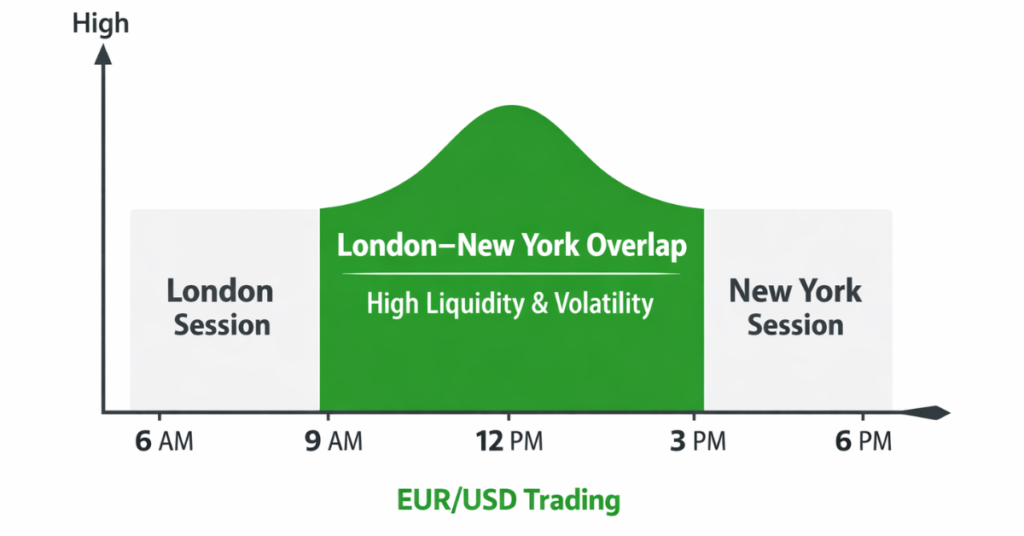
The EUR/USD pair experiences peak activity during specific global session overlaps, which is crucial for traders looking to capture larger price movements and higher liquidity.
1. London Session (8:00 AM – 5:00 PM GMT)
The London session is the most influential for EUR/USD because it includes major European banks and institutions. High trading volumes during this session often lead to tighter spreads, increased volatility, and clear price trends.
2. New York Session (1:00 PM – 10:00 PM GMT)
The New York session brings strong USD flows into the market. The London–New York overlap (1:00 PM – 5:00 PM GMT) is the most active window for EUR/USD, offering optimal opportunities for scalping and swing trading.
3. Early Asian & Sydney Sessions
While liquidity is lower, these sessions can present small but predictable price movements. Traders often use these hours to prepare for the London session or execute breakout strategies.
Tighter spreads reduce trading costs.
Higher liquidity enables smoother trade execution.
Opportunities for leveraged trading are more predictable.
By understanding when EUR/USD is most active and pairing it with the right trading tools and conditions, traders can significantly improve their performance and reduce unnecessary risks.
When Does EUR/USD Close?
The EUR/USD market closes for the week at 10:00 PM UTC on Friday, marking the end of five continuous trading days.
The forex market doesn’t close daily like the stock market. Instead, the action shifts across global time zones. Things tend to move fastest during the London–New York overlap and calm down during the Asian and Sydney hours.
Weekly Close vs. Daily Rollover
Although the market officially closes on Friday, brokers usually apply a daily rollover at around:
- 5:00 PM New York time
- 10:00 PM UTC
This rollover is used for interest calculations and swap adjustments. It is not a market closure, but rather a procedural reset that happens every trading day.
Trading During Close & Rollover Periods
The weekly close and rollover hours can bring lower liquidity and price fluctuations, so choosing the right broker becomes especially important.
Platforms like Defcofx offer features designed to support traders during these transition periods:
- High leverage options up to 1:2000, allowing flexible position management
- Tight spreads starting from 0.3 pips, helping reduce trading costs
- No commissions or swap fees
- Withdrawals processed within 4 business hours
- Global accessibility for traders in multiple time zones
These features help traders manage positions efficiently and control costs — even during lower-liquidity periods or session transitions.
Note: Trading conditions such as spreads, execution speed, and leverage vary by broker. Traders should review these factors carefully, especially during rollover or low-liquidity periods.
Open a Live Trading AccountImportant Trading Considerations Around Market Open
Trading at the EUR/USD Sunday open (10:00 PM UTC) requires extra attention because fewer traders are active during the early Sydney session. When fewer people are trading, price moves can be less stable, and spreads may be slightly wider than during busy hours like the London–New York overlap.
Weekend news can also cause something called a price gap, which means the market opens at a different price than where it closed on Friday.
Example: If EUR/USD closes at 1.0850 on Friday and important news happens over the weekend, the market might reopen at 1.0870 on Sunday. This 20-pip jump happens instantly, there are no trades in between. If you had a stop-loss set at 1.0840, your trade could close immediately when the market reopens.
How to Trade EUR/USD Efficiently During Active Hours
To trade EUR/USD effectively, you need to know when the market is most active and how price movements behave during those times.
Best Time to Trade: London–New York Overlap
The most active period is when the London and New York sessions overlap (1:00 PM – 5:00 PM GMT).
During these hours:
- Liquidity is highest
- Spreads are usually tighter
- Price movements are stronger
- Trends are clearer
This makes it ideal for both short-term traders (scalpers) and swing traders.
What About Quieter Sessions?
During the Sydney session (around 10:00 PM GMT Sunday open), fewer major banks are active. As a result:
- Price movements are usually smaller
- Trends develop more slowly
- Breakouts are less aggressive
These hours may suit traders who prefer slower, steadier moves.
Watch Economic News
Major economic announcements can cause sudden volatility. For example:
- European Central Bank (ECB) decisions affect EUR
- U.S. Non-Farm Payroll (NFP) reports affect USD
When these events are released, price can move sharply within minutes. Planning around news releases can help reduce unexpected risk.
Strategy Tip
- Scalping often works best during high-liquidity hours.
- Swing or trend trading may be more suitable during calmer periods.
Broker Considerations
Execution quality, spreads, leverage, and trading costs can impact results, especially during volatile periods. Traders should review broker conditions carefully to ensure they match their strategy and risk tolerance.
Final Thoughts on What Time Does EUR/USD Market Open?
The EUR/USD market resumes trading at 10:00 PM UTC on Sunday and closes at 10:00 PM UTC on Friday. While it operates 24 hours a day during the week, volatility varies depending on global trading sessions. The London–New York overlap typically provides the highest liquidity and tightest spreads, making it the most active trading period.
FAQs
The EUR/USD market opens at 10:00 PM UTC on Sunday, coinciding with the Sydney session. Liquidity is initially low but gradually increases as Asian, European, and then U.S. markets open.
Yes, EUR/USD trades continuously for 24 hours a day from Monday to Friday, moving across global sessions. There is no daily close; only the weekly close occurs at 10:00 PM UTC on Friday.
The best time is during the London–New York session overlap (1:00 PM – 5:00 PM GMT), when liquidity is highest and spreads are tightest. Early Asian and Sydney sessions can also be used for low-volatility strategies.
In Eastern Standard Time, the EUR/USD market opens at 5:00 PM EST on Sunday and closes at 5:00 PM EST on Friday.
No. The EUR/USD market does not have daily closing hours like stock exchanges. Trading continues across different global sessions, with activity fluctuating depending on which financial center is open.
Discover More Forex Guides With Defcofx
- Can I Trade With $1 on MetaTrader 5?
- What Does It Mean to Short the Market?
- What is an Expert Advisor | Automated Trading Guide
- Pairs Trading – Market-Neutral Stock & Forex Guide
- How to Read Stock Candlesticks?
- How Many Countries Use Dollars?
- Can I Trade Gold With $100?
- What Country has the Best Exchange rate for USD?