


The 10000 hour rule in forex trading refers to the idea that mastering trading skills may require around 10,000 hours of deliberate practice and market experience. The concept suggests that consistent learning, analyzing charts, managing risk, and refining strategies over time helps traders gradually develop the expertise needed to trade the forex market effectively.
Key Takeaways
- The 10000 hour rule suggests that mastering a complex skill such as forex trading requires long-term deliberate practice and real market experience rather than quick shortcuts.
- In trading, the rule emphasizes consistent learning, chart analysis, and strategy refinement over time.
- Successful traders typically progress through multiple stages of learning, from understanding forex basics to developing disciplined risk management.
- The concept highlights that quality practice matters more than simply accumulating hours in front of the charts.
- Modern trading tools, educational resources, and structured learning approaches can significantly accelerate the forex trading learning curve.
Understanding the 10000 Hour Rule
What the 10000 Hour Rule Means
The 10000 hour rule suggests that achieving mastery in any complex skill requires around 10,000 hours of focused and deliberate practice. In forex trading, this translates to consistent learning, chart analysis, and real market experience over time.
Key points about the rule in trading:
- Mastery comes from structured practice and experience, not just “time spent” in front of charts.
- Forex trading requires multiple skills:
- Interpreting price movements and trends
- Understanding market psychology
- Developing risk management techniques
- Refining trading strategies
- Beginners gradually progress from learning basic concepts to analyzing advanced market patterns.
Example progression:
- Early stage: Learning currency pairs, spreads, leverage
- Intermediate stage: Analyzing charts, testing strategies
- Advanced stage: Controlling emotions, making consistent trading decisions
Origin of the 10000 Hour Rule
- Popularized by the book Outliers written by Malcolm Gladwell.
- Based on research by psychologist Anders Ericsson, studying how experts develop high-level skills.
- Found that top performers in fields like music, chess, and sports often spend thousands of hours in deliberate practice before reaching mastery.
- The rule emphasizes long-term dedication and structured practice, not a strict formula.
Why the Rule Became Popular in Skill Development
The 10000 hour rule gained popularity because it clearly demonstrates that expertise requires time and effort.
In forex trading:
- Market conditions are influenced by economic data, geopolitical events, and interest rates, requiring ongoing observation.
- Traders improve by consistently studying charts and reviewing trades.
- Experience helps traders identify patterns, manage risks, and develop discipline.
Does the 10000 Hour Rule Apply to Forex Trading?
While the 10000 hour rule originated in areas like music and sports, its principles can be applied to forex trading because mastering trading requires both skill and experience. Traders develop expertise through repeated practice, analysis, and exposure to real market conditions over time.
5 Key ways the rule applies to forex:
- Experience Builds Skill: Regular trading and chart analysis help traders recognize patterns, market behavior, and price reactions.
- Deliberate Practice Matters: Simply placing trades isn’t enough; traders need to analyze mistakes, test strategies, and refine decisions.
- Screen Time is Not Enough: Spending hours on charts matters only if the time is focused and structured.
- Stages of Learning: Traders move through beginner, intermediate, and advanced stages, gradually improving decision-making and risk management.
Understanding that experience combined with intentional practice is key can help traders avoid the misconception that simply logging hours guarantees success. Quality of learning and exposure to real market scenarios is far more important than just accumulating trading hours.
How Long Does It Actually Take to Learn Forex Trading?
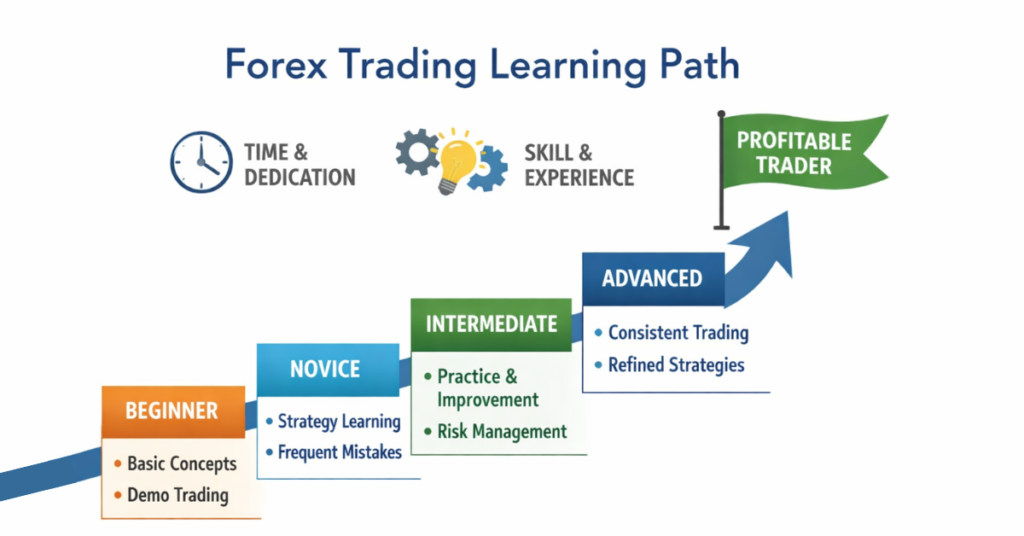
Learning forex trading isn’t about reaching a fixed number of hours; it’s about progressing through stages of skill development. The time required varies based on a trader’s dedication, practice quality, and ability to learn from mistakes. Most traders follow a general path from beginner to advanced levels:
Beginner Stage: Learning the Fundamentals
At this stage, traders focus on understanding the basics of forex trading:
- Learning what currency pairs, pips, and spreads are
- Understanding leverage, margin, and trading platforms
- Familiarizing themselves with chart types and basic indicators
This stage can take several months of consistent study and practice, often using demo accounts to trade without risking real money.
Intermediate Stage: Developing Trading Strategies
Once the basics are understood, traders move on to:
- Testing and refining strategies using historical data
- Learning how to interpret market news and economic indicators
- Practicing risk management and position sizing
At this level, deliberate practice is crucial, as mistakes provide valuable learning opportunities. Traders start to identify patterns in the market and gain confidence in decision-making.
Choosing a broker with favorable trading conditions can accelerate learning. Platforms like Defcofx offer up to 1:2000 leverage, low spreads starting from 0.3 pips, and no commissions or swap fees, giving new traders the flexibility to experiment with strategies while managing costs. Fast withdrawals and global access further support consistent practice.
Open a Live Trading AccountAdvanced Stage: Achieving Consistency and Profitability
In the advanced stage, the focus shifts to:
- Maintaining discipline under market volatility
- Optimizing strategies for different market conditions
- Using advanced tools like automated trading systems or algorithmic strategies
Traders at this level are gradually moving toward consistent profitability, demonstrating the benefits of long-term experience combined with deliberate practice.
The Forex Trading Learning Curve
Mastering forex trading involves more than just time spent; it requires developing key skills, trading psychology, and risk management techniques. The learning curve is often steep, but understanding it helps traders progress efficiently.
4 Key Skills Traders Must Develop
Traders need to build multiple skills simultaneously to succeed:
- Market Analysis: Understanding price movements, trends, and technical indicators
- Strategy Development: Designing and testing strategies for different market conditions
- Risk Management: Learning position sizing, stop-loss placement, and controlling potential losses
- Decision-Making: Making informed choices quickly under changing market conditions
By focusing on these 4 skills, traders ensure that every trading session contributes to meaningful progress rather than just accumulating hours.
Trading Psychology and Emotional Control
Emotional discipline is a critical part of the learning curve:
- Controlling fear and greed to avoid impulsive decisions
- Handling losses and drawdowns without deviating from the plan
- Developing patience and consistency for long-term profitability
Risk Management and Capital Protection
Proper risk management allows traders to stay in the game longer and learn more efficiently:
- Using stop-loss and take-profit orders
- Allocating only a small percentage of capital per trade
- Maintaining a trading journal to track performance and mistakes
Brokers that provide low spreads starting from 0.3 pips, no commissions, and fast support like Defcofx can help traders focus on learning without being hindered by high trading costs or delayed withdrawals.
Open a Live Trading AccountIs 10,000 Hours Really Necessary to Become a Profitable Trader?
The 10,000 hour rule provides a useful framework, but it isn’t a strict requirement for becoming a profitable forex trader. What truly matters is the quality of practice, consistent learning, and real market exposure, rather than simply counting hours.
Many traders can accelerate their learning by focusing on deliberate practice, which involves actively analyzing trades, refining strategies, and learning from mistakes. Simply spending time on charts without reflection or strategy development does little to improve skill. In other words, 10,000 hours of unfocused practice may be less effective than 5,000 hours of structured, intentional learning.
3 Key points to consider:
- Quality over quantity: Focused learning with a clear plan accelerates skill acquisition.
- Practical experience: Engaging with live markets, testing strategies, and analyzing outcomes teaches lessons faster than theory alone.
- Adaptive learning: Monitoring and adjusting strategies based on performance leads to quicker mastery.
In conclusion, the 10,000 hour rule serves as a guideline highlighting the importance of dedication and structured practice, but consistent, deliberate effort is what ultimately determines a trader’s profitability.
How Traders Can Apply the 10000 Hour Rule in Forex Trading
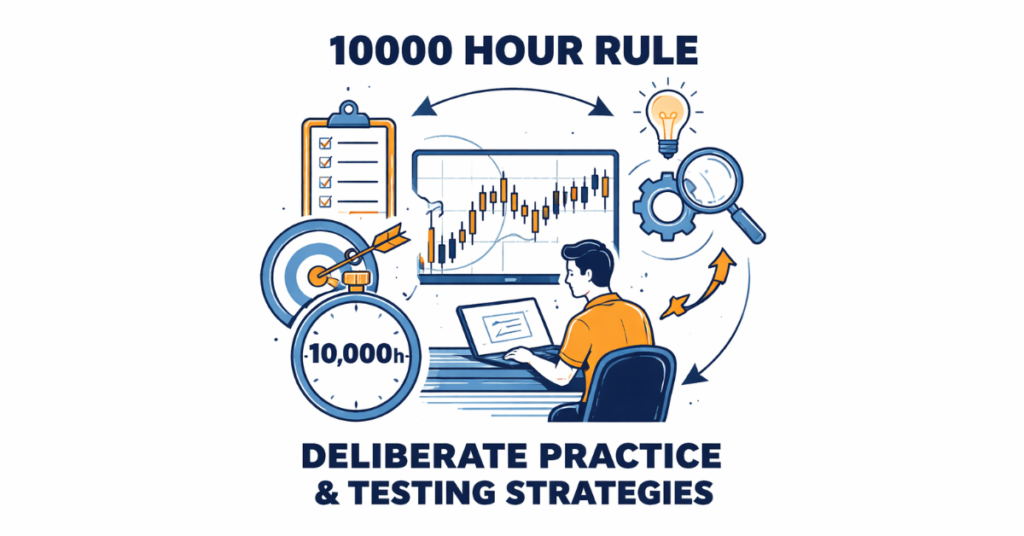
Applying the 10000 hour rule in forex trading is less about counting hours and more about structuring practice to maximize learning. Traders can make every session productive by combining market observation, strategy testing, and performance review.
A practical approach includes the following steps:
- Practicing with Demo Accounts: Beginners should use demo accounts to apply strategies in a risk-free environment. This allows them to test trade setups, understand platform tools, and develop confidence without financial pressure.
- Testing and Refining Strategies: Traders should continuously experiment with different trading strategies, track outcomes, and refine approaches based on results. This deliberate practice accelerates skill development compared to random trading.
- Reviewing Past Trades: Keeping a trading journal helps traders analyze mistakes, identify successful patterns, and make data-driven decisions in future trades. Reflection ensures practice is structured and meaningful.
FAQs
It’s a guideline, not a strict rule. Success in forex comes from consistent, deliberate practice and real market exposure, not just counting hours. Structured learning and reviewing trades accelerate skill development.
It varies usually months to years, depending on dedication and practice quality. Traders who focus on structured learning, strategy testing, and journaling progress faster than those trading randomly.
Yes. Beginners can speed up learning by:
Using demo accounts
Testing and refining strategies
Learning from past trades
Platforms like Defcofx, offering high leverage up to 1:2000, low spreads, and fast withdrawals, help beginners practice safely and efficiently.
Traders need:
Market analysis (technical and fundamental)
Strategy development and testing
Risk management
Trading psychology
Brokers with low costs and fast support, like Defcofx, provide an environment to develop these skills effectively.
Yes. Focusing on structured, reflective practice reviewing trades and refining strategies helps traders improve faster. Combined with reliable platforms like Defcofx, deliberate practice accelerates skill development and profitability.
Final Thoughts on Should Forex Traders Follow the 10000 Hour Rule?
The 10000 hour rule serves as a guideline rather than a strict requirement in forex trading. While mastery does require time, experience, and consistent effort, the quality of practice and deliberate learning are far more important than simply accumulating hours. Traders who focus on structured study, testing strategies, analyzing outcomes, and controlling emotions are likely to progress faster than those who trade aimlessly.
Choosing the right broker can also make a meaningful difference in skill development. Platforms like Defcofx provide traders with high leverage options, low trading costs, fast withdrawals, and global accessibility, creating an environment where deliberate practice is efficient and consistent.
Ultimately, while 10,000 hours highlights the importance of dedication and consistent effort, success in forex trading is achieved through focused learning, disciplined practice, and strategic use of resources rather than the number of hours alone.
Open a Live Trading AccountDiscover More Forex Guides With Defcofx
- What Does It Mean to Short the Market?
- What is an Expert Advisor | Automated Trading Guide
- Pairs Trading – Market-Neutral Stock & Forex Guide
- How to Read Stock Candlesticks?
- How Many Countries Use Dollars?
- What Is Insider Trading?
- How Much Can I Earn From Trading per Month?
- When Should I Sell my Stock?
- Forex vs Stocks vs Crypto – Full Comparison Guide