


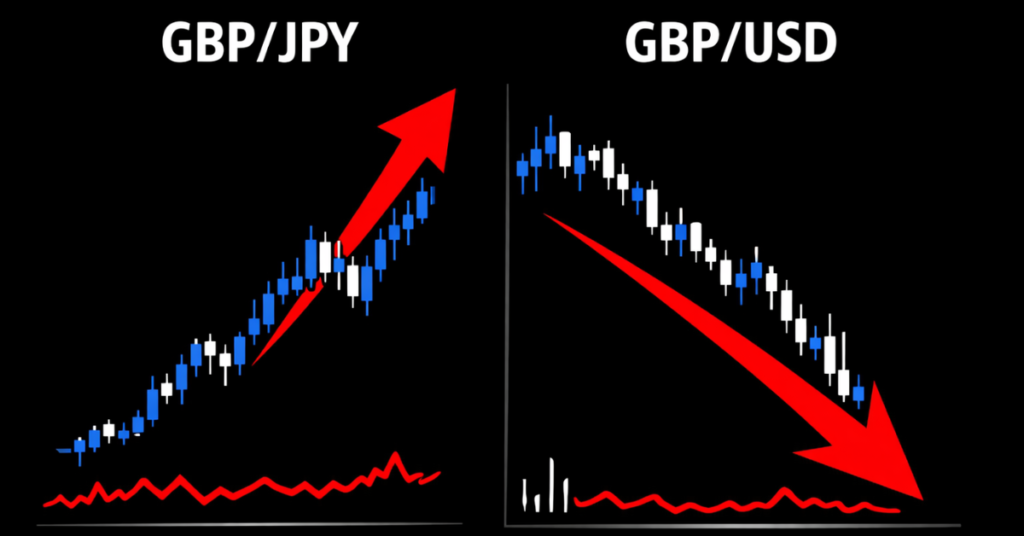
The forex pairs that move the most in a day are GBP/JPY, GBP/AUD, EUR/JPY, GBP/USD, AUD/JPY, and USD/TRY. These pairs show the highest daily price ranges due to economic contrast between the currencies involved, sensitivity to global risk sentiment, and lower relative liquidity compared to major pairs like EUR/USD.
Key Takeaways
- GBP/JPY consistently moves the most per day among accessible forex pairs, averaging 150–200 pips daily under normal market conditions.
- Cross pairs involving GBP or JPY dominate the high-movement list because they combine risk-sensitive and safe-haven currencies.
- The largest daily movements occur during the London session open and the London–New York overlap (1:00 PM to 5:00 PM GMT).
- Economic news releases including interest rate decisions, CPI, and NFP produce the sharpest intraday spikes on these pairs.
- Higher daily movement means more opportunity per session, but it also means losses accumulate faster without proper risk management.
What Is Forex Volatility and How Is It Measured?
Forex volatility measures how much a currency pair’s price changes within a specific time period. In practical terms, it tells you how far a pair typically moves in a day, measured in pips. The higher the average daily pip range, the more volatile the pair.
Volatility is most commonly measured using the Average True Range (ATR) indicator, which calculates the average price range over a defined number of sessions. A higher ATR value means the pair moves more per day. It can also be assessed through Bollinger Bands, where widening bands signal increasing volatility.
Simple example: EUR/USD with an ATR of 60 pips moves an average of 60 pips per day. GBP/JPY with an ATR of 160 pips moves more than twice as far in the same period. A scalper or day trader gets more opportunity on GBP/JPY, but also more risk per trade.
Why Some Forex Pairs Move More Than Others
Each currency pair has a different daily movement range because of specific structural reasons tied to the currencies involved. Understanding these reasons helps you predict which pairs will be most active in a given market environment.
- Liquidity differences: EUR/USD is the most traded pair globally with over $1 trillion in daily volume. This depth absorbs large orders without dramatic price impact. GBP/JPY has far lower daily volume, so the same order size moves the price more. Lower liquidity equals sharper price movements.
- Economic contrast between two currencies: When one currency belongs to a strong, stable economy and the other to a weaker or more uncertain one, the pair moves more aggressively. Example: GBP/JPY pairs the UK economy (sensitive to inflation and political changes) against the Japanese Yen (a safe-haven currency that moves on global fear). These contrasting reactions amplify the pair’s daily range.
- Central bank policy divergence: When the Bank of England is hiking rates while the Bank of Japan holds at near-zero, the interest rate differential creates strong directional pressure on GBP/JPY, producing sustained and large moves.
- News sensitivity: Some pairs are directly exposed to high-impact economic releases. GBP/USD moves sharply on UK CPI, UK employment, and Bank of England decisions. USD/TRY reacts violently to Turkish inflation data and political announcements. The more a pair’s currencies are exposed to scheduled high-impact events, the more it moves.
Forex Pairs That Move the Most in a Day
Below are the pairs that consistently show the highest average daily pip ranges, with approximate movement figures and the specific reasons behind their activity.
| Pair | Avg Daily Range | Primary Driver | Best For |
| GBP/JPY | ~150–200 pips | Risk sentiment, UK and BOJ policy | Day trading, scalping, breakouts |
| GBP/AUD | ~130–180 pips | UK vs Australian economic contrast, commodity sensitivity | Breakout and trend trading |
| EUR/JPY | ~80–120 pips | ECB policy, global risk sentiment | Range and breakout strategies |
| GBP/USD | ~80–120 pips | UK economic data, Fed decisions | News trading, trend following |
| AUD/JPY | ~60–100 pips | Risk-on/risk-off, Chinese data, commodities | Sentiment-based trading |
| NZD/JPY | ~50–90 pips | Regional risk appetite, RBNZ policy | Range trading in Asian session |
| USD/TRY | ~300–600 pips | Turkish inflation, political risk | Experienced traders only |
GBP/JPY: The Most Active Pair Explained
GBP/JPY moves more than most pairs because it combines two currencies that respond to completely different forces and often move in opposite directions simultaneously. When global risk appetite falls (risk-off), investors sell GBP (weakens) and buy JPY (safe-haven strengthens). When risk appetite rises (risk-on), GBP rises and JPY weakens. Both forces activate together, doubling the directional impact.
Real example: During the March 2023 US banking crisis, GBP/JPY dropped over 400 pips in two sessions as investors moved aggressively into JPY safe-haven assets while simultaneously exiting risk-sensitive GBP positions. A trader holding a buy position without a stop-loss would have faced severe losses before having time to respond manually.
USD/TRY: Extreme Volatility Warning
USD/TRY produces the largest raw pip moves of any commonly traded pair, but this comes with substantially wider spreads, lower liquidity, and far less predictable technical behavior. Turkey has experienced annual inflation exceeding 60–70% in recent years alongside unconventional central bank policy. While this creates huge daily ranges, the practical tradability is significantly more difficult than cross pairs like GBP/JPY. This pair is not recommended for traders without extensive experience in emerging market dynamics.
Volatility by Trading Session
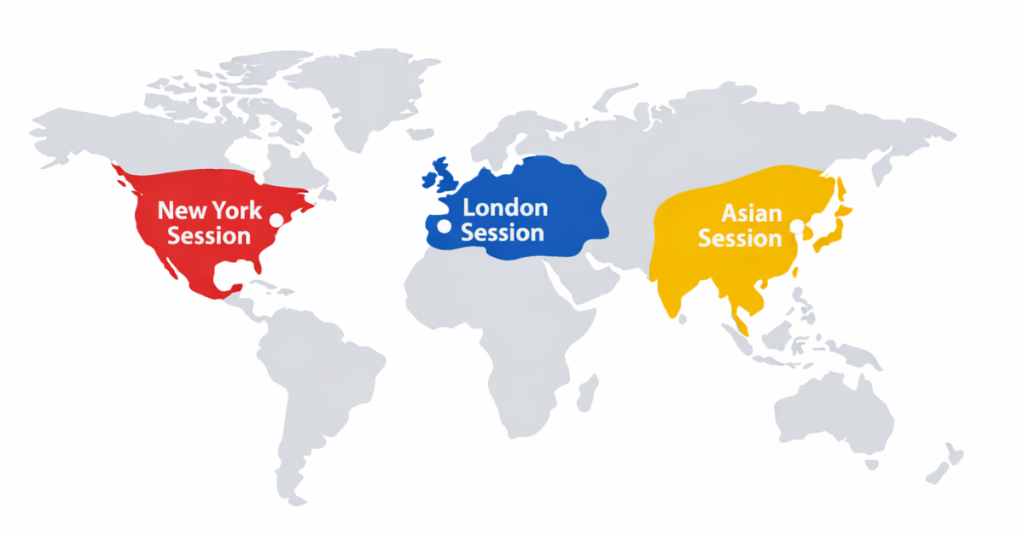
The same pair can behave very differently depending on which trading session is active. Knowing when your target pair is most active is as important as knowing which pair to trade.
| Session | Hours (GMT) | Most Active Pairs | Typical Behavior |
| Asian (Tokyo) | 12:00 AM – 9:00 AM | USD/JPY, AUD/JPY, NZD/JPY, AUD/USD | Range-bound, slow, lower volatility |
| London | 8:00 AM – 5:00 PM | GBP/JPY, GBP/USD, EUR/JPY, EUR/USD | Strong trends, breakouts, high volume |
| New York | 1:00 PM – 10:00 PM | EUR/USD, GBP/USD, USD/JPY, USD/CAD | News-driven spikes, fast momentum |
| London–NY Overlap | 1:00 PM – 5:00 PM | All major and cross pairs | Peak volatility, highest daily ranges |
Example: GBP/JPY may move only 30–40 pips during the Asian session when both London and New York are closed. The same pair can move 150 pips within three hours after the London open at 8:00 AM GMT when institutional GBP order flow enters the market. Timing your trades to the right session is essential for capturing the pair’s full movement potential.
Best Time to Trade High Volatility Pairs
Timing matters as much as pair selection. Trading GBP/JPY during the Asian session produces a fraction of the opportunity available during London hours. Here are the three windows that consistently produce the most movement.
- London–New York Overlap (1:00 PM to 5:00 PM GMT): The single highest-volume and highest-volatility window of the week. Both European and US institutions are simultaneously active. Most major intraday trends form and extend during this four-hour window. Best for GBP, EUR, and USD pairs.
- London Session Open (8:00 AM GMT): Sharp moves occur as European institutional order flow enters. GBP pairs in particular see their largest single-hour movements of the day during the first 60–90 minutes of the London session. The London breakout of the Asian session range is one of the most widely used setups on GBP/JPY specifically.
- Major Economic News Releases: Regardless of session, high-impact events produce the sharpest intraday spikes. US NFP, Bank of England rate decisions, UK CPI, and FOMC statements all consistently produce 100–200+ pip moves on affected pairs within minutes of release. Spreads widen during these windows, which must be factored into entry and stop-loss planning.
Indicators That Measure Forex Pair Movement
Three indicators are most commonly used to measure and anticipate daily movement levels in forex pairs.
Average True Range (ATR). The most practical tool for daily movement analysis. ATR calculates the average pip range over a set number of sessions. Example: if GBP/JPY shows an ATR of 150 on the daily chart, that tells you the pair typically moves 150 pips per day. Use ATR to set realistic profit targets and proportional stop-losses that match the pair’s actual range rather than applying fixed pip values that may be too tight or too wide for that instrument.
Bollinger Bands. Bollinger Bands expand when volatility is rising and contract when it is falling. When bands are unusually tight (low volatility, consolidation), a breakout typically follows. This is particularly observable on GBP/JPY during the Asian session, where a tight range often breaks sharply at the London open. Wide bands following a major news event signal that volatility is already elevated and the initial move may be running out of momentum.
Daily high-low range. The simplest approach: check the distance between the current day’s high and low on the daily chart. Compare it to the ATR. If the pair has already moved 90% of its average daily range, the remaining movement potential for that session is limited. If it has only moved 20% of its average range, significant movement opportunity remains.
Best Strategies for High-Movement Forex Pairs
High daily movement pairs require strategies specifically designed to capture directional momentum or defined range behavior. Applying a strategy built for low-volatility conditions to GBP/JPY produces consistently poor results.
- Breakout Trading: Enter when price breaks through a defined support or resistance level with volume confirmation. On GBP/JPY, the Asian session range high and low are commonly used as breakout triggers at the London open. When price breaks above the Asian high at 8:00 AM GMT, it often signals a strong London session uptrend.
- Scalping: Multiple short entries targeting 15–30 pips within the session. Works best on GBP/JPY and EUR/JPY during London hours when consistent institutional flow creates short-term momentum runs. Requires a broker with tight spreads because spread costs across many trades compound into meaningful performance impact.
- News Trading: Position before or confirm entry after major economic releases that directly affect the pair. Example: a stronger-than-expected UK CPI print supports a GBP/USD buy on the assumption that the Bank of England will need to maintain or raise rates. The spike following the data release often provides the entry signal. Requires strict stop-loss placement due to potential whipsaws.
- Trend Following: Use moving averages or price structure to identify the session’s directional bias and trade in that direction only. Example: if GBP/JPY is forming a series of higher highs and higher lows on the H1 chart during the London session, only take long setups at pullback support levels. Trend following on volatile pairs requires accepting wider stops proportional to the pair’s ATR.
- Risk management on every trade: This applies to all four strategies above. Use a stop-loss on every trade. Size positions so the stop-loss hit equals 1–2% of account capital maximum.
Risks of Trading High-Movement Pairs
- Sudden price spikes: GBP/JPY can move 100+ pips within minutes of a major news event. Without a stop-loss already placed, the loss is realized before manual intervention is possible. Example: the August 2024 BOJ rate hike announcement caused GBP/JPY to drop over 500 pips in a single session.
- Slippage: During high-impact events, market orders fill at different prices than visible at entry. A buy order placed at 190.00 on GBP/JPY might fill at 190.30 if the market gaps through that level following a news release. Using limit orders where possible and avoiding entries immediately before scheduled news reduces this exposure.
- Stop-loss whipsawing: Volatile pairs regularly spike through common stop-loss zones before reversing. A stop placed 20 pips below entry on a pair with an ATR of 160 pips is almost certain to be hit by normal market noise before the trade direction resolves. Stop placement must be proportional to ATR, not to arbitrary pip values.
- Emotional pressure: Watching GBP/JPY move 50 pips against a position in ten minutes is a very different experience from watching EUR/USD move 10 pips. Fast markets amplify emotional reactions. Traders who have not built discipline on lower-volatility pairs typically make their worst decisions on high-movement pairs.
How to Choose the Right Pair for Your Level
Not every trader should trade GBP/JPY immediately. The right pair for you depends on your current experience level and how your strategy performs in different volatility environments.
- Beginners: Start with EUR/USD or USD/JPY. EUR/USD moves 50–80 pips daily, reacts to analyzable economic events, has the tightest spreads of any pair, and has the deepest available educational and analytical resources. Build risk management habits and strategy consistency on these pairs before adding volatility.
- Intermediate traders: GBP/USD, EUR/JPY, and AUD/JPY offer higher daily ranges (80–120 pips) while still maintaining reasonable liquidity and technical reliability. These are appropriate once consistent performance on major pairs is demonstrated on a demo account.
- Experienced traders: GBP/JPY and GBP/AUD reward traders who have strong risk management discipline, understand session timing, and can read breakout setups accurately. These pairs only become productive once the behavioral and analytical foundation is solid.
Trade High-Movement Pairs with Defcofx
For traders targeting high daily movement pairs, broker execution quality and cost structure determine whether a strategy produces net profit or net loss. On a pair like GBP/JPY where scalping targets may be 20–30 pips, a 3-pip spread represents 10–15% of the trade’s value consumed before the trade closes. Delayed execution on a breakout entry means missing the level entirely and entering at a worse price. Defcofx is a forex and CFD broker registered in Saint Lucia, operating on MetaTrader 5 with full access to GBP/JPY, EUR/JPY, GBP/AUD, GBP/USD, AUD/JPY, NZD/JPY, USD/TRY, and every other major, minor, and exotic pair alongside commodities and indices.
- Spreads from 0.3 pips with zero commissions and no swap fees, keeping costs minimal on every trade across all high-movement pairs
- Leverage up to 1:2000, giving traders complete flexibility to calibrate position sizing proportionally to each pair’s average daily range
- 40% welcome bonus on first deposits of $1,000 or more, available to all qualifying clients globally
- Withdrawals processed within 4 business hours including weekends, so capital remains accessible regardless of market conditions
- MT5 platform with ATR, Bollinger Bands, and all volatility indicators built in, plus fast order execution for breakout and scalp entries on fast-moving pairs
- Global access with multilingual support, welcoming traders from all countries
New to volatile pairs? Start with a free demo account on Defcofx to practice GBP/JPY, EUR/JPY, and GBP/USD during London session hours in real market conditions before committing real capital. Opening a live account takes only a few minutes when you are ready.
Open a Live Trading AccountFinal Thoughts: Forex Pairs That Move the Most in a Day
GBP/JPY moves the most per day among accessible forex pairs, followed by GBP/AUD, EUR/JPY, and GBP/USD for cross and major pairs, and USD/TRY for exotic pairs with the caveat of significantly wider spreads and less reliable technical behavior.
The key insight is that daily movement is not just about which pair you choose. It is about when you trade it. GBP/JPY during the Asian session produces very different results from GBP/JPY during the London–New York overlap. Matching your pair selection to the active session is what converts theoretical daily range into actual tradeable opportunity.
Use ATR to verify current movement levels before setting targets and stops. Apply a defined strategy matched to the pair’s character (breakout, scalping, or trend following). Size positions to keep stop-loss risk at 1–2% of account capital regardless of how large the daily range looks. If you are ready to apply these principles in live conditions, Defcofx gives you access to all high-movement pairs with session-aligned market access and competitive conditions.
Open a Live Trading AccountFAQ
GBP/JPY consistently moves the most per day among cross pairs, averaging 150–200 pips under normal market conditions. Among exotic pairs, USD/TRY moves more in raw pip terms (300–600 pips daily) but carries significantly wider spreads and less reliable technical behavior. For most retail traders, GBP/JPY is the highest-movement practical choice.
Among the four traditional major pairs (EUR/USD, GBP/USD, USD/JPY, USD/CHF), GBP/USD is the most volatile, typically averaging 80–120 pips daily. It reacts sharply to UK inflation data, Bank of England policy decisions, and US economic releases. GBP/JPY is technically a cross pair rather than a major, but it is the highest-movement pair accessible to retail traders.
No. Beginners should start with more stable major pairs like EUR/USD or USD/JPY. High-movement pairs like GBP/JPY move too fast for traders who are still developing analytical skills and risk management habits. A 150-pip stop-loss on GBP/JPY that matches the pair’s normal range represents a much larger dollar loss than the same stop on EUR/USD. Build consistency on major pairs first, then progress to higher-movement instruments.
The London–New York overlap (1:00 PM to 5:00 PM GMT) produces the most movement of any session window. Combined institutional participation from European and US markets creates the highest daily volume, strongest breakouts, and the most sustained intraday trends. The London session open at 8:00 AM GMT is the second most active window, particularly for GBP and EUR pairs.
Approximate average daily ranges under normal market conditions: EUR/USD and USD/JPY move 50–80 pips. GBP/USD and EUR/JPY move 80–120 pips. GBP/JPY and GBP/AUD move 130–200 pips. USD/TRY moves 300–600 pips. These figures expand significantly during major economic news events and contract during low-volume holiday periods.
Check the ATR indicator on the daily chart for your pair. If GBP/JPY shows an ATR of 150 pips, placing a stop-loss 30 pips below your entry is almost certain to be hit by normal intraday noise. A stop proportional to ATR would be at least 50–80 pips, ensuring the trade has room to breathe within the pair’s natural daily range. Then size your position so that this stop-loss distance equals 1–2% of your account capital maximum.