


The most common forex trading mistakes include poor risk management, emotional decision-making, overtrading, misusing leverage, and trading without a plan. These mistakes are not caused by the market. They come from how traders behave and make decisions. Regulated broker data shows that between 70% and 80% of retail forex traders lose money, and the primary causes are the same avoidable errors repeated consistently.
Key Takeaways
- Between 70% and 80% of retail forex traders lose money, primarily due to avoidable behavioral mistakes rather than market unpredictability.
- Trading without a plan is the single most common structural mistake. It turns every trade into a guessing exercise rather than an analytical decision.
- Emotional trading driven by fear and greed leads to inconsistent decisions that override logical strategy.
- Overtrading and chasing losses through revenge trading consistently drain capital faster than any single bad trade.
- Misusing leverage is the leading mechanical cause of large, rapid account losses. High leverage without proper position sizing eliminates the protective value of stop-losses.
- Choosing a reliable broker with transparent conditions removes unnecessary operational friction and helps traders focus entirely on strategy execution.
Why Do Most Forex Traders Lose Money?
The forex market does not cause trader losses. Traders cause their own losses through specific, documented, and avoidable behaviors. This is confirmed by the regulatory requirement in the European Union, United Kingdom, and Australia that forces brokers to disclose the percentage of retail client accounts that lose money. Across regulated brokers, this figure consistently sits between 70% and 80% of retail accounts.
The primary causes are well documented: no trading plan, poor risk management, misuse of leverage, emotional decision-making, and overtrading. None of these are market problems. They are all behavioral problems that can be corrected with structure and discipline.
Most Common Forex Trading Mistakes
1. Trading Without a Plan
Trading without a plan is the most structurally damaging mistake a trader can make. A trading plan defines entry rules, exit rules, maximum risk per trade, what conditions you will not trade in, and how you will respond to losses. Without these definitions, every trading decision becomes reactive rather than analytical.
Traders without a plan typically enter trades based on current price movement, gut feeling, or unverified signals. Over time this produces wildly inconsistent results with no repeatable edge, making it impossible to identify what is working and what is not.
2. Poor Risk Management
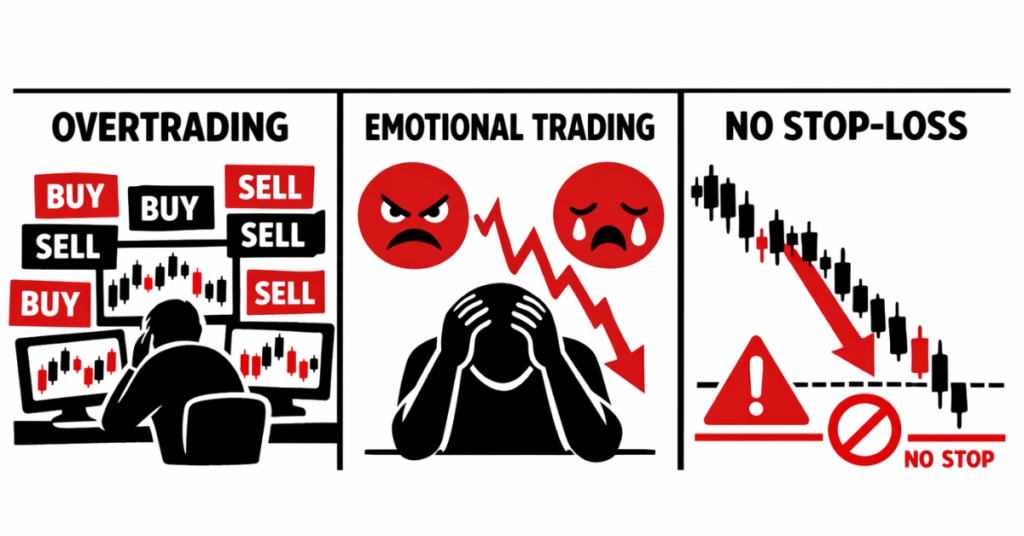
Risk management is the single most important factor in long-term trading survival. Even a profitable strategy fails without it, because eventually a losing streak will occur, and uncontrolled losses during that period will eliminate the gains from all previous winners.
The standard professional approach is to risk no more than 1–2% of account capital per trade. At 1% risk, a trader would need to lose 100 consecutive trades to deplete their account. Most retail traders who blow accounts risk 10–25% or more per trade, meaning a short losing streak is enough to cause permanent damage. Read our full guide on forex risk management for the practical framework.
3. Overtrading
Overtrading occurs when traders take more trades than their strategy justifies, typically driven by impatience, excitement after a win, or the impulse to recover losses quickly. The problem is not the number of trades itself but the quality of those trades dropping as the frequency increases.
Every additional trade that does not meet the strategy’s entry criteria adds exposure without analytical justification. Overtrading also increases transaction costs, as each spread paid reduces net profitability. Fewer, higher-quality setups consistently outperform high-frequency low-conviction entries. For perspective on where scalping becomes counterproductive, see our guide on overtrading and scalping.
4. Emotional Trading (Fear and Greed)
Emotional trading replaces analytical decision-making with reactive behavior. Fear causes premature exits on winning trades, cutting profits before the strategy’s target is reached. Greed causes holding losing trades too long, hoping they will recover instead of accepting the planned stop-loss. FOMO (fear of missing out) causes entering trades without confirmation just to participate in a move already in progress.
Emotional decisions are almost always made against the rules of the trader’s own strategy. The pattern of a trader knowing what they should do but doing the opposite under market pressure is one of the most documented and most destructive behavioral loops in retail trading.
5. Misusing Leverage
Leverage is not inherently dangerous. It is a capital efficiency tool that, when applied correctly, allows traders with smaller accounts to access meaningful market exposure. The problem arises when leverage is used to open positions far larger than the account can safely support.
6. Ignoring Market Analysis
Entering trades without technical or fundamental analysis removes the logical basis for the decision. Trades entered without analysis are guesses. Over a large enough sample of guesses, the outcome approaches 50/50 minus trading costs, which produces a net loss.
Technical analysis provides structure for identifying price direction, entry timing, and stop placement. Fundamental analysis provides context for understanding why a currency pair is likely to move in a given direction. Using both together produces higher-probability setups. See our overview of forex trading strategies for practical frameworks that combine both.
7. Revenge Trading (Chasing Losses)
Revenge trading is the behavior of immediately entering a new trade after a loss with the goal of recovering that loss quickly. It is driven entirely by emotion rather than strategy and is one of the fastest ways to turn a small, manageable loss into a large, damaging one.
The underlying psychology is that the loss feels personal and the urgency to recover it overrides all analytical thinking. The revenge trade almost always fails to meet the trader’s own entry criteria, is often oversized relative to normal risk limits, and usually ends in a larger loss than the original. This cycle can repeat multiple times in a single session, destroying weeks of progress.
8. Poor Broker Selection
The broker environment directly affects trading outcomes in ways traders often underestimate. Wide spreads reduce profitability on every single trade. Slow execution causes entry prices to differ from the price visible when the decision was made. Unreliable platforms during volatile market conditions force manual trade management under the worst possible circumstances. Withdrawal delays create distrust and distraction from strategy execution.
A reliable broker does not guarantee profits, but it removes structural disadvantages that compound over time into meaningful performance drag. For guidance on evaluating brokers, see our guide on how to choose a forex broker.
How to Avoid Forex Trading Mistakes
Most forex trading mistakes can be substantially reduced by building three foundational habits: structure, risk discipline, and emotional control. These are not complex skills. They are practiced behaviors that improve through deliberate repetition.
- Build and follow a trading plan. Define your entry criteria, exit rules, maximum risk per trade, and which conditions mean you do not trade at all. Write it down. Apply it consistently. The plan’s purpose is to replace reactive decision-making with pre-defined responses. A pre-trade checklist applied before every entry is one of the most practical implementations of this principle.
- Apply risk management on every single trade. Use a stop-loss on every trade without exception. Size positions so that the maximum loss if the stop-loss hits equals 1–2% of account capital. This rule keeps losing streaks survivable. The mathematics of 1% risk means a trader can lose 20 consecutive trades and still have 82% of their account remaining.
- Separate emotions from execution. Emotional decisions override the strategy you spent time developing. The most effective practical tool is a checklist applied before entering any trade: does this meet my entry criteria, where is my stop, what is my target, what is my risk in dollar terms? If any of these questions cannot be answered immediately, do not enter the trade.
- Practice before trading live capital. Every behavioral mistake is less costly on a demo account than on a live account. A demo account reveals how you actually respond to fast markets, losing streaks, and emotional pressure without any financial consequence. Transitioning to live trading before these behavioral patterns are identified and corrected is one of the most common beginner mistakes.
- Review your trades consistently. A trading journal that records every trade including entry reason, outcome, and what you would do differently is the most efficient learning tool available. Identifying patterns in your mistakes is faster and more effective than reading more strategy content. Improvement comes from understanding your specific behavioral tendencies, not from finding new setups.
How the Right Broker Reduces Trading Mistakes
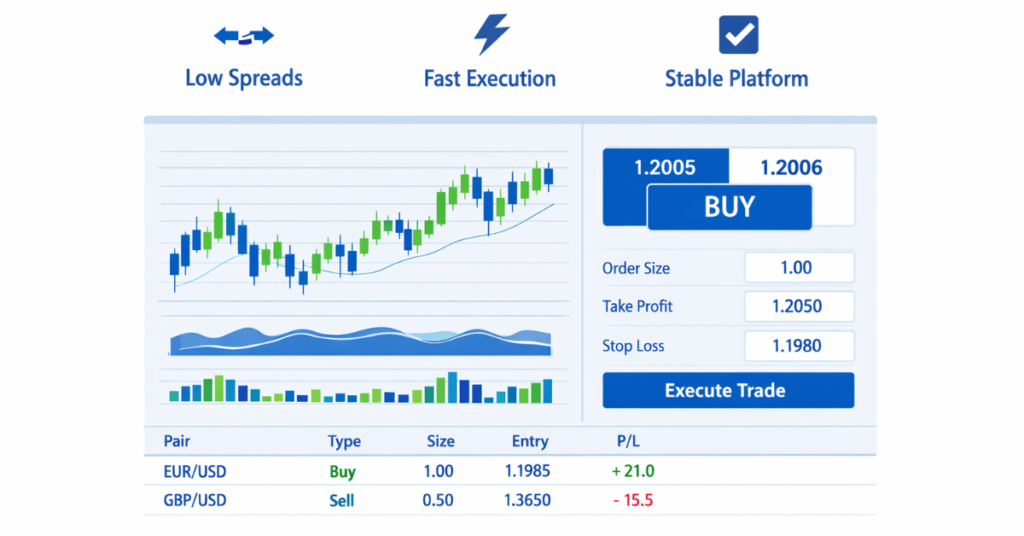
Broker quality is an underappreciated factor in how frequently traders make mistakes. When the trading environment creates friction, uncertainty, or unexpected cost, it pulls focus away from strategy execution and toward operational problem-solving, which is exactly when emotional and reactive decisions creep in.
Stable pricing and fast execution allow traders to enter and exit at the prices their strategy specifies. When execution is delayed, the fill price differs from the decision price, which can shift a well-planned trade from a reasonable risk-reward to a poor one. This creates frustration that compounds into emotional trading.
Transparent costs eliminate the psychological pressure of trying to “recover spreads” through overtrading. When a trader knows exactly what each trade costs before entering, they can evaluate whether the setup’s expected value justifies the cost. When costs are hidden or unpredictable, traders often take marginal setups just to feel active.
Reliable withdrawals remove the distraction and distrust that comes from uncertain access to capital. Traders who are worried about whether they can access their funds are not focused entirely on their strategy.
Trade with Defcofx: Built Around Transparent Conditions
Correcting behavioral trading mistakes starts with the trader. But the environment those corrections are made in matters. Defcofx is a forex and CFD broker registered in Saint Lucia, operating through MetaTrader 5 with access to currency pairs, commodities, indices, stocks, and cryptocurrencies. The platform is built around the kind of transparent, low-friction conditions that let traders focus entirely on executing their strategy rather than managing operational uncertainty.
- Spreads from 0.3 pips with zero commissions and no swap fees, so every trade’s cost is known before entry and does not create pressure to overtrade to “recover costs”
- Leverage up to 1:2000, with full trader control over position sizing so risk per trade can be calibrated precisely to each trader’s risk management framework
- 40% welcome bonus on first deposits of $1,000 or more, available to all qualifying clients globally
- Withdrawals processed within 4 business hours including weekends, removing capital access uncertainty from the trading environment entirely
- MT5 platform with fast execution, advanced charting, and all technical indicators needed to build and test a disciplined strategy
- Free demo account in real market conditions, allowing traders to identify and correct behavioral mistakes before any real capital is at risk
- Global access with multilingual support, welcoming traders from all countries
Ready to trade with the right foundation? Opening an account with Defcofx takes only a few minutes. Start on the demo, apply the principles above, and transition to live trading when your behavioral patterns are consistent.
Open a Live Trading AccountBeginner Tips for Long-Term Forex Success
Long-term success in forex is built on consistent habits applied over hundreds of trades, not on individual winning setups or short-term performance. Beginners who focus on the right foundations from the start avoid the most damaging early mistakes that set back later development.
- Start on a demo account and stay there until results are consistent. The demo environment is where behavioral patterns are identified and corrected without financial consequence. Beginners who rush to live trading before consistency on demo is established almost always repeat the same mistakes with real money.
- Risk only 1–2% of capital per trade maximum. This is not a conservative suggestion. It is the mathematical foundation of account survival. It makes losing streaks survivable and preserves capital long enough for a strategy to demonstrate its real edge over a meaningful sample size.
- Master one strategy before adding another. Switching between strategies prevents any single approach from being applied long enough to evaluate properly. Choose one method, apply it consistently for at least 50–100 trades on demo, and review the results honestly before changing anything.
- Keep a trade journal from day one. Record every trade including the entry reason, exit reason, and what you would do differently. Review it weekly. Patterns in your mistakes will become visible within a few weeks and give you specific, personal improvement targets rather than generic advice.
- Measure success by process, not by profit. In the early stages of trading, a session where you followed your plan perfectly and lost is more valuable than a session where you broke your rules and won. The plan following is the skill. The profit is the result of applying the skill consistently over time.
FAQ
Trading without a plan is the most common and most structurally damaging mistake. Without defined entry rules, exit rules, and maximum risk per trade, every trading decision becomes reactive rather than analytical. This produces inconsistent results regardless of how good the underlying strategy is, because execution is driven by emotion rather than pre-defined logic.
Regulatory disclosure data from EU and UK brokers shows that 70–80% of retail forex accounts lose money. The documented primary causes are poor risk management, emotional trading, misuse of leverage, and no defined trading plan. Beginners also frequently skip the demo account phase, entering live markets before behavioral patterns and risk management habits are established.
Apply a stop-loss on every trade, risk no more than 1–2% of account capital per trade, follow a written trading plan with defined entry and exit rules, and use a pre-trade checklist before entering any position. Keep a trading journal and review it weekly to identify specific behavioral patterns causing losses. Practice on a demo account until results are consistent before trading with real capital.
Leverage is not inherently dangerous. It is a capital efficiency tool. The danger comes from misapplication, specifically opening positions sized so large relative to account capital that even a small adverse move causes a margin call or wipes out the account. When leverage is used to control position sizes that keep risk per trade at 1–2% of account capital, it functions as intended and does not increase danger beyond what any unleveraged trade carries.
Revenge trading is the behavior of entering a new trade immediately after a loss with the specific goal of recovering that loss quickly. It is driven entirely by emotion rather than strategy analysis and almost always violates the trader’s own entry criteria. The revenge trade is typically oversized, poorly timed, and ends in a larger loss than the original. In severe cases the cycle repeats multiple times in a single session.
No. Every trader makes mistakes, and losses are a normal part of any trading strategy applied over a large enough sample. The goal is not to eliminate mistakes entirely but to ensure that mistakes are controlled, that losses are smaller than wins on average, and that behavioral errors are identified and corrected through honest trade review. Consistent improvement over hundreds of trades produces better outcomes than searching for a perfect mistake-free strategy.
Final Thoughts: Common Forex Trading Mistakes
The most common forex trading mistakes are behavioral, not analytical. Trading without a plan, mismanaging risk, overtrading, allowing emotions to override strategy, and misusing leverage are all choices that traders make, not outcomes the market imposes. This is both the challenge and the opportunity in forex. Because these mistakes are behavioral, they can be corrected with deliberate practice and structure.
The traders who consistently perform better over time are not those who find the best entry signals. They are those who manage losses most effectively, follow their plan most consistently, and improve their behavioral patterns most honestly through journal review and self-assessment.
Start with a demo account, apply the risk management framework, build a trading plan, and give yourself enough trades to evaluate your strategy honestly. If you are ready to do that with the right broker environment, Defcofx gives you the platform, the conditions, and the free demo access to build on a solid foundation.
Open a Live Trading Account