


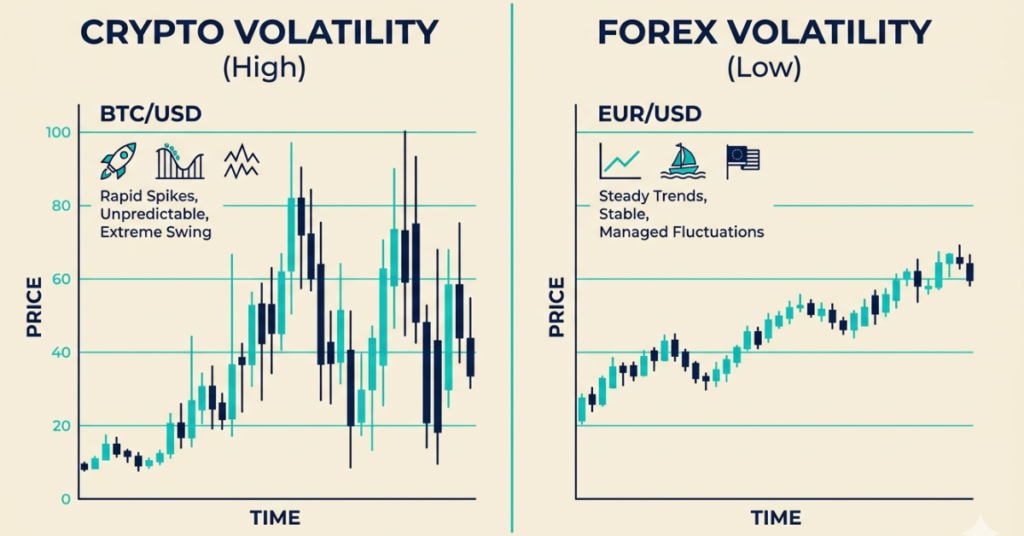
Cryptocurrency is more volatile than forex. The crypto market experiences larger and faster price swings due to lower liquidity, higher speculation, and less regulation. The forex market is more stable because it is backed by global economies, central bank policy, and the highest trading volume of any financial market, producing comparatively controlled and more predictable price movements.
Key Takeaways
- Cryptocurrency markets are significantly more volatile than forex, with major coins regularly moving 5–15% or more in a single day.
- Forex markets are more stable, with major pairs like EUR/USD typically moving 0.5–1% daily under normal conditions.
- Crypto volatility is driven by speculation, social media, regulatory news, and sentiment shifts with no economic anchor.
- Forex volatility is driven by structured economic data, central bank decisions, and macroeconomic fundamentals.
- Volatility creates both profit potential and higher risk. Without risk management, higher volatility produces faster losses, not just faster profits.
- Beginners generally find forex more manageable due to its structured, data-driven nature compared to the unpredictable character of crypto markets.
What Is Volatility in Trading?
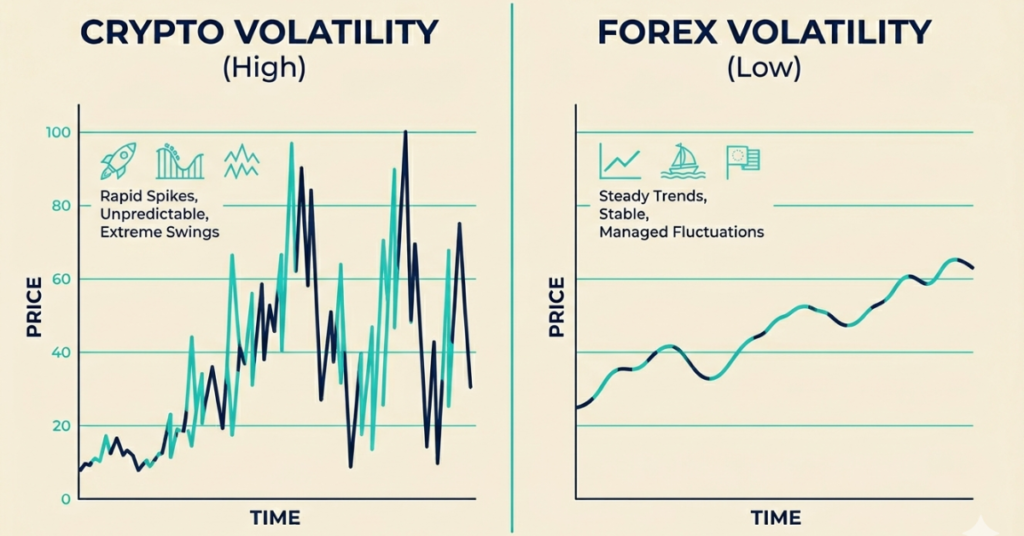
Volatility measures how much and how quickly the price of an asset changes over a given period. In practical terms, it describes the intensity of price movement, whether prices move steadily and gradually or swing sharply in short time frames.
In trading, volatility is commonly measured using the Average True Range (ATR) indicator, which shows how much an instrument typically moves within a session, or through standard deviation calculations of price returns over time. The higher the ATR or standard deviation, the more volatile the instrument.
A Simple Example
- Bitcoin moves from $40,000 to $44,000 in a few hours, then drops back to $38,000 the next day. That is a 10%+ swing in under 24 hours. High volatility.
- EUR/USD moves from 1.1000 to 1.1050 over the same day, a 0.45% move, and stays broadly within that range. That is lower volatility, structured and more predictable.
Understanding the Crypto Market
The cryptocurrency market is a digital financial system where assets like Bitcoin, Ethereum, and thousands of other tokens are traded. Unlike traditional financial markets, crypto is decentralized, meaning no central authority such as a government or central bank controls it. The market operates 24 hours a day, 7 days a week, 365 days a year without pause.
This constant global activity, combined with relatively low institutional liquidity compared to forex, makes crypto highly reactive to sentiment shifts, news events, and speculative activity.
How Volatile Is the Crypto Market?
Crypto is among the most volatile asset classes in existence. Bitcoin, the most liquid and established cryptocurrency, has historically experienced daily moves of 5–10% or more during active market periods. Smaller cryptocurrencies (altcoins) regularly move 20–50% in a single day during speculative periods. The causes include market speculation, viral social media posts, exchange listings or delistings, regulatory announcements from major governments, security breaches or exchange collapses, and shifts in institutional sentiment.
Understanding the Forex Market
The forex market is where global currencies are traded, such as the US Dollar, Euro, and Japanese Yen. It is the largest and most liquid financial market in the world, with an average daily trading volume exceeding $7.5 trillion according to the Bank for International Settlements (BIS). Unlike crypto, forex operates during major global market sessions rather than continuously around the clock, though it is effectively active 24 hours a day on weekdays through rolling session coverage.
Because forex is directly tied to national economies, central bank policy, and international trade, its prices move in a more structured and analyzable pattern compared to speculative digital asset markets.
How Volatile Is the Forex Market?
Forex is significantly less volatile than crypto, particularly on major currency pairs. EUR/USD, the most traded pair globally, typically moves between 50–120 pips (roughly 0.5–1%) on a normal trading day. Even the most volatile major pair, GBP/JPY, averages 150–200 pips daily under standard conditions. This is dramatically smaller than typical daily crypto moves on a percentage basis. The stability is produced by massive daily trading volume, strong institutional participation, and price behavior anchored to measurable economic fundamentals.
Crypto vs Forex Volatility: Direct Comparison
| Factor | Crypto Market | Forex Market |
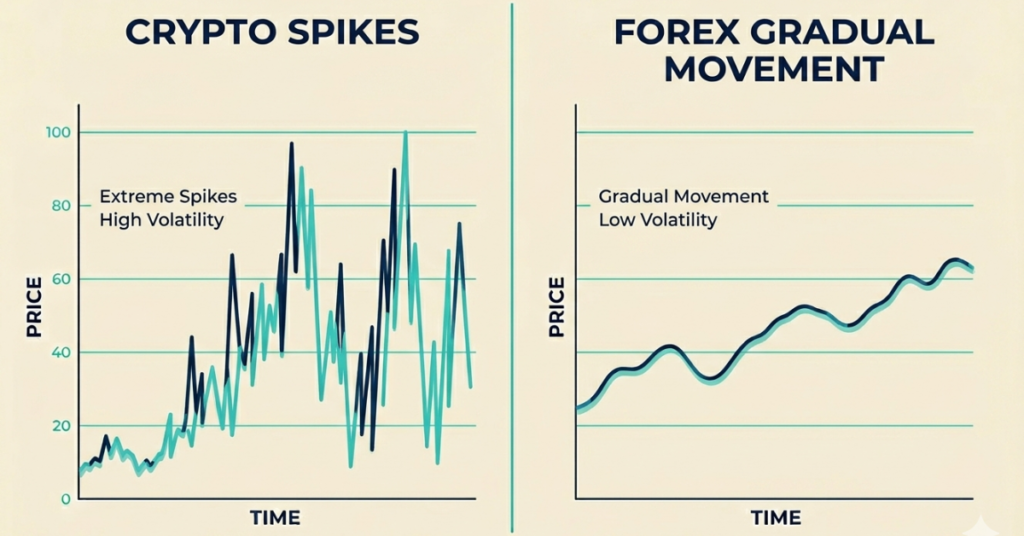
| Volatility Level | Very High (5–50%+ daily possible) | Moderate to Low (0.5–2% daily on majors) |
| Market Hours | 24/7, 365 days | 24 hours, weekdays only (Sunday–Friday) |
| Daily Volume | ~$100–200 billion (crypto total) | ~$7.5 trillion (BIS, forex total) |
| Liquidity | Lower, uneven across assets | Extremely high, especially on major pairs |
| Price Movement | Sudden, large, sentiment-driven spikes | Gradual, controlled, data-driven moves |
| Primary Drivers | News, social media, speculation, hype | Economic data, central bank decisions |
| Regulation | Inconsistent, varies by country | Heavily regulated, structured oversight |
| Risk Level | Very High | High but more manageable |
Why Crypto Is More Volatile Than Forex
Crypto markets are structurally designed to be more volatile. The combination of speculative demand, low institutional depth, regulatory uncertainty, and the absence of economic anchors means sentiment drives prices more aggressively than in any traditional market.
- Lower liquidity: The entire crypto market’s daily volume is a fraction of forex. When a large buyer or seller enters a smaller cryptocurrency market, there are fewer counterparty orders to absorb the trade, causing outsized price movement.
- No economic anchor: Forex prices are tied to GDP, inflation, employment, and central bank policy. These are measurable, scheduled events. Crypto has no equivalent fundamental anchor. A single tweet or influencer post can move Bitcoin by several percent because there is nothing else to price it against objectively.
- Speculation-driven participation: A large portion of crypto trading is driven by retail speculators seeking short-term gains rather than institutional participants hedging real economic exposure. This amplifies sentiment swings.
- 24/7 operation without circuit breakers: Traditional stock markets have circuit breakers that pause trading during extreme moves. Crypto has no equivalent. Panic selling or buying runs unimpeded around the clock.
- Regulatory unpredictability: Sudden announcements from major governments (banning crypto, restricting exchanges, introducing new tax rules) can cause immediate 10–20% price swings in hours. Forex is heavily regulated with established frameworks that change slowly and predictably.
Why Forex Is More Stable
Forex stability is not accidental. It is a structural outcome of how the market is built, who participates in it, and what drives prices. The forex market is the most liquid financial market on earth for a reason, and that depth directly suppresses extreme volatility on major pairs.
- Massive liquidity depth: $7.5 trillion in daily volume means even very large orders from institutional traders are absorbed without causing dramatic price spikes. A central bank order that would collapse a crypto exchange barely moves EUR/USD.
- Central bank stabilization: Central banks actively manage their currencies. When exchange rates deviate significantly from economic fundamentals, central banks intervene through interest rate adjustments, open market operations, or direct FX intervention. This creates a natural ceiling on extreme moves.
- Economic fundamentals provide direction: Forex moves are tied to scheduled, measurable economic events including CPI releases, non-farm payrolls, central bank meetings, and GDP reports. Traders can anticipate when volatility is likely to occur and prepare accordingly.
- Institutional dominance creates stability: Major banks, pension funds, sovereign wealth funds, and multinational corporations trade forex for genuine economic purposes, not speculation alone. This fundamental demand creates more consistent price behavior.
Which Market Is Better for Beginners?
| Factor | Crypto Trading | Forex Trading |
| Price Movement | Very fast and unpredictable | Slower and more structured |
| Risk Level | Very High | High but more manageable |
| Learning Difficulty | Higher, emotionally intense | Lower, more analytical framework available |
| Market Behavior | Driven by sentiment and hype | Driven by measurable economic data |
| Analysis Methods | Technical, sentiment-based | Technical and fundamental analysis both applicable |
| Demo Practice Available | Yes | Yes |
| Best For Beginners | Challenging, not recommended first | More beginner-friendly structure |
Forex is generally the more appropriate starting point for new traders. Its prices react to economic logic, and there is a well-established body of analytical tools, educational resources, and structured trading frameworks available. Understanding why EUR/USD moves based on ECB policy is a learnable, logical process.
Crypto trading requires the same discipline as forex but operates in a market where the usual economic analysis applies inconsistently. Prices can move against all logic based purely on social media activity, making it harder to build repeatable analytical skills early on.
Risks in Both Markets
Both crypto and forex carry genuine financial risk, and understanding the specific risk profile of each market helps traders apply the right controls before entering.
Crypto Market Risks
- Extreme price crashes: Major cryptocurrencies have historically lost 70–90% of their value in extended bear markets. Even during bull markets, 30–50% corrections within weeks are documented and common.
- Unregulated platforms: Exchange collapses, exit scams, and security breaches have resulted in billions of dollars in losses for traders who had funds on centralized platforms. Counterparty risk is substantially higher in crypto than forex.
- Emotional trading spirals: The 24/7 nature of crypto markets means there is no forced pause. Traders can make impulsive decisions at 3 AM during a volatile move that they would never make in a structured market session.
- Liquidity risk on smaller assets: Altcoins with lower trading volume can gap massively during panic, making stop-losses ineffective as price jumps over them entirely.
Forex Market Risks
- Leverage amplification: Forex’s greatest risk is leverage misuse. High leverage on stable pairs still produces large losses when market moves are unexpected. Industry data shows 70–80% of retail forex traders lose money, primarily due to leverage misuse and poor risk management.
- News event spikes: High-impact events like central bank rate surprises or unexpected economic data can produce 100–200 pip moves in seconds, triggering stop-losses or causing slippage.
- Overtrading: The structure and regularity of forex can create a false sense of security, leading traders to over-trade and accumulate transaction costs that erode profitability.
Practical Example: Volatility in Action
Example 1: Crypto Market Movement
A trader buys Bitcoin at $40,000 based on positive market sentiment. Within 24 hours, a negative regulatory announcement causes Bitcoin to drop to $34,000, a 15% loss. The same trader’s account drops by the leverage-adjusted equivalent before a stop-loss at $36,000 limits further damage. This type of event is not unusual in crypto and can happen at any hour.
Example 2: Forex Market Movement
A trader buys EUR/USD at 1.1000 ahead of a Eurozone CPI release. The data comes in stronger than expected, pushing EUR/USD to 1.1080, an 80-pip move. The trader exits at 1.1060 with 60 pips profit. The movement was triggered by a scheduled, anticipated event and the price moved in a defined, readable direction rather than spiking chaotically in both directions.
Both trades generated profit in these examples. The key difference is predictability and the quality of the setup. The forex trade was built on analyzable, scheduled economic data. The crypto trade relied on sustained positive sentiment, which reversed without warning.
How to Trade Volatility Effectively
Volatility is a tool, not a problem. The traders who consistently profit from volatile markets are not the ones who take the biggest positions. They are the ones who apply the most disciplined risk management relative to the market they are trading.
- Always use a stop-loss: In volatile markets, stop-losses are not optional. Define your maximum acceptable loss before entering any trade and place the stop immediately upon entry.
- Size positions to match volatility: A position sized for EUR/USD movement is too large for Bitcoin. Scale down position sizes in higher-volatility markets to keep percentage risk per trade consistent. Read our guide on position sizing for a practical framework.
- Avoid overtrading: High volatility creates the illusion that more trades equal more profit. In reality, each trade adds transaction cost and emotional exposure. Fewer, higher-quality setups consistently outperform high-frequency entries.
- Know what drives the market you are trading: In forex, volatility is scheduled around known economic events. Checking the calendar before each session is a basic but critical habit. In crypto, volatility can be triggered by anything, including social media posts, making pre-trade planning harder but still essential.
- Practice before trading live: Both forex and crypto can be practiced on demo accounts in real market conditions. Building experience with how each market moves under different conditions, before risking real capital, is the single most important step a new trader can take.
Trade with Defcofx
Whether your focus is the structured volatility of forex markets or the faster-moving cryptocurrency space, having the right broker infrastructure determines how efficiently you can execute your strategy and protect your capital. Defcofx is a globally accessible forex and CFD broker registered in Saint Lucia, operating through MetaTrader 5 with access to major and minor currency pairs, cryptocurrencies, gold, oil, indices, and more.
For traders navigating volatility in either market, the conditions at Defcofx are built around cost efficiency and execution reliability:
- Spreads from 0.3 pips with no commissions or swap fees, keeping trading costs minimal whether you are scalping forex or trading cryptocurrency CFDs
- Leverage up to 1:2000, giving traders full control over position sizing to calibrate risk appropriately to the volatility of whichever market they are in
- 40% welcome bonus on first deposits of $1,000 or more, available to all qualifying clients globally
- Withdrawals processed within 4 business hours including weekends, so your capital remains accessible regardless of market conditions
- MT5 platform with advanced charting, volatility indicators, and fast execution across forex, crypto CFDs, and commodities
- Global access with multilingual support, welcoming traders from all countries without geographic restrictions
New to either market? A free demo account on Defcofx lets you trade forex pairs and cryptocurrency CFDs in live market conditions with zero financial risk. Opening an account takes only a few minutes.
Open a Live Trading AccountFinal Thoughts: Crypto vs Forex Volatility
Cryptocurrency is clearly more volatile than forex by every measurable standard. Daily percentage moves, frequency of sharp reversals, sensitivity to unscheduled news, and the absence of an economic anchor all combine to make crypto a genuinely different risk environment from forex.
Forex is not risk-free. Leverage misuse, news spikes, and emotional trading cause real losses in forex every day. But the market’s structure, its deep liquidity, central bank oversight, and data-driven price behavior, creates a trading environment where risk is more manageable and more predictable than in crypto.
For beginners, forex is the stronger starting point. For experienced traders who understand the risk, crypto’s higher volatility can offer more opportunity, but only when approached with the same disciplined risk framework that successful forex traders apply. The full comparison of forex and crypto trading covers the broader differences between these two markets if you want to explore beyond volatility specifically.
Open a Live Trading AccountFAQ
Yes, significantly so. Major cryptocurrencies like Bitcoin regularly move 5–15% or more in a single day. Major forex pairs like EUR/USD typically move 0.5–1% daily under normal conditions. The difference in scale is structural: crypto has far lower liquidity, no economic anchor, and is heavily driven by speculation and sentiment rather than macroeconomic fundamentals.
Forex is generally safer in the sense of being more predictable and having more regulatory oversight. However, both markets carry significant financial risk. Neither is safe without proper risk management, including stop-losses, controlled position sizing, and a defined maximum risk per trade. The 70–80% retail loss rate in forex demonstrates that safety comes from discipline, not from choosing the less volatile market.
Forex is the better starting point for most beginners. Its price movements are tied to analyzable economic events, the market has a structured session schedule, and a deep library of educational resources and analytical tools is available. Crypto’s unpredictability, 24/7 operation, and sensitivity to random sentiment events makes it harder to build consistent analytical skills early in a trading career.
Crypto’s higher volatility creates the potential for larger percentage gains per trade. However, it creates equal potential for larger losses. Historically, the majority of retail crypto traders have lost money, particularly those without formal risk management. Forex offers smaller per-trade potential but more consistent and repeatable setups for traders who develop a disciplined strategy.
Crypto is more volatile for several structural reasons: far lower daily trading volume than forex, no central bank anchor or economic fundamental to price against, heavy retail speculative participation, 24/7 operation without circuit breakers, and sensitivity to unscheduled events including social media posts, regulatory announcements, and exchange incidents. These factors combine to produce price movements that are larger, faster, and less predictable than forex.
Choose based on your experience, risk tolerance, and strategy. If you prefer a structured, data-driven market with more predictable patterns, forex is the better fit. If you are comfortable with high volatility, fast moves, and a market driven more by sentiment than economics, crypto may suit you. Most experienced traders recommend starting with forex to build analytical and risk management skills before adding crypto to a trading portfolio.